UEG Week Recordings UEG Week Posters Online courses Guidelines Mistakes in... Podcasts Webinars
Visit ueg.eu Create myUEG account Log In

Filters:

UEG Online Course
accredited
Share via Email Share on Facebook Share on X Share on LinkedIn Share on Bluesky

Log in to access this content.

Free for all myUEG account holders. Your access level is set automatically based on your occupation. Medical professionals get full access to all content. If you are a non-medical user, you can only access UEG Week content from congresses you attended.

Log In Create a free account

Not sure what you can access? Learn more about account types.

Acute pancreatitis is the most frequent pancreatic disease and the most common reason for emergency room admission for all nonmalignant gastrointestinal diseases. This rapid-onset and painful inflammation of the pancreas is troublesome to manage because it has a diverse and often unpredictable clinical course. Although the inflammation usually subsides, complications can develop, and some patients will progress to chronic pancreatitis.
Learning objectives

  • The aetiology of acute pancreatitis
  • The different classification systems for acute pancreatitis
  • The diagnosis of acute pancreatitis
  • The therapeutic regimes for acute pancreatitis
    Target audience

This course is suitable for gastroenterologists in training, but it is also appropriate for physicians and surgeons in other disciplines, as well as nurses, biotechnicians and advanced-years’ medical students who have an interest in gastroenterology.

Acute pancreatitis

Acute pancreatitis

Ali Alexander Aghdassi, Markus M. Lerch

Event

Acute pancreatitis

Topics

Pancreas

Accreditation status

accredited

Duration

1 hour

Published

2020
Login to access
UEG Online Course
accredited
Share via Email Share on Facebook Share on X Share on LinkedIn Share on Bluesky

Log in to access this content.

Free for all myUEG account holders. Your access level is set automatically based on your occupation. Medical professionals get full access to all content. If you are a non-medical user, you can only access UEG Week content from congresses you attended.

Log In Create a free account

Not sure what you can access? Learn more about account types.

With the introduction of population-based screening programs in several countries, the proportion of patients diagnosed with early invasive colorectal cancer (T1 CRC) has been vastly increasing. There are several major challenges in clinical management of this patient group, resulting in significant practice variations among physicians.

This online course covers the most relevant aspects of clinical management of T1 CRC patients, and provides an overview of latest insights and current knowledge gaps. To facilitate the learning process, several questions on real-life patient cases have been included in which learners can bring the acquired knowledge directly into practice.

Learning objectives

  • To understand how to reach a conclusive diagnosis of GORD
  • To know how to reach a conclusive diagnosis of no GORD
  • To understand how to deal with an inconclusive diagnosis

Target audience

This course is suitable for gastroenterologists, surgeons, pathologists, nurses and any other healthcare professionals interested in, or actively involved in clinical management of T1 CRC patients. 

This course was developed by Alexandra M.J. Langers, Jurjen J. Boonstra, James C.H. Hardwick, Richard (H.) Dang et al. in receipt of an Activity Grant from UEG.

Management of early-invasive (T1) colorectal cancer

Management of early-invasive (T1) colorectal cancer

Alexandra Langers, Jurjen J. Boonstra, James Hardwick

Event

Management of early-invasive (T1) colorectal cancer

Topics

Digestive Oncology

Accreditation status

accredited

Duration

1 hour

Published

2020
Login to access
UEG Mistakes In Articles
Share via Email Share on Facebook Share on X Share on LinkedIn Share on Bluesky

Log in to access this content.

Free for all myUEG account holders. Your access level is set automatically based on your occupation. Medical professionals get full access to all content. If you are a non-medical user, you can only access UEG Week content from congresses you attended.

Log In Create a free account

Not sure what you can access? Learn more about account types.

By far the most common risk factors for the development of acute pancreatitis are excessive alcohol consumption and gallstone disease. Several mutations have been identified that, in combination with nongenetic factors or alone, can lead to pancreatitis. Certain drugs are known to be associated with the development of pancreatitis and smoking might also increase the probability of it developing. 80–85% of patients diagnosed with the disease will have mild disease and make an uneventful recovery with little more than adequate fluid therapy and analgesia needed to support them. The remaining patients, however, will suffer from moderately severe to severe acute pancreatitis, with the development of pancreatic necrosis, severe sepsis or abdominal compartment syndrome. These patients are at immediate danger of multiorgan failure and death and require multidisciplinary intensive care, organ support and often pancreatic interventions conducted by experienced investigators. Since it is difficult to predict outcomes and complications develop during the disease course, treatment in specialized centres that have a high case load is recommended.4

Mistakes in the management of acute pancreatitis and how to avoid them

Mistakes in the management of acute pancreatitis and how to avoid them

Peter Simon, Markus M. Lerch, Julia Mayerle, Georg Beyer, Elisabeth Orgler-Gasche

Topics

Pancreas

Citation

Beyer G, et al. Mistakes in the management of acute pancreatitis and how to avoid them. UEG Education 2016: 16: 27–30.

Published

2024
UEG Presentation
Share via Email Share on Facebook Share on X Share on LinkedIn Share on Bluesky
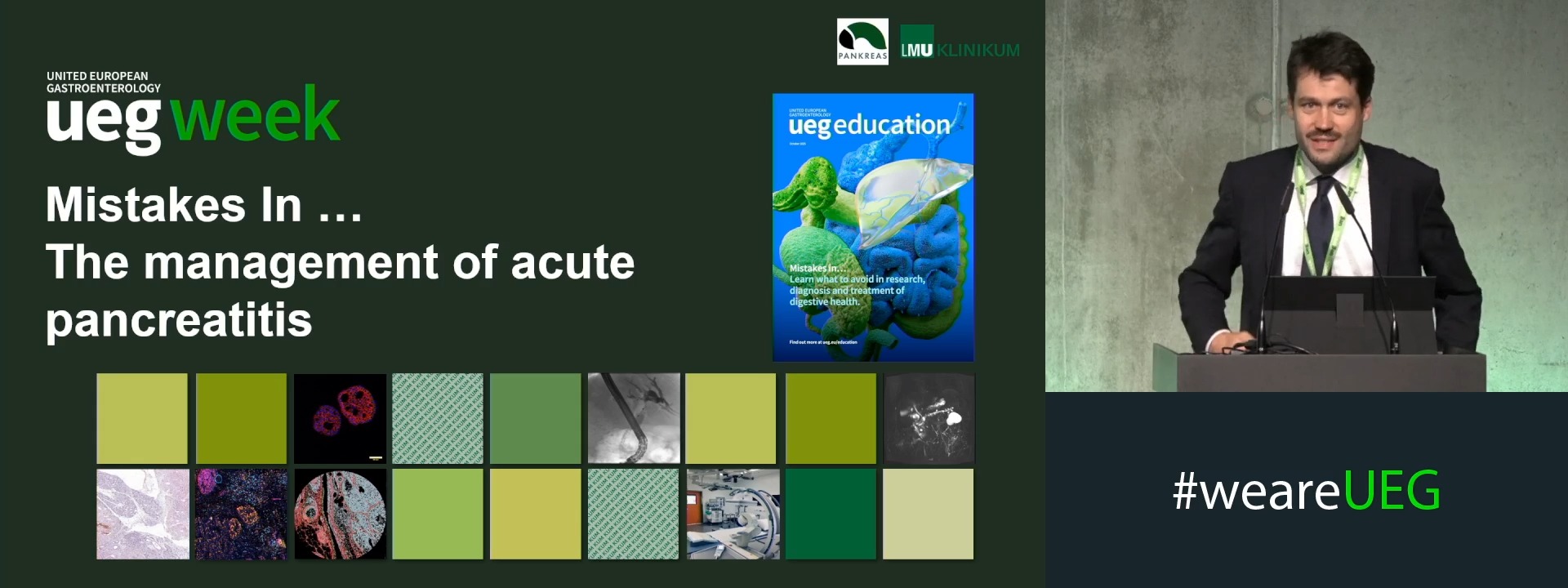
The management of acute pancreatitis

Log in to access this content.

Free for all myUEG account holders. Your access level is set automatically based on your occupation. Medical professionals get full access to all content. If you are a non-medical user, you can only access UEG Week content from congresses you attended.

Log In Create a free account

Not sure what you can access? Learn more about account types.

The management of acute pancreatitis

Georg Beyer 1

1 University Hospital LMU Munich, München, Germany

Event

UEG Week Berlin 2025

Topics

Hepatobiliary Nurses Small Intestine & Nutrition Pancreas

Session

Mistakes in …: Hepatobiliary and pancreas

Citation

United European Gastroenterology Journal 2025; 13 (Supplement 8)

Published

2025
UEG Online Course
accredited
Share via Email Share on Facebook Share on X Share on LinkedIn Share on Bluesky

Log in to access this content.

Free for all myUEG account holders. Your access level is set automatically based on your occupation. Medical professionals get full access to all content. If you are a non-medical user, you can only access UEG Week content from congresses you attended.

Log In Create a free account

Not sure what you can access? Learn more about account types.

Chronic pancreatitis is a severe fibroinflammatory disorder of the pancreas that has a high associated morbidity and mortality. The number of hospitalizations for chronic pancreatitis has markedly increased and the global incidence of the disease continues to rise. Even though progress has been made in identifying common risk factors for chronic pancreatitis, the pathogenesis of the disease remains poorly understood.

This online course covers the definition of chronic pancreatitis, mortality, socioeconomic effect, aetiology and epidemiology, diagnosis and staging, management and the occurrence of bile duct obstruction and pseudocysts. Two clinical cases are also included, allowing application of knowledge in real-life scenarios. 

Learning objectives


To become familiar with:

  • The definition of chronic pancreatitis and its symptoms
  • The aetiology and epidemiology of chronic pancreatitis
  • The progression and natural history of chronic pancreatitis
  • Diagnosis and staging of chronic pancreatitis
  • Pain management and management of pancreatic exocrine insufficiency
  • Endoscopic therapy
  • Surgical therapy

Target audience

This course is suitable for gastroenterologists in training, but is also appropriate for physicians and surgeons in other disciplines, as well as nurses, biotechnicians and advanced-years’ medical students who have an interest in gastroenterology. 

Chronic pancreatitis

Chronic pancreatitis

Julia Mayerle, Georg Beyer

Event

Chronic pancreatitis

Topics

Pancreas

Accreditation status

accredited

Duration

1 hour

Published

2017
Login to access
UEG Presentation
Share via Email Share on Facebook Share on X Share on LinkedIn Share on Bluesky
Panel discussion: Acute severe pancreatitis

Log in to access this content.

Free for all myUEG account holders. Your access level is set automatically based on your occupation. Medical professionals get full access to all content. If you are a non-medical user, you can only access UEG Week content from congresses you attended.

Log In Create a free account

Not sure what you can access? Learn more about account types.

Panel discussion: Acute severe pancreatitis

Marco J. Bruno 1, Jacob Hamm 2, Peter Hegyi 3, Jayanta Samanta 4

1 Eramus University Medical Centre, Rotterdam, Netherlands

2 University Medical Center Goettingen, Goettingen, Germany

3 University of Pecs, Pecs, Hungary

4 Post Graduate Institute of Medical Education and Research, Chandigarh, Kolkata, India

Event

UEG Week Berlin 2025

Topics

Endoscopy Pancreas

Session

Therapy update: Acute severe pancreatitis – It's all about timing!

Citation

United European Gastroenterology Journal 2025; 13 (Supplement 8)

Published

2025
UEG Presentation
Share via Email Share on Facebook Share on X Share on LinkedIn Share on Bluesky
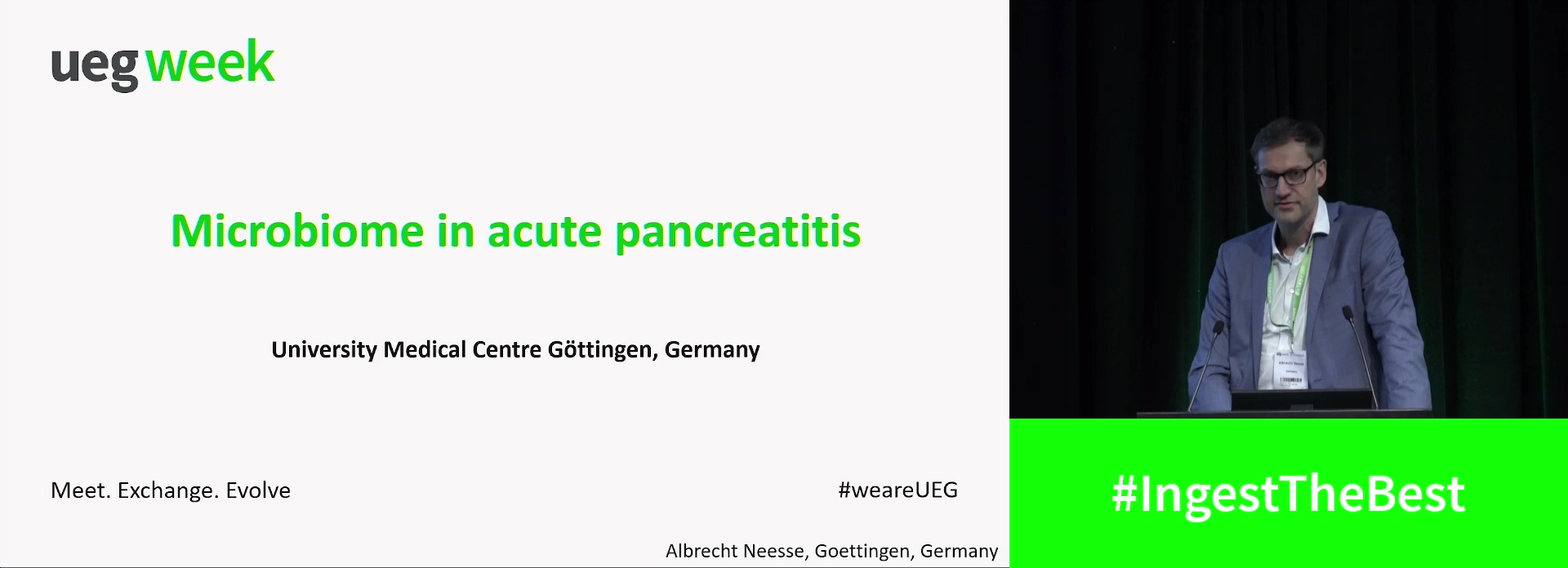
Microbiome in acute pancreatitis

Log in to access this content.

Free for all myUEG account holders. Your access level is set automatically based on your occupation. Medical professionals get full access to all content. If you are a non-medical user, you can only access UEG Week content from congresses you attended.

Log In Create a free account

Not sure what you can access? Learn more about account types.

Microbiome in acute pancreatitis

Albrecht Neesse 1

1 Universitätsklinikum Göttingen, Hamburg, Germany

Event

UEG Week Copenhagen 2023

Topics

Gut Microbiota Mechanisms & Personalised Medicine Pancreas

Session

Microbiome at GI interfaces

Published

2023

The global reference point for the digestive health community

Platform Publisher

United European Gastroenterology

Wickenburggasse 1 1080 Vienna, Austria

Contact us

support@ueg.eu

ueg.eu

T: +43 1 997 1639

Legal

Terms & Conditions

Imprint

Privacy Policy

Explore

My Bookmarks

My recommendations

My fields of interest

© 2026 United European Gastroenterology

Change fields of interest

These fields are selected based on the interests in your myUEG profile.
Click the item to unselect it. You can select multiple items.