UEG Week Recordings UEG Week Posters Online courses Guidelines Mistakes in... Podcasts Webinars
Visit ueg.eu Create myUEG account Log In

Filters:

UEG Online Course
accredited
Share via Email Share on Facebook Share on X Share on LinkedIn Share on Bluesky

Log in to access this content.

Free for all myUEG account holders. Your access level is set automatically based on your occupation. Medical professionals get full access to all content. If you are a non-medical user, you can only access UEG Week content from congresses you attended.

Log In Create a free account

Not sure what you can access? Learn more about account types.

Chronic pancreatitis is a severe fibroinflammatory disorder of the pancreas that has a high associated morbidity and mortality. The number of hospitalizations for chronic pancreatitis has markedly increased and the global incidence of the disease continues to rise. Even though progress has been made in identifying common risk factors for chronic pancreatitis, the pathogenesis of the disease remains poorly understood.

This online course covers the definition of chronic pancreatitis, mortality, socioeconomic effect, aetiology and epidemiology, diagnosis and staging, management and the occurrence of bile duct obstruction and pseudocysts. Two clinical cases are also included, allowing application of knowledge in real-life scenarios. 

Learning objectives


To become familiar with:

  • The definition of chronic pancreatitis and its symptoms
  • The aetiology and epidemiology of chronic pancreatitis
  • The progression and natural history of chronic pancreatitis
  • Diagnosis and staging of chronic pancreatitis
  • Pain management and management of pancreatic exocrine insufficiency
  • Endoscopic therapy
  • Surgical therapy

Target audience

This course is suitable for gastroenterologists in training, but is also appropriate for physicians and surgeons in other disciplines, as well as nurses, biotechnicians and advanced-years’ medical students who have an interest in gastroenterology. 

Chronic pancreatitis

Chronic pancreatitis

Julia Mayerle, Georg Beyer

Event

Chronic pancreatitis

Topics

Pancreas

Accreditation status

accredited

Duration

1 hour

Published

2017
Login to access
UEG Online Course
accredited
Share via Email Share on Facebook Share on X Share on LinkedIn Share on Bluesky

Log in to access this content.

Free for all myUEG account holders. Your access level is set automatically based on your occupation. Medical professionals get full access to all content. If you are a non-medical user, you can only access UEG Week content from congresses you attended.

Log In Create a free account

Not sure what you can access? Learn more about account types.

Autoimmune pancreatitis (AIP) is a rare autoinflammatory condition of the pancreas that is steroid responsive. Correct diagnosis of patients who present with clinical features of AIP is key because AIP can mimic pancreatic cancer, a deadly disease, which is ten times more common.

All aspects of AIP—from its definition and epidemiology to its clinical presentation, subtypes, diagnosis, pathophysiology and treatment—are covered in this online course by Julia Mayerle and Georg Beyer.  

Learning objectives:

  • The definition and epidemiology of autoimmune pancreatitis (AIP)
  • The clinical presentation and clinical subtypes of AIP
  • The diagnosis of AIP
  • Pathophysiological considerations for AIP
  • Treatment strategies for AIP

Target audience

This course is suitable for gastroenterologists in training, but is also appropriate for physicians and surgeons in other disciplines, as well as nurses, biotechnicians and advanced-years’ medical students who have an interest in gastroenterology.

Autoimmune Pancreatitis

Autoimmune Pancreatitis

Julia Mayerle, Georg Beyer

Event

Autoimmune Pancreatitis

Topics

Pancreas

Accreditation status

accredited

Duration

1 hour

Published

2019
Login to access
UEG Mistakes In Articles
Share via Email Share on Facebook Share on X Share on LinkedIn Share on Bluesky

Log in to access this content.

Free for all myUEG account holders. Your access level is set automatically based on your occupation. Medical professionals get full access to all content. If you are a non-medical user, you can only access UEG Week content from congresses you attended.

Log In Create a free account

Not sure what you can access? Learn more about account types.

By far the most common risk factors for the development of acute pancreatitis are excessive alcohol consumption and gallstone disease. Several mutations have been identified that, in combination with nongenetic factors or alone, can lead to pancreatitis. Certain drugs are known to be associated with the development of pancreatitis and smoking might also increase the probability of it developing. 80–85% of patients diagnosed with the disease will have mild disease and make an uneventful recovery with little more than adequate fluid therapy and analgesia needed to support them. The remaining patients, however, will suffer from moderately severe to severe acute pancreatitis, with the development of pancreatic necrosis, severe sepsis or abdominal compartment syndrome. These patients are at immediate danger of multiorgan failure and death and require multidisciplinary intensive care, organ support and often pancreatic interventions conducted by experienced investigators. Since it is difficult to predict outcomes and complications develop during the disease course, treatment in specialized centres that have a high case load is recommended.4

Mistakes in the management of acute pancreatitis and how to avoid them

Mistakes in the management of acute pancreatitis and how to avoid them

Peter Simon, Markus M. Lerch, Julia Mayerle, Georg Beyer, Elisabeth Orgler-Gasche

Topics

Pancreas

Citation

Beyer G, et al. Mistakes in the management of acute pancreatitis and how to avoid them. UEG Education 2016: 16: 27–30.

Published

2024
UEG Presentation
Share via Email Share on Facebook Share on X Share on LinkedIn Share on Bluesky
Gut hormone co-agonists for the treatment of metabolic syndrome: From bench to bedside

Log in to access this content.

Free for all myUEG account holders. Your access level is set automatically based on your occupation. Medical professionals get full access to all content. If you are a non-medical user, you can only access UEG Week content from congresses you attended.

Log In Create a free account

Not sure what you can access? Learn more about account types.

Gut hormone co-agonists for the treatment of metabolic syndrome: From bench to bedside

Matthias Tschöp 1

1 Technische Universität München, Munich, Germany

Event

UEG Week Vienna 2024

Session

Opening Plenary

Citation

United European Gastroenterology Journal 2024; 12 (Supplement 8)

Published

2024
UEG Presentation
Share via Email Share on Facebook Share on X Share on LinkedIn Share on Bluesky
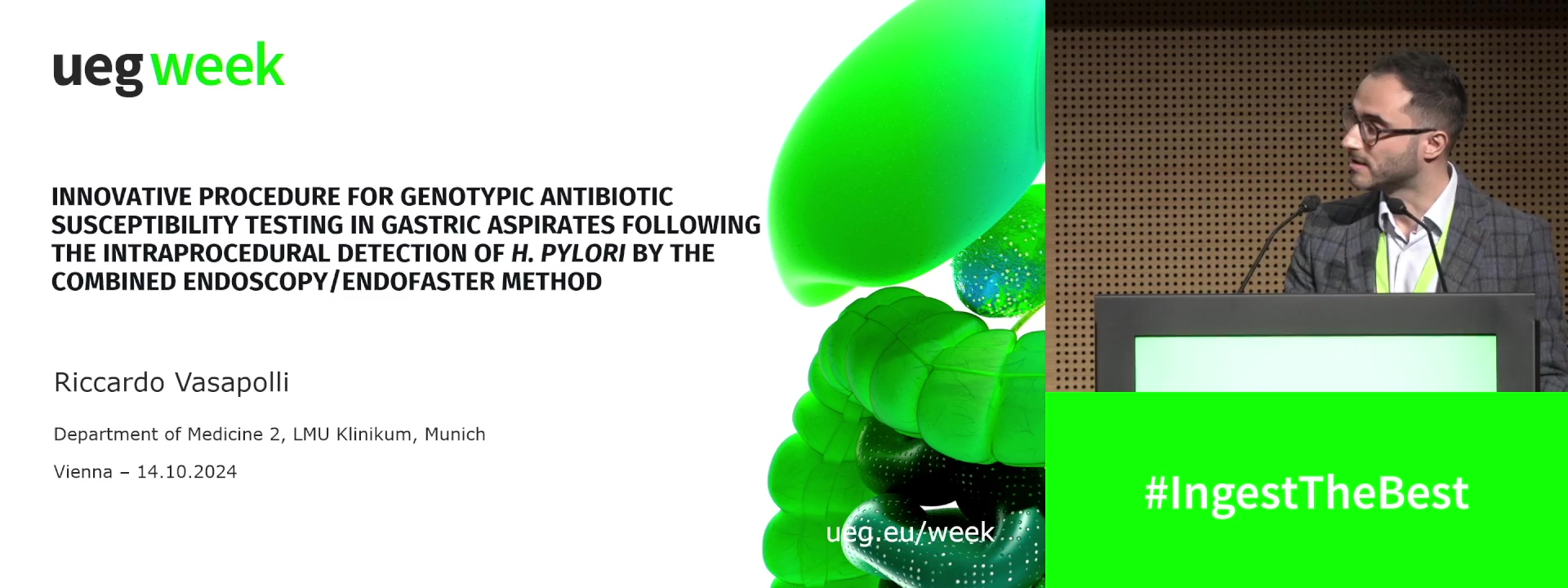
INNOVATIVE PROCEDURE FOR GENOTYPIC ANTIBIOTIC SUSCEPTIBILITY TESTING IN GASTRIC ASPIRATES FOLLOWING THE INTRAPROCEDURAL DETECTION OF H. PYLORI BY THE COMBINED ENDOSCOPY/ENDOFASTER METHOD

Log in to access this content.

Free for all myUEG account holders. Your access level is set automatically based on your occupation. Medical professionals get full access to all content. If you are a non-medical user, you can only access UEG Week content from congresses you attended.

Log In Create a free account

Not sure what you can access? Learn more about account types.

Introduction

Antibiotic resistance in Helicobacter pylori (H. pylori) poses an increasing challenge for infection management. Genotypic antibiotic susceptibility testing (GAST) is proposed as cost-effective approach for successful treatment.

Aims & Methods

Aim of our study was to evaluate GAST for detecting clarithromycin and levofloxacin resistance in gastric aspirates from H. pylori-positive patients compared to conventional phenotypic AST (PAST).
Patients undergoing upper GI endoscopy (UGE) between February 2022 and April 2023 were prospectively recruited. Real-time diagnosis of H. pylori was pursued during UGE through gastric juice analysis by Endofaster1. In case of intraprocedural H. pylori detection, two types of gastric aspirates were collected: a) undiluted gastric juice (GJ) and b) water rinse aspirate (WR). The WR was obtained after complete removal of the GJ and instillation of 30 mL sterile saline solution against the wall of the stomach corpus. Furthermore, gastric biopsies were collected for histology and culture-based PAST by E-test. Sanger sequencing of the 23S rRNA and gyrA genes from H. pylori was performed using gastric aspirates to detect polymorphisms associated with resistance to macrolides and fluoroquinolones, respectively. The test accuracy of GJ-GAST and WR-GAST was determined using PAST as the gold standard. The McNemar test was used to compare sensitivities and specificities between GJ- and WR-GAST. The level of agreement among different AST was assessed by Cohen’s κ-value.

Results

Seventy-two consecutive patients (29/43 male/female; mean age, 47.0 ± 13.5 years) tested H. pylori-positive during the UGE were included in the study. According to PAST the resistance rates were 15.3% (11/72) for clarithromycin and 18.1% (13/72) for levofloxacin. The diagnostic measures of GJ-GAST and WR-GAST for resistance detection, as well as their agreement with PAST are shown in Table 1. Overall, GAST and PAST results showed substantial agreement (κ-value ranging from 0.67 to 0.77) and a very high level of concordance (>93%) for detecting clarithromycin and levofloxacin resistance using both GJ and WR.
There were no significant differences in diagnostic performances between GJ- and WR-GAST (p > 0.05), as confirmed by an almost perfect agreement with a κ-value of 0.93 for both clarithromycin and levofloxacin. Additionally, molecular analysis, involving the inspection of Sanger chromatograms, enabled an increase in the detection of heteroresistance cases by 33% for clarithromycin and up to 50% for levofloxacin, compared to PAST.


GJ-GAST
WR-GAST
Clarithromycin
Levofloxacin
Clarithromycin
Levofloxacin
Sensitivity
63.6% (30.8% - 89.1%)
69.2% (38.6% - 90.9%)
54.6% (23.4% - 83.3%)
66.7% (34.9% - 90.1%)
Specificity
100 % (94.0% - 100%)
98.3% (90.8% - 100%)
100% (94.1% - 100%)
100% (93.7% - 100%)
Accuracy
94.4% (86.2%-98.4%)
93.0% (84.3% - 97.7%)
93.1% (84.5% - 97.7%)
94.2% (85.8% -98.4%)
Positive predictive value
100% (59.0% - 100%)
90.0% (56.0% - 98.5%)
100% (54.1 % - 100%)
100% (63.1% - 100%)
Negative predictive value
93.8% (87.3% - 97.0%)
93.4% (86.3% - 97.0%)
92.4% (86.5% - 95.9%)
93.4% (86.5% - 96.9%)
Pairwise concordance
67/71 (93.1%)
66/71 (93.0%)
67/72 (93.0%)
66/70 (94.3%)
κ-value 0.75 (0.51 - 0.98)
0.74 (0.53 - 0.95)
0.67 (0.41 - 0.93)
0.77 (0.55 - 0.98)

Table 1. Diagnostic performances of GJ-GAST and WR-GAST for detection of clarithromycin and levofloxacin resistances, as compared to PAST. 95% confidence intervals are indicated in brackets.

Conclusion

Genotypic AST from gastric aspirates, following intraprocedural diagnosis of H. pylori, provides highly accurate results for detecting clarithromycin and levofloxacin resistances, comparable to conventional phenotypic AST. This novel method of GAST, performed using water rinse aspirates collected during UGE, is a valid and practical tool for tailoring eradication regimens.

References

1. Vasapolli R, Ailloud F, Suerbaum S, et al. Intraprocedural gastric juice analysis as compared to rapid urease test for real-time detection of Helicobacter pylori. World J Gastroenterol 2023;29:1638-1647.

INNOVATIVE PROCEDURE FOR GENOTYPIC ANTIBIOTIC SUSCEPTIBILITY TESTING IN GASTRIC ASPIRATES FOLLOWING THE INTRAPROCEDURAL DETECTION OF H. PYLORI BY THE COMBINED ENDOSCOPY/ENDOFASTER METHOD

Riccardo Vasapolli 1, Florent Ailloud 2, Beate Spiessberger 2, Peter Malfertheiner 3, Sebastian Suerbaum 4, Christian Schulz 1

1 University Hospital LMU Munich, Munich, Germany|||DZIF Deutsches Zentrum für Infektionsforschung, Partner Site Munich, Munich, Germany

2 Max von Pettenkofer Institute, Ludwig Maximilians University of Munich, Munich, Germany|||National Reference Center for Helicobacter pylori, Munich, Germany

3 University Hospital LMU Munich, Munich, Germany

4 Max von Pettenkofer Institute, Ludwig Maximilians University of Munich, Munich, Germany|||National Reference Center for Helicobacter pylori, Munich, Germany|||DZIF Deutsches Zentrum für Infektionsforschung, Partner Site Munich, Munich, Germany

Event

UEG Week Vienna 2024

Topics

Stomach & H. Pylori

Submission format

Abstract

Session

H.pylori basics

Citation

United European Gastroenterology Journal 2024; 12 (Supplement 8)

Published

2024
UEG Poster
Standard Poster
Share via Email Share on Facebook Share on X Share on LinkedIn Share on Bluesky

Log in to access this content.

Free for all myUEG account holders. Your access level is set automatically based on your occupation. Medical professionals get full access to all content. If you are a non-medical user, you can only access UEG Week content from congresses you attended.

Log In Create a free account

Not sure what you can access? Learn more about account types.

Introduction

By 2030, pancreatic ductal adenocarcinoma (PDAC) is predicted to become the second leading cause of cancer-related death. Due to its resistance to conventional therapies and heterogeneous mutational landscape, molecular stratification and the development of targeted therapeutic options are essential for improving survival of PDAC patients. Previous work from our group investigated loss-of-function mouse models for the ATM serine/threonine kinase causing homologous recombination deficiency (HRD) in PDAC. Specifically, ATM loss was reported to accelerate tumorigenesis, support metastatic burden, and coincide with oncogenic programs, including epithelial-mesenchymal transition (EMT). Interestingly, ATM-deficient tumors accumulated EZH2, suggesting that ATM status contributes to rewiring the epigenetic landscape of pancreatic tumors, subsequently supporting oncogenic features.

Aims & Methods

To investigate whether and how EZH2 impacts ATM-deficient PDAC pathogenesis, we generated conditional double ATM and EZH2 knockouts in KrasG12D/+; Ptf1aCre/+ mice. In vitro approaches were conducted using primary cell lines isolated from murine endpoint tumors. Additionally, CRISPR/Cas9 strategy was implemented on ATM-deficient cell lines to decipher the ATM-EZH2 molecular axis.

Results

Double-null mice showed extended mouse survival and decreased undifferentiated malignant cell features. Strikingly, interrogation of publicly available human datasets (TCGA, PanCancer Atlas) revealed a significant extended progression-free survival of ATMneg EZH2neg PDAC patients compared to ATMneg EZH2pos PDAC cases. Furthermore, we identified the histone-methyltransferase EZH2 as a direct ATM substrate impacting the mesenchymal phenotype of ATM-depleted tumors. Interestingly, RNA-seq analysis of ATM-deficient pancreatic cancer cells revealed upregulation of a transcriptomic program associated with cell differentiation upon EZH2 depletion by CRISPR/Cas9 strategy. In line, EZH2 depletion restored differentiated tumor features ex vivo. Further in vitro investigations revealed that ATM status significantly impacts EZH2 activity via a post-translational regulation axis, leading to a fostered tumor supporting EZH2 activity during pancreatic carcinogenesis. Specifically, the ATM kinase activity results in EZH2 ubiquitination and degradation by promoting Cullin1 E3-ubiquitin ligase recruitment. Finally, we demonstrated that a combinatorial therapy involving a potent EZH2 inhibitor promotes genomic instability and exacerbates the cytotoxic effects of PARP interference in ATM-deficient HRD PDAC.

Conclusion

Overall, we show that ATM deficiency significantly impacts EZH2 epigenetic functions and highlight the molecular stratification according to ATM status prior to pharmacological EZH2 interference in PDAC therapies as a valuable approach to target ATM-deficient HRD tumors.

THE EZH2 EPIGENETIC FACTOR, A CRITICAL ONCOGENIC PLAYER OF THE ATM-DEFICIENT PANCREATIC CANCER TUMORIGENESIS

THE EZH2 EPIGENETIC FACTOR, A CRITICAL ONCOGENIC PLAYER OF THE ATM-DEFICIENT PANCREATIC CANCER TUMORIGENESIS

Elodie Roger 1, Anna Härle 1, Menar Ekizce 1, Dharini Srinivasan 1, Johann Gout 1, Elisabeth Hessmann 2, Alexander Kleger 3, Lukas Perkhofer 4

1 University Ulm Hospital, Institute of Molecular Oncology and Stem Cell Biology, Ulm, Germany

2 Universitätsmedizin Göttingen, Göttingen, Deutschland, Göttingen, Germany

3 University Ulm Hospital, Institute of Molecular Oncology and Stem Cell Biology, Ulm, Germany|||Division of Interdisciplinary Pancreatology, Ulm University Hospital, Ulm, Germany

4 Division of Interdisciplinary Pancreatology, Ulm University Hospital, Ulm, Germany|||University Ulm Hospital, Institute of Molecular Oncology and Stem Cell Biology, Ulm, Germany

Conference

UEG Week Vienna 2024

Topics

Pancreas

Submission format

Abstract

Session

Pancreatic cancer: Basic (Posters)

Citation

United European Gastroenterology Journal 2024; 12 (Supplement 8)

Published

2024
UEG Poster
Standard Poster
Share via Email Share on Facebook Share on X Share on LinkedIn Share on Bluesky

Log in to access this content.

Free for all myUEG account holders. Your access level is set automatically based on your occupation. Medical professionals get full access to all content. If you are a non-medical user, you can only access UEG Week content from congresses you attended.

Log In Create a free account

Not sure what you can access? Learn more about account types.

Introduction

Chronic pancreatitis is a progressive inflammatory disease characterized by irreversible damage to the pancreas. The etiology of the disease is heterogenous and includes alcohol abuse, smoking, genetic risk factors and autoimmune diseases. Several clinical classification and severity scoring systems have been proposed, but none have been globally accepted or reached broad clinical use. Identifying patients at a higher risk of death is crucial for improving patient care and management.

Aims & Methods

This study aimed to develop a prediction model based on promoter hypermethylation of specific genes and clinical factors to differentiate patients with chronic pancreatitis who are at a higher risk of mortality. Clinical variables such as age, sex, smoking status, alcohol consumption, exocrine insufficiency, and endocrine insufficiency, as well as the methylation status of 16 genes, were analyzed using a backward stepwise Cox regression model. The methylation status was determined by a specialized bisulfite based PCR technique. The final model's performance was evaluated using the area under the receiver operating characteristic (ROC) curve (AUC), and used to determine a risk score for each patients. The “cutpt” package in Stata was used to determine an optimal cut-off, in order to stratify patients into low and high-risk groups. Kaplan-Meier survival curves, and cox regression, and AUC were used to determine the accuracy of the risk groups.

Results

Ninety-seven patients with chronic pancreatitis were included in the study. The final prediction model included age, sex, exocrine insufficiency, endocrine insufficiency, and the methylation status of 5 genes: SFRP2, HIC1, MLH1, RASSF1A, and CDKN2B. The AUC of the model was 0.84, indicating high reliability. The model was superior to a model including only clinical variables (AUC = 0.76), indicating added value of the methylation markers. The optimal cut-off value for the risk score was 7.76. According to this, 67 patients were in the low-risk group, and 30 in the high-risk group. The 5-year survival in the high-risk group was 53% compared to 94% in the low-risk group. Being in the high-risk group was significantly associated with an increased HR of death of 10.2 (95% CI; 4.9-21.1), demonstrating the model's strong prognostic value.

Conclusion

The developed prediction model, which combines clinical factors and gene promoter hypermethylation status, could be a valuable tool for identifying patients with chronic pancreatitis who are at a higher risk of death. This study serves as proof-of-concept of the unexplored potential of methylation analysis in cell-free DNA in chronic pancreatitis. This model can potentially enhance patient care by enabling targeted interventions and monitoring for high-risk individuals, ultimately improving their prognosis and quality of life.

Disclosure

S.D.H., P.H.M., O.T.-U., and H.B.K. declare that they have a patent on a diagnostic panel including the promoter hypermethylation status of 8 genes. Application No. 16161073.8 – 1403 Pancreatic Cancer methylation Markers (18.03.2016)

ASSESSING MORTALITY RISK IN CHRONIC PANCREATITIS: A PREDICTION MODEL INCORPORATING CLINICAL VARIABLES AND PROMOTER HYPERMETHYLATION IN CELL-FREE DNA

ASSESSING MORTALITY RISK IN CHRONIC PANCREATITIS: A PREDICTION MODEL INCORPORATING CLINICAL VARIABLES AND PROMOTER HYPERMETHYLATION IN CELL-FREE DNA

Benjamin Stubbe 1, Henrik Bygum Krarup 1, Inge Søkilde Pedersen 1, Poul Henning Madsen 1, Søren Schou Olesen 1, Ole Thorlacius-Ussing 1, Stine Dam Henriksen 1

1 Aalborg University Hospital, Aalborg, Denmark

Conference

UEG Week Copenhagen 2023

Topics

Pancreas

Submission format

Abstract

Session

Acute and chronic pancreatitis (Posters)

Citation

United European Gastroenterology Journal 2023; 11 (Supplement 8)

Published

2023

The global reference point for the digestive health community

Platform Publisher

United European Gastroenterology

Wickenburggasse 1 1080 Vienna, Austria

Contact us

support@ueg.eu

ueg.eu

T: +43 1 997 1639

Legal

Terms & Conditions

Imprint

Privacy Policy

Explore

My Bookmarks

My recommendations

My fields of interest

© 2026 United European Gastroenterology

Change fields of interest

These fields are selected based on the interests in your myUEG profile.
Click the item to unselect it. You can select multiple items.