UEG's content platform for gastroenterology education bringing recordings, courses, guidelines, and more together in one place.
Trending on Gutflix
Rate for better recommendations!
Your feedback helps us show you more of what you like and less of what you dislike!

Log in to continue.
This content is part of Gutflix. Log in with your myUEG account, or create one free, to watch it.
Not sure what you can access? Learn more about account types.
EPIDEMIOLOGY OF SLEEP QUALITY IN ROME IV IRRITABLE BOWEL SYNDROME (IBS)
Affiliations
1 Leeds Gastroenterology Institute, Leeds, United Kingdom
2 County Durham and Darlington NHS Foundation Trust, Darlington, United Kingdom
3 Leeds Institute of Medical Research, Leeds, United Kingdom
Log in to continue.
This content is part of Gutflix. Log in with your myUEG account, or create one free, to watch it.
Not sure what you can access? Learn more about account types.
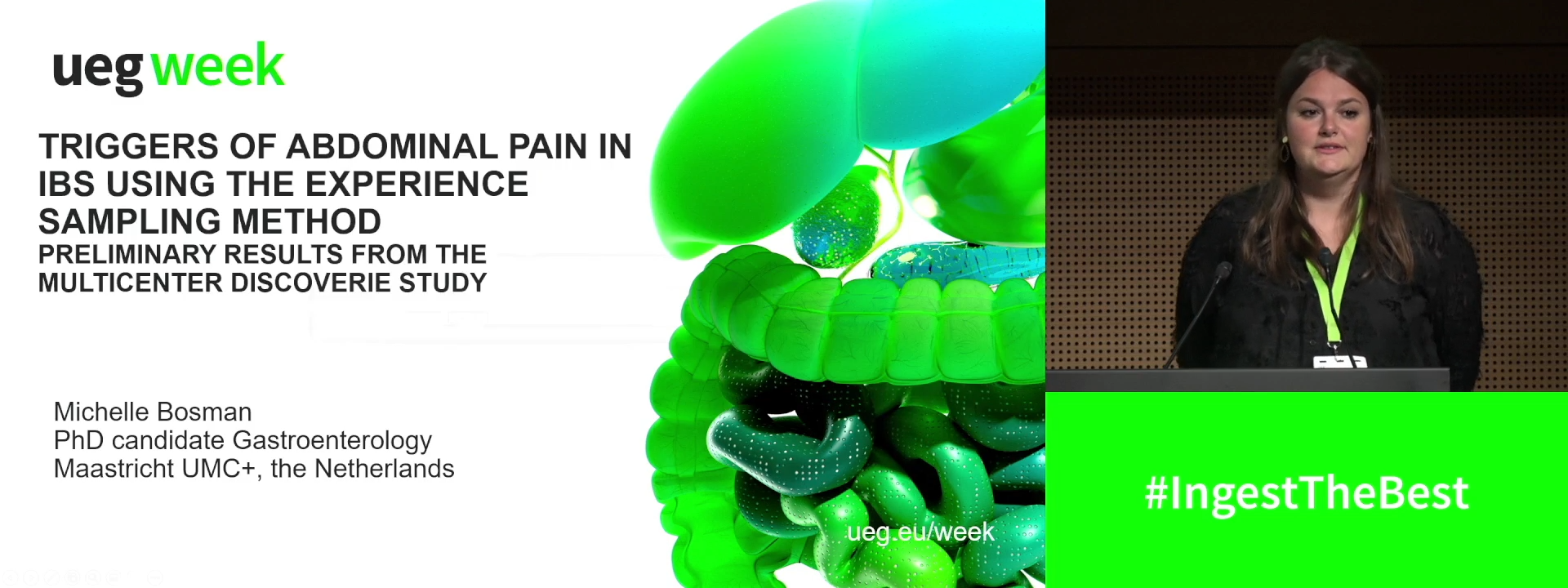
EXPLORING DYNAMIC TRIGGERS OF ABDOMINAL PAIN IN IRRITABLE BOWEL SYNDROME USING THE EXPERIENCE SAMPLING METHOD - PRELIMINARY RESULTS FROM THE MULTICENTER DISCOVERIE STUDY
Michelle Bosman 1, Lisa Vork 1, Maaike Van Den Houte 2, Irina Midenfjord 3, Silvia Muñoz 4, Maria Raffaella Barbaro 5, Dan Lucian Dumitrascu 6, Daisy Mae Jonkers 1, Daniel Keszthelyi 1
Affiliations
1 Department of Gastroenterology-Hepatology, NUTRIM School of Nutrition and Translational Research in Metabolism, Maastricht University Medical Center, Maastricht, Netherlands
2 Laboratory for Brain-Gut Axis Studies, Translational Research in Gastrointestinal Disorders (TARGID), Department of Chronic Diseases & Metabolism, KU Leuven, Leuven, Belgium
3 Department of Internal Medicine, Institute of Medicine, Sahlgrenska Academy, University of Gothenburg, Gothenburg, Sweden
4 Psychiatry, Mental Health and Addictions Research Group, Vall d’Hebron Institute of Research (VHIR), Barcelona, Spain
5 IRCCS Azienda Ospedaliero-Universitaria di Bologna, Bologna, Italy, Bologna, Italy
6 Second Department of Internal Medicine, Iuliu Hatieganu University of Medicine and Pharmacy Cluj-Napoca, Cluj-Napoca, Romania

Log in to continue.
This content is part of Gutflix. Log in with your myUEG account, or create one free, to watch it.
Not sure what you can access? Learn more about account types.
INCREASED DISEASE BURDEN IN IRRITABLE BOWEL SYNDROME WITH COMORBIDITIES
Irina Midenfjord 1, Elias Sundelin 1, Inês A. Trindade 1, Mahrukh Khadija 1, Hans Törnblom 1, Javier Santos 2, Danique Mulder 3, Alejandro Arias-Vasquez 3, Georgy Ruesing 4, Andreas Reif 4, Mareike Aichholzer 4, Maaike Van Den Houte 5, Lukas Van Oudenhove 5, Maria Chiara Matteucci 6, Giovanni Barbara 6, Michelle Bosman 7, Daisy Mae Jonkers 7, Josep Antoni Ramos-Quiroga 2, Éva Jekkel 8, István Bitter 8, Andrei Pop 9, Dan Lucian Dumitrascu 9, Carmen Alonso-Cotoner 2, Amanda Rodriguez 2, Magnus Simrén 1
Affiliations
1 University of Gothenburg, Gothenburg, Sweden
2 Vall d'Hebron Hospital Universitari, Barcelona, Spain
3 Radboud University Medical Center, Donders Institute for Brain, Cognition and Behaviour, Nijmegen, Netherlands
4 Johann Wolfgang Goethe- Universitat Frankfurt Am Main, Frankfurt, Germany
5 Katholieke Universiteit Leuven, Leuven, Belgium
6 University of Bologna and IRCCS Azienda Ospedaliero Universitaria di Bologna, Bologna, Italy
7 Maastricht University Medical Center, Maastricht, Netherlands
8 Semmelweis University, Budapest, Hungary
9 'Iuliu Hatieganu' University of Medicine and Pharmacy, Cluj-Napoca, Romania