UEG's educational platform for gastroenterology education bringing recordings, courses, guidelines, and more together in one place.
Most popular content
Rate for better recommendations!
Your feedback helps us show you more of what you like and less of what you dislike!
Log in to access this content.
Free for all myUEG account holders. Your access level is set automatically based on your occupation. Medical professionals get full access to all content. If you are a non-medical user, you can only access UEG Week content from congresses you attended.
Not sure what you can access? Learn more about account types.

BILIARY LEAKS AFTER LIVER TRANSPLANT: PREDICTING HEALING AND STRICTURE RISK THROUGH LEAK GRADE, TIMING AND STENT STRATEGY
Delio Stefani Donati 1, Arianna Venturini 1, Dario Gambaccini 1, Pierfrancesco Visaggi 2, Gherardo Tapete 1, Veronica Natali 1, Andrea Pancetti 1, Valeria Bolognesi 1, Emanuele Marciano 1
1 Endoscopy Unit, Azienda Ospedaliero Universitaria Pisana, Pisa, Italy
2 Endoscopy Unit, Azienda Ospedaliero Universitaria Pisana, Pisa, Italy|||Gastroenterology Unit, University of Pisa, Pisa, Italy
Conference
Topics
Submission format
Citation
Published
Log in to access this content.
Free for all myUEG account holders. Your access level is set automatically based on your occupation. Medical professionals get full access to all content. If you are a non-medical user, you can only access UEG Week content from congresses you attended.
Not sure what you can access? Learn more about account types.
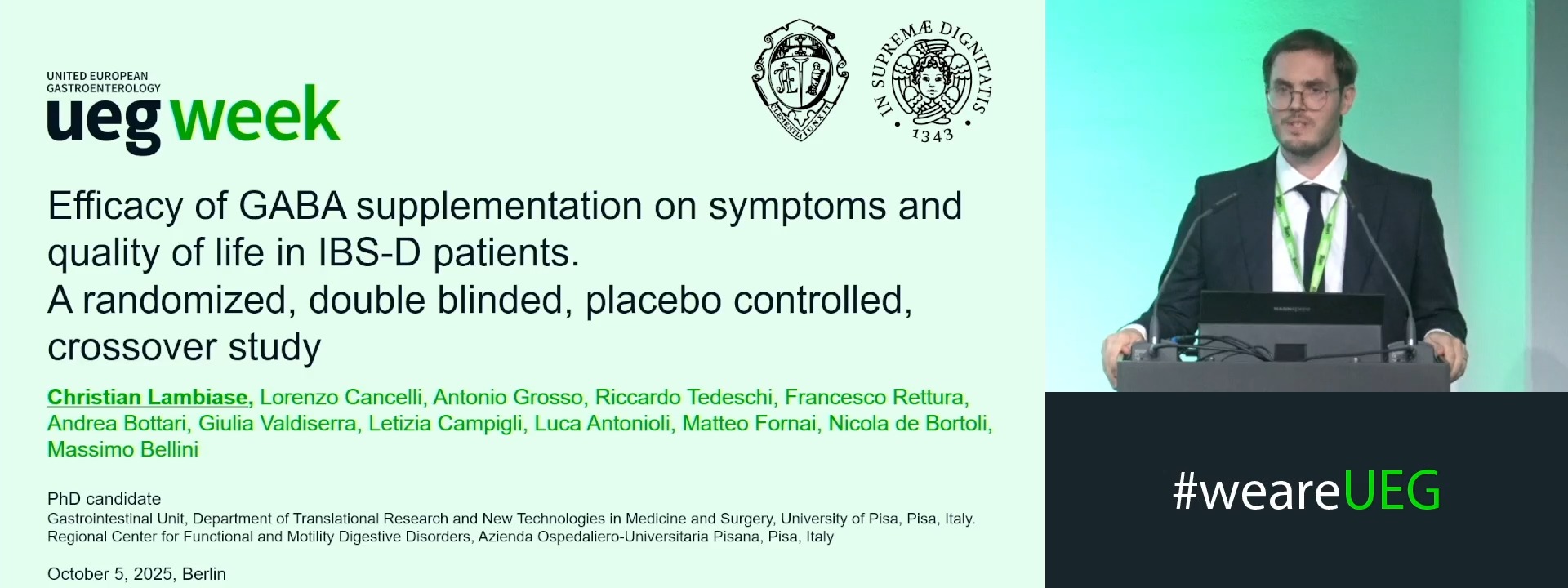
EFFECTS OF GAMMA-AMINOBUTYRIC ACID SUPPLEMENTATION ON SYMPTOMS AND QUALITY OF LIFE IN IBS-D PATIENTS. PRELIMINARY RESULTS FROM A RANDOMIZED, DOUBLE BLINDED, PLACEBO CONTROLLED, CROSSOVER STUDY
Christian Lambiase 1, Lorenzo Cancelli 1, Antonio Grosso 1, Riccardo Tedeschi 1, Francesco Rettura 1, Andrea Bottari 1, Giulia Valdiserra 2, Letizia Campigli 2, Luca Antonioli 2, Matteo Fornai 2, Nicola de Bortoli 1, Massimo Bellini 1
1 University of Pisa, Pisa, Italy|||Azienda Ospedaliero-Universitaria Pisana, Pisa, Italy
2 University of Pisa, Pisa, Italy
Event
Topics
Submission format
Session
Citation
Published
Log in to access this content.
Free for all myUEG account holders. Your access level is set automatically based on your occupation. Medical professionals get full access to all content. If you are a non-medical user, you can only access UEG Week content from congresses you attended.
Not sure what you can access? Learn more about account types.
Nurse Programme (Complete Session)
Event
Session
Citation
Published
Log in to access this content.
Free for all myUEG account holders. Your access level is set automatically based on your occupation. Medical professionals get full access to all content. If you are a non-medical user, you can only access UEG Week content from congresses you attended.
Not sure what you can access? Learn more about account types.
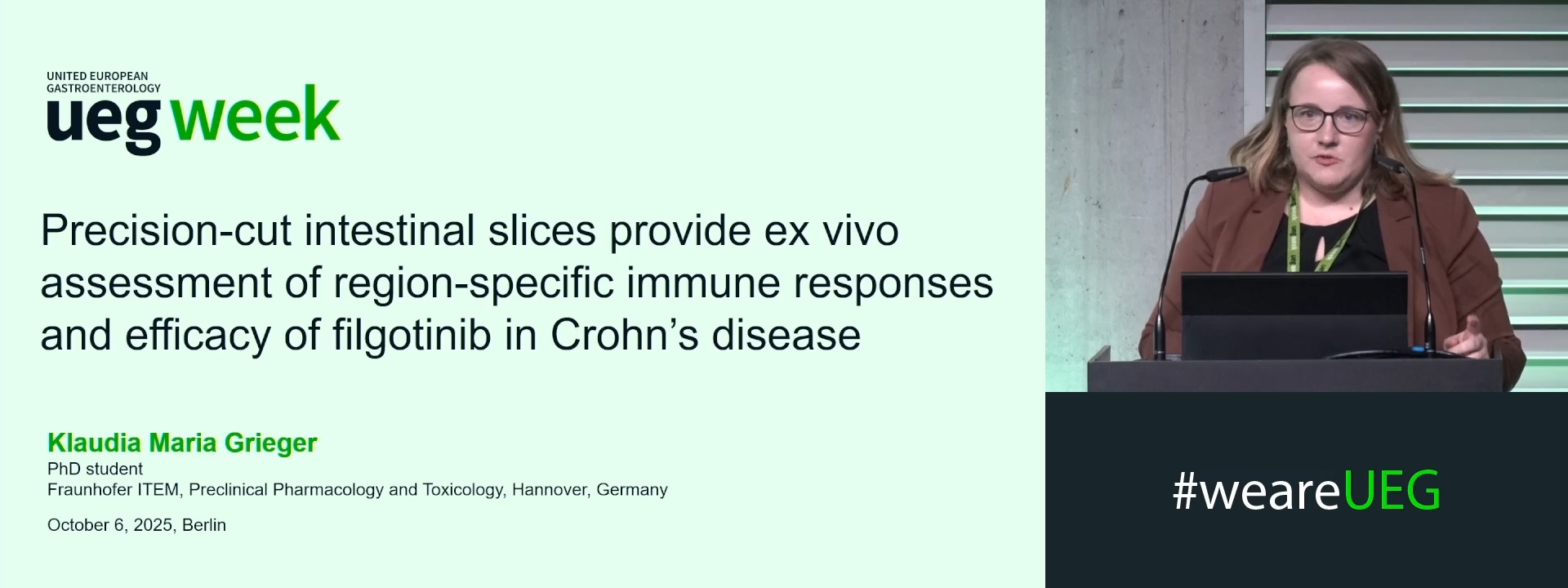
PRECISION-CUT INTESTINAL SLICES PROVIDE EX VIVO ASSESSMENT OF REGION-SPECIFIC IMMUNE RESPONSES AND EFFICACY OF FILGOTINIB IN CROHN'S DISEASE
Klaudia Maria Grieger 1, Valerie Beneke 1, Vanessa Neuhaus 1, Ulf Kulik 2, Heiko Aselmann 3, Benjamin Gundert 3, Armin Braun 1, Christina Hesse 1, Susann Dehmel 1, Katherina Sewald 1
1 Fraunhofer Institute for Toxicology and Experimental Medicine, Hannover, Germany
2 Hannover Medical school (MHH), Hannover, Germany
3 KRH Klinikum Region Hannover, Hannover, Germany
Event
Submission format
Citation
Published
Log in to access this content.
Free for all myUEG account holders. Your access level is set automatically based on your occupation. Medical professionals get full access to all content. If you are a non-medical user, you can only access UEG Week content from congresses you attended.
Not sure what you can access? Learn more about account types.
EP300/H3K27AC/IDO1 SIGNALING AXIS REGULATES THE CROSSTALK BETWEEN TOLDCS AND T<SUB >REG</SUB> CELLS TO PROMOTE LIVER REGENERATION IN ACETAMINOPHEN-INDUCED LIVER FAILURE
1 Tongji Hospital, School Of Medicine, Tongji University, Shanghai, China
2 Tongji University Tongji Hospital Dept. of Gastroenterology, Shanghai, China
Conference
Topics
Submission format
Citation
Published
Log in to access this content.
Free for all myUEG account holders. Your access level is set automatically based on your occupation. Medical professionals get full access to all content. If you are a non-medical user, you can only access UEG Week content from congresses you attended.
Not sure what you can access? Learn more about account types.
SAFETY AND EFFICACY OF COLD VS. HOT SNARE ENDOSCOPIC MUCOSAL RESECTION FOR COLORECTAL POLYPS: A SYSTEMATIC REVIEW AND META-ANALYSIS OF RANDOMIZED CONTROLLED TRIALS
Ahmed Farag 1, Amro Bani-Hani 2, Rihab Kherroubi 3, Alaa Mohamed Elsayed Abbas 4, Ahmed Ayman Shawky 5, Mohamed Hamouda Elkasaby 6
1 Ain Shams University, Cairo, Egypt
2 Faculty of Medicine, The Hashemite University, Zarqa, Jordan
3 Faculty of Medicine, University of Algiers Benyoucef Benkhedda, Algiers, Algeria
4 Faculty of Medicine, Menofia University, Menofia, Egypt
5 Faculty of Medicine, Mansoura University, Mansoura, Egypt
6 Faculty of Medicine, Al-Azhar University, Cairo, Egypt
Conference
Topics
Submission format
Session
Citation
Published
Log in to access this content.
Free for all myUEG account holders. Your access level is set automatically based on your occupation. Medical professionals get full access to all content. If you are a non-medical user, you can only access UEG Week content from congresses you attended.
Not sure what you can access? Learn more about account types.
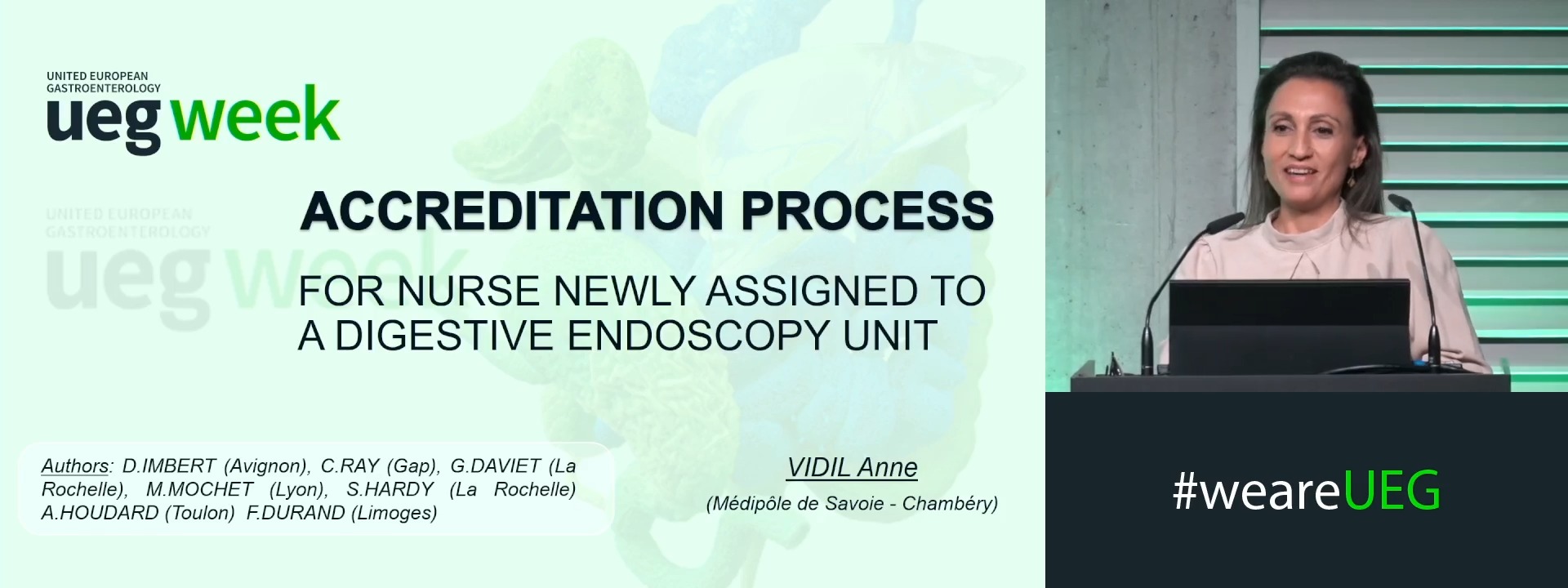
Accreditation for a newly recruited endoscopy nurse
1 None, None, France
Event
Topics