Introduction
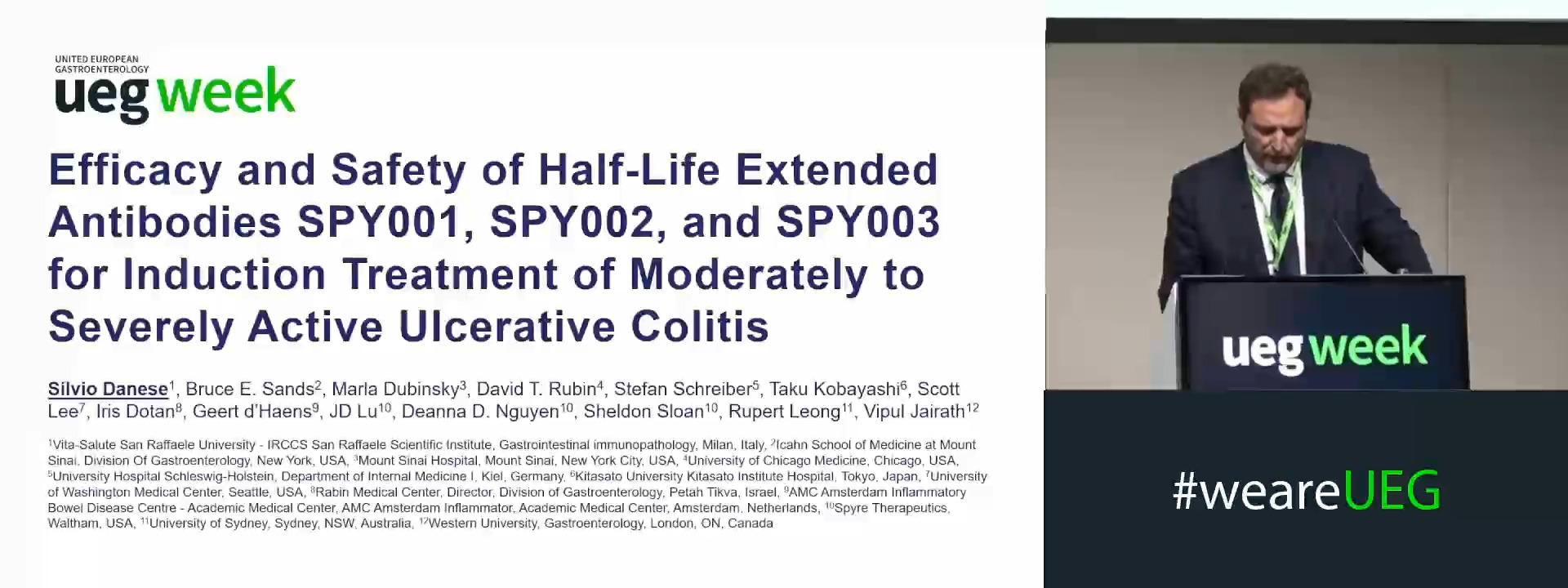
SPY001, SPY002, and SPY003 are investigational mAbs targeting a4b7, TL1A, and IL-23, respectively, with half-life extending modifications that enable potentially quarterly or semiannual dosing either as mono or combination therapies. SKYLINE-UC is a platform trial assessing the efficacy and safety of these single agents and their pairwise combinations in participants with moderately to severely active UC via a patient-centric study design that reduces placebo exposure and overall sample size. Here, we present the Week 12 Induction Treatment Period (ITP) data for Part A.
Aims & Methods
This ongoing treat-through study comprises an open-label Part A evaluating the efficacy and safety of SPY001, SPY002, and SPY003 as single agents and a randomized, placebo-controlled Part B evaluating these three agents (in two dosing regimens) and their pairwise combinations in participants with moderately to severely active UC (defined as modified Mayo Score [mMS] ³ 5, rectal bleeding [RB] subscore ³ 1, and endoscopic subscore [ES] ³ 2 with central reading). Part A comprised of IV induction treatment at Weeks 0 & 4 with SC maintenance dosing at Weeks 12, 24, & 36. Given Part A open-label design, the primary endpoint was the change in Robarts Histopathology Index (RHI) from baseline (per-protocol analysis set) with secondary endpoints of endoscopic improvement (ES ≤ 1), clinical remission (ES ≤ 1; stool frequency subscore ≤ 1; RB subscore = 0), and change in mMS (full analysis set) from baseline, all at Week 12. Non-responder imputation was applied to the binary endpoints, while the observed data were used for the analysis of continuous variables.
Results
43 and 48 participants enrolled, with 41 and 47 completing the ITP for SPY001 and SPY002, respectively. Baseline characteristics and efficacy results are as per Table 1. SPY001 and SPY002 met the primary endpoint with a reduction from baseline in RHI of -9.2 (p < 0.0001) and -10.7 (p < 0.0001), respectively. Secondary endpoints were 39.5% and 33.3% achieving clinical remission, 51.2% and 41.7% achieving endoscopic improvement, and changes from baseline in mMS of -3.7 and -3.7, for SPY001 and SPY002, respectively. 14.0% and 41.7% of participants receiving SPY001 and SPY002, respectively, reported at least one treatment-emergent AEs, with 2.3% and 4.2% reporting any SAEs, 0% and 6.3% with drug-related AEs, and 0% and 4.2% with AEs leading to study drug discontinuation. Data for SPY003 will be available at the time of presentation.
| | SPY001 (anti-a4b7) | SPY002 (anti-TL1A) |
| Baseline mMS (mean±SD) | 6.8 ± 1.1 | 6.9 ± 1.0 |
| Baseline Endoscopy Score of 3 | 56% | 56% |
| Baseline RHI (mean±SD) | 15.6 ± 8.6 | 16.9 ± 8.5 |
| Advanced Therapy-Naïve | 81% | 65% |
| Mean Change in RHI from baseline at Week 12 (1o endpoint) | -9.2 (95% CI: -12.6, -5.7)
p<0.0001 | -10.7 (95% CI: -14.1, -7.2)
p<0.0001 |
| Clinical remission rate at Week 12 (2o endpoint) | 17/43 (39.5%, 95% CI: 26.4%, 54.4%) | 16/48 (33.3%, 95% CI: 21.7%, 47.5%) |
| Endoscopic improvement rate at Week 12 (2o endpoint) | 22/43 (51.2%, 95% CI: 36.8%, 65.4%) | 20/48 (41.7%, 95% CI: 28.8%, 55.7%) |
| Mean Change in Modified Mayo Score at Week 12 (2o endpoint) | -3.7 (95% CI: -4.3, -3.0)
p< 0.0001 | -3.7 (95% CI: -4.2, -3.2)
p< 0.0001 |
Conclusion
SPY001 and SPY002 demonstrated statistically and clinically significant changes from baseline in RHI score (with p<0.0001), along with robust rates of clinical remission, endoscopic improvement, and changes from baseline in mMS. Both were well tolerated. SPY001, SPY002, and SPY003 are being tested as monotherapies at two dosing levels and as pairwise combinations in Part B with a placebo-controlled factorial design.
Disclosure
Silvio Danese: Health, Abbvie, Blackbird Celltrion, Labs, Alimentiv, BMS, Ensho, Amgen, Boehringer Enthera, Anaptys Exeliome Bio, Ingleheim, Asahi Biosciences, Kasei, Biomebank, Asieris, Ferring, Caldera, AstraFresenius Calluna, Zeneca, Kabi, Catalytic Attovia, Gilead, Granite Bio, GSK, Janssen, Lilly, Merck, Mountainfield, MRM Health, Nxcrn, Organon, Prometheus, OSE Rochc/Gcncntcch, Tmmunotherapeutics, Sanofi, Pendophann, SCOPE, Shattuck Pioneering Labs, Medicine, Sorriso, Spyre, Pfizer, Xencor, Synedgen, Zealand Takeda, Pharma Teva, Tillotts, Union Therapeutics, Ventus, Ventyx, Vividion, Xencor, Zealand Pharma.
Bruce Sands: Spyre Therapeutics, Takeda, Roche,Merck, Teva, Sanofi, AbbVie, Lilly and J&J Innovative Medicine.
Marla Dubinsky: Abivax, Abbvie, Astra Zeneca, Boehringer Ingleheim, Celltrion, Johnson and Johnson, Lilly, Merck, Pfizer, Prometheus, Roche/Genentech, Sanofi, Spyre, Takeda, Tentarix.
David Rubin: Takeda, Pfizer, Abbvie, Abivax SA, Altrubio, Athos Therapeutics, Inc, Bristol-Myers Squibb, Celltrion, Clostrabio, Connect BioPharma, Eli Lilly & Co., Genentech (Roche) Inc., Gilead, Iterative Health, Johnson & Johnson, Merck & Co., Mirador, Odyssey Therapeutics, Pfizer, Sanofi, Spyre, Takeda Pharmaceuticals, Throne, Vedanta Biosciences, Ventyx.
Stefan Schreiber: Celltrion, Eli Lilly, Fresenius, Gilead, I-Mab, Janssen, Pfizer, Protagonist Therapeutics, ProventionBio, Takeda, Ventyx, AbbVie, Alfasigma, Bristol Myers Squibb, Falk, Ferring, Galapagos.
Taku Kobayashi: Abbvie GK, Alfresa Pharma Corporation, Alimentiv, Bristol Meyers Squibb, Celltrion, Covidien, EA Pharma, Eli Lilly Japan K.K., Ferring Pharmaceuticals, Galapagos, Gilead Sciences, Janssen Pharmaceutical K.K., JIMRO, Kissei Pharmaceutical, Kowa, Kyorin Pharmaceutical, Mitsubishi Tanabe Pharma Corporation, Mochida Pharmaceutical, MSD, Nippon, Kayaku, Pfizer Japan Inc, Sanofi, Sekisui Medical, Spyre, Takeda Pharmaceutical, TOPPAN Holdings, and Zeria Pharmaceutical and receiving research funding from Abbvie GK, Alfresa Pharma Corporation, Bristol Meyers Squibb, EA Pharma, Gilead Sciences, Helmsley Charitable Trust, JIMRO, Kyorin Pharmaceutical, Miyarisan Pharmaceutical, Mochida Pharmaceutical, Nippon Kayaku, Pfizer Japan Inc, Sekisui Medical, Samsung Electronics, Takeda Pharmaceutical, Zeria Pharmaceutical.
Scott Lee: Spyre Therapeutics
Iris Dotan: Abbvie, Astra Zeneca, Athos, BMS, Celltrion, Falk Pharma, Ferring, Galapagos, Gilead, High5MD, Janssen, Lilly, Mirador, Nestle, Pfizer, Roche/Genentech, Sandoz, Sangamo, Spyre, Takeda, Harp Dx.
Geert d'Haens: Abbvie, Eli Lilly, J&J, Sanofi, Merck
Rupert Leong: AbbVie, Aspen, BMS, Celgene, Celltrion, Chiesi, Ferring, GLutagen, Hospira, Johnson & Johnson, Lilly, MSD, Novartis, Pfizer, Prometheus Biosciences,Takeda, Joanna Tiddy USYD, McCusker Charitable Foundation, Celltrion, Shire, Janssen, Takeda, GESA, NHMRC, Gutsy Group, Pfizer, MRFF.
Vipul Jairath: Abbvie, Alimentiv, Amgen, Anaptys Bio, Asahi Kasei, Asieris, Astra Zeneca, Attovia, Blackbird Labs, BMS, Boehringer Ingleheim, Biomebank, Caldera, Calluna, Catalytic Health, Celltrion, Ensho, Enthera, Exeliome Biosciences, Ferring, Fresenius Kabi, Gilead, Granite Bio, GSK, Janssen, Lilly, Merck, Mountainfield, MRM Health, Nxera, Organon, OSE Immunotherapeutics, Pendopharm, Pioneering Medicine, Pfizer, Prometheus, Roche/Genentech, Sanofi, SCOPE, Shattuck Labs, Sorriso, Spyre, Synedgen, Takeda, Teva, Tillotts, Union Therapeutics, Ventus, Ventyx, Vividion, Xencor, Zealand Pharma.
Deanna Nguyen: Spyre Therapeutics
Sheldon Sloan: Spyre Therapeutics
JD Lu: Spyre Therapeutics