UEG's educational platform for gastroenterology education bringing recordings, courses, guidelines, and more together in one place.
Most popular content
Rate for better recommendations!
Your feedback helps us show you more of what you like and less of what you dislike!
Log in to access this content.
Free for all myUEG account holders. Your access level is set automatically based on your occupation. Medical professionals get full access to all content. If you are a non-medical user, you can only access UEG Week content from congresses you attended.
Not sure what you can access? Learn more about account types.

IS THERE A VALUE TO EMA TESTING IN PATIENTS WITH HIGH TITRES OF TTG FOR A NON-BIOPSY DIAGNOSIS OF COELIAC DISEASE?
Shreyashee Sengupta 1, Gillian Madders 2, Arthur McQuaid 1, Cariossa Lee-Brennan 1, Vincent Tormey 1, Valerie Byrnes 2
1 University Hospital Galway, Galway, Ireland
2 University Hospital Galway, Galway, Ireland|||National University of Galway, Galway, Ireland
Conference
Topics
Submission format
Citation
Published
Log in to access this content.
Free for all myUEG account holders. Your access level is set automatically based on your occupation. Medical professionals get full access to all content. If you are a non-medical user, you can only access UEG Week content from congresses you attended.
Not sure what you can access? Learn more about account types.
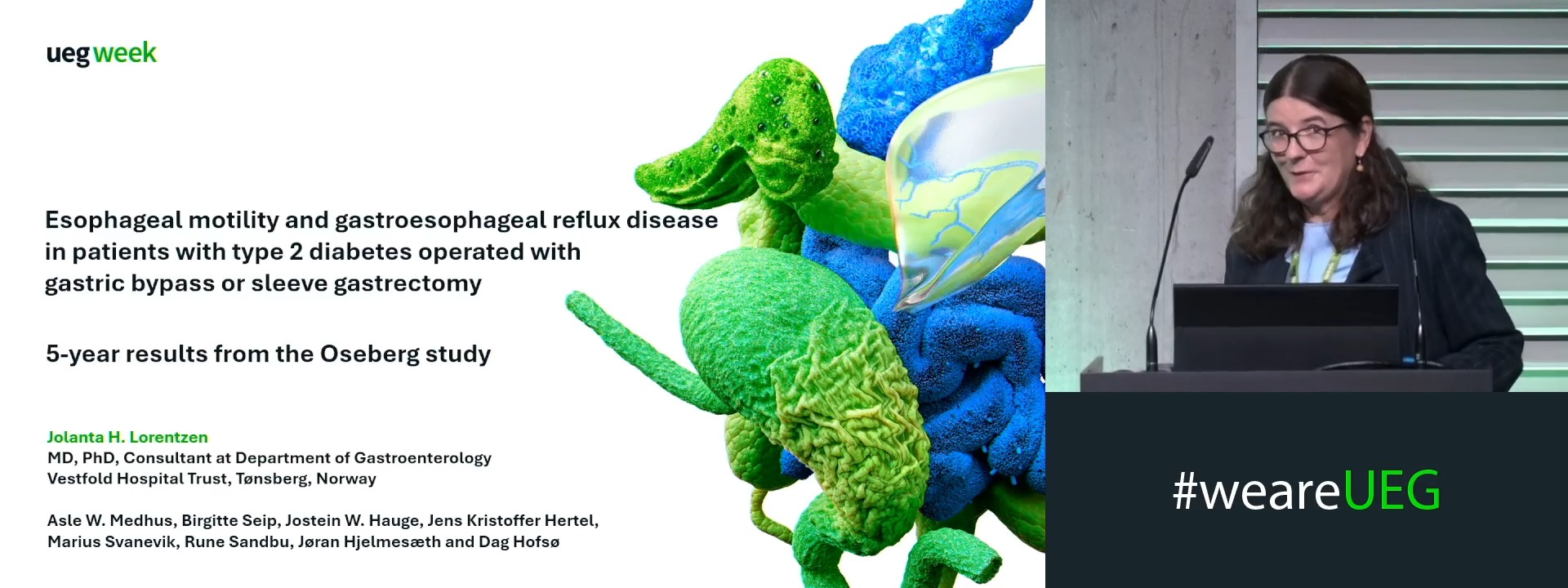
ESOPHAGEAL MOTILITY AND GASTROESOPHAGEAL REFLUX DISEASE IN PATIENTS WITH TYPE 2 DIABETES OPERATED WITH GASTRIC BYPASS OR SLEEVE GASTRECTOMY, 5-YEAR RESULTS FROM THE OSEBERG STUDY
Jolanta Lorentzen 1, Jostein W. Hauge 2, Asle W. Medhus 3, Jens K. Hertel 2, Birgitte Seip 4, Marius Svanevik 2, Rune Sandbu 2, Dag Hofsø 2, Jøran Hjelmesæth 2
1 Vestfold Hospital Trust, Tønsberg, Norway
2 Vestfold Hospital Trust, Tonsberg, Norway
3 Oslo University Hospital, Oslo, Norway
4 Vestfold Hospital, Tønsberg, Norway
Event
Submission format
Session
Citation
Published
Log in to access this content.
Free for all myUEG account holders. Your access level is set automatically based on your occupation. Medical professionals get full access to all content. If you are a non-medical user, you can only access UEG Week content from congresses you attended.
Not sure what you can access? Learn more about account types.
GLUTEN-INDUCED GASTRIC VISCERAL HYPERSENSITIVITY VIA SP-MEDIATED NEUROIMMUNE MECHANISMS: INSIGHTS FROM CLINICAL AND ANIMAL STUDIES IN FUNCTIONAL DYSPEPSIA
1 Sir Run Run Shaw Hospital, School of Medicine, Zhejiang Univeristy, Hangzhou, China|||The First Affiliated Hospital, School of Medicine, Zhejiang University, Hangzhou, China
2 Sir Run Run Shaw Hospital, School of Medicine, Zhejiang Univeristy, Hangzhou, China
3 Wenzhou Central Hospital, Wenzhou, China
Conference
Topics
Submission format
Session
Citation
Published
Log in to access this content.
Free for all myUEG account holders. Your access level is set automatically based on your occupation. Medical professionals get full access to all content. If you are a non-medical user, you can only access UEG Week content from congresses you attended.
Not sure what you can access? Learn more about account types.
Introduction
Biomarkers, like stool short-chain fatty acids (SCFA), metabolites by fermented nondigestible carbohydrates and branched-chain fatty acids (BCFA) derived from the metabolism of essential amino acids may allow for objective measurements of IBS biological changes without self-reporting bias. Diets low in FODMAP significantly reduce the abnormal fecal total SCFA in IBS patients, indicating that the diet normalizes the IBS patients’ abnormal fecal SCFA output.
Aims & Methods
By conducting an exploratory analysis, we aimed to measure stool SCFAs/BCFAs level changes in a subgroup of subjects enrolled in an RCT evaluating the efficacy of a Mediterranean version of the Low-FODMAPS diet (MED-LFD) compared to the nutritional recommendations of the British National Institute for Health and Care Excellence (NICE) for managing non-constipation IBS. A subset of 40 (23 MED-LFD & 17 NICE) patients provided stool samples at 3 time points: Before dietary intervention, at the 1st (4 weeks after initiation of intervention for NICE and at the end of phase 2 for MED-LFD), and the 2nd folow-up (FU), 6 months after intervention initiation. We measured symptoms severity using IBS-SSS. Table 1 shows the detailed measurement of the consumed FODMAPs per day assessed using a triple-pass 24-hour dietary recall twice at the two FUs.
Table 1.
| 1st Follow-up | 2nd Follow-up | |||||
| FODMAPs, M(IQR) | MED-LFD (N=20) | NICE (N=17) | p | MED-LFD (N=19) | NICE (N=15) | p |
| Excess fructose, g/meal | 0.17 (0.13-0.38) | 0.19 (0.11-0.83) | 0.563 | 0.22 (0.11, 0.39) | 0.3 (0.2, 0.47) | 0.275 |
| Sorbitol, g/meal | 0.02 (0.0-0.06) | 0.11 (0.01-0.39) | 0.021 | 0.02 (0, 0.08) | 0.14 (0.01, 0.28) | 0.245 |
| Mannitol, g/meal | 0.004 (0.0-0.07) | 0.06 (0.01-0.13) | 0.077 | 0.02 (0.01, 0.13) | 0.04 (0, 0.09) | 0.664 |
| Fructans, g/meal | 0.43 (0.33-0.54) | 0.63 (0.48-0.7) | 0.051 | 0.54 (0.27, 0.8) | 0.73 (0.51, 1.07) | 0.080 |
| GOS, g/meal | 0.09 (0.07-0.18) | 0.21 (0.09-0.36) | 0.106 | 0.14 (0.07, 0.32) | 0.23 (0.14, 0.48) | 0.171 |
| Total oligosaccharides, g/meal | 0.54 (0.39-0.79) | 0.85 (0.65-1.1) | 0.038 | 0.7 (0.33, 1.16) | 1.08 (0.72, 1.52) | 0.050 |
| Total FODMAPs, g/meal | 1.36 (1.0- 1.90) | 2.51 (1.68-3.42) | 0.011 | 1.54 (1.10-2.62) | 2.62 (1.42-3.90) | 0.086 |
| Lactose, g/meal | 0.04 (0.01-0.56) | 1.36 (0.47-2.46) | 0.002 | 0.32 (0.04, 1.15) | 0.27 (0.01, 2.39) | 0.808 |
SCFAs/BCFAs were extracted from frozen samples and analyzed using Gas Chromatography/Mass Spectrometry. SCFAs and BCFAs levels were measured in umol/g of stool. A paired/unpaired t-test was performed to illustrate the organic acid changes among and within two groups. In multiple groups comparison, significant differences between means were examined using one-way analysis of variance. A polynomial regression model was used to describe the relation between BCFAs/SCFAs levels change with IBS-SSS change from baseline at the 1st FU.
Results
We detected a significant reduction in the concentrations of total SCFAs and BCFAs in the MED-LFD (-21.4±20 and -0.429±0.882) and the NICE (-9.9±17.7 and -0.819±0.933) groups, respectively, at the 1st FU. At the 2nd FU, similar reductions from the baseline concentration levels were detected in both intervention groups (total SCFAs: -20.2±18.7 in MED-LFD vs. -10.9±7.4 in NICE; total BCFAs: -0.494±0.806 in MED-LFD vs. -0.76±0.83 in NICE). A polynomial association was observed between the changes in IBS-SSS scores and the changes in stool concentrations of BCFAs and SCFAs from baseline to the 1st FU. Specifically, there was a slight upward trend in the difference of BCFA levels, indicating that a decrease in IBS-SSS scores is associated with a reduction in BCFA levels during the 1st follow-up. This trend peaked around an IBS-SSS change of minus 50 points, the cut-off value for clinical response. Beyond this point, this association slightly declines. A similar trend was noted for SCFA level changes, with the peak occurring around an IBS-SSS change of minus 100 points, after which the association diminishes.
Conclusion
SCFA/BCFA stool levels changes from baseline might be an objective measure of successful dietary intervention for IBS
References
1. Ju X, Jiang Z, Ma J, Yang D. Changes in Fecal Short-Chain Fatty Acids in IBS Patients and Effects of Different Interventions: A Systematic Review and Meta-Analysis. Nutrients. 2024;16(11):1727
2. Rossi M, Aggio R, Staudacher HM, et al. Volatile Organic Compounds in Feces Associate With Response to Dietary Intervention in Patients With Irritable Bowel Syndrome. Clin Gastroenterol Hepatol. 2018;16(3):385-391.e1.
EXPLORATORY ANALYSIS INDICATES THAT CHANGES IN STOOL SHORT-CHAIN AND BRANCHED-CHAIN FATTY ACIDS LEVELS MAY SERVE AS OBJECTIVE MARKER OF SUCCESSFUL DIETARY INTERVENTION OF IRRITABLE BOWEL SYNDROME SYMPTOMS
AREZINA KASTI 1, Dimitrios E. Pavlidis 2, Konstantinos Katsas 1, Maroulla Nikolaki 1, Konstantinos Papadimitriou 3, John Kapolos 2, Konstantinos Triantafyllou 4
1 Attikon General University Hospital, Athens, Greece
2 University of Peloponnese, Kalamata, Greece
3 Agricultural University of Athens, Athens, Greece
4 Attikon University General Hospital, Athens, Greece
Conference
Topics
Submission format
Session
Citation
Published
Log in to access this content.
Free for all myUEG account holders. Your access level is set automatically based on your occupation. Medical professionals get full access to all content. If you are a non-medical user, you can only access UEG Week content from congresses you attended.
Not sure what you can access? Learn more about account types.
COMPARISON OF EFFICACY OF ENDOSCOPIC BAND LIGATION (EBL) WITH ARGON PLASMA COAGULATION (APC) IN THE MANAGEMENT OF BLEEDING GASTRIC VASCULAR ECTASIAS (GVE)
1 Shaikh Zayed Hospital, Lahore, Pakistan
2 Jinnah Hospital Lahore, Lahore, Pakistan
Conference
Topics
Submission format
Session
Citation
Published
Log in to access this content.
Free for all myUEG account holders. Your access level is set automatically based on your occupation. Medical professionals get full access to all content. If you are a non-medical user, you can only access UEG Week content from congresses you attended.
Not sure what you can access? Learn more about account types.
RELEVANCE OF SYMPTOM QUESTIONNAIRES AND HYDROGEN BREATH TESTS IN SUSPECTED LACTOSE OR FRUCTOSE INTOLERANCE
1 Medical University Graz, Graz, Austria
2 Medical University Vienna, Wien, Austria
3 Medical University Graz, Graz, Austria|||Privatklinik Kastanienhof, Graz, Austria
Conference
Topics
Submission format
Session
Citation
Published
Log in to access this content.
Free for all myUEG account holders. Your access level is set automatically based on your occupation. Medical professionals get full access to all content. If you are a non-medical user, you can only access UEG Week content from congresses you attended.
Not sure what you can access? Learn more about account types.
TREAT-TO-TARGET IN EOSINOPHILIC ESOPHAGITIS: THE IMPACT OF GOING BEYOND CLINICAL REMISSION
Joana Camões Neves 1, Patrícia Vaz Conde 2, Andreia Guimarães 3, José Damasceno 4, Ana Neiva 5, Raquel Gonçalves 2, Dalila Costa 5
1 Braga Hospital, Porto, Portugal
2 Braga Hospital, Braga, Portugal
3 Hospital Braga, Guimarães, Portugal
4 Braga Hospital, Vila Nova de Gaia, Portugal
5 Hospital de Braga, Braga, Portugal
Conference
Topics