UEG's content platform for gastroenterology education bringing recordings, courses, guidelines, and more together in one place.
Trending on Gutflix
Rate for better recommendations!
Your feedback helps us show you more of what you like and less of what you dislike!
Log in to continue.
This content is part of Gutflix. Log in with your myUEG account, or create one free, to watch it.
Not sure what you can access? Learn more about account types.
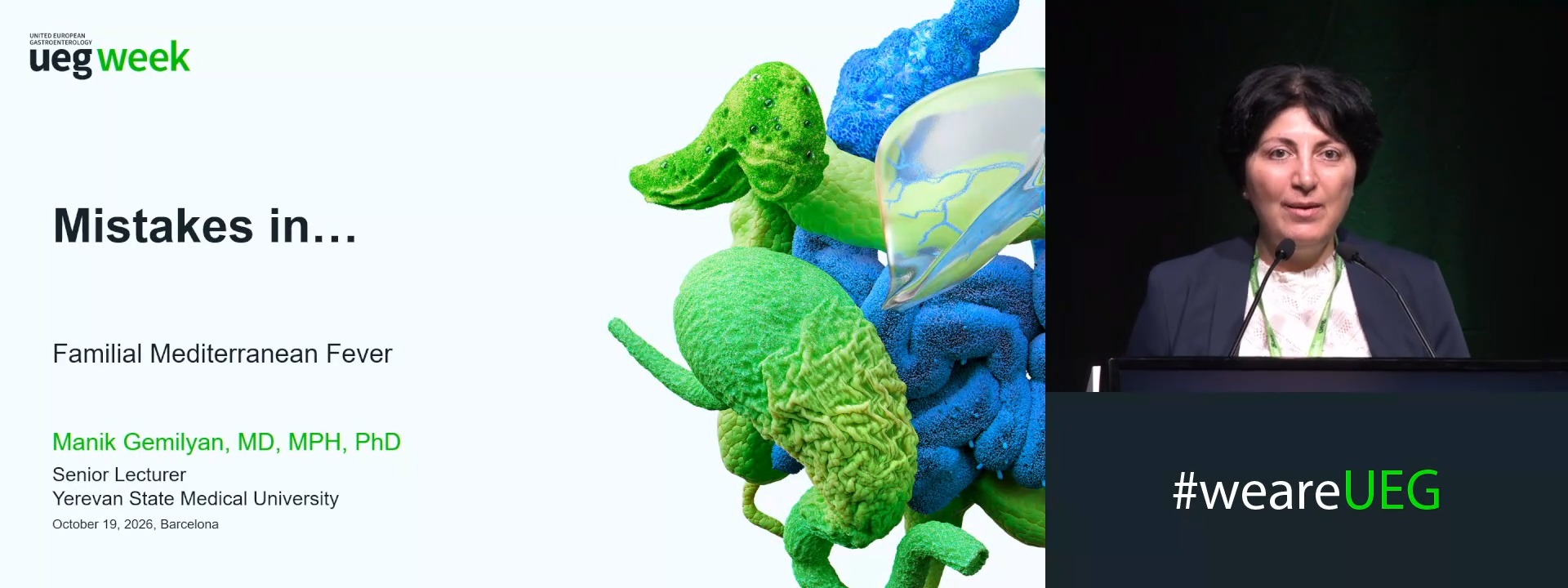
Familial Mediterranean fever
Affiliations
1 Yerevan State Medical University, Yerevan, Armenia
Log in to continue.
This content is part of Gutflix. Log in with your myUEG account, or create one free, to watch it.
Not sure what you can access? Learn more about account types.
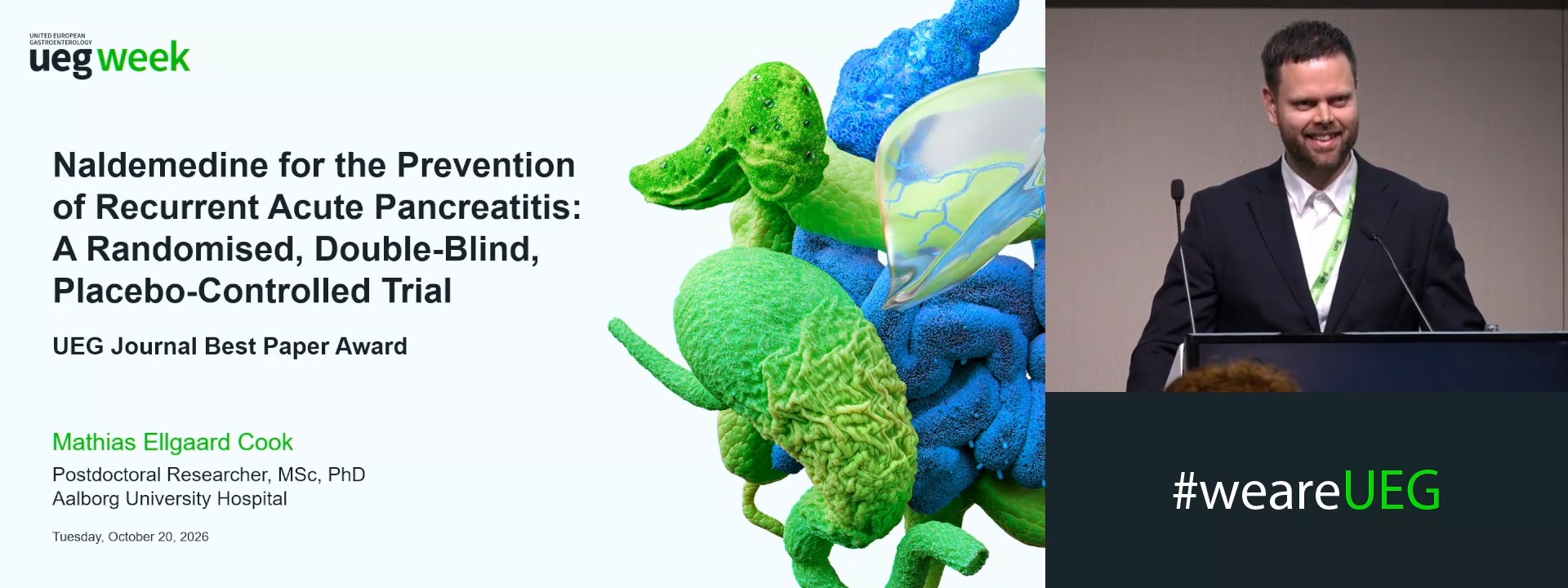
UEG Journal Best Paper Award
Affiliations
1 Aalborg University Hospital, Aalborg, Denmark
Log in to continue.
This content is part of Gutflix. Log in with your myUEG account, or create one free, to watch it.
Not sure what you can access? Learn more about account types.
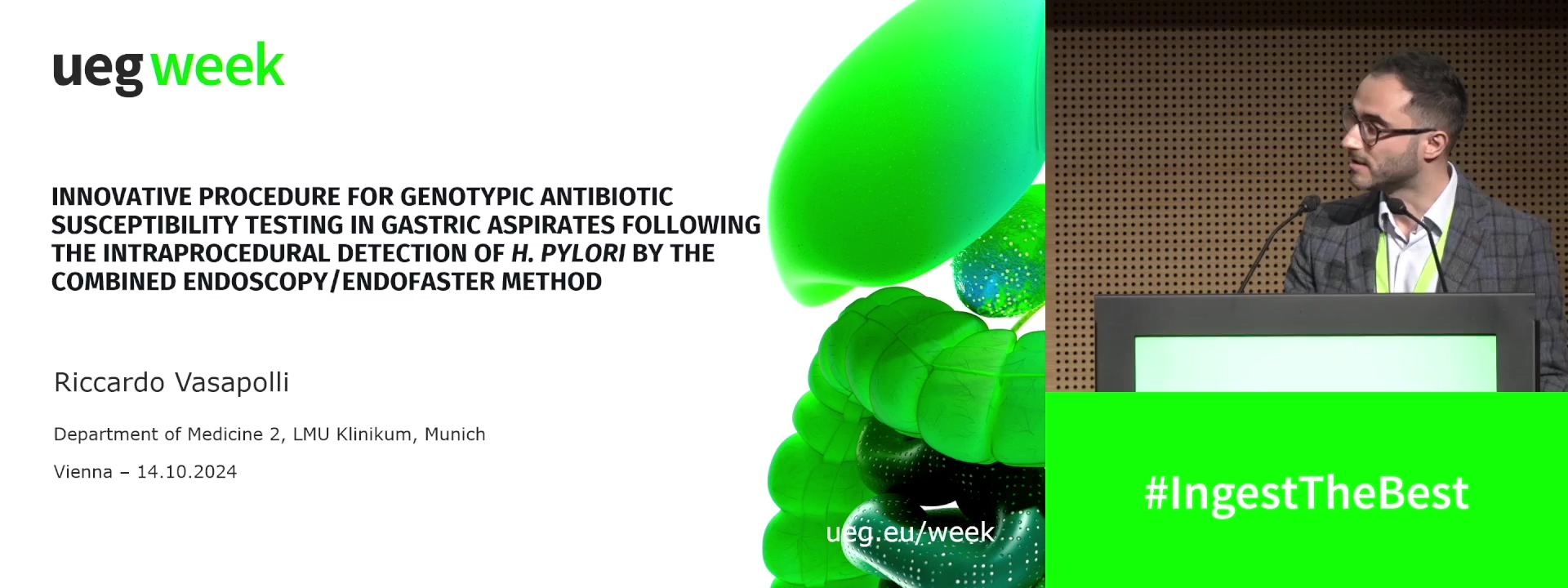
INNOVATIVE PROCEDURE FOR GENOTYPIC ANTIBIOTIC SUSCEPTIBILITY TESTING IN GASTRIC ASPIRATES FOLLOWING THE INTRAPROCEDURAL DETECTION OF H. PYLORI BY THE COMBINED ENDOSCOPY/ENDOFASTER METHOD
Riccardo Vasapolli 1,2, Florent Ailloud 3,4, Beate Spiessberger 3,4, Peter Malfertheiner 1, Sebastian Suerbaum 3,4,2, Christian Schulz 1,2
Affiliations
1 University Hospital LMU Munich, Munich, Germany
2 DZIF Deutsches Zentrum für Infektionsforschung, Partner Site Munich, Munich, Germany
3 Max von Pettenkofer Institute, Ludwig Maximilians University of Munich, Munich, Germany
4 National Reference Center for Helicobacter pylori, Munich, Germany

Log in to continue.
This content is part of Gutflix. Log in with your myUEG account, or create one free, to watch it.
Not sure what you can access? Learn more about account types.
A PILOT INVESTIGATION OF THE SAFETY, TOLERABILITY AND EFFECTIVENESS OF RADIOFREQUENCY VAPOR (RFV) ABLATION FOR DUODENAL MUCOSAL ABLATION (DA) FOR THE MANAGEMENT OF TYPE-2 DIABETES MELLITUS (STEAN T-2DM PILOT)
Benjamin Norton 1, Apostolis Papaefthymiou 1, Andrea Telese 1, Alejandro Nieponice 2, Leonardo Rodriguez Grunert 3, Pablo Becerra Hoebel 3, Charlie Murray 1, Kenneth Chang 4, C. Roberto Simons-Linares 5, Rehan Haidry 1
Affiliations
1 Cleveland Clinic London, London, United Kingdom
2 Hospital Universitario, Fundacion Favaloro, Buenos Aires, Argentina
3 Clinica Colonial, Santiago, Chile
4 University of California Irvine, Orange, United States
5 Cleveland Clinic Ohio, Ohio, United States