UEG's educational platform for gastroenterology education bringing recordings, courses, guidelines, and more together in one place.
Most popular content
Rate for better recommendations!
Your feedback helps us show you more of what you like and less of what you dislike!
Log in to access this content.
Free for all myUEG account holders. Your access level is set automatically based on your occupation. Medical professionals get full access to all content. If you are a non-medical user, you can only access UEG Week content from congresses you attended.
Not sure what you can access? Learn more about account types.

REQUIRED WITHDRAWAL TIMES TO MEET ADENOMA DETECTION TARGETS DURING COLONOSCOPY
Mahsa Taghiakbari 1, Sara-Ivana Calce 1, Douglas Kevin Rex 2, Roupen Djinbachian 1, Alan N. Barkun 3, Victoire Michal 4, Claire Gefflot 4, Mickael Bouin 1, Simon Bouchard 1, Benoit Panzini 1, Erik Deslandres 1, Dane Christina Daoud 1, Robert Battat 1, Katarzyna Orlicka 1, Edmond-Jean Bernard 1, Jeremy Liu Chen Kiow 1, Daniel von Renteln 1
1 University of Montreal Hospital Center (CHUM), Montreal, Canada
2 Indiana University School of Medicine, Indianapolis, United States
3 McGill University Health Centre and McGill University, Montreal, Canada
4 University of Montreal Hospital Research Center (CRCHUM), Montreal, Canada
Conference
Topics
Submission format
Citation
Published
Log in to access this content.
Free for all myUEG account holders. Your access level is set automatically based on your occupation. Medical professionals get full access to all content. If you are a non-medical user, you can only access UEG Week content from congresses you attended.
Not sure what you can access? Learn more about account types.
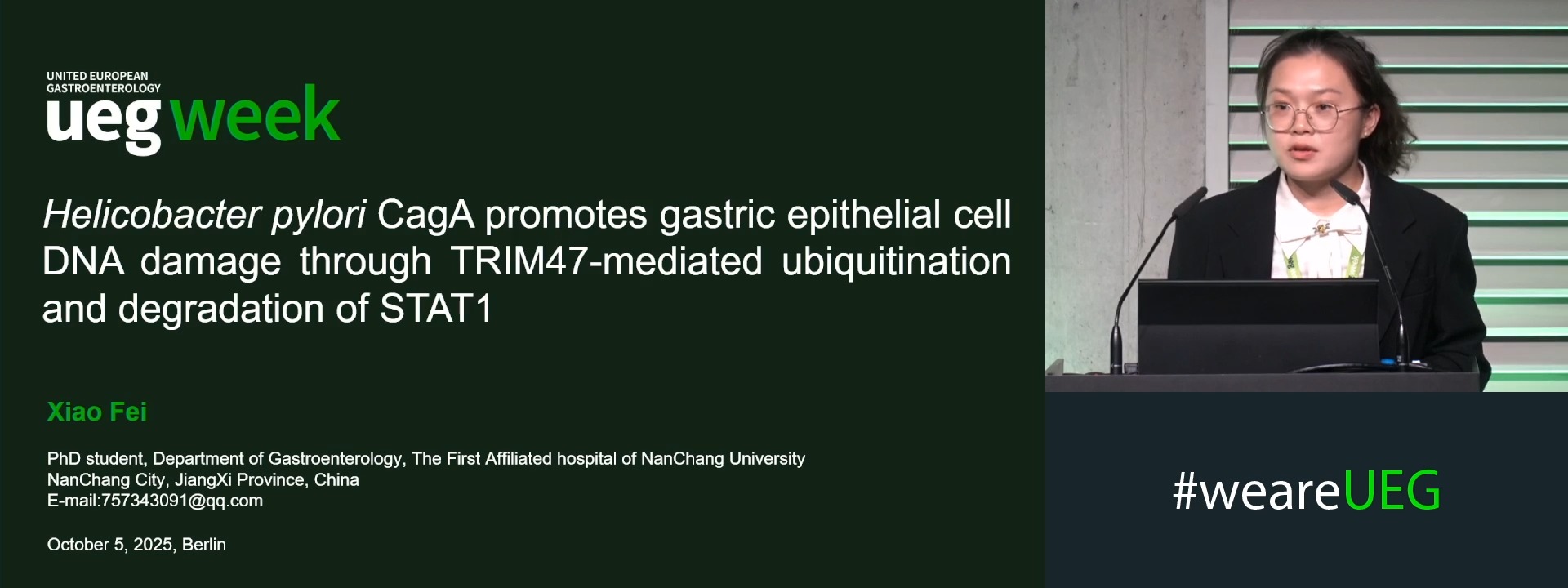
HELICOBACTER PYLORI CAGA PROMOTES GASTRIC EPITHELIAL CELL DNA DAMAGE THROUGH TRIM47-MEDIATED UBIQUITINATION AND DEGRADATION OF STAT1
1 The First Affiliated Hospital, Jiangxi Medical College, Nanchang University, Nanchang, China
Event
Submission format
Citation
Published
Log in to access this content.
Free for all myUEG account holders. Your access level is set automatically based on your occupation. Medical professionals get full access to all content. If you are a non-medical user, you can only access UEG Week content from congresses you attended.
Not sure what you can access? Learn more about account types.
A RARE CASE OF PSEUDOHEMATURIA INDUCED BY MESALAZINE
Isabel Caetano 1, Plácido Gomes 1, Diogo Simas 1, Catarina Atalaia-Martins 1, Maria Silva 1, Sandra Barbeiro 1, Helena Vasconcelos 1
1 Unidade Local de Saúde da Região de Leiria, Leiria, Portugal
Conference
Topics
Submission format
Session
Published
Log in to access this content.
Free for all myUEG account holders. Your access level is set automatically based on your occupation. Medical professionals get full access to all content. If you are a non-medical user, you can only access UEG Week content from congresses you attended.
Not sure what you can access? Learn more about account types.
THE DARK SIDE OF THE ESOPHAGUS: A CASE REPORT OF ACUTE ESOPHAGEAL NECROSIS
Zaeem Jafar 1, Luqman Helmi 2, Mohammed Kharief 1, Mohammed Ali Hasabalrasoul Mohammed 3, Abdelnour Elsadig 1, You Yi Hong 1, Ashraf Morcos 4
1 University Hospital Waterford, Waterford, Ireland
2 Cork University Hospital, Cork, Ireland
3 University Hospital Waterford, Limerick, Ireland
4 Waterford University Hospital, Ireland, Ireland
Conference
Topics
Submission format
Session
Published
Log in to access this content.
Free for all myUEG account holders. Your access level is set automatically based on your occupation. Medical professionals get full access to all content. If you are a non-medical user, you can only access UEG Week content from congresses you attended.
Not sure what you can access? Learn more about account types.
SEVERE PERFORATED DIVERTICULITIS IN A YOUNG ADULT UNMASKING ASCARIS INFESTATION: A MULTIDIMENSIONAL SURGICAL AND INFECTIOUS CHALLENGE
1 Emirates Health Services, Sharjah, United Arab Emirates
2 Emirates Health Services, Ras Al-Khiemah, United Arab Emirates
Conference
Topics
Submission format
Session
Published
Log in to access this content.
Free for all myUEG account holders. Your access level is set automatically based on your occupation. Medical professionals get full access to all content. If you are a non-medical user, you can only access UEG Week content from congresses you attended.
Not sure what you can access? Learn more about account types.
PREDICTORS OF RECURRENCE AFTER ENDOSCOPIC RETROGRADE APPENDICITIS THERAPY FOR ACUTE APPENDICITIS: A MULTI-CENTER COHORT STUDY WITH LONG-TERM FOLLOW-UP IN CHINA
1 The First Affilaited Hospital of Zhengzhou University, Zhengzhou, China
Conference
Topics
Submission format
Citation
Published
Log in to access this content.
Free for all myUEG account holders. Your access level is set automatically based on your occupation. Medical professionals get full access to all content. If you are a non-medical user, you can only access UEG Week content from congresses you attended.
Not sure what you can access? Learn more about account types.
DUODENAL CONFOCAL LASER ENDOMICROSCOPY REVEALS INTESTINAL BARRIER DYSFUNCTION IN ADVANCED CHRONIC LIVER DISEASE AND PREDICTS CLINICAL OUTCOME
Benedikt Simbrunner 1, Daniel Steinacher 1, Adrian Frick 1, Katharina Pomej 1, Benedikt Hofer 1, Lorenz Balcar 1, Georg Semmler 1, Mathias Jachs 1, Lukas Hartl 1, Michael Trauner 1, Mattias Mandorfer 1, Thomas Reiberger 1, Johann Hammer 1
1 Medical University of Vienna, Wien, Austria
Conference
Topics