UEG's content platform for gastroenterology education bringing recordings, courses, guidelines, and more together in one place.
Trending on Gutflix
Rate for better recommendations!
Your feedback helps us show you more of what you like and less of what you dislike!
Log in to continue.
This content is part of Gutflix. Log in with your myUEG account, or create one free, to watch it.
Not sure what you can access? Learn more about account types.
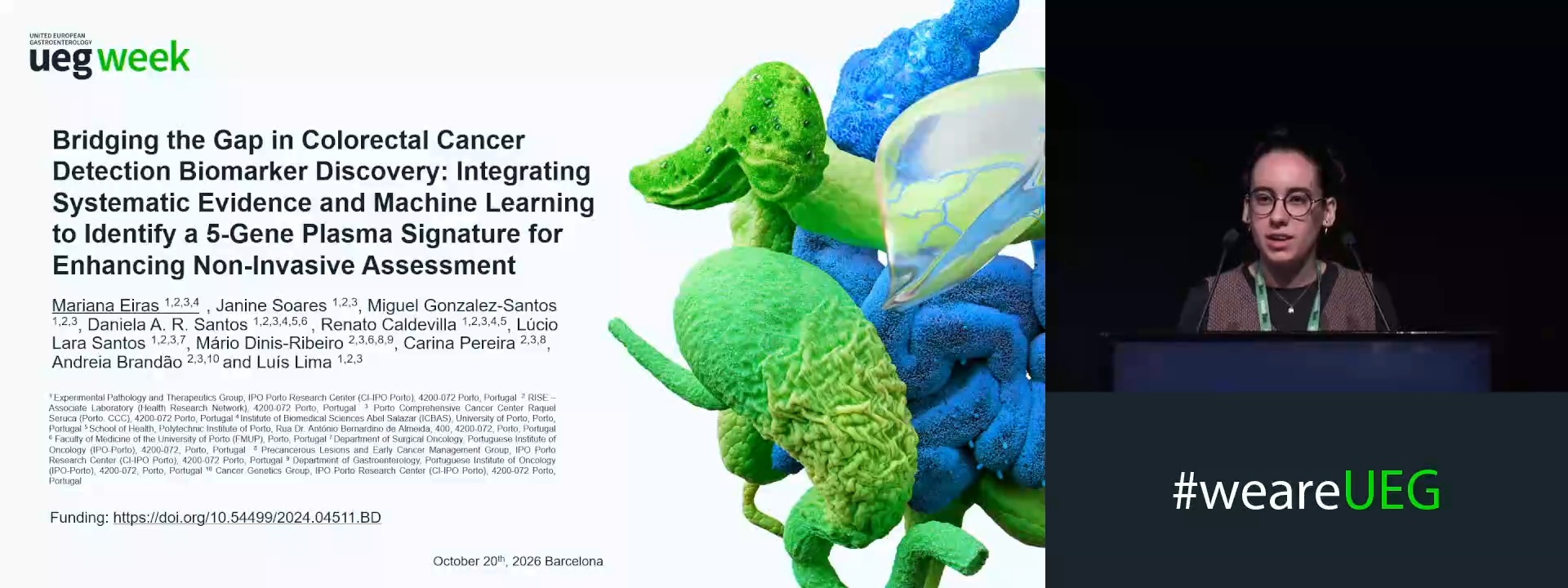
BRIDGING THE GAP IN COLORECTAL CANCER DETECTION BIOMARKER DISCOVERY: INTEGRATING SYSTEMATIC EVIDENCE AND MACHINE LEARNING TO IDENTIFY A 5-GENE PLASMA SIGNATURE FOR ENHANCING NON-INVASIVE ASSESSMENT
Mariana Eiras 1,2,3, Janine Soares 1,2,4, Miguel Gonzalez-Santos 1,2,4, Daniela A. R. Santos 1,5,6, Renato Caldevilla 1,5,6, Lúcio Lara Santos 1,2,7, Mario Dinis-Ribeiro 8,9,10, Ana Carina Pereira 2,11,12, Andreia Brandao 2,11,13, Luis Lima 1,2,4
Affiliations
1 Experimental Pathology and Therapeutics Group, IPO Porto Research Center (CI-IPO Porto), Porto, Portugal
2 Porto Comprehensive Cancer Center Raquel Seruca (Porto. CCC), Porto, Portugal
3 Institute of Biomedical Sciences Abel Salazar (ICBAS), University of
4 RISE – Associate Laboratory (Health Research Network), Porto, Portug
5 Institute of Biomedical Sciences Abel Salazar (ICBAS), University of Porto, Porto, Portugal
6 School of Health, Polytechnic Institute of Porto, Port
7 Department of Surgical Oncology, Portuguese Institute of Oncology (I
8 Precancerous Lesions and Early Cancer Management Group, IPO Porto Research Center (CI‐IPO Porto), Porto, Portugal
9 Department of Gastroenterology, Portuguese Institute of Oncology (IPO-Porto), Porto, Portugal
10 Faculty of Medicine of the University of Po
11 RISE – Associate Laboratory (Health Research Network), Porto, Portugal
12 Precancerous Lesions and Early Cancer Management Group, IPO Porto Research Center (CI‐IPO Porto), Port
13 Cancer Genetics Group, IPO Porto Research Center (CI-IPO Porto), Porto, Portugal
Log in to continue.
This content is part of Gutflix. Log in with your myUEG account, or create one free, to watch it.
Not sure what you can access? Learn more about account types.
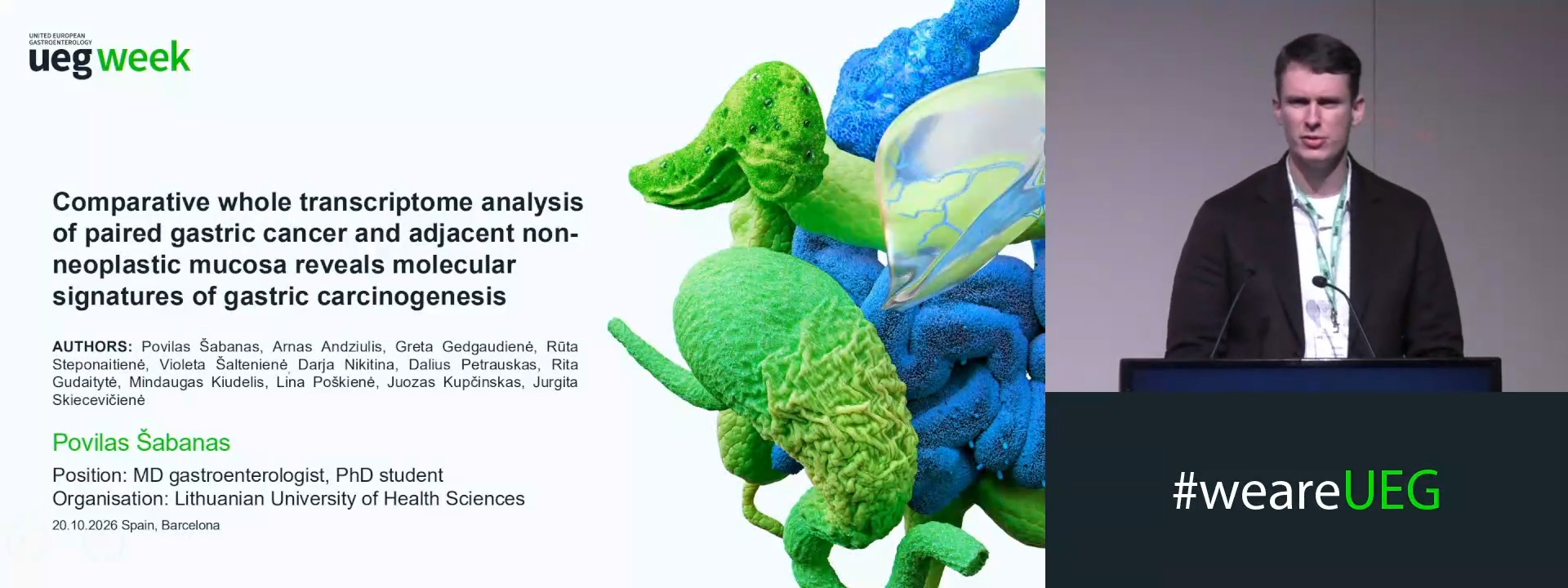
COMPARATIVE WHOLE TRANSCRIPTOME ANALYSIS OF PAIRED GASTRIC CANCER AND ADJACENT NON-NEOPLASTIC MUCOSA REVEALS MOLECULAR SIGNATURES OF GASTRIC CARCINOGENESIS
Povilas Šabanas 1, Arnas Andziulis 1, Greta Gedgaudiene 1, Rūta Steponaitienė 1, Violeta Šaltenienė 1, Darja Nikitina 1, Laimas Virginijus Jonaitis 1, Paulius Jonaitis 1, Dalius Petrauskas 1, Rita Gudaityte 1, Mindaugas Kiudelis 1, Lina Poškienė 1, Juozas Kupcinskas 1
Affiliations
1 Lithuanian University of Health Sciences, Kaunas, Lithuania
Log in to continue.
This content is part of Gutflix. Log in with your myUEG account, or create one free, to watch it.
Not sure what you can access? Learn more about account types.
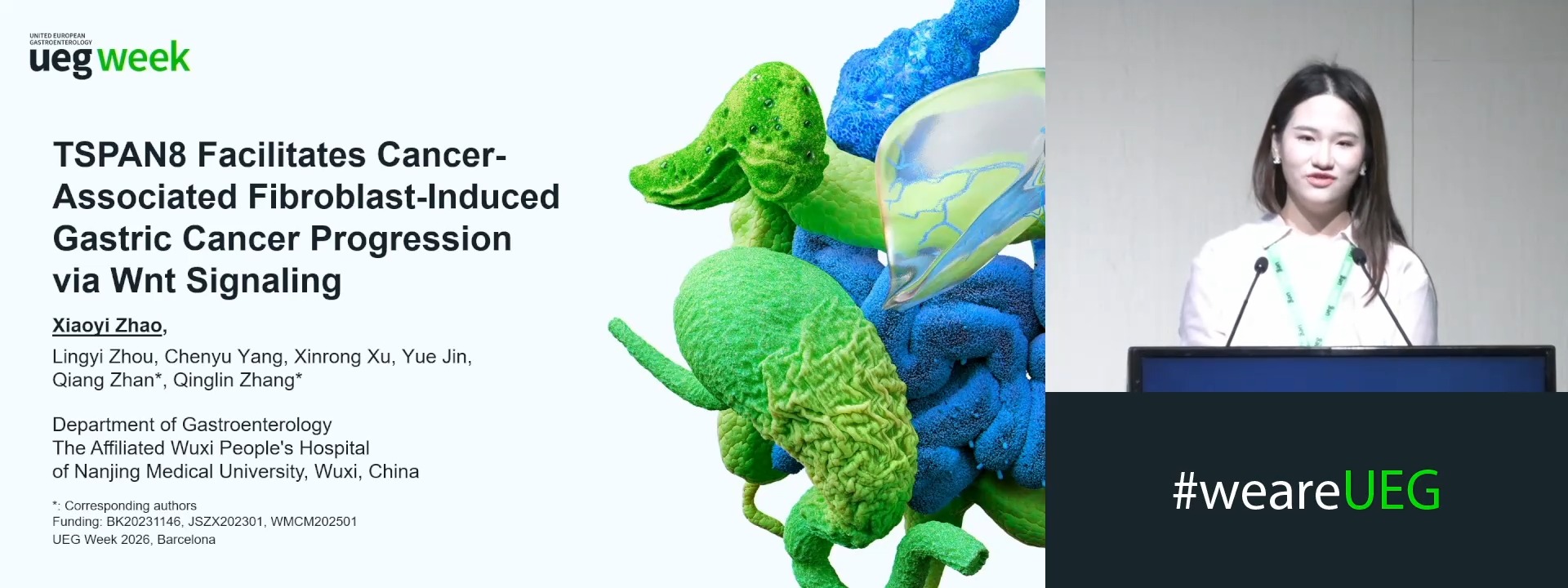
TSPAN8 FACILITATES CANCER-ASSOCIATED FIBROBLAST-INDUCED GASTRIC CANCER PROGRESSION VIA WNT SIGNALING
Affiliations
1 Wuxi People's Hospital Affiliated to Nanjing Medical University, Wuxi, China
Log in to continue.
This content is part of Gutflix. Log in with your myUEG account, or create one free, to watch it.
Not sure what you can access? Learn more about account types.
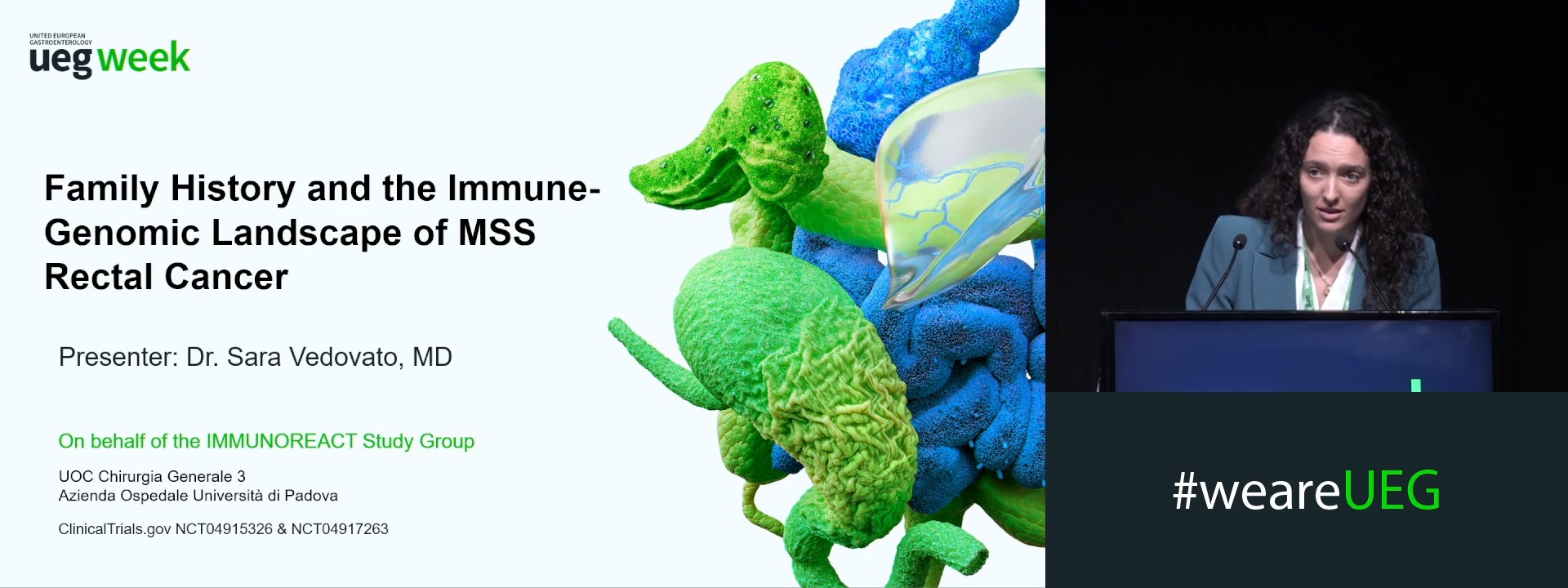
FAMILIAL COLORECTAL CANCER HISTORY IS ASSOCIATED WITH A DISTINCT IMMUNE–GENOMIC PHENOTYPE IN MICROSATELLITE-STABLE RECTAL CANCER: A PROSPECTIVE MULTICENTRE COHORT STUDY
Silvia Negro 1, Melania Scarpa 2, Francesca Galuppini 3, Sara Vedovato 4, Roberta Salmaso 3, Andromachi Kotsafti 2, Valerio Pellegrini 5, Luca Maria Saadeh 4, Antonio Rosato 2, Gaya Spolverato 1, Imerio Angriman 1, Cesare Ruffolo 4, Quoc Riccardo Bao 4, Anna Matteazzi 4, Lorenzo Dell'Atti 6, Dario Gregori 3, Ignazio CASTAGLIUOLO 3, Matteo Fassan 7, Angelo Paolo Dei Tos 3, Marco Scarpa 1
Affiliations
1 DISCOG, University of Padova, Padova, Italy
2 Veneto Institute of Oncology IOV-IRCCS, Padova, Italy
3 University of Padova, Padova, Italy
4 Azienda Ospedale Università di Padova, Padova, Italy
5 AULSS 2 Marca Trevigiana, Treviso, Italy
6 Azienda Unità Sanitaria Locale - IRCCS Reggio Emilia, Reggio Emilia, Italy
7 University of Padova, Treviso, Italy
Log in to continue.
This content is part of Gutflix. Log in with your myUEG account, or create one free, to watch it.
Not sure what you can access? Learn more about account types.
Summary: Advanced colorectal cancer: Previously deadly, now chronic disease
Affiliations
1 AMC, Amsterdam, Netherlands
Log in to continue.
This content is part of Gutflix. Log in with your myUEG account, or create one free, to watch it.
Not sure what you can access? Learn more about account types.
Panel discussion: Advanced colorectal cancer: Previously deadly, now chronic disease