UEG's content platform for gastroenterology education bringing recordings, courses, guidelines, and more together in one place.
Trending on Gutflix
Rate for better recommendations!
Your feedback helps us show you more of what you like and less of what you dislike!
Log in to continue.
This content is part of Gutflix. Log in with your myUEG account, or create one free, to watch it.
Not sure what you can access? Learn more about account types.
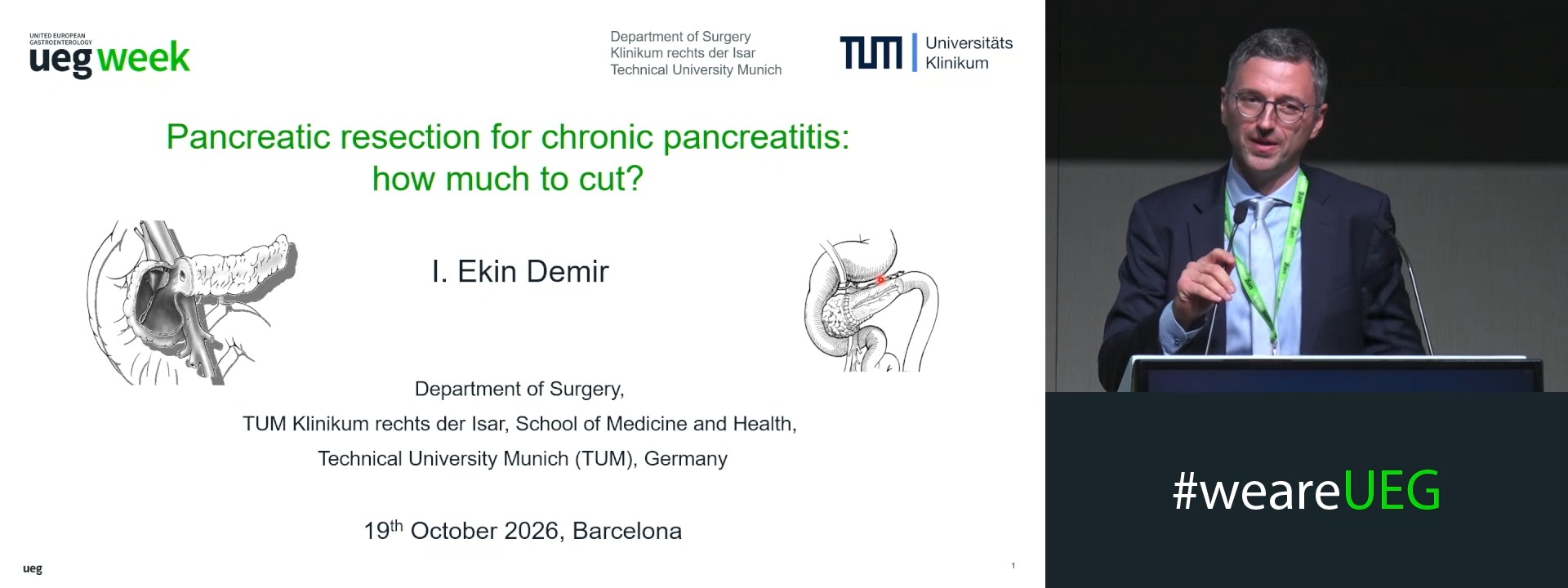
Pancreatic resection: How much to cut?
Affiliations
1 Klinikum Rechts Der Isar, Technical University of Munich, Munich, Germany
Log in to continue.
This content is part of Gutflix. Log in with your myUEG account, or create one free, to watch it.
Not sure what you can access? Learn more about account types.
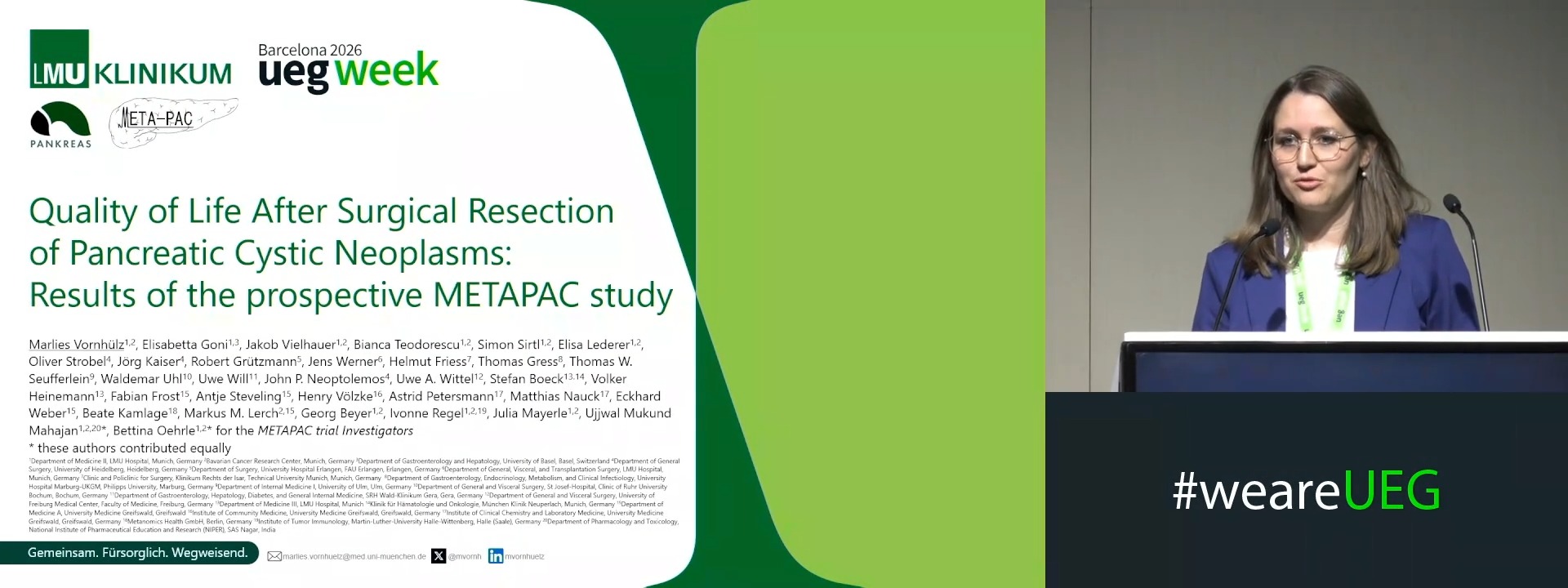
QUALITY OF LIFE AFTER SURGICAL RESECTION OF PANCREATIC CYSTIC NEOPLASMS: RESULTS OF THE PROSPECTIVE METAPAC STUDY
Marlies Vornhuelz 1, Elisabetta Goni 2,1, Jakob Vielhauer 1, Bianca Teodorescu 1, Simon Sirtl 1, Elisa Lederer 1, Oliver Strobel 3, Jörg Kaiser 3, Robert Grützmann 4, Jens Werner 1, Helmut Friess 5, Thomas M. Gress 6, Thomas Seufferlein 7, Waldemar Uhl 8, Uwe Will 9, John P. Neoptolemos 3, Uwe A. Wittel 10, Stefan Boeck 1,11, Unknown Unknown 1, Fabian Frost 12, Antje Steveling 12, Henry Völzke 12, Astrid Petersmann 12, Matthias Nauck 12, Eckhard Weber 12, Beate Kamlage 13, Markus M. Lerch 12,1, Georg Beyer 1, Ivonne Regel 1,14, Julia Mayerle 1, Ujwal Mukund Mahajan 1,15, Bettina Oehrle 1
Affiliations
1 LMU Hospital, Munich, Germany
2 University Digestive Health Care Center Basel-Clarunis, Basel, Switzerlan, Basel, Switzerland
3 University of Heidelberg, Heidelberg, Germany
4 University Hospital Erlangen, Erlangen, Germany
5 Klinikum rechts der Isar, Munich, Germany
6 Philipps Universität Marburg, Marburg, Germany
7 Universitätsklinikum Ulm - Klinik für Innere Medizin I, Ulm, Germany
8 St Josef-Hospital, Clinic of Ruhr University Bochum, Bochum, Germany
9 SRH Wald-Klinikum Gera, Gera, Germany
10 University of Freiburg Medical Center, Freiburg, Germany
11 München Klinik Neuperlach, Munich, Germany
12 University Medicine Greifswald, Greifswald, Germany
13 Metanomics Health GmbH, Berlin, Germany
14 Martin-Luther-University Halle-Wittenberg, Halle (Saale), Germany
15 National Institute of Pharmaceutical Education and Research (NIPER), Nagar, India

Log in to continue.
This content is part of Gutflix. Log in with your myUEG account, or create one free, to watch it.
Not sure what you can access? Learn more about account types.
ERPC
Affiliations
1 Edouardo Herriot University Hospital, Lyon, France