Introduction
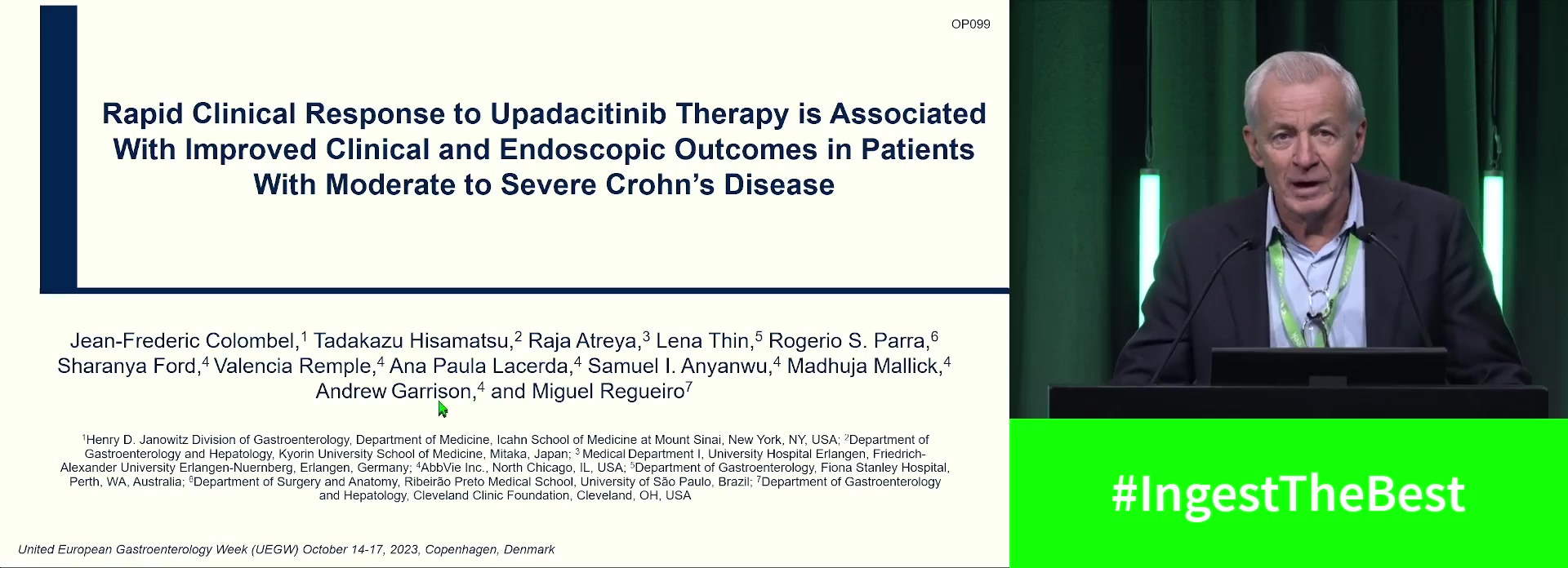
Upadacitinib (UPA) is an oral, selective JAK inhibitor that demonstrated efficacy compared to placebo (PBO) in two induction (U-EXCEED and U-EXCEL) and one maintenance (U-ENDURE) phase 3 studies.1-3 UPA is approved for patients with moderate to severely active Crohn’s disease (CD).4,5 Symptom improvement was seen as early as Day 5-6 with UPA 45 mg (UPA45) compared with PBO, an important treatment target.6,7 Here, we evaluated the effect of achieving early response to UPA45 on clinical and endoscopic outcomes at the end of the induction and maintenance studies.
Aims & Methods
In U-EXCEED and U-EXCEL, patients were randomized (2:1) to UPA45 or PBO for 12 weeks (wks); results from the induction studies were pooled for this post hoc analysis. Clinical responders to 12-wk induction treatment were randomized (1:1:1) to receive UPA 15 mg (UPA15), UPA 30 mg QD (UPA30) or PBO maintenance treatment for 52 wks. Early clinical responders were defined as those patients who achieved a daily very soft/liquid stool frequency (SF) < 3 and daily abdominal pain score (APS) ≤ 1 within the first 15 days and maintained this status for >5 consecutive days until Day 19 (inclusive). Endpoints were assessed at Wk 12 of induction and Wk 52 of maintenance (Table 1). Due to unbalanced patient numbers between PBO and UPA45 in induction, only descriptive analyses were performed.
Results
Of the overall study population1,2, 17.1% (n=115) of UPA-treated and 6.3% (n=22) of PBO-treated patients were early responders. Baseline demographics and characteristics were similar for both populations. Early responders to UPA45 (84.0%) or PBO (81.8%) had higher rates of SF/APS clinical remission at Wk 12 compared with the overall population (45.5% UPA45; 18.2% PBO). At Wk 52, greater SF/APS clinical remission rates were observed during maintenance for early responders treated with UPA15 (54.8%) or UPA30 (71.1%) vs PBO (25.9%); these rates were higher than what was observed for the overall population (33.9% UPA15; 49.3% UPA30, 15.2% PBO). For endoscopic outcomes, early clinical responders treated UPA45 achieved higher rates of endoscopic response (54.1% vs 40.3%), endoscopic remission (36.6% vs 24.2%), and mucosal healing (34.0% vs 21.1%) vs the overall population at Wk 12; this was also seen for PBO-treated early responders (see Table). These high rates of endoscopic remission (36.8%), response (50.0%), and mucosal healing (28.9%) were maintained with UPA30 for early responders at Wk 52 and were numerically greater than the overall population rates or PBO (see Table). When compared to the overall study population,the treatment effects at Wk 52 across clinical and endoscopic outcomes for both doses were generally higher for the early responder population evaluated here.
| | Week 12 of Induction | Week 52 of Maintenance |
| EARLY RESPONDERS | PBO
(N=22)
% [95% CI]d | UPA 45 mg
(N=115)
% [95% CI]d | Difference vs. PBO
% [95% CI]e | PBO
(N=27)
% [95% CI]d | UPA 15 mg
(N=42)
% [95% CI]d | Difference vs. PBO
% [95% CI]e | UPA 30 mg
(N=38)
% [95% CI]d | Difference vs. PBO
% [95% CI]e |
| Endoscopic remissiona | 13.6 [0.0, 28.0] | 36.6 [27.7, 45.4] | 22.9 [6.1, 39.7] | 3.7 [0.0, 10.8] | 28.7 [15.0, 42.5] | 25.0 [9.6, 40.5] | 36.8 [21.5, 52.2] | 33.1 [13.1, 53.2] |
| Endoscopic responseb | 18.2 [2.1, 34.3] | 54.1 [45.0, 63.3] | 35.9 [17.4, 54.5] | 11.1 [0.0, 23.0] | 37.1 [22.3, 51.9] | 26.0 [7.0, 44.0] | 50.0 [34.1, 65.9] | 38.9 [15.9, 61.9] |
| Mucosal healingc | 9.1 [0.0, 21.1] | 34.0 [25.3, 42.7] | 24.9 [10.1, 39.7] | 3.7 [0.0, 10.8] | 21.6 [9.1, 34.1] | 17.9 [3.5, 32.3] | 28.9 [14.5, 43.4] | 25.2 [6.0, 44.5] |
| OVERALL POPULATION | PBO
(N=347)
% [95% CI]d | UPA 45 mg
(N=674)
% [95% CI]d | Difference vs. PBO
% [95% CI]e | PBO
(N=223)
% [95% CI]d | UPA 15 mg
(N=221)
% [95% CI]d | Difference vs. PBO
% [95% CI]e | UPA 30 mg
(N=229)
% [95% CI]d | Difference vs. PBO
% [95% CI]e |
| Endoscopic remissiona | 4.9 [2.6, 7.2] | 24.2 [21.0, 27.4] | 19.4 [15.5, 23.2]*** | 5.4 [2.4, 8.4] | 18.6 [13.5, 23.7] | 13.7 [8.0, 19.5]*** | 30.6 [24.6, 36.6] | 25.2 [18.8, 31.6]*** |
| Endoscopic responseb | 8.4 [5.5, 11.3] | 40.3 [36.6, 44.0] | 32.2 [27.6, 36.7]*** | 7.2 [3.8, 10.6] | 27.3 [21.4, 33.2] | 20.6 [14.1, 27.0]*** | 40.7 [34.4, 47.1] | 33.8 [27.1, 40.4]*** |
| Mucosal healingc | N=345
2.6 [0.9, 4.3] | N=671
21.1 [18.0, 24.2] | 18.5 [15.0, 21.9]*** | N=222
4.6 [1.8, 7.4] | N=219
14.2 [9.6, 18.8] | 9.6 [4.4, 15.0]*** | N=229
25.4 [19.8, 31.1] | 20.8 [14.8, 26.7]*** |
Patient randomization was stratified by baseline corticosteroid use, endoscopic disease severity, and the number of previously failed biologics. All patients within this dataset were included here within the Intention to Treat population.
a. Endoscopic remission: SES-CD ≤ 4, at least a 2-point reduction versus baseline and no subscore >1 in any individual variable
b. Endoscopic response: Decrease in SES-CD > 50% from baseline (or for subjects with a baseline SES-CD of 4, at least a 2-point reduction from baseline)
c. Mucosal healing: SES-CD ulcerated surface subscore = 0 in patients with SES-CD ulcerated surface subscore ≥ 1 at baseline
d. 95% CI for response rate was the synthetic result based on Student's t-distribution from PROC MIANALYZE procedure if there are missing data due to COVID-19 or is based on the normal approximation to the binomial distribution if there are no missing data due to COVID-19.
e. 95% CI for the difference was calculated based on normal approximation to the binomial distribution incorporating the continuity correction for the comparison of two treatment groups. The calculations are based on non-responder imputation incorporating multiple imputation to handle missing data. ***P<0.0001 vs PBO. Due to unbalanced patient numbers between PBO and UPA45 in induction, only descriptive analyses were performed for the early responder population. Confidence Interval, CI; Coronavirus disease 2019, COVID-19; Placebo, PBO; Once daily, QD; Simple Endoscopic Score for Crohn’s Disease, SES-CD; upadacitinib, UPA |
Conclusion
Early clinical responders to upadacitinib therapy had high rates for clinical and endoscopic endpoints at Weeks 12 and 52, suggesting that early symptom improvement with upadacitinib may indicate promising durability in outcomes for patients with CD.
References
1. Colombel, JF et al. Abstract 867f. Gastroenterology [Abstract] 162(7): 2022; S-1394.
2. Loftus, EV Jr. et al. Abstract. United European Gastroenterology Journal. [Abstract] 10: 2022; 103.
3. Panes, J. et al. American Journal of Gastroenterology. [Abstract] 117: 2022. S11.
4. Medicines & Healthcare Products Regulatory Agency. RINVOQ 45 mg prolonged-release tablets (Great Britain). 09 Feb 2023. Retrieved 15 March 2023 from https://www.medicines.org.uk/emc/product/13935/smpc.
5. Annex I: Summary of Product Characteristics (RINVOQ). European Medicines Agency.
24 April 2023. Retrieved 25 April 2023 from https://www.ema.europa.eu/en/documents /product-information/rinvoq-epar-product-information_en.pdf
6. Turner D, et al. Gastroenterology 2021;160:1570–1583.
7. J F Colombel et al, Journal of Crohn's and Colitis. [Abstract] 17: S1 2023; i102–i103.
Disclosure
Jean-Frederic Colombel reports receiving research grants from AbbVie, Janssen Pharmaceuticals and Takeda; receiving payment for lectures from AbbVie, Amgen, Allergan, Inc. Ferring Pharmaceuticals, Shire, and Takeda; receiving consulting fees from AbbVie, Amgen, Arena Pharmaceuticals, Boehringer Ingelheim, BMS, Celgene Corporation, Eli Lilly, Ferring Pharmaceuticals, Galmed Research, Genentech, Glaxo Smith Kline, Janssen Pharmaceuticals, Kaleido Biosciences, Imedex, Immunic, Iterative Scopes, Merck, Microbia, Novartis, PBM Capital, Pfizer, Protagonist Therapeutics, Sanofi, Takeda, TiGenix, Vifor; and hold stock options in Intestinal Biotech Development
Tadakazu Hisamatsu has received research grants from AbbVie, Alfresa Pharma, Daiichi Sankyo, EA Pharma, JIMRO, Kyorin Pharmaceutical, Mitsubishi Tanabe Pharma, Mochida Pharmaceutical, Nippon Kayaku, Pfizer, Takeda, and Zeria Pharmaceutical; consulting fees from AbbVie, Celgene, EA Pharma, Janssen, Nichi-Iko, and Pfizer; and lecture fees from AbbVie, EA Pharma, Janssen, JIMRO, Kyorin Pharmaceutical, Mitsubishi Tanabe Pharma, Mochida Pharmaceutical, Pfizer, and Takeda.
Raja Atreya has been a consultant and/or speaker for AbbVie, Amgen, Arena Pharmaceuticals, Biogen, Boehringer Ingelheim, Bristol-Myers Squibb, Celgene, Celltrion Healthcare, DrFalk Pharma, Ferring, Fresenius Kabi, Galapagos, Gilead, GlaxoSmithKline plc, InDex Pharmaceuticals, Janssen-Cilag, Kliniksa Pharmaceuticals, Lilly, MSD Sharp & Dohme, Novartis, Pandion Therapeutics, Pfizer, Roche Pharma, Samsung Bioepsis, Stelic Institute, Takeda Pharma, Tillotts Pharma AG, Viatris and has received research/educational support from AbbVie, Biogen, InDex Pharmaceuticals, Takeda Pharma, Tillotts Pharma AG.
Lena Thin is an advisory board member for AbbVie; receives advisory board/steering committees fees for education from AbbVie, Takeda, Janssen, Ferring, BMS, Pfizer, Celltrion, Chiesi; receives research grants from Celltrion, Takeda, Pfizer; and is an executive member of the Australian New Zealand IBD consortium.
Rogerio S. Parra has served as a consultant, speaker, and advisory board member for AbbVie, Janssen, Takeda, Ferring, and Pfizer.
Sharanya Ford, Valencia Remple, Ana Paula Lacerda,Samuel I. Anyanwu,Madhuja Mallick, and AndrewGarrisonare employees of AbbVie and may own stock options.
Miguel Regueiro has served as a consultant, speaker, and advisory board member for AbbVie.
Funding: AbbVie funded this study and participated in the study design, research, analysis, data collection, interpretation of data, reviewing, and approval of the publication. All authors had access to relevant data and participated in the drafting, review, and approval of this publication. No honoraria or payments were made for authorship.
Acknowledgments: AbbVie and authors thank all the trial investigators and the patients who participated in this clinical trial. Paulette Krishack, PhD of AbbVie Inc., provided medical writing assistance for the development of this publication.