UEG's educational platform for gastroenterology education bringing recordings, courses, guidelines, and more together in one place.
Most popular content
Rate for better recommendations!
Your feedback helps us show you more of what you like and less of what you dislike!
Log in to access this content.
Free for all myUEG account holders. Your access level is set automatically based on your occupation. Medical professionals get full access to all content. If you are a non-medical user, you can only access UEG Week content from congresses you attended.
Not sure what you can access? Learn more about account types.
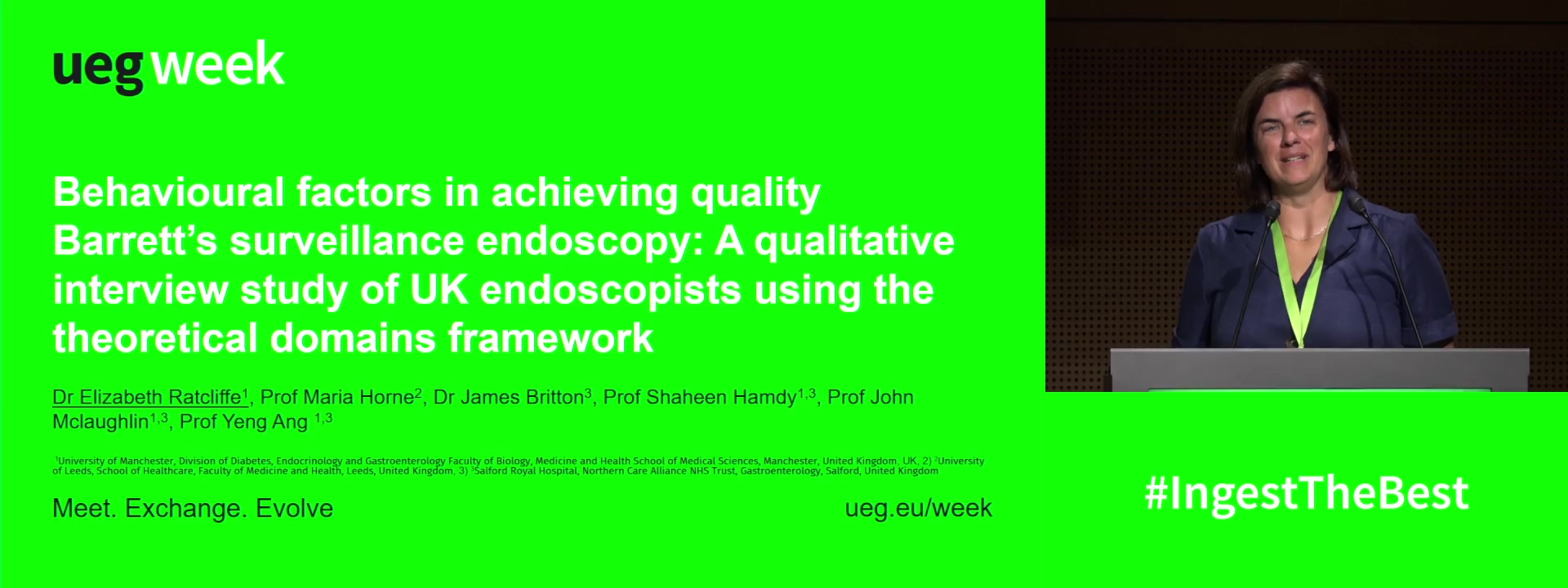
BEHAVIOURAL FACTORS IN ACHIEVING QUALITY BARRETT’S SURVEILLANCE ENDOSCOPY: A QUALITATIVE INTERVIEW STUDY OF UK ENDOSCOPISTS USING THE THEORETICAL DOMAINS FRAMEWORK
Elizabeth Ratcliffe 1, Maria Horne 2, James Britton 3, Shaheen Hamdy 4, John McLaughlin 5, Yeng Ang 6
1 University of Manchester, Manchester, United Kingdom
2 University of Leeds, Leeds, United Kingdom
3 Salford Royal Hospital, Northern Care Alliance NHS Trust, Salford, United Kingdom
4 Salford Royal Hospital, Salford, United Kingdom
5 University of Manchester Salford Royal Hospital Gastrointestinal Centre, Manchester, United Kingdom
6 Salford Royal NHS Foundation, Salford, United Kingdom
Event
Topics
Submission format
Citation
Published
Log in to access this content.
Free for all myUEG account holders. Your access level is set automatically based on your occupation. Medical professionals get full access to all content. If you are a non-medical user, you can only access UEG Week content from congresses you attended.
Not sure what you can access? Learn more about account types.
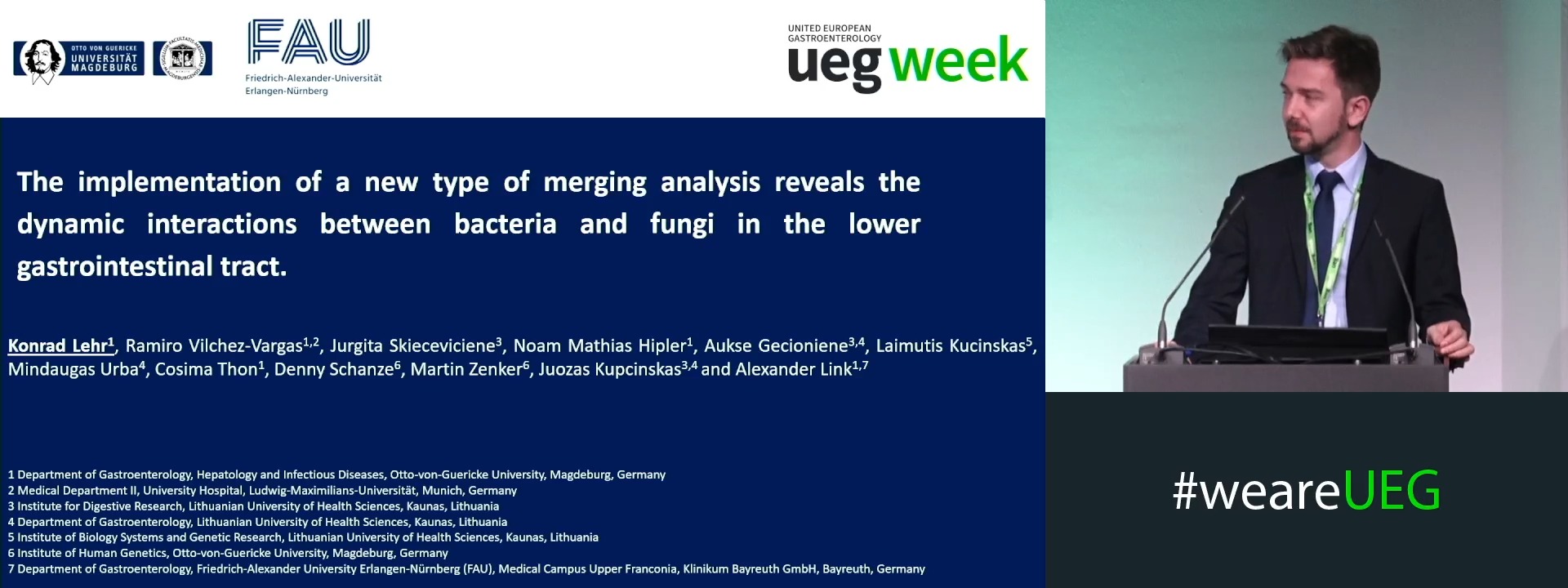
THE IMPLEMENTATION OF A NEW TYPE OF MERGING ANALYSIS REVEALS THE DYNAMIC INTERACTIONS BETWEEN BACTERIA AND FUNGI IN THE LOWER GASTROINTESTINAL TRACT
Konrad Lehr 1, Ramiro Vilchez-Vargas 2, Jurgita Skieceviciene 3, Noam Hipler 1, Aukse Gecioniene 4, Laimutis Kucinskas 3, Mindaugas Urba 3, Cosima Thon 1, Denny Schanze 1, Unknown Unknown 1, Juozas Kupcinskas 4, Alexander Link 1
1 Otto-von-Guericke University, Magdeburg, Germany
2 Otto-von-Guericke University, Magdeburg, Germany|||Ludwig-Maximilians-University, Munich, Germany
3 Lithuanian University of Health Sciences, Kaunas, Lithuania
4 Lithuanian University of Health Sciences, Kaunas, Lithuania|||Lithuanian University of Health Sciences, Kaunas, Lithuania
Event
Topics
Submission format
Citation
Published
Log in to access this content.
Free for all myUEG account holders. Your access level is set automatically based on your occupation. Medical professionals get full access to all content. If you are a non-medical user, you can only access UEG Week content from congresses you attended.
Not sure what you can access? Learn more about account types.

CHANGES IN GENE EXPRESSION IN MULTIPLEX IBD FAMILIES, CONSEQUENCES OF SHARED HOUSEHOLD: A MULTIPLEX IBD FAMILY STUDY
Tone Bergene Aabrekk 1, Geir Aamodt 2, Trond Espen Detlie 3, Marte Lie Høivik 4, Vendel Ailin Kristensen 5, Petr Ricanek 6, Baoyan Bai 3, Tone Møller Tannæs 3, Yvonne Böttcher 7, May-Bente Bengtson 8
1 University of Oslo, Oslo, Norway|||Vestfold Hospital Trust, Tønsberg, Norway
2 Norwegian University of Life Sciences, Ås, Norway
3 Akershus University Hospital, Lørenskog, Norway
4 Oslo University Hospital, Oslo, Norway|||University of Oslo, Oslo, Norway
5 University of Oslo, Oslo, Norway|||Oslo University Hospital, Oslo, Norway
6 Lovisenberg Diaconal Hospital, Oslo, Norway
7 University of Oslo, Oslo, Norway|||Akershus University Hospital, Lørenskog, Norway
8 Vestfold Hospital Trust, Tønsberg, Norway
Conference
Topics
Submission format
Session
Citation
Published
Log in to access this content.
Free for all myUEG account holders. Your access level is set automatically based on your occupation. Medical professionals get full access to all content. If you are a non-medical user, you can only access UEG Week content from congresses you attended.
Not sure what you can access? Learn more about account types.
FROM DYSLIPIDEMIA TO MASLD: ZONULIN AS A MISSING LINK
Khrystyna Kvit 1, Nataliia Kharchenko 2, Eugene Skyarov 3, Volodymyr Prystai 3, Victoriya Kischak 4, Marta Yakymiv 4
1 Danylo Halytsky Lviv National Medical University, Lviv, Ukraine
2 Shupyk National Healthcare University of Ukraine, Kyiv, Ukraine
3 Damylo Halytsky Lviv National Medical University, Lviv, Ukraine
4 Gastrolife Clinic, Lviv, Ukraine
Conference
Topics
Submission format
Session
Citation
Published
Log in to access this content.
Free for all myUEG account holders. Your access level is set automatically based on your occupation. Medical professionals get full access to all content. If you are a non-medical user, you can only access UEG Week content from congresses you attended.
Not sure what you can access? Learn more about account types.
REVALUATING THE CLINICAL COURSE OF AMA-POSITIVE PATIENTS WITH NORMAL LIVER ENZYMES: A LARGE RETROSPECTIVE COHORT STUDY
1 Emek Medical Center, Afula, Israel
2 Hillel Yaffe Medical Center, Hadera, Israel
3 Clalit Health Services, Afula, Israel
4 Assuta medical center, Ashkelon, Israel
5 Clalit Health Services, Nof Haglil, Israel
Conference
Topics
Submission format
Session
Citation
Published
Log in to access this content.
Free for all myUEG account holders. Your access level is set automatically based on your occupation. Medical professionals get full access to all content. If you are a non-medical user, you can only access UEG Week content from congresses you attended.
Not sure what you can access? Learn more about account types.
EFFECT OF A HISTAMINE RICH MEAL VERSUS A LOW HISTAMINE MEAL ON URINARY HISTAMINE AND N-METHYLHISTAMINE EXCRETION
1 KU Leuven, Leuven, Belgium
2 UZ Leuven, Leuven, Belgium
3 University of Leuven, University Hospital Gasthuisberg, Leuven, Belgium
Conference
Topics
Submission format
Session
Citation
Published
Log in to access this content.
Free for all myUEG account holders. Your access level is set automatically based on your occupation. Medical professionals get full access to all content. If you are a non-medical user, you can only access UEG Week content from congresses you attended.
Not sure what you can access? Learn more about account types.
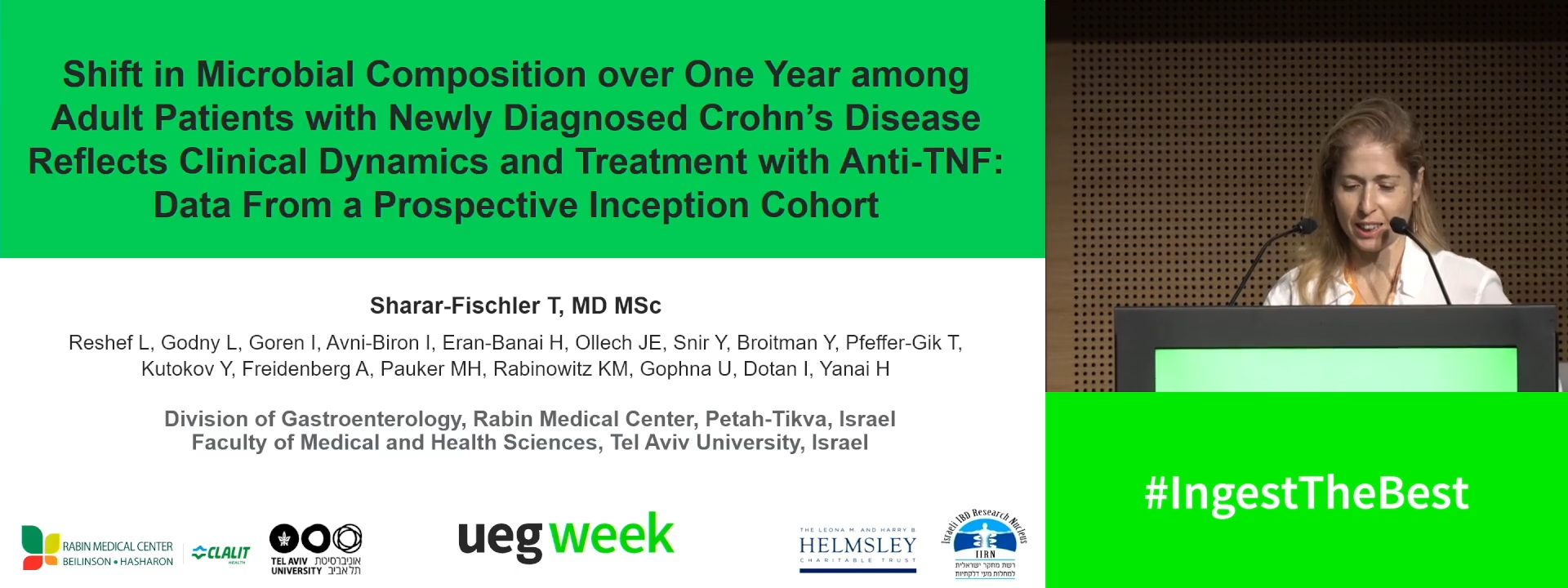
SHIFT IN MICROBIAL COMPOSITION OVER ONE-YEAR AMONG PATIENTS WITH NEWLY DIAGNOSED CROHN’S DISEASE REFLECTS CLINICAL DYNAMICS AND TREATMENT WITH ANTI-TNF: DATA FROM A PROSPECTIVE REAL-WORLD STUDY
Tali Sharar Fischler 1, Leah Reshef 2, Lihi Godny 1, Adi Friedeberg 1, Maor Pauker 1, Keren M Rabinowitz 3, Irit Avni-Biron 1, Uri Gophna 2, Iris Dotan 1, Henit Yanai 1
1 Rabin Medical Center, Petah Tikva, Israel|||Tel Aviv University, Tel Aviv, Israel
2 Tel Aviv University, Tel Aviv, Israel
3 Rabin Medical Center, Petah Tikva, Israel
Event
Topics