UEG's content platform for gastroenterology education bringing recordings, courses, guidelines, and more together in one place.
Trending on Gutflix
Rate for better recommendations!
Your feedback helps us show you more of what you like and less of what you dislike!
Log in to continue.
This content is part of Gutflix. Log in with your myUEG account, or create one free, to watch it.
Not sure what you can access? Learn more about account types.
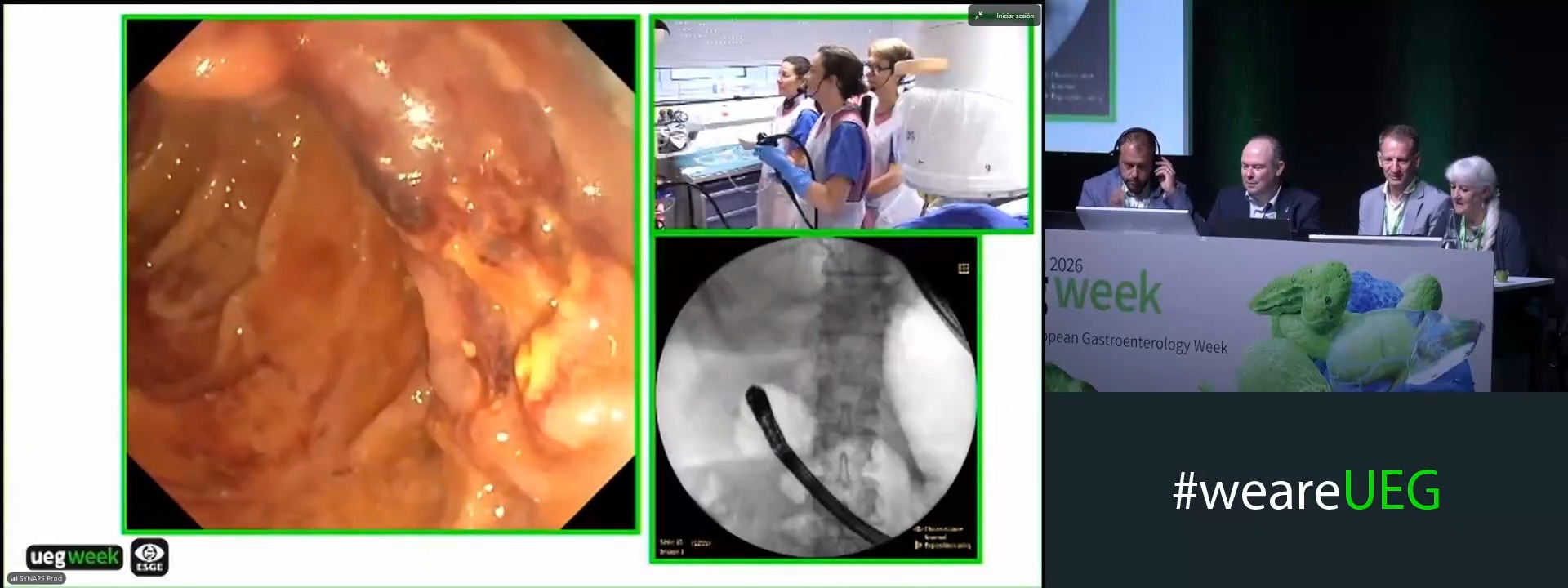
ESGE live endoscopy II (Complete Session)
Log in to continue.
This content is part of Gutflix. Log in with your myUEG account, or create one free, to watch it.
Not sure what you can access? Learn more about account types.
Radiological assessment of response for organ preservation: Can ctDNA help in early stage?
Affiliations
1 Centre Hospitalier Universitaire de Poitiers, Poitiers, France
2 School of Medicine, National & Kapodistrian University of Athens, Athens, Greece
Log in to continue.
This content is part of Gutflix. Log in with your myUEG account, or create one free, to watch it.
Not sure what you can access? Learn more about account types.
PROSPECTIVE VALIDATION OF AN ALGORITHMIC TOOL TO SAFELY CEASE ANTI-TUMOR NECROSIS FACTOR THERAPY IN CROHN’S DISEASE: A STEPPED WEDGE CLUSTER RANDOMIZED TRIAL
Mees van der Hoff 1, Jonne Staal 2, Doranne Thomassen 3, Marjolijn Duijvestein 4, Monique Devillers 2, Djuna C de Jong 1, Marijn C. Visschedijk 5, Petra van Boeckel 6, Frank Wolfhagen 7, Alexander Bodelier 8, Rachel West 9, Sander van der Marel 10, Janneke Wonders 11, Jeroen P.W. Maljaars 3, Simone Wolfkamp 12, Wout Mares 13, Tessa E.H. Römkens 14, Rosalie C. Mallant-Hent 15, Adriaan Tan 16, Esmerij van der Zanden 17, Dirk van Asseldonk 18, Greetje Tack 19, Stella C M Heemskerk 2, Suzanne Polinder 2, Marcel G. W. Dijkgraaf 20, Ewout Steyerberg 3, C. Janneke van der Woude 2, Geert R. D'Haens 1, Annemarie de Vries 2
Affiliations
1 Amsterdam UMC, Amsterdam, Netherlands
2 Erasmus MC, Rotterdam, Netherlands
3 LUMC, Leiden, Netherlands
4 Radboudumc, Nijmegen, Netherlands
5 UMC Groningen, Groningen, Netherlands
6 St. Antonius Hospital, Nieuwegein, Netherlands
7 Albert Schweitzer Hospital, Dordrecht, Netherlands
8 Amphia Hospital, Breda, Netherlands
9 Sint Franciscus Gasthuis, Rotterdam, Netherlands
10 Haaglanden MC, Den Haag, Netherlands
11 Haga Hospital, Den Haag, Netherlands
12 OLVG, Amsterdam, Netherlands
13 Gelderse Vallei Hospital, Ede, Netherlands
14 Jeroen Bosch Hospital, 's-Hertogenbosch, Netherlands
15 Flevo Hospital, Almere, Netherlands
16 Canisius Wilhelmina Hospital, Nijmegen, Netherlands
17 Amstelland Hospital, Amstelveen, Netherlands
18 Noordwest Ziekenhuisgroep, Alkmaar, Netherlands
19 Frisius MC, Leeuwarden, Netherlands
20 University of Amsterdam, Amsterdam, Netherlands
Log in to continue.
This content is part of Gutflix. Log in with your myUEG account, or create one free, to watch it.
Not sure what you can access? Learn more about account types.
USE AND PERSISTENCE OF INFLIXIMAB (IV AND SC) IN FRANCE BETWEEN 2021 AND 2024: THE RIPOSTE IBD NATIONWIDE POPULATION-BASED COHORT STUDY
Julien Kirchgesner 1, Stephane NANCEY 2, Nathalie Quiles 3, Clément Prati 4, Lucile Foulley 5, Caroline Habauzit 5, Salim Benkhalifa 5, Laura Pina Vegas 6
Affiliations
1 Saint-Antoine Hospital - Department of Gastroenterology, Paris, France
2 CHU Lyon, Pierre Benite, France
3 Hopital Saint Joseph, Marseille, France
4 Centre Hospitalier Universitaire Hôpital Jean Minjoz, Besançon, France
5 Celltrion Healthcare France, Issy Les Moulineaux, France
6 Hôpital Henri Mondor, Créteil, France
Log in to continue.
This content is part of Gutflix. Log in with your myUEG account, or create one free, to watch it.
Not sure what you can access? Learn more about account types.
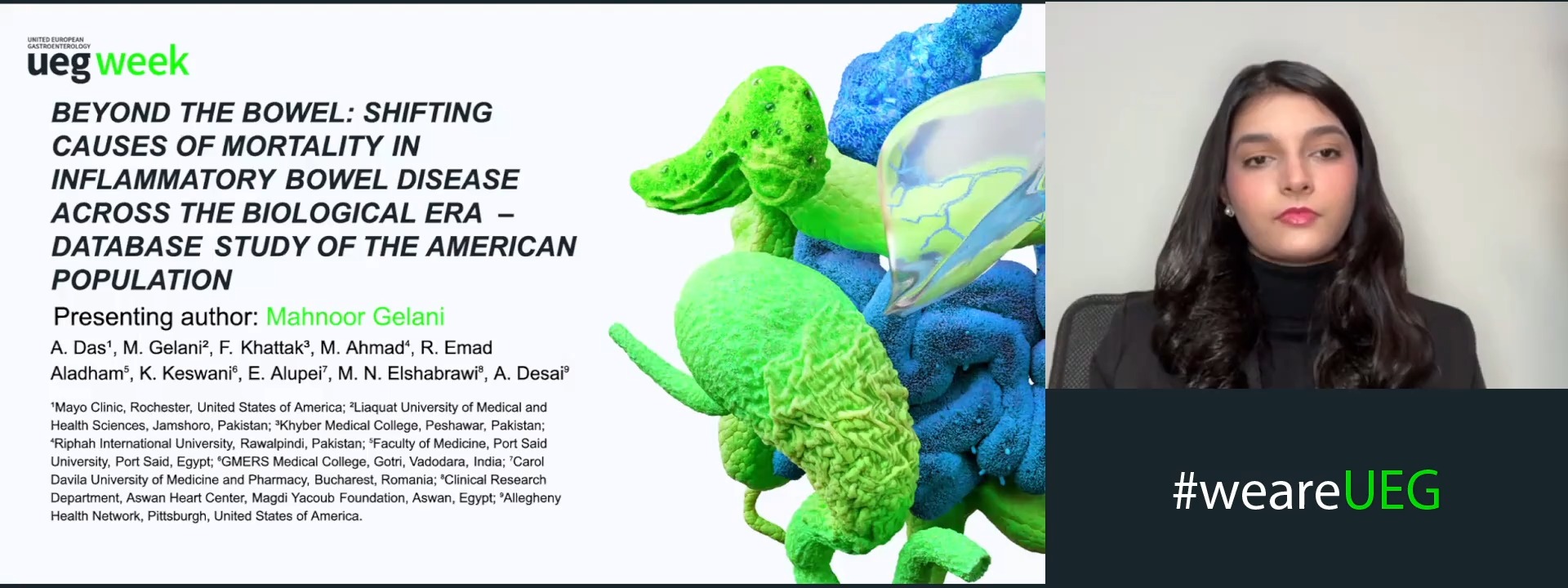
BEYOND THE BOWEL: SHIFTING CAUSES OF MORTALITY IN INFLAMMATORY BOWEL DISEASE ACROSS THE BIOLOGIC ERA - DATABASE STUDY OF AMERICAN POPULATION (1990–2025)
Ashesh Das 1, Mahnoor Gelani 2, Fazia Khattak 3, Mahad Ahmad 4, Rovan Emad Aladham 5, Krish Keswani 6, Elena Alupei 7, Mohamed Nasser Elshabrawi 8, Aakash Desai 9
Affiliations
1 Mayo Clinic, Rochester, United States
2 Liaquat University of Medical and Health Science, Jamshoro, Pakistan
3 Khyber Medical College, Peshawar, Pakistan
4 Riphah International University, Rawalpindi, Pakistan
5 Faculty of Medicine Port Said University, Port Said, Pakistan
6 GMERS Medical College, Gotri, Vadodara, India
7 Carol Davila University of Medicine and Pharmacy, Bucharest, Romania
8 Clinical Research Department, Aswan Heart Center, Magdi Yaqoup Foundation, Aswan, Egypt
9 Allegheny Health Network, Pittsburgh, United States
Log in to continue.
This content is part of Gutflix. Log in with your myUEG account, or create one free, to watch it.
Not sure what you can access? Learn more about account types.
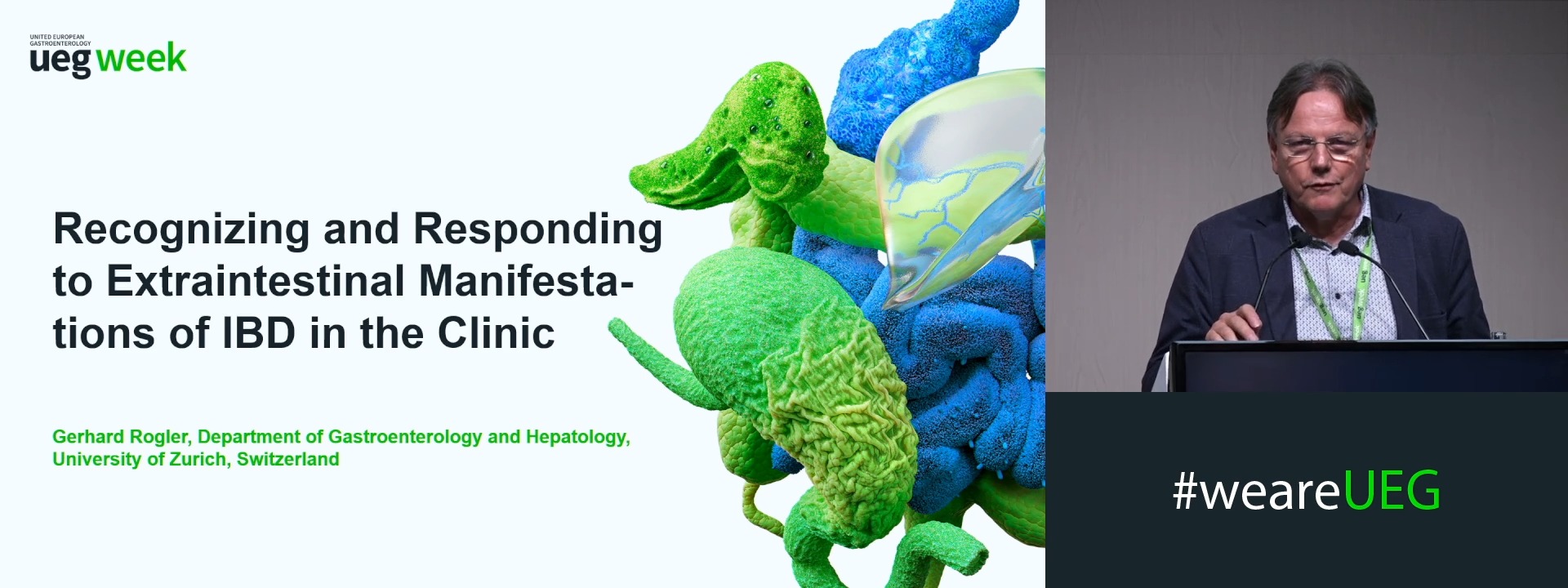
Recognising and responding to extraintestinal manifestations of IBD in the clinic
Affiliations
1 UniversitätsSpital Zürich, Zurich, Switzerland