UEG's educational platform for gastroenterology education bringing recordings, courses, guidelines, and more together in one place.
Most popular content
Rate for better recommendations!
Your feedback helps us show you more of what you like and less of what you dislike!
Log in to access this content.
Free for all myUEG account holders. Your access level is set automatically based on your occupation. Medical professionals get full access to all content. If you are a non-medical user, you can only access UEG Week content from congresses you attended.
Not sure what you can access? Learn more about account types.
Introduction
Tofacitinib, filgotinib, and upadacitinib, are Janus kinase inhibitors (iJAKs) approved for inflammatory bowel disease (IBD) treatment. Although no direct comparative studies exist, potential differences in efficacy and safety are attributed to in vitro-demonstrated affinity of each molecule for different JAK isoforms. JAK1 plays a crucial role in modulating cytokine-mediated immune responses, such as IL-6 and interferon, which are involved in inflammation and skin homeostasis. Its inhibition can promote conditions that may trigger acne.
Acne may be increased in iJAK-treated patients, meaning a clinical challenge for gastroenterologists.
Aims & Methods
A retrospective study was conducted at ten referral centers in Spain, including all IBD patients who had received iJAK therapy and had at least 3 months of follow-up. Demographic data, disease-related variables, and acne characteristics when appropriate, were collected. Univariate and multivariate logistic regressions were used to identify risk factors for acne; model discrimination was assessed by AUC.
Results
A total of 549 patients included: 258 (47%) were women; 354 (64%) had ulcerative colitis, 191 (35%) had Crohn’s disease and 1% had indeterminate colitis. Mean age was 41 years (IQR 30-52). 219 patients (40%) were treated with tofacitinib, 281 (51%) with upadacitinib, and 49 (9%) with filgotinib.
Ninety patients (16%) developed acne during iJAK treatment: 69% were mild, with only 4 severe cases (4%). Acne occurred early (median onset 42 days, IQR 7-122), predominantly on the face (56%), trunk (13%) or both (31%). Acne morphology included comedones (60%), papules (59%), pustules (39%), nodular-cystic (12%), scarring (9%); 48% showed more than one morphology.
Thirty-six patients received specific acne treatment: 89% topical (antiseptics, benzoyl peroxide, retinoids), 69% systemic (antibiotics, retinoids, antiandrogens), and 44% combined treatment. 83% of those patients responded to acne specific treatment, and only 8 patients (9% of those with acne; 1.5% overall) had to discontinue iJAK treatment, with acne resolving in all cases.
Acne developed in 26%, 6% and 6% of upadacitinib, tofacitinib and filgotinib treated patients respectively (p=0.001). Multivariate analysis showed that acne development was associated with upadacitinib (OR 10.28;IC95%=4,7–22,6; p<0,001) and history of acne (OR 3.52; IC95%=1,5–8,3; p=0,004), while older age (>35 years, OR 0.31; IC95% 0,11–0,83; p=0,02) and Crohn’s disease (OR 0.47; IC95% 0,25–0,90; p=0,02) showed to be protective. This model was reliable in predicting acne development (AUC 0.79). Additionally, univariate analysis showed high dose of iJAK was also associated with acne development, which could not be confirmed in multivariate analysis.
Conclusion
Acne occurred in a relevant proportion of iJAK-treated patients, was generally mild and manageable with dermatological care, and rarely required treatment discontinuation. Risk factors for iJAK-associated acne included use of upadacitinib (probably reflecting a greater affinity for JAK1) and history of acne, while older age and Crohn’s disease were protective.
Gastroenterologists should be aware of both likelihood and management of this specific adverse event when considering iJAK therapy.
Disclosure
Y G-L, MC, GB, ER, IB, DC, M B-dA, LM, I M-J, DG, IV have provided scientific advisory / participated in educational activities / received unrestricted research grants / received payments for lecturing from Johnson & Johnson, Takeda, Pfizer, Amgen, AbbVie, Lilly, AlfaSigma, Ferring, Gilead.

INCIDENCE, RISK FACTORS, AND MANAGEMENT OF ACNE IN IBD PATIENTS TREATED WITH JAK INHIBITORS: A MULTICENTER RETROSPECTIVE COHORT STUDY ON 549 PATIENTS (THE JAKNE PROJECT)
Iago González Lama 1, Marta Isabel Calvo Moya 2, Fernado Alfageme 2, Guillermo Bastida Paz 3, Ignacio Omella 4, María del Sol Porto-Silva 5, Elena Ricart 6, Marta Poncela 7, Eduardo Iyo Miyashiro 8, María Hernández Pérez 9, ISABEL BLAZQUEZ GOMEZ 10, Lucía Guerrero 1, Shanshan Wang 2, Victoria Ortiz 2, Victoria Marturano 3, Daniel Sebastian Ceballos Santos 4, Manuel Barreiro de Acosta 5, Andrés de la Peña 8, Susana Tabernero Da Veiga 9, David Rafael de la Cruz Esteban 1, Paula Gutierrez Landaluce 2, Tamara Azar 3, Pablo Vázquez García 4, Laura Nieto-Garcia 5, Ignacio Marín-Jiménez 7, Daniel Ginard 8, Laura Cudero 1, Maria Isabel Vera Mendoza 2
1 12 de Octubre University Hospital, Madrid, Spain
2 Hospital Universitario Puerta de Hierro Majadahonda, Madrid, Spain
3 Hospital La Fe, Valencia, Spain
4 Doctor Negrín University Hospital, Las Palmas, Spain
5 Hospital Clínico Universitario, Santiago de Compostela, Spain
6 Hospital Clinic, Barcelona, Spain
7 Gregorio Marañón General University Hospital, Madrid, Spain
8 Hospital Son Espases, Palma de Mallorca, Spain
9 Príncipe de Asturias University Hospital, Alcalá de Henares, Spain
10 Hospital Torrejon De Ardoz, Torrejon de Ardoz, Spain
Conference
Topics
Submission format
Citation
Published
Log in to access this content.
Free for all myUEG account holders. Your access level is set automatically based on your occupation. Medical professionals get full access to all content. If you are a non-medical user, you can only access UEG Week content from congresses you attended.
Not sure what you can access? Learn more about account types.
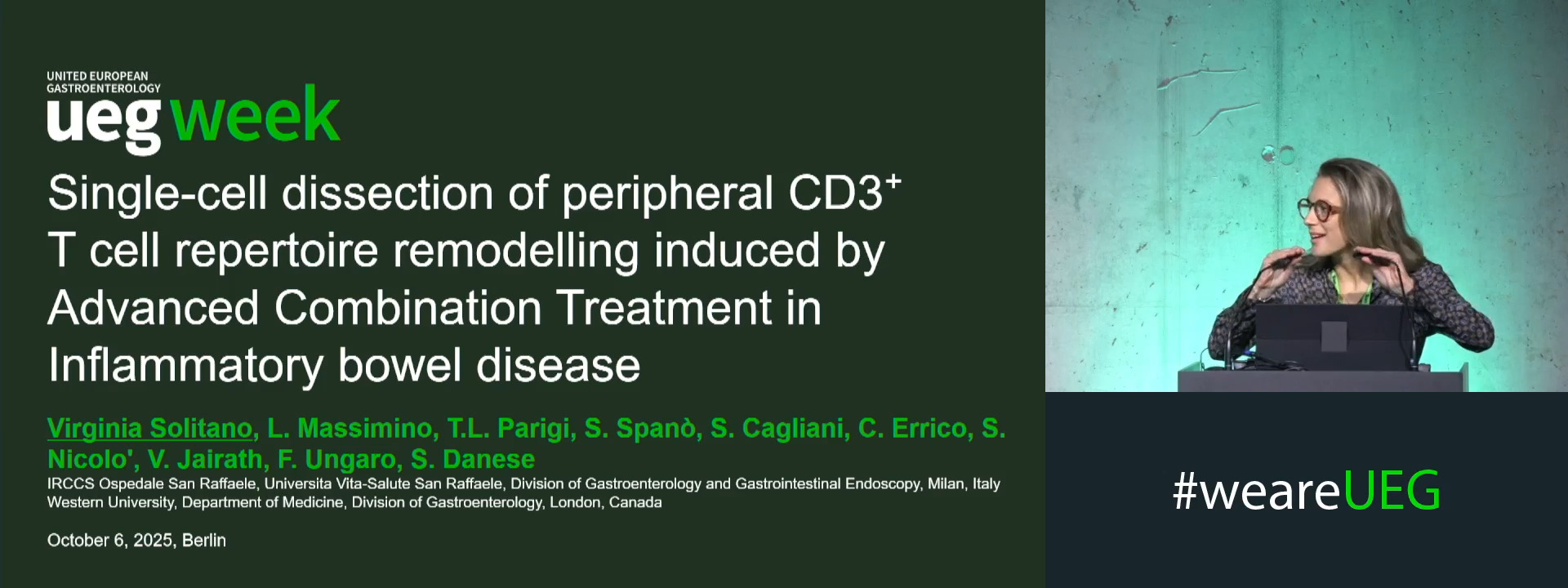
SINGLE-CELL DISSECTION OF PERIPHERAL CD3⁺ T CELL REPERTOIRE REMODELING INDUCED BY ADVANCED COMBINATION TREATMENT IN INFLAMMATORY BOWEL DISEASE
VIRGINIA SOLITANO 1, Luca Massimino 1, Tommaso Lorenzo Parigi 1, Salvatore Spanò 1, Stefania Cagliani 1, Carmela Errico 1, Sabrina Nicolo' 1, Vipul Jairath 2, Federica Ungaro 1, Silvio Danese 1
1 IRCCS Ospedale San Raffaele, Universita Vita-Salute San Raffaele, Milan, Italy
2 Western University, London, Canada
Event
Submission format
Citation
Published
Log in to access this content.
Free for all myUEG account holders. Your access level is set automatically based on your occupation. Medical professionals get full access to all content. If you are a non-medical user, you can only access UEG Week content from congresses you attended.
Not sure what you can access? Learn more about account types.
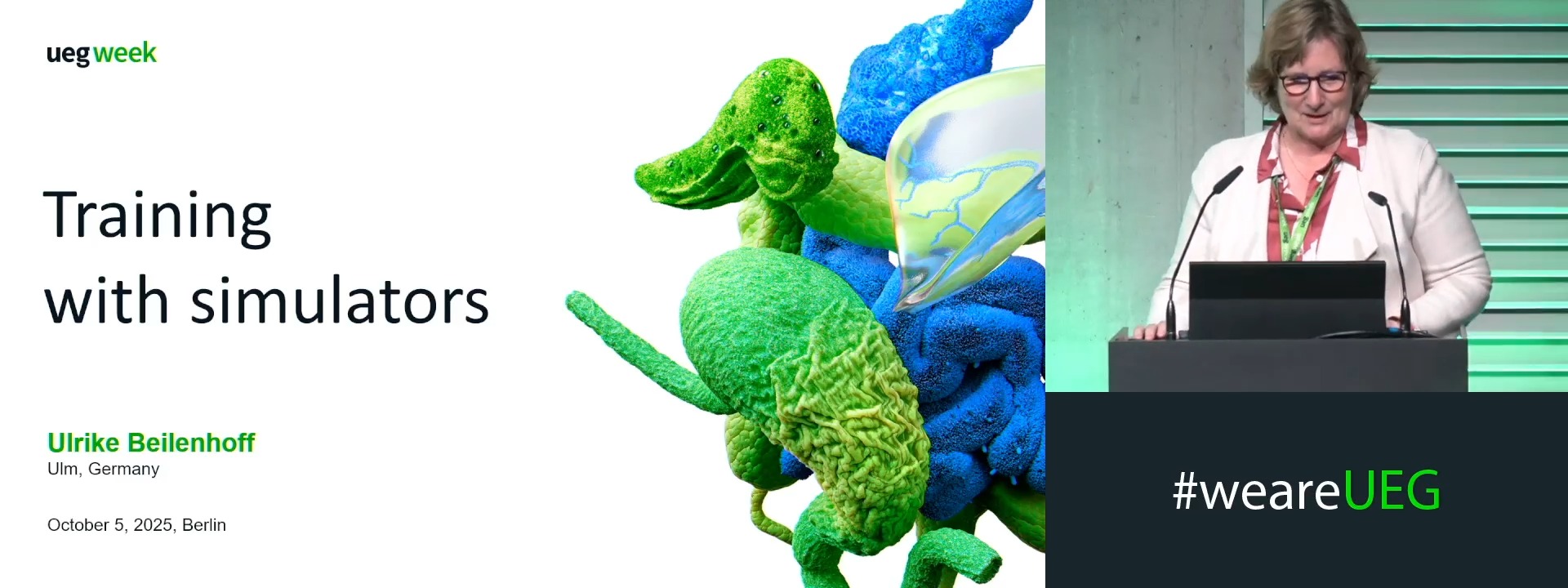
Training with simulators
1 ESGENA Scientific Secretary, Ulm, Germany
Event
Topics
Citation
Published
Log in to access this content.
Free for all myUEG account holders. Your access level is set automatically based on your occupation. Medical professionals get full access to all content. If you are a non-medical user, you can only access UEG Week content from congresses you attended.
Not sure what you can access? Learn more about account types.
QUANTITATIVE HISTOLOGIC FEATURES OF THE INFLAMMATORY MICROENVIRONMENT IN PATIENTS WITH ULCERATIVE COLITIS ASSOCIATE WITH ENDOSCOPIC RESPONSE TO UPADACITINIB AT INDUCTION
John Shamshoian 1, Neel Patel 2, Sandrine Degryse 1, Jacqueline Brosnan-Cashman 1, Lara Murray 1, Christina Jayson 1, Kevin Kolahi 3, Jan-Renier Moonen 3, Aditee Shrotre 3, Xiao Zhou 3, Patrick Caplazi 3, Steven Chirieleison 3, Stephen Laroux 4
1 PathAI, Boston, United States
2 PathAI at time of submission, Boston, United States
3 AbbVie, South San Francisco, United States
4 AbbVie, Worcester, United States
Conference
Topics
Submission format
Citation
Published

Log in to access this content.
Free for all myUEG account holders. Your access level is set automatically based on your occupation. Medical professionals get full access to all content. If you are a non-medical user, you can only access UEG Week content from congresses you attended.
Not sure what you can access? Learn more about account types.
How to define the hot spots?
1 Radboudumc, Nijmegen, Netherlands
Event
Session
Citation
Published
Log in to access this content.
Free for all myUEG account holders. Your access level is set automatically based on your occupation. Medical professionals get full access to all content. If you are a non-medical user, you can only access UEG Week content from congresses you attended.
Not sure what you can access? Learn more about account types.
ENDOSCOPIC CHARACTERISTICS OF LOCAL TUMOR REGROWTH IN PATIENTS UNDERGOING WATCH-AND-WAIT AFTER NEOADJUVANT THERAPY FOR RECTAL CANCER
Sylwester Szczegielniak 1, Peter Thelin Schmidt 2, Patrik Lundström 1, Charlotte Höög 1, Per J. Nilsson 1, Anna Martling 3, Stephan L. Haas 4
1 Karolinska University Hospital, Stockholm, Sweden
2 Uppsala University Hospital, Uppsala, Sweden
3 Karolinska Institutet, Stockholm, Sweden
4 Karolinska University Hospital and Department of Medicine, Karolinska Institutet, Stockholm, Sweden
Conference
Topics
Submission format
Session
Citation
Published

Log in to access this content.
Free for all myUEG account holders. Your access level is set automatically based on your occupation. Medical professionals get full access to all content. If you are a non-medical user, you can only access UEG Week content from congresses you attended.
Not sure what you can access? Learn more about account types.
EFFICACY AND SAFETY OF SUBCUTANEOUS GUSELKUMAB INDUCTION AND MAINTENANCE THERAPY IN PARTICIPANTS WITH ULCERATIVE COLITIS: RESULTS THROUGH WEEK 48 FROM THE PHASE 3 ASTRO STUDY
Jessica Allegretti 1, Laurent Peyrin-Biroulet 2, Millie Long 3, Matthew Germinaro 4, Thomas Baker 4, Mary Kavalam 4, Yelina Alvarez 4, Karen Hertzog 4, Silke Jorgens 4, Hongyan Zhang 4, Lingjing Jiang 4, Tadakazu Hisamatsu 5, David T. Rubin 6, Silvio Danese 7
1 Brigham and Women´s Hospital, Boston, United States
2 Inserm U1256, Nancy University Hospital, Vandoeuvre-les-Nancy, France
3 University of North Carolina at Chapel hill, Chapel Hill, United States
4 Johnson & Johnson, Spring House, United States
5 Kyorin University School of Medicine, Tokyo, Japan
6 University of Chicago Medicine, Chicago, United States
7 Vita-Salute San Raffaele University - IRCCS San Raffaele Scientific Institute, Milan, Italy