UEG's educational platform for gastroenterology education bringing recordings, courses, guidelines, and more together in one place.
Most popular content
Rate for better recommendations!
Your feedback helps us show you more of what you like and less of what you dislike!
Log in to access this content.
Free for all myUEG account holders. Your access level is set automatically based on your occupation. Medical professionals get full access to all content. If you are a non-medical user, you can only access UEG Week content from congresses you attended.
Not sure what you can access? Learn more about account types.
COMPARATIVE SAFETY OF JANUS KINASE INHIBITORS VS. TUMOR NECROSIS FACTOR ANTAGONISTS IN PATIENTS WITH INFLAMMATORY BOWEL DISEASES
Dhruv Ahuja 1, Kuan-Hung Yeh 2, Han Hee Lee 3, Sagar B. Patel 2, Shane W. Goodwin 4, Christopher Ma 5, Ashwin N. Ananthakrishnan 6, Namrata Singh 7, Vipul Jairath 4, Ronghui Xu 8, Siddharth Singh 2
1 University of California, San Diego, USA; Indira Gandhi Hospital, New Delhi, San Diego, United States
2 University of California, San Diego, USA, San Diego, United States
3 Catholic University of Korea, Seoul, Korea, Republic of
4 Western University, London, Ontario, Canada, Ontario, Canada
5 University of Caglary, Calgary, Canada
6 Harvard Medical School, Boston, Massachusetts, USA, Boston, United States
7 University of Washington, Seattle, Washington, USA, Seattle, United States
8 University of California, San Diego, San Diego, United States
Conference
Topics
Submission format
Citation
Published
Log in to access this content.
Free for all myUEG account holders. Your access level is set automatically based on your occupation. Medical professionals get full access to all content. If you are a non-medical user, you can only access UEG Week content from congresses you attended.
Not sure what you can access? Learn more about account types.
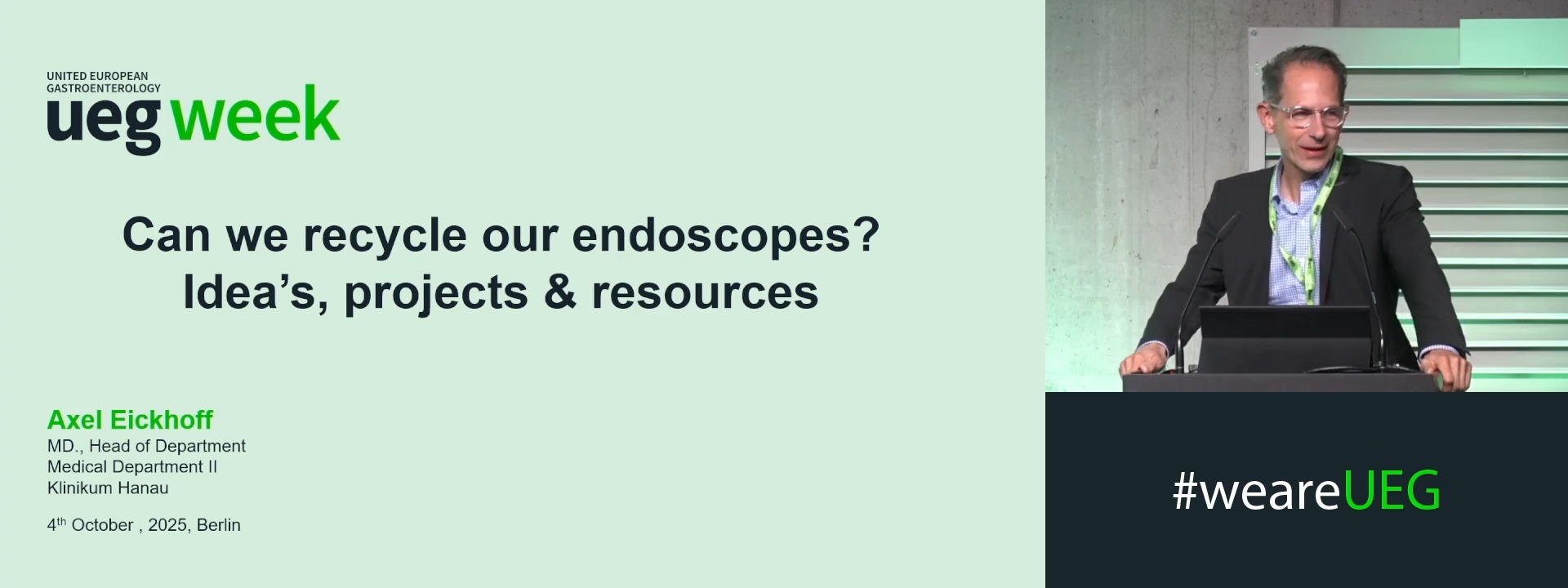
Can we recycle our endoscopes? Ideas, Projects and resources
1 Klinikum Hanau, None, Germany
Event
Topics
Citation
Published
Log in to access this content.
Free for all myUEG account holders. Your access level is set automatically based on your occupation. Medical professionals get full access to all content. If you are a non-medical user, you can only access UEG Week content from congresses you attended.
Not sure what you can access? Learn more about account types.
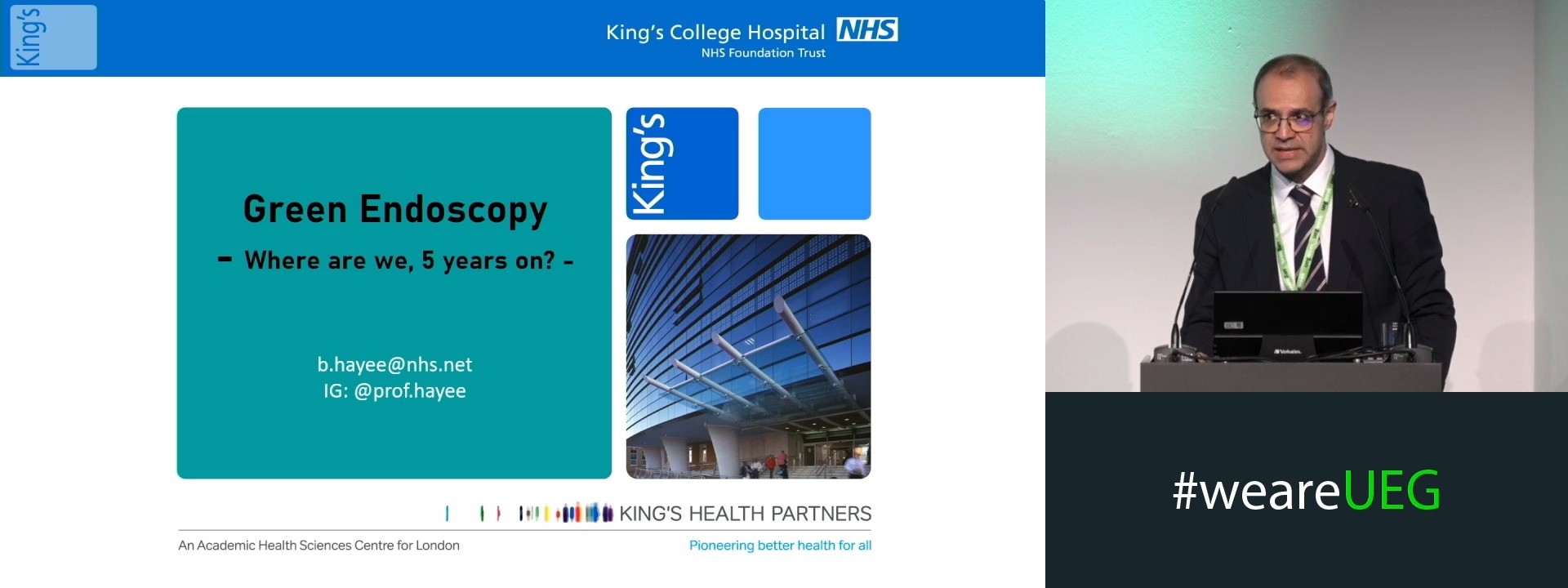
The carbon footprint of endoscopy
1 Kings College Hospital, London, United Kingdom
Event
Session
Citation
Published
Log in to access this content.
Free for all myUEG account holders. Your access level is set automatically based on your occupation. Medical professionals get full access to all content. If you are a non-medical user, you can only access UEG Week content from congresses you attended.
Not sure what you can access? Learn more about account types.
Log in to access this content.
Free for all myUEG account holders. Your access level is set automatically based on your occupation. Medical professionals get full access to all content. If you are a non-medical user, you can only access UEG Week content from congresses you attended.
Not sure what you can access? Learn more about account types.
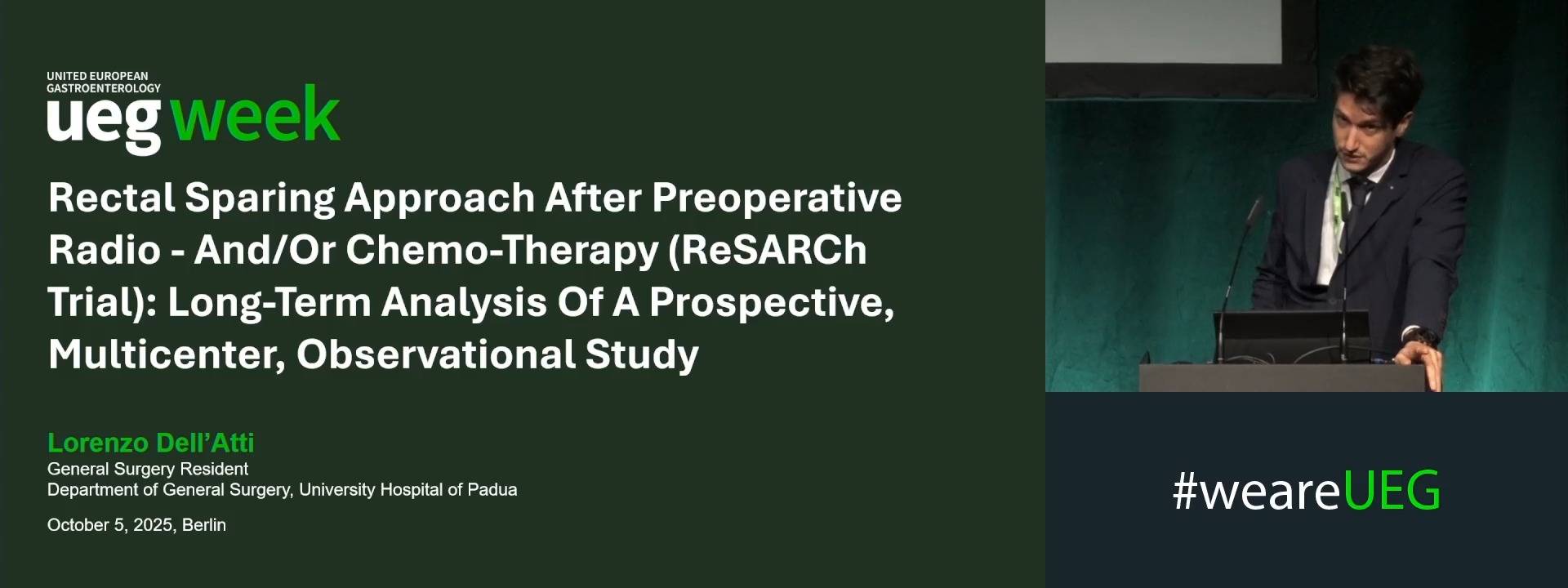
RECTAL SPARING APPROACH AFTER PREOPERATIVE RADIO - AND/OR CHEMO-THERAPY (RESARCH TRIAL): LONG-TERM ANALYSIS OF A PROSPECTIVE, MULTICENTER, OBSERVATIONAL STUDY
Quoc Riccardo Bao 1, Lorenzo Dell'Atti 1, Alessandra Pulvirenti 1, Marco Scarpa 1, Angelo Restivo 2, Daniela Rega 3, Claudio Coco 4, Maria Antonietta Gambacorta 4, Paolo Delrio 3, Nicola Cillara 5, Simona Deidda 4, Antonino Spinelli 6, Francesco Bianco 3, Giacomo Sarzo 1, Emilio Morpurgo 7, Claudio Belluco 8, Giuditta Chiloiro 9, Filippo Crimì 1, Isacco Maretto 1, Alessandro Perin 1, Emanuele Damiano Luca Urso 1, Federico Scognamiglio 1, Francesca Bergamo 10, Salvatore Pucciarelli 1, Gaya Spolverato 1
1 Azienda Ospedaliera Universitaria di Padova, Padova, Italy
2 Università degli Studi di Cagliari, Cagliari, Italy
3 IRCSS Fondazione G. Pascale, Napoli, Italy
4 Università Cattolica del Sacro Cuore, Roma, Italy
5 Azienda ASL di Cagliari, Cagliari, Italy
6 Humanitas University, Rozzano Milano, Italy
7 Azienda ULSS n 6 Euganea, Padova, Italy
8 Centro di Riferimento Oncologico di Aviano, CRO-IRCCS, Aviano, Italy
9 Fondazione Policlinico Universitaria A. Gemelli IRCCS, Roma, Italy
10 Veneto Institute of Oncology IOV-IRCCS, Padova, Italy
Event
Topics
Submission format
Citation
Published
Log in to access this content.
Free for all myUEG account holders. Your access level is set automatically based on your occupation. Medical professionals get full access to all content. If you are a non-medical user, you can only access UEG Week content from congresses you attended.
Not sure what you can access? Learn more about account types.
Focus on JAKs
1 Inselspital - Bern University Hospital, Bern, Switzerland
Event
Citation
Published
Log in to access this content.
Free for all myUEG account holders. Your access level is set automatically based on your occupation. Medical professionals get full access to all content. If you are a non-medical user, you can only access UEG Week content from congresses you attended.
Not sure what you can access? Learn more about account types.
EFFICACY OF GUSELKUMAB FOR SMALL BOWEL LESIONS USING BALLOON ASSISTED ENTEROSCOPY: A PHASE 3, OPEN-LABEL, MULTICENTER STUDY
TEPPEI OMORI 1, Kazuo Ohtsuka 2, Kenji Watanabe 3, Taku Kobayashi 4, Naoki Hosoe 5, Motohiro Esaki 6, Tomoki Matsuda 7, Takehiko Sakamoto 8, Koji Masuda 8, Madoka Chinen 8, Hiroshi Horio 8, Shinichi Yoshigoe 8, Tadakazu Hisamatsu 9
1 Kyorin University Suginami Hospital, Kyorin University School of Medicine, Suginami-ku, Japan|||Tokyo Women's Medical University, Shinjuku-ku, Japan
2 Institute of Science Tokyo, Bunkyo-ku, Japan
3 Toyama University, Toyama, Japan
4 Kitasato University Kitasato Institute Hospital, Minato-ku, Japan
5 Keio University, Minato-ku, Japan
6 Saga University, Saga, Japan
7 Sendai Kousei Hospital, Sendai, Japan
8 Johnson & Johnson, Chiyoda-ku, Japan
9 Kyorin University School of Medicine, Mitaka, Japan
Conference
Topics