UEG's content platform for gastroenterology education bringing recordings, courses, guidelines, and more together in one place.
Trending on Gutflix
Rate for better recommendations!
Your feedback helps us show you more of what you like and less of what you dislike!
Log in to continue.
This content is part of Gutflix. Log in with your myUEG account, or create one free, to watch it.
Not sure what you can access? Learn more about account types.
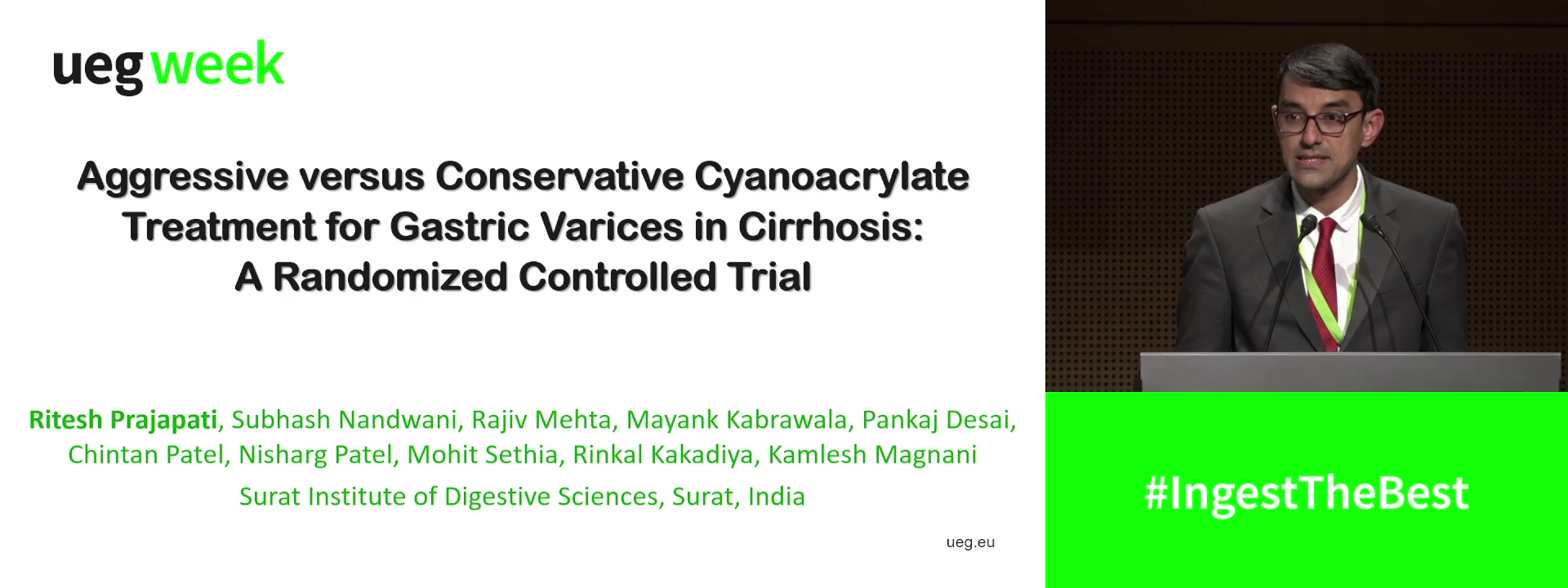
A PROSPECTIVE, SINGLE-CENTER, RANDOMIZED, OPEN-LABEL STUDY TO INVESTIGATE EFFICACY AND LONG-TERM OUTCOME OF CYANOACRYLATE GLUE FOR ALL GASTRIC VARICES (GOV1, GOV2, IGV1, IGV2) VERSUS ITS USE ONLY GOV 2 AND IGV 1 GASTRIC VARICES WITH STIGMA OF RECENT HAEMO
Pankaj Desai 1, Chintan Patel 1, Mayank V Kabrawala 1, Ritesh Prajapati 1, Rinkalben Kakadiya 1, Mohit Sethia 1, Nisharg Patel 1
Affiliations
1 SIDS Hospital & Research Centre, Surat, India

Log in to continue.
This content is part of Gutflix. Log in with your myUEG account, or create one free, to watch it.
Not sure what you can access? Learn more about account types.
Faecal microbiota transplantation for other disorders beyond clostridioides difficile infection
Affiliations
1 Aarhus University Hospital, Aarhus N, Denmark