UEG's content platform for gastroenterology education bringing recordings, courses, guidelines, and more together in one place.
Trending on Gutflix
Rate for better recommendations!
Your feedback helps us show you more of what you like and less of what you dislike!
Log in to continue.
This content is part of Gutflix. Log in with your myUEG account, or create one free, to watch it.
Not sure what you can access? Learn more about account types.
Upper GI disorders
Affiliations
1 Inst of medicine, Gothenburg, Sweden
Log in to continue.
This content is part of Gutflix. Log in with your myUEG account, or create one free, to watch it.
Not sure what you can access? Learn more about account types.
OVERDIAGNOSIS OF SUPERIOR MESENTERIC ARTERY SYNDROME: LIMITED DIAGNOSTIC CONCORDANCE BETWEEN IMAGING MODALITIES AND LIMITED BENEFIT OF SURGERY
Christian von Muhlenbrock 1,2,3, Sandrien Abbeel 4, Thomas Debrouwere 1, Dirk Vanbeckevoort 1, Jan Tack 1, Tim Vanuytsel 1
Affiliations
1 KU Leuven, Leuven, Belgium
2 Universidad de Chile, Santiago, Chile
3 Universidad de los Andes, Santiago, Chile
4 KU Leuven, Eppegem, Belgium
Log in to continue.
This content is part of Gutflix. Log in with your myUEG account, or create one free, to watch it.
Not sure what you can access? Learn more about account types.
Dyspepsia: To treat or to scope
Affiliations
1 European Society for Primary Care Gastroenterology (ESPCG), Sant Adrià de Besòs ( Barcelona), Spain
Log in to continue.
This content is part of Gutflix. Log in with your myUEG account, or create one free, to watch it.
Not sure what you can access? Learn more about account types.
PREVALENCE OF GERD IN PATIENTS WITH EOSINOPHILIC ESOPHAGITIS AND ITS IMPACT ON TREATMENT OUTCOMES: INSIGHTS FROM A SWEDISH TERTIARY CENTRE COHORT
Affiliations
1 Karolinska Institutet, Stockholm, Sweden
2 Karolinska University Hospital, Stockholm, Sweden
Log in to continue.
This content is part of Gutflix. Log in with your myUEG account, or create one free, to watch it.
Not sure what you can access? Learn more about account types.
Intestinal permeability testing
Affiliations
1 UZ Leuven, KU Leuven, Leuven, Belgium
Log in to continue.
This content is part of Gutflix. Log in with your myUEG account, or create one free, to watch it.
Not sure what you can access? Learn more about account types.
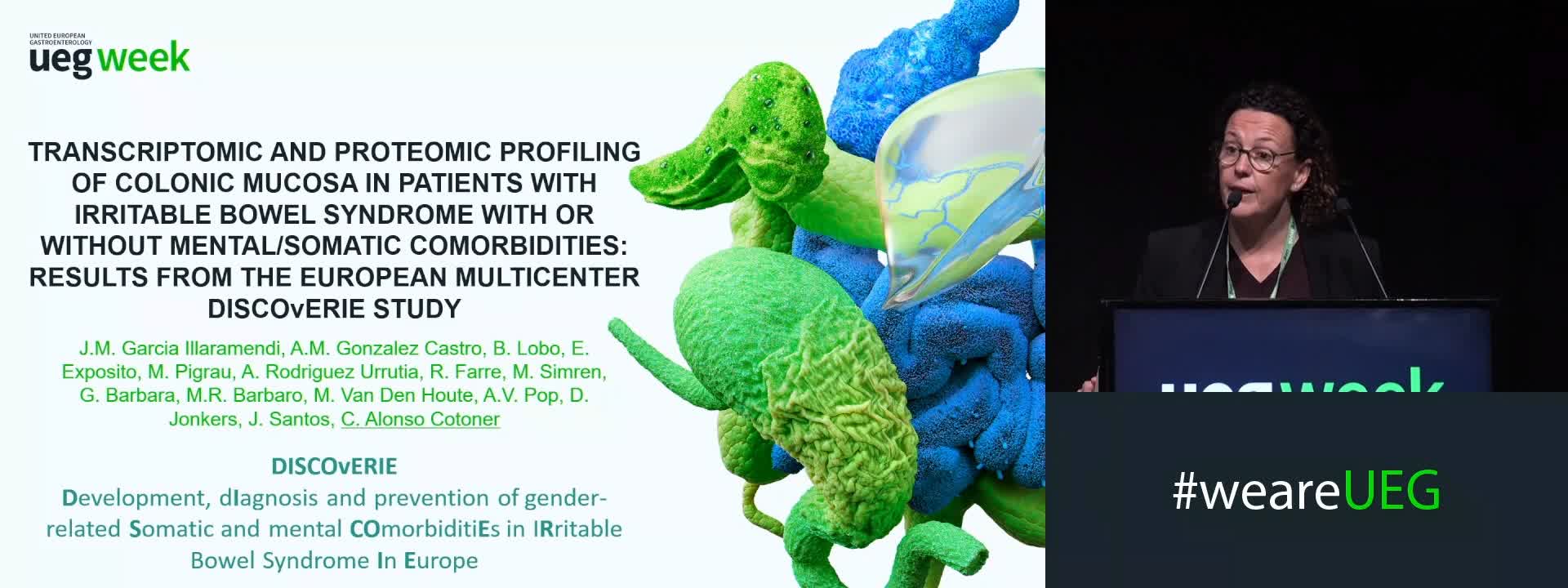
TRANSCRIPTOMIC AND PROTEOMIC PROFILING OF COLONIC MUCOSA IN PATIENTS WITH IRRITABLE BOWEL SYNDROME WITH OR WITHOUT MENTAL/SOMATIC COMORBIDITIES: RESULTS FROM THE EUROPEAN MULTICENTER DISCOVERIE STUDY
Juan Manuel Garcia 1, Ana Maria Gonzalez-Castro 1,2, Beatriz Lobo Alvarez 1,2,3, Elba Exposito 1, Marc Pigrau Pastor 4,3, Amanda Rodriguez 1,3,5, Ricard Farré 6, Magnus Simrén 7, Giovanni Barbara 8,9, Maria Raffaella Barbaro 9,8, Maaike Van Den Houte 10, Andrei Pop 11, Daisy Mae Jonkers 12, Javier Santos 1,2,3, Carmen Alonso-Cotoner 1,2,3
Affiliations
1 Vall d’Hebron Research Institute, Barcelona, Spain
2 CIBEREHD, Madrid, Spain
3 Vall d’Hebron Hospital Universitari, Vall d’Hebron Barcelona Hospital Campus, Barcelona, Spain
4 Universitat Autonoma de Barcelona, Barcelona, Spain
5 CIBERSAM, Madrid, Spain
6 University of Leuven, Translational Research Center for Gastrointestinal Disorders (TARGID), Leuven, Belgium
7 Sahlgrenska University Hospital - Dept of Internal Medicine, Sahlgrenska University Hospital ; Gothe, Gothenburg, Sweden
8 University of Bologna, Bologna, Italy
9 Università di Bologna, Bologna, Italy
10 Laboratory for Brain-Gut Axis Studies, Translational Research in Gastrointestinal Disorders (TARGID), Leuven, Belgium
11 Iuliu Hatieganu University of Medicine and Pharmacy Cluj-Napoca, Cluj-Napoca, Romania
12 Maastricht University Medical Center, Maastricht, Netherlands