Introduction
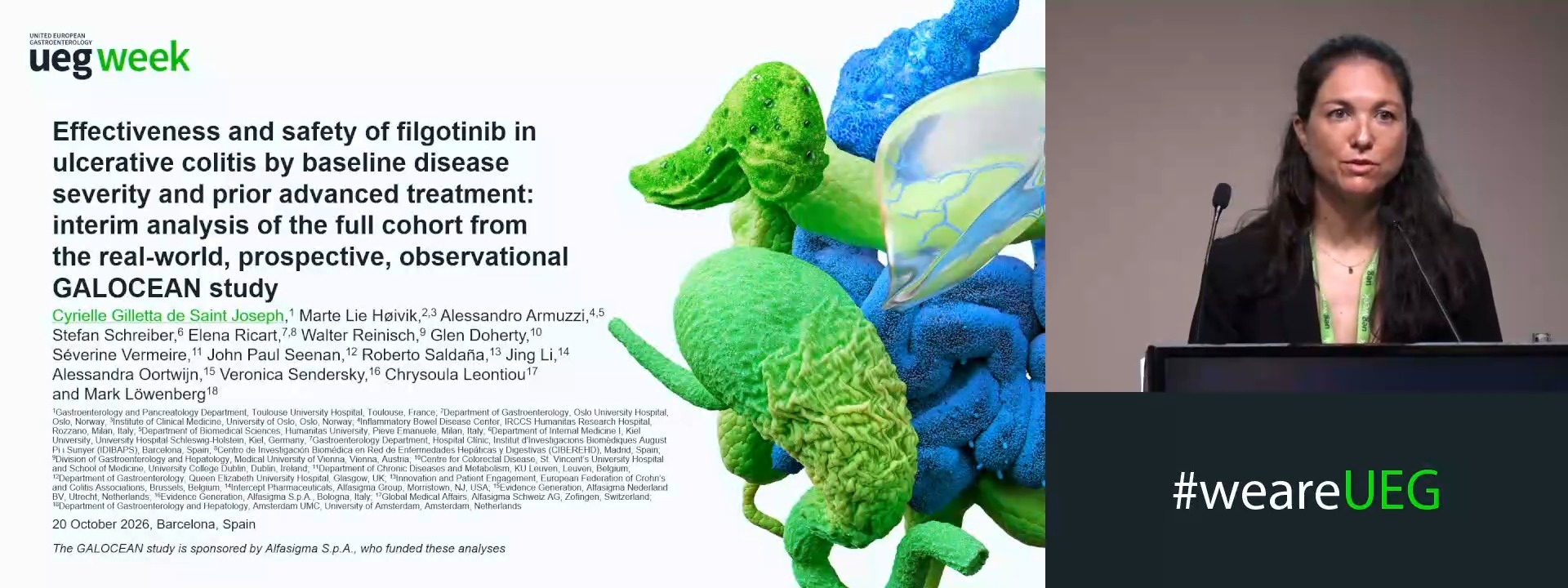
Filgotinib (FIL) is an oral, once-daily, Janus kinase 1 preferential inhibitor approved to treat moderately to severely active ulcerative colitis (UC).1,2 Analyses of the SELECTION trial suggested that patients with moderate disease severity or who were biologic-naive had better responses to FIL than those with severe disease or prior biologic exposure, suggesting early use of FIL may be beneficial in UC.3,4
Aims & Methods
Here, we report the real-world effectiveness of FIL in UC by baseline (BL) disease severity and prior use of advanced treatment (AT). GALOCEAN (NCT05817942) is an ongoing, European, multicentre, prospective, observational study of adults with UC receiving FIL in routine care; this interim analysis reports data for the full cohort. Effectiveness outcomes (partial Mayo Clinic Score [pMCS], two-item patient-reported outcome [PRO2] score) were assessed at BL, week (W) 10 and W24 in the full analysis set (FAS). C-reactive protein (CRP) levels were measured at BL, W10 and W24; data are reported up to W10 owing to missing data at W24. Safety was assessed by documenting adverse events (AEs) in the safety analysis set. Effectiveness and safety outcomes were analysed by BL disease severity (moderate [pMCS 5–6] or severe [pMCS 7–9]) and separately by prior use of AT (AT-naive or AT-experienced [AT-exp]). Data are reported as observed.
Results
As of 7 November 2025, 488 enrolled patients had available BL data in the FAS; 421 had reached W10 and 321 had reached W24. Of patients with BL pMCS data, 36.6% (173/473) were categorized as having moderate disease, and 28.1% (133/473) as having severe disease at BL. Most patients (73.8% [360/488]) were AT-exp; 30.9% (151/488), 22.1% (108/488) and 20.7% (101/488) had received 1, 2 or ≥3 ATs, respectively. At W10, the moderate group had numerically lower pMCS and PRO2 scores and higher proportions of patients in clinical remission than the severe group (W10 pMCS remission: 40.7% vs 29.9%; Table). Improvements from BL in effectiveness outcomes were maintained up to W24 in both severity groups, although differences between groups were smaller than at W10 (W24 pMCS remission: moderate, 58.1%; severe, 54.2%). At W10, 66.7% (72/108) of the moderate group and 56.3% (40/71) of the severe group had a CRP level <3 mg/L. In the AT-naive and AT-exp groups, pMCS and PRO2 score improved from BL at W10 and improved further by W24 (Table). The AT-naive group had numerically greater improvements in all clinical outcomes than the AT-exp group at W10 and W24. No new safety signals were identified when treatment-emergent AEs were assessed across subgroups.
Conclusion
In this real-world study, patients treated with FIL who had moderate disease showed numerically better clinical outcomes and higher remission rates at W10 than those with severe disease; similarly, AT-naive patients had a greater estimated benefit with FIL than AT-exp patients. Improvements from BL were maintained up to W24, with comparable remission rates in both severity groups by W24. These findings align with previous real-world data and support the benefit of early use of FIL in the UC treatment pathway.5
| Outcome | Time point | Group | Moderate BL
disease severitya
(n=173) | Severe BL
disease severitya
(n=133) | AT-naive
(n=128) | AT-experienced
(n=360) |
| pMCS | BL | Mean (SD) | 5.5 (0.5) | 7.5 (0.6) | 4.9 (2.1) | 5.2 (2.1) |
| W10 | Mean (SD)
Mean CFB (SD)
Remission, % (n/N)b | 2.4 (2.3), n=137
−3.1 (2.2), n=137
40.7 (57/140) | 3.2 (2.6), n=95
−4.2 (2.6), n=95
29.9 (29/97) | 1.7 (2.1), n=99
−3.2 (2.3), n=97
56.4 (57/101) | 2.6 (2.5), n=264
−2.7 (2.6), n=259
40.1 (108/269) |
| W24 | Mean (SD)
Mean CFB (SD)
Remission, % (n/N)b | 1.7 (2.1), n=86
−3.8 (2.1), n=86
58.1 (50/86) | 2.2 (2.7), n=57
−5.2 (2.8), n=57
54.2 (32/59) | 0.9 (1.5), n=70
−3.7 (2.3), n=69
72.9 (51/70) | 2.0 (2.4), n=160
−3.3 (2.9), n=156
55.5 (91/164) |
| PRO2 score | BL | Mean (SD) | 3.5 (0.7) | 4.9 (0.6) | 3.0 (1.7) | 3.3 (1.6) |
| W10 | Mean (SD)
Mean CFB (SD)
Remission, % (n/N)c | 1.4 (1.5), n=145
−2.1 (1.6), n=145
39.3 (57/145) | 2.0 (1.8), n=98
−2.9 (1.8), n=98
29.6 (29/98) | 0.9 (1.4), n=114
−2.0 (1.8), n=113
57.0 (65/114) | 1.6 (1.7), n=273
−1.7 (1.9), n=270
36.6 (100/273) |
| W24 | Mean (SD)
Mean CFB (SD)
Remission, % (n/N)c | 1.0 (1.4), n=92
−2.5 (1.6), n=92
51.1 (47/92) | 1.4 (1.8), n=61
−3.5 (1.9), n=61
50.0 (31/62) | 0.4 (0.9), n=79
−2.3 (1.8), n=78
74.7 (59/79) | 1.2 (1.7), n=169
−2.0 (2.1), n=166
49.1 (84/171) |
Data are presented for the full analysis set, which comprised all patients who initiated up to and including FIL 200 mg with available BL data. Data are reported as observed for patients who remained on FIL, remained in the study and reached the relevant study visit. N numbers shown are the number of patients who reached the visit and had been assessed for the specified outcome measure.
aFor patients in the FAS with available BL pMCS data, BL disease severity groups were defined by pMCS (inactive [pMCS 0–1]; mild [pMCS 2–4]; moderate [pMCS 5–6]; severe [pMCS 7–9]).
bpMCS remission was defined as a pMCS of ≤1, with rectal bleeding, stool frequency and Physician's Global Assessment subscores of ≤1.
cPRO2 remission was defined as rectal bleeding and stool frequency subscores of 0.
AT, advanced treatment; BL, baseline; CFB, change from baseline; FIL, filgotinib; pMCS, partial Mayo Clinic Score; PRO2, two-item patient-reported outcome; SD, standard deviation; W, week. |
References
1. Alfasigma S.p.A. Summary of product characteristics, Jyseleca. EMA, 2025. Accessed 30 March 2026. https://www.ema.europa.eu/en/documents/product-information/jyseleca-epar-product-information_en.pdf.
2. Feagan BG et al. Lancet 2021;397:2372–84.
3. Dotan I et al. J Crohns Colitis 2023;17:1207–16.
4. Louis E et al. Dig Liver Dis 2025;57:1411–8.
5. Tursi A et al. Intest Res 2025; doi:10.5217/ir.2025.00067.
Disclosure
The GALOCEAN study is sponsored by Alfasigma S.p.A., who funded these analyses. Medical writing support was provided by PharmaGenesis London, UK, and was funded by Alfasigma S.p.A.
CGdSJ reports speaker and/or consultancy fees from AbbVie, Alfasigma, Amgen, Celltrion, Ferring Pharmaceuticals, Galapagos, Janssen Pharmaceuticals, MSD, Pfizer and Takeda.
MLH reports research grants, speaker fees and/or advisory board fees from AbbVie, Eli Lilly, Ferring Pharmaceuticals, Galapagos, Janssen Pharmaceuticals, MSD, Pfizer, Takeda, Tillotts Pharma and Viatris (formerly Meda).
AA reports consultancy and/or advisory board fees from AbbVie, Alfasigma, AstraZeneca, Biogen, Boehringer Ingelheim, Bristol Myers Squibb, Celltrion, Eli Lilly, Ferring Pharmaceuticals, Galapagos, Gilead Sciences, Giuliani, Janssen Pharmaceuticals, LIONHEALTH Benefit Society, Merck, Nestlé, Pfizer, Roche, Samsung Bioepis, Sandoz, Sanofi, Takeda and Tillotts Pharma; lecture and/or speaker bureau fees from AbbVie, AG Pharma, Alfasigma, Biogen, Bristol Myers Squibb, Celltrion, Eli Lilly, Ferring Pharmaceuticals, Galapagos, Gilead Sciences, Janssen Pharmaceuticals, LIONHEALTH Benefit Society, Merck, Novartis, Pfizer, Roche, Samsung Bioepis, Sandoz, Takeda and Teva Pharmaceuticals; and research grants from Biogen, MSD, Pfizer and Takeda.
SS reports personal fees from AbbVie, Amgen, Arena Pharmaceuticals, Biogen, Bristol Myers Squibb, Celgene, Celltrion, Dr. Falk Pharma, Eli Lilly, Ferring Pharmaceuticals, Fresenius Kabi, Galapagos/Gilead Sciences, Hikma Pharmaceuticals, I-Mab, Janssen Pharmaceuticals, Morphic Therapeutic, MSD, Mylan, Pfizer, Protagonist Therapeutics, Provention Bio, Sandoz/Hexal, Takeda, Theravance Biopharma and Ventyx Biosciences; and funding from the Deutsche Forschungsgemeinschaft Excellence Cluster.
ER reports speaker fees from AbbVie, Faes Farma, Ferring Pharmaceuticals, Galapagos, Janssen Pharmaceuticals, Kern Pharma, MSD, Pfizer and Takeda; and consultancy fees from AbbVie, Eli Lilly, Fresenius Kabi, Galapagos, Janssen Pharmaceuticals, MSD and Pfizer.
WR reports speaker and/or consultancy fees from AbbVie, Amgen, AOP Health (formerly AOP Orphan), Boehringer Ingelheim, Bristol Myers Squibb, Calyx, Celltrion, Eli Lilly, Ferring Pharmaceuticals, Galapagos, Gilead Sciences, InDex Pharmaceuticals, Janssen Pharmaceuticals, MedAhead, MEDICE, Microbiotica, MSD, Pfizer, Roche, Sobi and Takeda; advisory board fees from AbbVie, Amgen, Boehringer Ingelheim, Bristol Myers Squibb, Celltrion, Galapagos, Janssen Pharmaceuticals and Pfizer; and research funding from AbbVie, Janssen Pharmaceuticals, Sandoz, Sanofi and Takeda.
GD reports research/educational grants and/or speaker/personal fees from Abbott, AbbVie, Amgen, Bristol Myers Squibb, Celltrion, Dr. Falk Pharma, Galapagos, Genuity Science, Gilead Sciences, Janssen Pharmaceuticals, MSD, Pfizer, Takeda/Shire and Tillotts Pharma.
SV reports financial support for research from AbbVie, Galapagos, Johnson & Johnson, Pfizer and Takeda; speaker and/or consultancy fees from AbbVie, Abivax, AbolerIS Pharma, Agomab Therapeutics, Alimentiv (formerly Robarts Clinical Trials), Arena Pharmaceuticals, AstraZeneca, Biora Therapeutics (formerly Progenity), Boehringer Ingelheim, Bristol Myers Squibb, Celgene, Cytoki Pharma, Dr. Falk Pharma, Eli Lilly, Ferring Pharmaceuticals, Galapagos, Genentech-Roche, Gilead Sciences, GSK, Hospira, IMIDomics, Janssen Pharmaceuticals, Johnson & Johnson, Materia Prima, Mestag Therapeutics, MiroBio, Morphic Therapeutic, MRM Health, MSD, Mundipharma, Pfizer, ProDigest, Prometheus Biosciences, Surrozen, Takeda, Theravance Biopharma, Tillotts Pharma, VectivBio, Ventyx Biosciences and Zealand Pharma; and participation on a data safety monitoring board for Sanofi.
JPS reports speaker fees from AbbVie, Alfasigma, Amgen, AstraZeneca, Bristol Myers Squibb, Eisai Pharma, Fresenius Kabi, Janssen-Cilag, Pfizer, Pharmacosmos UK, Takeda UK and Tillotts Pharma UK; and advisory board fees from AbbVie, Dr. Falk Pharma (UK) and Galapagos.
RS reports no financial disclosures or conflicts of interest.
JL is an employee of Intercept Pharmaceuticals, Alfasigma Group.
AO and CL are employees of Alfasigma S.p.A.
VS is a consultant funded by Alfasigma S.p.A.
ML reports consultancy/lecture fees from AbbVie, Bristol Myers Squibb, Eli Lilly, Galapagos, Janssen-Cilag, Johnson & Johnson, Medtronic, Pfizer, Takeda and Tillotts Pharma; and grants from Alfasigma, Galapagos, the Netherlands Federation of University Medical Centres, the Netherlands Organisation for Health Research and Development (ZonMw) and the Top Consortia for Knowledge and Innovation (TKI).