UEG's content platform for gastroenterology education bringing recordings, courses, guidelines, and more together in one place.
Trending on Gutflix
Rate for better recommendations!
Your feedback helps us show you more of what you like and less of what you dislike!
Log in to continue.
This content is part of Gutflix. Log in with your myUEG account, or create one free, to watch it.
Not sure what you can access? Learn more about account types.
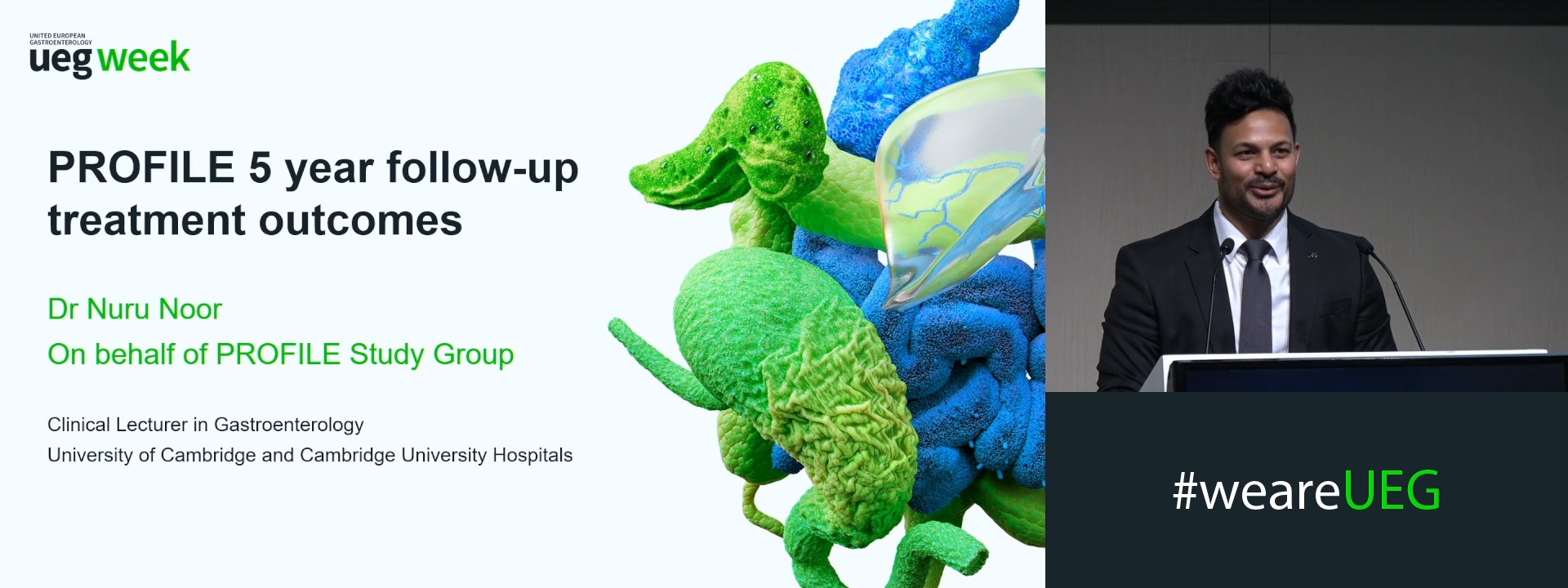
PROFILE TRIAL 5-YEAR FOLLOW-UP SHOWS EARLY “TOP-DOWN” ANTI-TNF THERAPY RESULTS IN HIGH TREATMENT DURABILITY AND MODIFIES THE COURSE OF CROHN’S DISEASE
Nurulamin Noor 1, Mohmmed Tauseef Sharip 1, Haiyan Zheng 2, Barry Widmer 3, Biljana Brezina 1, Kamal Vijaykant Patel 4, Francis Dowling 5, Suhaylah Bhatti 5, Nadia Alsmade 5, Tariq Ahmad 6, Paul Banim 7, James Berrill 8, Rachel Cooney 9, Juan de la Revilla Negro 1, Shanika De Silva 10, Shahida Din 11, Dharmaraj Durai 12, John Gordon 13, Ailsa L Hart 14, Peter Irving 15, Matthew Johnson 16, Alexandra Kent 17, Bel Klaartje Kok 18, Gordon Moran 19, Craig Mowat 20, Pritash Patel 21, Tim Raine 1, Rebecca Saich 22, Dan Sharpstone 23, Melissa Smith 24, Alan Steel 25, Sreedhar Subramanian 1, Alan Wiles 26, Horace Williams 27, James O. Lindsay 18, Nicholas A Kennedy 6, Eoin F. McKinney 28, Paul A Lyons 28, Kenneth Smith 29, James C. Lee 30, David Robertson 31, Miles Parkes 1
Affiliations
1 Cambridge University Hospitals, Cambridge, United Kingdom
2 University of Bath, Bath, United Kingdom
3 University of Cambridge, Cambridge, United Kingdom
4 St George's Hopsital, London, United Kingdom
5 Cambridge Clinical Trials Unit, Cambridge, United Kingdom
6 Royal Devon and Exeter NHS Foundation Trust, Exeter, United Kingdom
7 James Paget Hospital, Great Yarmouth, United Kingdom
8 Royal Glamorgan Hospital, Llantrisant, United Kingdom
9 University Hospital Birmingham, Birmingham, United Kingdom
10 Russells Hall Hospital, Dudley, United Kingdom
11 Western General Hospital, Edinburgh, United Kingdom
12 University Hospital of Wales, Cardiff, United Kingdom
13 Royal Hampshire County Hospital, Winchester, United Kingdom
14 St Mark’s Hospital and Academic Institute, Harrow, United Kingdom
15 Guy´s and St Thomas´ Hospital, London, United Kingdom
16 The Luton & Dunstable University Hospital, Luton, Bedfordshire, United Kingdom
17 Kings College Hospital NHS Trust, London, United Kingdom
18 The Royal London Hospital - Barts Health NHS Trust, London, United Kingdom
19 Nottingham Digestive Diseases Centre, Nottingham, United Kingdom
20 Ninewells Hospital and Medical School, Dundee, United Kingdom
21 Epsom and St Helier University Hospitals, Carshalton, United Kingdom
22 Basingstoke and North Hampshire Hospital, Basingstoke, United Kingdom
23 West Suffolk NHS Foundation Trust, Bury St Edmunds, United Kingdom
24 University Hospitals Sussex NHS Foundation Trust, Brighton, United Kingdom
25 Royal Liverpool Hospital, Liverpool, United Kingdom
26 The Queen Elizabeth Hospital, Kings Lynn, United Kingdom
27 Imperial College Healthcare NHS Trust, London, United Kingdom
28 University of Cambridge, School of Clinical Medicine, Cambridge, United Kingdom
29 University of Melbourn, Melbourne, Australia
30 The Francis Crick Institute, London, United Kingdom
31 MRC Biostatistics Unit, Cambridge, United Kingdom
Log in to continue.
This content is part of Gutflix. Log in with your myUEG account, or create one free, to watch it.
Not sure what you can access? Learn more about account types.
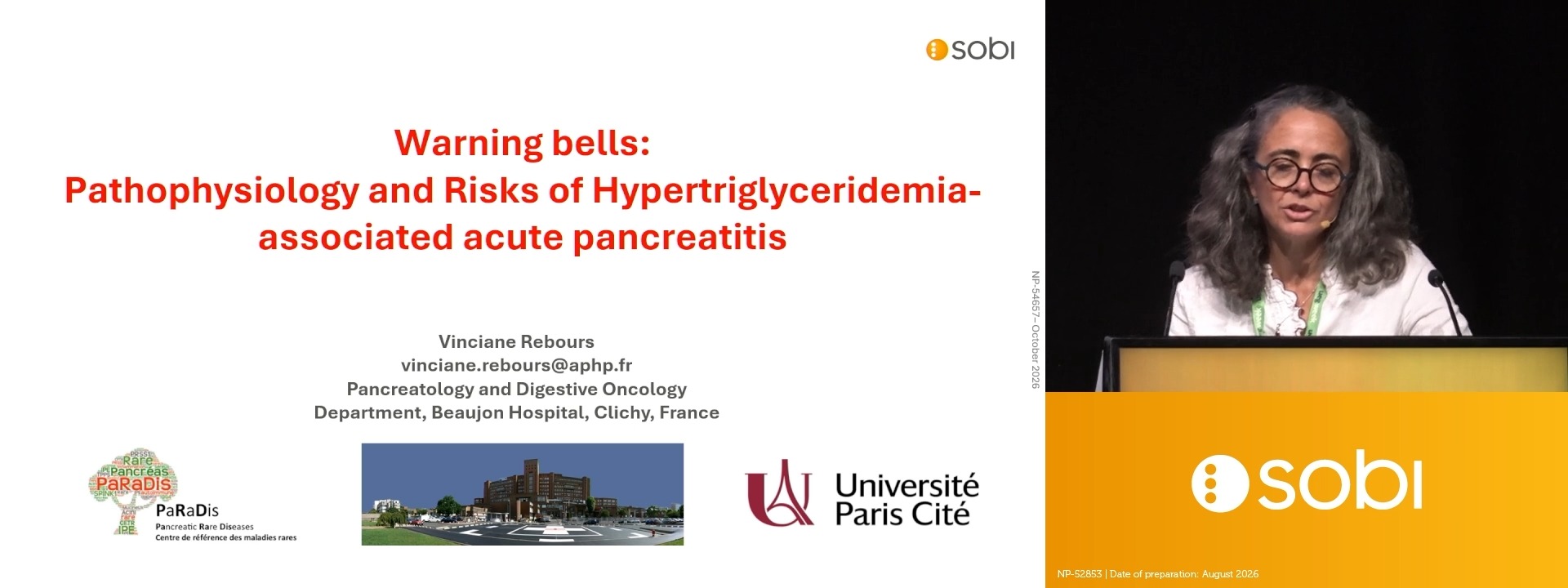
Guiding the care of hypertriglyceridemia-induced acute pancreatitis: Multidisciplinary care and the role of new therapies through apoC-III inhibition (Sobi (Swedish Orphan Biovitrum)) (Complete Session)
Affiliations
1 Hopital Beaujon, Clichy, France
2 San Raffaele Scientific Institute Irccs, Rome, Italy
3 Clínic Barcelona, Barcelona, Spain
Log in to continue.
This content is part of Gutflix. Log in with your myUEG account, or create one free, to watch it.
Not sure what you can access? Learn more about account types.
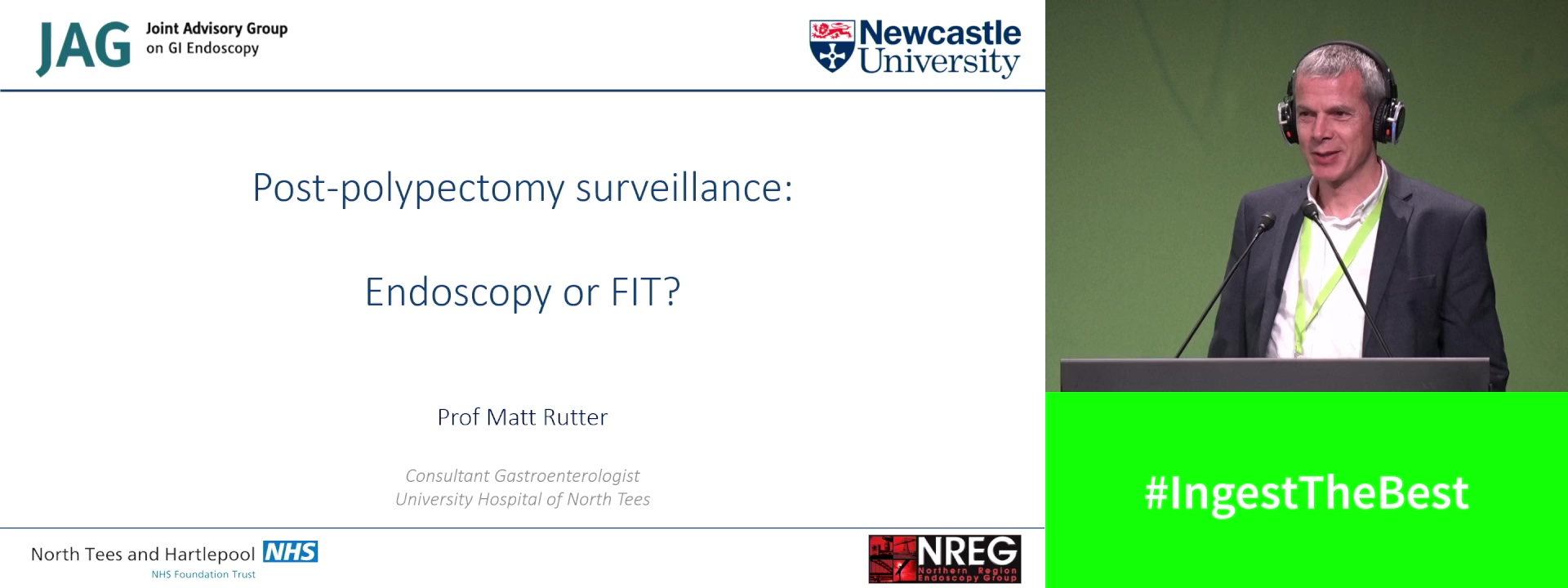
Postpolypectomy surveillance, endoscopy or FIT
Affiliations
1 University Hospital North Tees NHS Dept. of Gastroenterology - Gastroenterology, University Hospital, Stockton-on-Tees, United Kingdom