UEG's content platform for gastroenterology education bringing recordings, courses, guidelines, and more together in one place.
Trending on Gutflix
Rate for better recommendations!
Your feedback helps us show you more of what you like and less of what you dislike!
Log in to continue.
This content is part of Gutflix. Log in with your myUEG account, or create one free, to watch it.
Not sure what you can access? Learn more about account types.
Imaging is the only technique to study small bowel motility
Affiliations
1 Amsterdam UMC, Amsterdam, Netherlands
Log in to continue.
This content is part of Gutflix. Log in with your myUEG account, or create one free, to watch it.
Not sure what you can access? Learn more about account types.
How to diagnose functional dyspepsia and differentiate from gastroparesis
Affiliations
1 Wroclaw Medical University, Wroclaw, Poland
Log in to continue.
This content is part of Gutflix. Log in with your myUEG account, or create one free, to watch it.
Not sure what you can access? Learn more about account types.
IMPROVING LESION DELINEATION IN BARRETT’S DYSPLASIA WITH SEGMENT-ANYTHING-MODEL 2
Jin Lin Tan 1,2, Arpan Mukhopadhyay 2, Lokesha Rasanjalee 2, Dileepa Pitawela 2, JunSheng Jaryl Cheng 1,2, Ashwin George 2, Thomas Lokan 1,2, Mohamed Asif Ali Chinnaratha Mohamedashrafali 2,1, Hsiang-Ting (Tim) Chen 2, Rajvinder Singh 1,2
Affiliations
1 Lyell McEwin Hospital, Adelaide, Australia
2 Adelaide University, Adelaide, Australia
Log in to continue.
This content is part of Gutflix. Log in with your myUEG account, or create one free, to watch it.
Not sure what you can access? Learn more about account types.
How to treat functional dyspepsia and gastroparesis
Affiliations
1 Israelitic Krankenhaus, Hamburg, Germany
2 Institute for Clinical and Experimental Medicine Gastroenterology & Hepatology, Praha, Czech Republic

Log in to continue.
This content is part of Gutflix. Log in with your myUEG account, or create one free, to watch it.
Not sure what you can access? Learn more about account types.
Words of welcome
Affiliations
1 Saarland University Medical Center, Homburg, Germany
Log in to continue.
This content is part of Gutflix. Log in with your myUEG account, or create one free, to watch it.
Not sure what you can access? Learn more about account types.
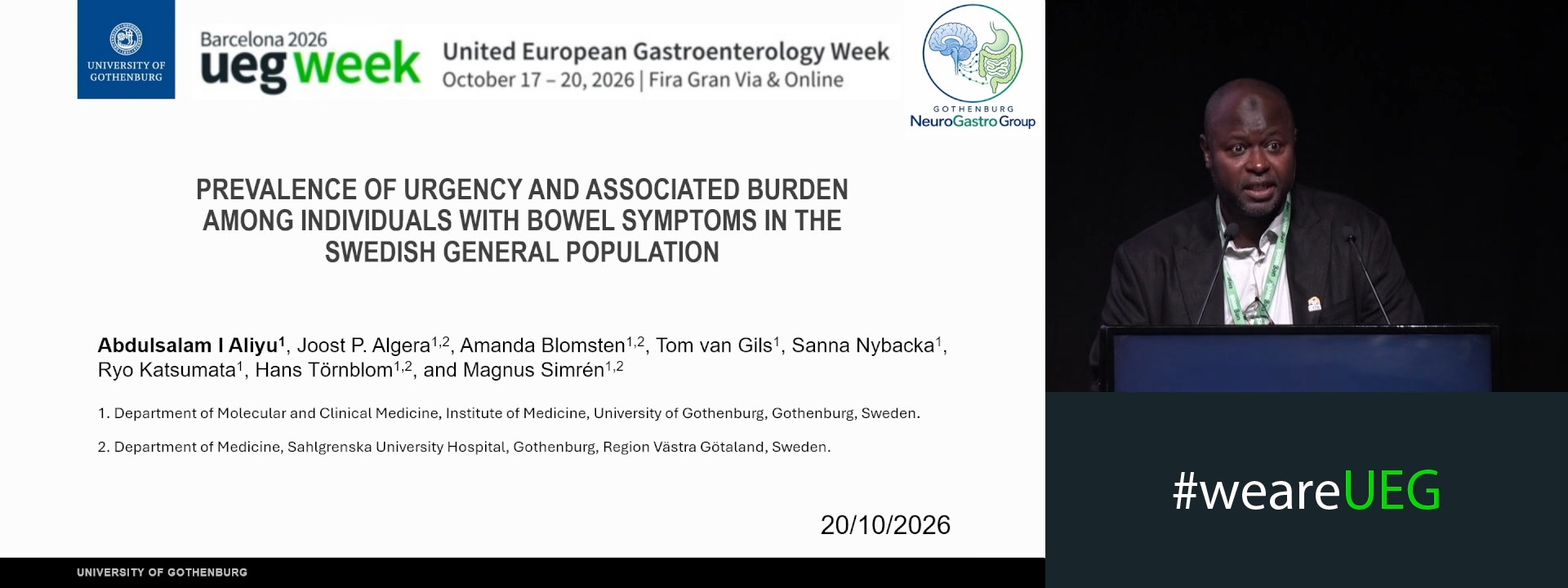
PREVALENCE OF URGENCY AND ASSOCIATED BURDEN AMONG INDIVIDUALS WITH BOWEL SYMPTOMS IN THE SWEDISH GENERAL POPULATION
Abdulsalam Aliyu 1, Joost Algera 2,1, Amanda Blomsten 1,2, Tom van Gils 1, Sanna Nybacka 1, Ryo Katsumata 1, Hans Törnblom 2,1, Magnus Simrén 1,2
Affiliations
1 University of Gothenburg, Institute of Medicine, Gothenburg, Sweden
2 Sahlgrenska University Hospital, Göteborg, Sweden