UEG's educational platform for gastroenterology education bringing recordings, courses, guidelines, and more together in one place.
Most popular content
Rate for better recommendations!
Your feedback helps us show you more of what you like and less of what you dislike!
Log in to access this content.
Free for all myUEG account holders. Your access level is set automatically based on your occupation. Medical professionals get full access to all content. If you are a non-medical user, you can only access UEG Week content from congresses you attended.
Not sure what you can access? Learn more about account types.

NOVEL ‘CLIP WITH LINE PULLEY SECURING’(CLIPS) CLOSURE TECHNIQUE FOR LARGE DEFECTS AFTER COLORECTAL ENDOSCOPIC SUBMUCOSAL DISSECTION
Darshan Parekh 1, Yohei Minato 2, Kohei Ono 2, Yuki Kano 2, Yoshiaki Kimoto 2, Nao Takeuchi 2, Hiroshi Yamazaki 2, SHINYA NAGAE 2, Koichi Furuta 2, Ken Ohata 2
1 Mumbai Institute of Gastroenterology, Mumbai, India
2 NTT Medical Center Tokyo, Tokyo, Japan
Conference
Topics
Submission format
Citation
Published
Log in to access this content.
Free for all myUEG account holders. Your access level is set automatically based on your occupation. Medical professionals get full access to all content. If you are a non-medical user, you can only access UEG Week content from congresses you attended.
Not sure what you can access? Learn more about account types.
EXPLORING THE DRIVING EFFECT OF CD8+ EXHAUSTED T CELLS ON MALIGNANT ADENOMA EPITHELIAL CELLS THROUGH RUNX2 BASED ON SINGLE-CELL TRANSCRIPTOME SEQUENCING
1 Zhejiang Chinese Medical University, Hangzhou, China, China
2 Zhejiang Chinese Medical University, Hangzhou, China
Conference
Topics
Submission format
Citation
Published
Log in to access this content.
Free for all myUEG account holders. Your access level is set automatically based on your occupation. Medical professionals get full access to all content. If you are a non-medical user, you can only access UEG Week content from congresses you attended.
Not sure what you can access? Learn more about account types.
STRATIFYING RISK BEYOND DIAGNOSIS: A GENE EXPRESSION SIGNATURE FOR EARLY GASTRIC CANCER AND METACHRONOUS LESION PREDICTION
1 Research Center of the Portuguese Institute of Oncology of Porto (CI-IPOP@RISE), Porto, Portugal|||Center for Health Technology and Services Research (CINTESIS@RISE), Porto, Portugal|||School of Medicine and Biomedical Sciences of University of Porto, Por
2 Research Center of the Portuguese Institute of Oncology of Porto (CI-IPOP@RISE), Porto, Portugal
3 Portuguese Institute of Oncology of Porto, Porto, Portugal
4 Research Center of the Portuguese Institute of Oncology of Porto (CI-IPOP@RISE), Porto, Portugal|||MEDCIDS, Faculty of Medicine of University of Porto, Porto, Portugal
Conference
Topics
Submission format
Citation
Published
Log in to access this content.
Free for all myUEG account holders. Your access level is set automatically based on your occupation. Medical professionals get full access to all content. If you are a non-medical user, you can only access UEG Week content from congresses you attended.
Not sure what you can access? Learn more about account types.
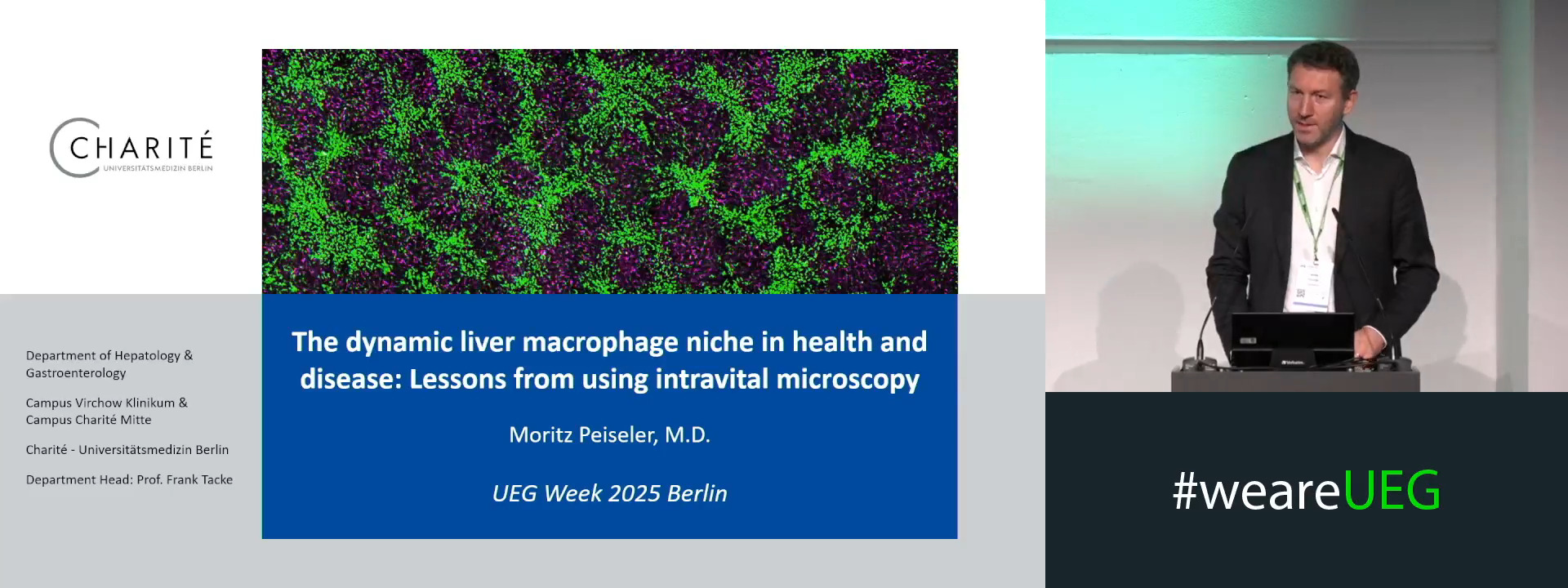
The dynamic liver macrophage niche in health and disease: Lessons from using intravital microscopy
1 Charité University Medicine Berlin, Berlin, Germany
Event
Citation
Published
Log in to access this content.
Free for all myUEG account holders. Your access level is set automatically based on your occupation. Medical professionals get full access to all content. If you are a non-medical user, you can only access UEG Week content from congresses you attended.
Not sure what you can access? Learn more about account types.
SEVERE PERFORATED DIVERTICULITIS IN A YOUNG ADULT UNMASKING ASCARIS INFESTATION: A MULTIDIMENSIONAL SURGICAL AND INFECTIOUS CHALLENGE
1 Emirates Health Services, Sharjah, United Arab Emirates
2 Emirates Health Services, Ras Al-Khiemah, United Arab Emirates
Conference
Topics
Submission format
Session
Published
Log in to access this content.
Free for all myUEG account holders. Your access level is set automatically based on your occupation. Medical professionals get full access to all content. If you are a non-medical user, you can only access UEG Week content from congresses you attended.
Not sure what you can access? Learn more about account types.
PREDICTORS OF RECURRENCE AFTER ENDOSCOPIC RETROGRADE APPENDICITIS THERAPY FOR ACUTE APPENDICITIS: A MULTI-CENTER COHORT STUDY WITH LONG-TERM FOLLOW-UP IN CHINA
1 The First Affilaited Hospital of Zhengzhou University, Zhengzhou, China
Conference
Topics
Submission format
Citation
Published
Log in to access this content.
Free for all myUEG account holders. Your access level is set automatically based on your occupation. Medical professionals get full access to all content. If you are a non-medical user, you can only access UEG Week content from congresses you attended.
Not sure what you can access? Learn more about account types.
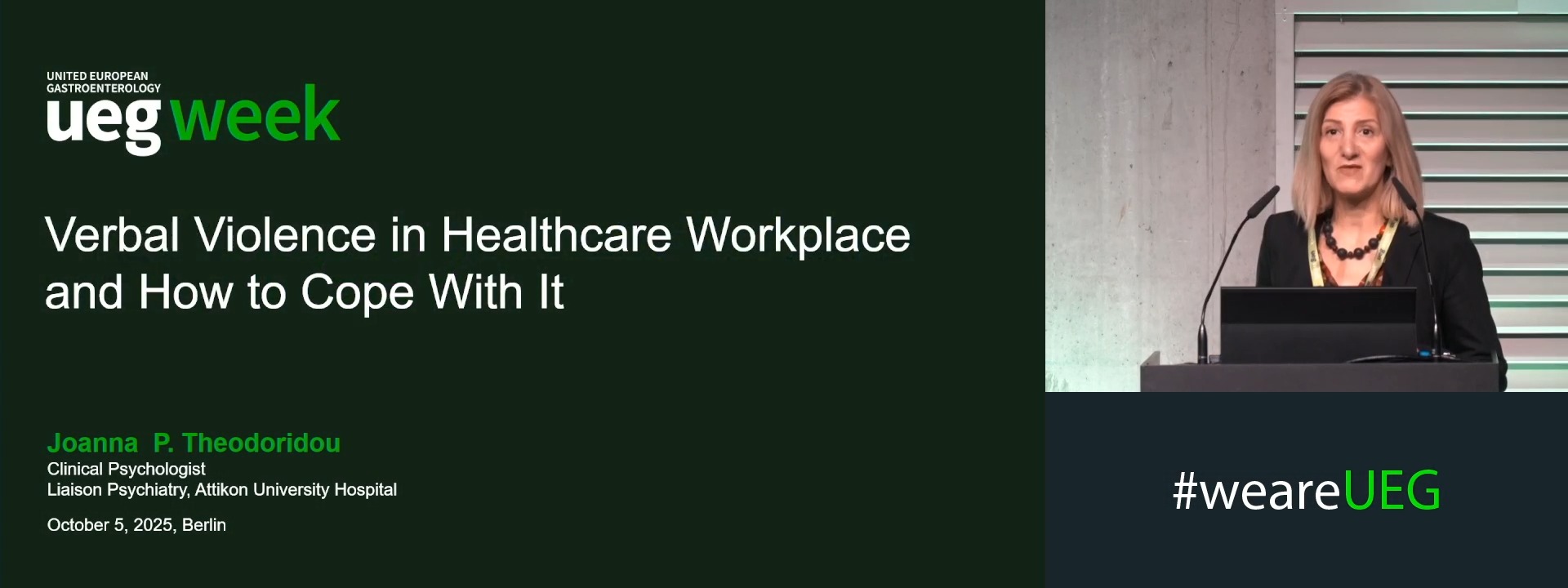
Verbal violence in the healthcare workplace and how to cope with it
1 None, None, Greece
Event
Topics
Session