UEG's educational platform for gastroenterology education bringing recordings, courses, guidelines, and more together in one place.
Most popular content
Rate for better recommendations!
Your feedback helps us show you more of what you like and less of what you dislike!
Log in to access this content.
Free for all myUEG account holders. Your access level is set automatically based on your occupation. Medical professionals get full access to all content. If you are a non-medical user, you can only access UEG Week content from congresses you attended.
Not sure what you can access? Learn more about account types.
EFFICACY OF SIMETHICONE PRIOR TO UPPER ENDOSCOPY ON MUCOSAL VISUALIZATION: PRELIMINARY RESULTS OF A BLINDED PROSPECTIVE TRIAL
Daniela Abrantes 1, André Bargas Bárbara 1, Ana Catarina Bravo 1, Bárbara Abreu 1, Madalina Gututui 1, Inês Alves 1, Daniel Tavares 1, Marisa Morais 1, Mafalda Mantas 1, João Cortez-Pinto 1, Catarina Frias-Gomes 1, Carolina Palmela 1, Catarina Gouveia 1, Elídio Barjas 1, Manuela Canhoto 1, Lídia Maria Roque Ramos 1, Joana Torres 1, Alexandre Oliveira Ferreira 1, Rui Loureiro 1, Maria Luisa Gloria 1
1 Unidade Local de Saúde de Loures/Odivelas, Hospital Beatriz Angelo, Loures, Portugal
Conference
Topics
Submission format
Citation
Published
Log in to access this content.
Free for all myUEG account holders. Your access level is set automatically based on your occupation. Medical professionals get full access to all content. If you are a non-medical user, you can only access UEG Week content from congresses you attended.
Not sure what you can access? Learn more about account types.
The endoscopy nurse's guide to the GI galaxy
1 University General Hospital Attikon, Athens, Greece
Event
Topics
Session
Citation
Published
Log in to access this content.
Free for all myUEG account holders. Your access level is set automatically based on your occupation. Medical professionals get full access to all content. If you are a non-medical user, you can only access UEG Week content from congresses you attended.
Not sure what you can access? Learn more about account types.
EUS-guided therapy of gastric varices: The role of endoscopic nurse-team work
1 Wojskowy Instytut Medyczny, Warsaw, Poland
2 Hospital of the Ministry of Interior and Administration, Szczecin, Poland
Event
Topics
Citation
Published
Log in to access this content.
Free for all myUEG account holders. Your access level is set automatically based on your occupation. Medical professionals get full access to all content. If you are a non-medical user, you can only access UEG Week content from congresses you attended.
Not sure what you can access? Learn more about account types.
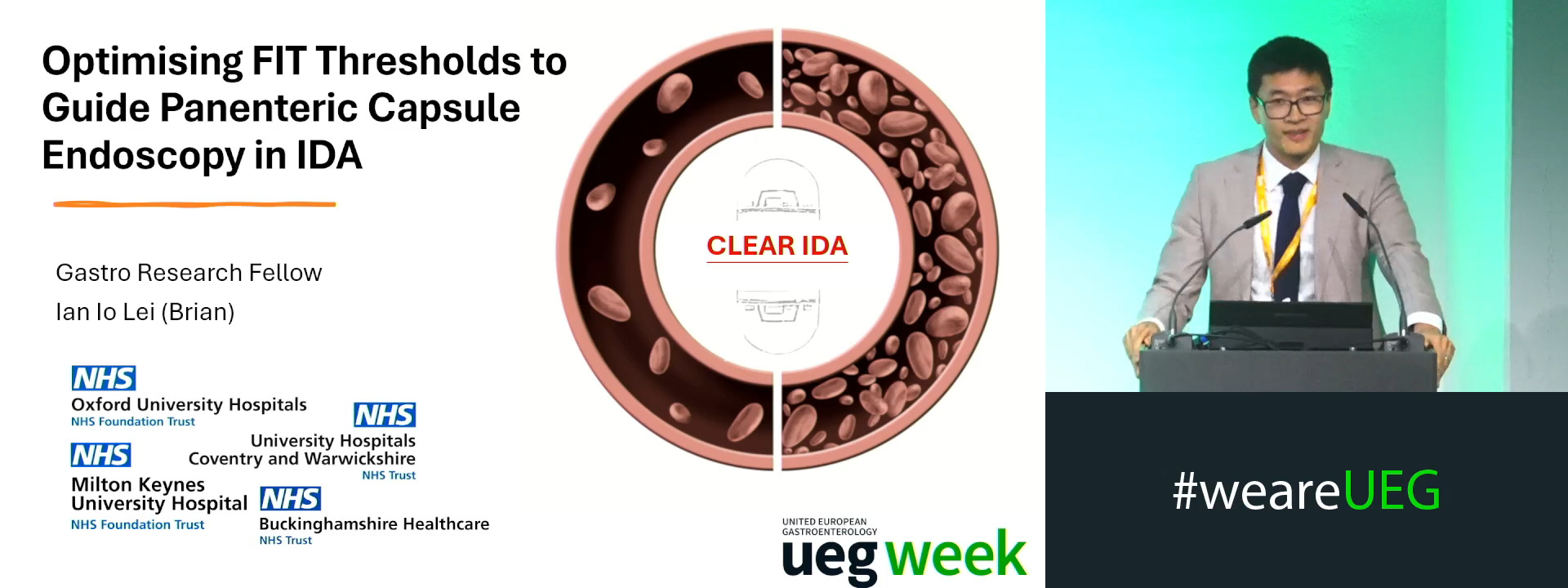
FROM STOOL TO SCOPE: OPTIMISING FIT THRESHOLDS TO GUIDE FUTURE PANENTERIC CAPSULE ENDOSCOPY AND REDUCE COLONOSCOPY BURDEN IN IRON DEFICIENCY ANAEMIA
Ian Io Lei 1, Nicola O'Connell 2, Michael Adu-Darko 3, Jessiya Parambil 4, Vishnupriya Suresh 2, Kiara McDonnell 5, Jessie Newville 5, Kirsten Chaplin 5, Deekshi Siyambalapityage 5, Asad Khan 3, Usman Muhammad 3, John Emil 3, Merali Abbas 3, Zia Kanji 3, Hamza Alam 3, Amelia Bennett 4, Hannah Soanes 4, Adrija Bhattacharyya 4, Karl Frey 4, Rosie Meakins 4, Archit Singhal 4, George Pack 4, Melike Gerrits 4, Harry Paterson 4, Vincent Cheung 6, Sue Cullen 5, Muhammad Imran Aslam 7, Ramesh P. Arasaradnam 2
1 University Hospital of Coventry and Warwickshire, Coventry, United Kingdom
2 University Hospital Coventry and Warwickshire, Coventry, United Kingdom
3 Milton Keynes University Hospital,, Milton Keynes, United Kingdom
4 Oxford University Hospital, Oxford, United Kingdom
5 Stoke Mandeville Hospital, Buckinghamshire Healthcare NHS Trust, Aylesbury, United Kingdom
6 John Radcliffe Hospital, Oxford, United Kingdom
7 University Hospitals of Coventry and Warwickshire, Coventry, United Kingdom
Event
Topics
Submission format
Citation
Published
Log in to access this content.
Free for all myUEG account holders. Your access level is set automatically based on your occupation. Medical professionals get full access to all content. If you are a non-medical user, you can only access UEG Week content from congresses you attended.
Not sure what you can access? Learn more about account types.
TRANSFORMING COLONOSCOPY: AI’S ROLE IN BOOSTING ADENOMA DETECTION ACROSS EXPERIENCE LEVELS
Delio Stefani Donati 1, Arianna Venturini 1, Pierfrancesco Visaggi 2, Dario Gambaccini 1, Gherardo Tapete 1, Veronica Natali 1, Filippo Ovidi 3, Antonio Grosso 3, Irene Solinas 3, Andrea Pancetti 1, Valeria Bolognesi 1, Emanuele Marciano 1
1 Endoscopy Unit, Azienda Ospedaliero Universitaria Pisana, Pisa, Italy
2 Endoscopy Unit, Azienda Ospedaliero Universitaria Pisana, Pisa, Italy|||Gastroenterology Unit, University of Pisa, Pisa, Italy
3 Gastroenterology Unit, University of Pisa, Pisa, Italy
Conference
Topics
Submission format
Citation
Published
Log in to access this content.
Free for all myUEG account holders. Your access level is set automatically based on your occupation. Medical professionals get full access to all content. If you are a non-medical user, you can only access UEG Week content from congresses you attended.
Not sure what you can access? Learn more about account types.
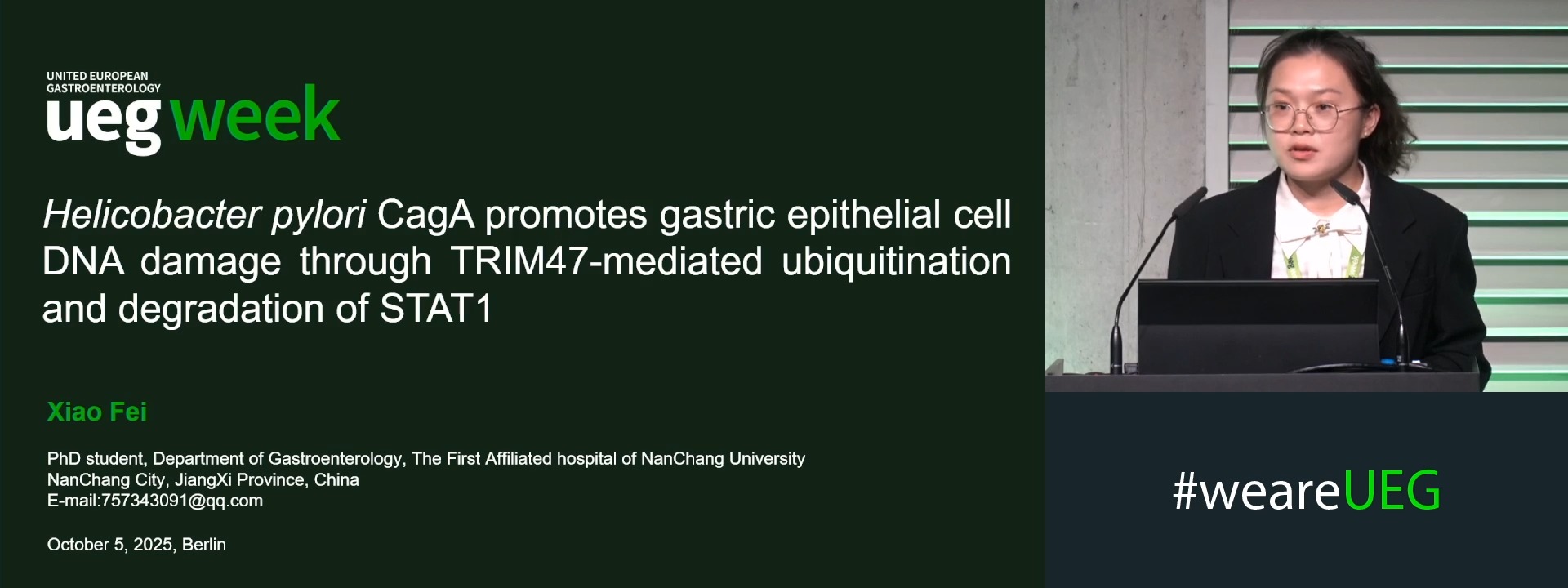
HELICOBACTER PYLORI CAGA PROMOTES GASTRIC EPITHELIAL CELL DNA DAMAGE THROUGH TRIM47-MEDIATED UBIQUITINATION AND DEGRADATION OF STAT1
1 The First Affiliated Hospital, Jiangxi Medical College, Nanchang University, Nanchang, China
Event
Submission format
Citation
Published
Log in to access this content.
Free for all myUEG account holders. Your access level is set automatically based on your occupation. Medical professionals get full access to all content. If you are a non-medical user, you can only access UEG Week content from congresses you attended.
Not sure what you can access? Learn more about account types.
ADVANTAGE OF RETROFLEX INSPECTION FOLLOWING FORWARD VIEW INSPECTION IN THE ASCENDING COLON DURING COLONOSCOPY
1 Kohseichuo General Hospital, Tokyo, Japan|||Gunma University Graduate School of Medicine, Gunma, Japan
2 Kohseichuo General Hospital, Tokyo, Japan
Conference
Topics
Submission format
Session