Introduction
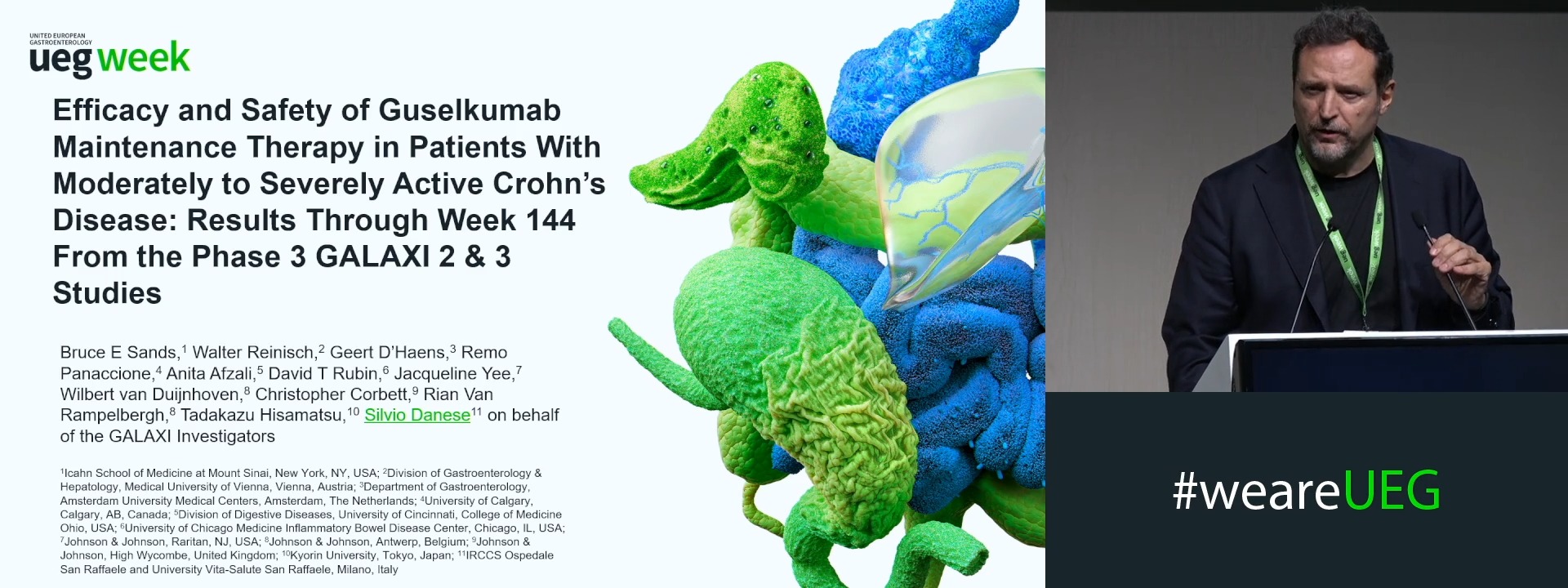
Guselkumab (GUS) is a dual-acting IL-23p19 subunit inhibitor that potently neutralizes IL-23 and binds to CD64, a receptor on cells that produce IL-23, and is approved for moderately to severely active CD.1 We report long-term efficacy/safety through Wk144 from the pooled GALAXI 2&3 long-term extension (LTE).
Aims & Methods
Pts with moderately to severely active CD (CDAI 220-450 and SES-CD≥6; or ≥4 for ileal-only disease) and a history of inadequate response/loss of response/intolerance to oral corticosteroids (CS), AZA/6-MP/MTX, or biologics (BIO-IR) were randomized to GUS 200mg IV induction at Wks0/4/8, followed by 200mg SC q4w or 100mg SC q8w as maintenance in a treat-through design. Pts were also randomized to ustekinumab (UST), but studies were not designed to compare GUS to UST beyond Wk48. Blinding was maintained through completion of the Wk48 analysis. Pts entered the LTE at Wk48 and continued their assigned maintenance dose. Between Wks52-80, pts on GUS 100mg SC q8w meeting inadequate response criteria underwent dose escalation to 200mg SC q4w. In the primary efficacy analysis, pts who met treatment failure criteria or had missing data were considered non-responders. In the LTE As Observed (LTE-AO) analysis, pts with available data who remained on continuous treatment through each timepoint were included. Clinical remission, 90-day CS-free clinical remission, endoscopic response, and endoscopic remission were assessed through Wk144 (definitions in Table).
Results
In total, 582 pts in the primary efficacy analysis set received GUS IV induction; 286 and 296 subsequently received GUS 100mg SC q8w and 200mg SC q4w. In total, 432/582 (74%) of GUS-treated pts continued treatment through Wk144.
At Wk144, among all randomized GUS-treated pts in the primary efficacy analysis set, pts achieved high proportions of clinical remission, 90D CS-free remission, endoscopic response, and endoscopic remission; these results were generally consistent with findings at Wks48/96 (Table). Pts in the LTE-AO analysis set achieved high proportions of clinical remission, 90D CS-free remission, endoscopic response, and endoscopic remission at Wk144. In the bionaïve and BIO-IR subpopulations, generally similar proportions achieved clinical remission, 90D CS-free remission, endoscopic response, and endoscopic remission at Wk144 (data not shown).
Through Wk144, safety events per 100 pt-years (py) were not higher in the GUS 100mg and 200mg groups vs PBO: AEs (274.2 and 295.8 vs 422.8), serious AEs (11.6 and 10.7 vs 27.3), serious infections (0.9 and 1.6 vs 4.5), and AEs leading to discontinuation (5.1 for both vs 19.3). Across GUS groups, AEs of interest per 100py were rare: active TB (GUS 100mg and 200mg: 0.2 and 0.1), malignancies (0.2 and 0.3), opportunistic infections (0.2 and 1.3), MACE (0.2 and 0.0), VTE (0.0 and 0.2), and clinically important hepatic disorders (0.5 and 0.7).
| Table. Efficacy summary through Week 144 |
| GUS 200 mg IV → 100 mg SC q8w
| GUS 200 mg IV → 200 mg SC q4w
|
Clinical remission
Primary efficacy analysis (NRI), N
Week 48, n (%)
Week 96, n (%)
Week 144, n (%)
LTE As Observed analysis, n/N (%)
Week 48
Week 96
Week 144
|
286
187 (65.4%)
170 (59.4%)
163 (57.0%)
199/251 (79.3%)
183/200 (91.5%)
172/183 (94.0%)
|
296
206 (69.6%)
187 (63.2%)
177 (59.8%)
214/256 (83.6%)
198/212 (93.4%)
185/204 (90.7%)
|
90-day corticosteroid-free clinical remission
Primary efficacy analysis (NRI), N
Week 48, n (%)
Week 96, n (%)
Week 144, n (%)
LTE As Observed analysis, n/N (%)
Week 48
Week 96
Week 144
|
286
180 (62.9%)
163 (57.0%)
154 (53.8%)
190/251 (75.7%)
174/200 (87.0%)
162/183 (88.5%)
|
296
190 (64.2%)
180 (60.8%)
171 (57.8%)
195/256 (76.2%)
192/212 (90.6%)
179/204 (87.7%)
|
Endoscopic response
Primary efficacy analysis (NRI), N
Week 48, n (%)
Week 96, n (%)
Week 144, n (%)
LTE As Observed analysis, n/N (%)
Week 48
Week 96
Week 144
|
286
137 (47.9%)
126 (44.1%)
116 (40.6%)
140/246 (56.9%)
130/196 (66.3%)
121/172 (70.3%)
|
296
156 (52.7%)
132 (44.6%)
143 (48.3%)
164/254 (64.6%)
140/207 (67.6%)
150/195 (76.9%)
|
Endoscopic remission
Primary efficacy analysis (NRI), N
Week 48, n (%)
Week 96, n (%)
Week 144, n (%)
LTE As Observed analysis, n/N (%)
Week 48
Week 96
Week 144
|
286
95 (33.2%)
81 (28.3%)
87 (30.4%)
98/246 (39.8%)
83/196 (42.3%)
89/172 (51.7%)
|
296
110 (37.2%)
93 (31.4%)
113 (38.2%)
116/254 (45.7%)
99/207 (47.8%)
119/195 (61.0%)
|
CD=Crohn’s disease; CDAI=Crohn’s disease activity index; GUS= guselkumab; IV= intravenous; LTE= long-term extension; NRI= participants who met treatment failure criteria or had missing data were considered non-responders (see below for further details); SC= subcutaneous; SES-CD=simple endoscopic score for Crohn’s disease.
Note: Clinical remission is defined as CDAI<150. Endoscopic response is defined as a ≥50% improvement from baseline in SES-CD score or SES-CD Score ≤ 2. Endoscopic remission is defined as an SES-CD Score ≤4 and at least a 2-point reduction from baseline and no subscore greater than 1 in any individual component. Participants in the primary efficacy analysis had moderately to severely active Crohn’s disease (CDAI 220-450 and SES-CD≥6; or ≥4 for ileal-only disease); a history of inadequate response or intolerance to oral corticosteroids, azathioprine, 6-mercaptopurine, methotrexate, or biologics; and who received ≥1 study drug dose.
Participants who were not in clinical response (≥100-point reduction in CDAI score from baseline or CDAI <150) and had CDAI ≥220 were eligible for dose adjustment (ie, guselkumab 100mg SC q8w → 200mg SC q4w or “sham” for participants treated with guselkumab 200mg SC q4w) between Weeks 52-80.
In the primary efficacy analysis, participants who had a CD-related surgery (with the exception of minor procedures), had a prohibited change in CD medications prior to Week 48, had a dose adjustment (including "sham") during Weeks 52-80, or discontinued study intervention for any reason (other than COVID-19 related reasons [excluding COVID-19 infection] or regional crisis) were considered not to have met the endpoint at the designated timepoint. Participants who discontinued study intervention due to COVID-19 related reasons (excluding COVID-19 infection) or regional crisis had their observed data used, if available. After accounting for the aforementioned data handling rules, participants who were missing data pertaining to an endpoint at the designated timepoint were considered not to have achieved the endpoint.
Participants in the LTE As Observed analysis had moderately to severely active Crohn’s disease (CDAI 220-450); a history of inadequate response or intolerance to oral corticosteroids, azathioprine, 6-mercaptopurine, methotrexate, or biologics; and who received ≥1 study drug dose in the LTE. In the As Observed analysis, no intercurrent events were defined and patients received continuous treatment up to the designated timepoint and had data available at the designated timepoint. Participants who had a dose adjustment from guselkumab 100 mg SC q8w to guselkumab 200 mg SC q4w are not included from the day after the date of dose adjustment. |
Conclusion
The overall benefit-risk profile of GUS in pts with moderately to severely active CD is further substantiated by the long-term efficacy/safety results from the 3yr LTE.
References
1) Sachen K, Hammaker D, Sarabia I, et al. Frontiers in Immunology. 2025; doi:10.3389/fimmu.2025.1532852.
Disclosure
BES reports honoraria for consulting and speaking and other support from J&J Innovative Medicine/Janssen.
WR has served as a speaker, a consultant, an advisory board member, and has received research funding from Johnson & Johnson.
GD reports consultancy activities for Johnson & Johnson.
RP reports having received consulting fees, speaker's fees, and served on advisory boards for Janssen.
AA reports having received consulting fees from Janssen and Johnson & Johnson; Speaker fees from Johnson & Johnson; and served on Advisory Boards for Janssen and Johnson & Johnson,
DTR has served as a consultant for Janssen Pharmaceuticals and Johnson & Johnson.
JY, WvD, CC, and RVR are employees of Johnson & Johnson and may own company stock/stock options.
TH received consulting fees and lecture fees from Janssen Pharmaceuticals.
SD reports consultancy fees from Janssen and Johnson & Johnson; and reports lecture fees from Janssen.