Introduction
Endoscopic healing is an important objective outcome measure in Crohn’s disease trials and a key treatment target in clinical practice. Despite growing focus on transmural healing, this is not currently recommended as a formal treatment target. Several, mostly retrospective, studies have reported that patients achieving transmural healing on cross-sectional imaging may have better outcomes than those with endoscopic healing alone.
Aims & Methods
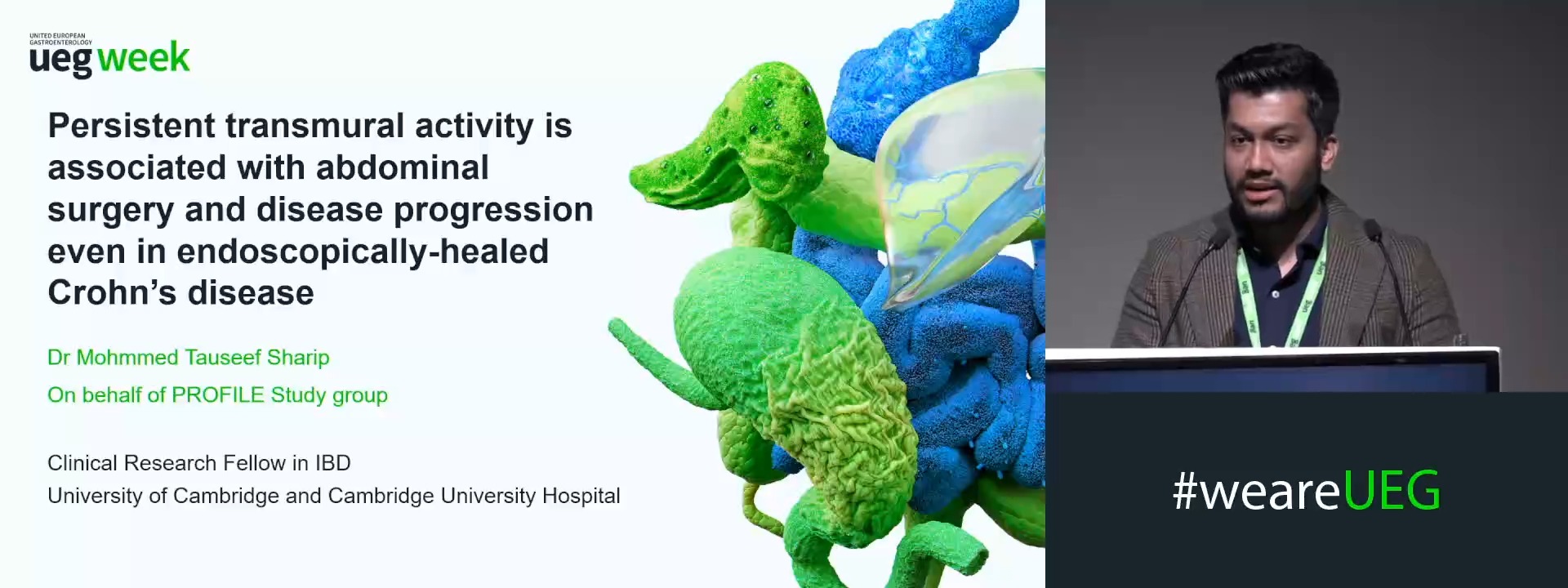
In a prospective randomised controlled trial (PROFILE), we aimed to evaluate discordance between endoscopic remission and transmural activity, and whether residual transmural activity correlated with adverse outcomes over subsequent five year follow-up.
PROFILE was a multicentre, open-label, randomized controlled trial (RCT) comparing top-down (early combined immunosuppression) with accelerated step-up therapy in adults with newly-diagnosed active Crohn’s disease. Participants underwent ileocolonoscopy and MRE at baseline and at the end of the trial (week 48), and were subsequently followed up for up to five years. Endoscopic activity was quantified using the Simple Endoscopic Score for Crohn’s Disease (SES-CD). Adjudicated central SES-CD at week 48 was used, with endoscopic remission defined as a total SES-CD of ≤4. Week-48 MRE studies were scored centrally on a per-segment basis.
Transmural assessment was restricted to endoscopically accessible sites to allow like-for-like comparison. Patients were cross-classified (2×2) by week-48 endoscopic status (remission vs active) and end-of-trial MRE transmural status (remission vs active), yielding four groups. The primary outcome measure for this study was a composite of abdominal surgery and development of stricturing (B2) or penetrating (B3) disease. Time-to-event outcomes were summarised with Kaplan–Meier estimates and compared across the four groups using a log-rank test.
Results
250 patients had paired week-48 ileo-colonoscopy and end-of-trial MRE (both centrally scored) and were event-free at this timepoint. After exclusion of 43 patients who did not meet the criteria for inclusion (e.g. prior abdominal surgery or established B2 or B3 disease), 207 patients formed the primary analysis cohort, among whom 16 needed abdominal surgery or had progression to B2/B3 disease over five years. Within the endoscopically accessible sites, 137 patients were in endoscopic remission (SES-CD ≤4) at week 48. Of these, 46/137 (34%) had persistent transmural activity on MRE within the endoscopically-healed sites, indicating discordance between endoscopic and transmural healing. Residual disease activity was almost exclusively within the terminal ileum (43/46, 93%) and was dominated by mural oedema (61%) and grade 3 wall thickening (54%). Conversely, deep ulceration was uncommon (9%). Notably, 21 of the 46 discordant patients (46%) had a week-48 SES-CD of 0, despite evidence of ongoing transmural disease activity. Need for abdominal surgery or progression to B2/B3 disease occurred in 5/46 (11%) patients with residual transmural activity despite endoscopic healing compared with 1/91 (1%) patients who were in both endoscopic and transmural remission (odds ratio 10.8, 95% CI 1.2–525; Fisher’s exact p=0.016).
Conclusion
Our study demonstrates that transmural activity can persist in approximately one in three patients with Crohn’s disease who have achieved endoscopic remission. Ongoing transmural activity was associated with higher risk of disease progression and abdominal surgery over a five-year period.
References
- Noor NM, Lee JC, Bond S, et al. A biomarker-stratified comparison of top-down versus accelerated step-up treatment strategies for patients with newly-diagnosed Crohn’s disease (PROFILE): a multicentre, open-label randomised controlled trial. Lancet Gastroenterology & Hepatology. 2024. PMID 38402895.
- Noor NM, Davies N, Tahir W, et al. Anti-TNF treatment from diagnosis is more effective and less costly than conventional ‘step-up’ care for patients with active Crohn’s disease: a cost-effectiveness analysis from the PROFILE trial. Journal of Crohns and Colitis. 2025. PMID 41125135.
Disclosure
MTS reports grant from AstraZeneca; support for attending meetings and travel from Takeda; and fees from advisory board membership of Dr Falk, Teva. NAK reports grants from Pharmacosmos; consulting fees from AbbVie, BMS, Falk, J&J, Pharmacosmos, Sandoz; honoraria from AbbVie, J&J, Pharmacosmos, Tillotts; support for attending meetings from AbbVie, J&J, Lilly. JCL reports grants or contracts from Kenneth Rainin Foundation Research Grant, MRC/MSD Alliance Research Grant, Lifearc ‘idea-to-innovation’ research grant; has received consulting fees from J&J, Enhanced Genomics, Pasithea, Isomorphic Labs; honoraria from J&J, AbbVie; patents planned, issued or pending GB2304900.0: “Methods of Treatment of Inflammatory Diseases”. MP reports travel grants from J&J, Takeda; and grants from AstraZeneca, Celltrion, Galapagos, Gilead, Lilly, Pfizer. NMN reports educational/travel grants and/or speaker fees from AbbVie, BMS, Celltrion, Falk, Ferring, J&J, Lilly, Medfyle, Pfizer, Pharmacosmos, Takeda and Tillotts; all outside the submitted work. All other authors report no conflicts of interest.