UEG's content platform for gastroenterology education bringing recordings, courses, guidelines, and more together in one place.
Trending on Gutflix
Rate for better recommendations!
Your feedback helps us show you more of what you like and less of what you dislike!
Log in to continue.
This content is part of Gutflix. Log in with your myUEG account, or create one free, to watch it.
Not sure what you can access? Learn more about account types.
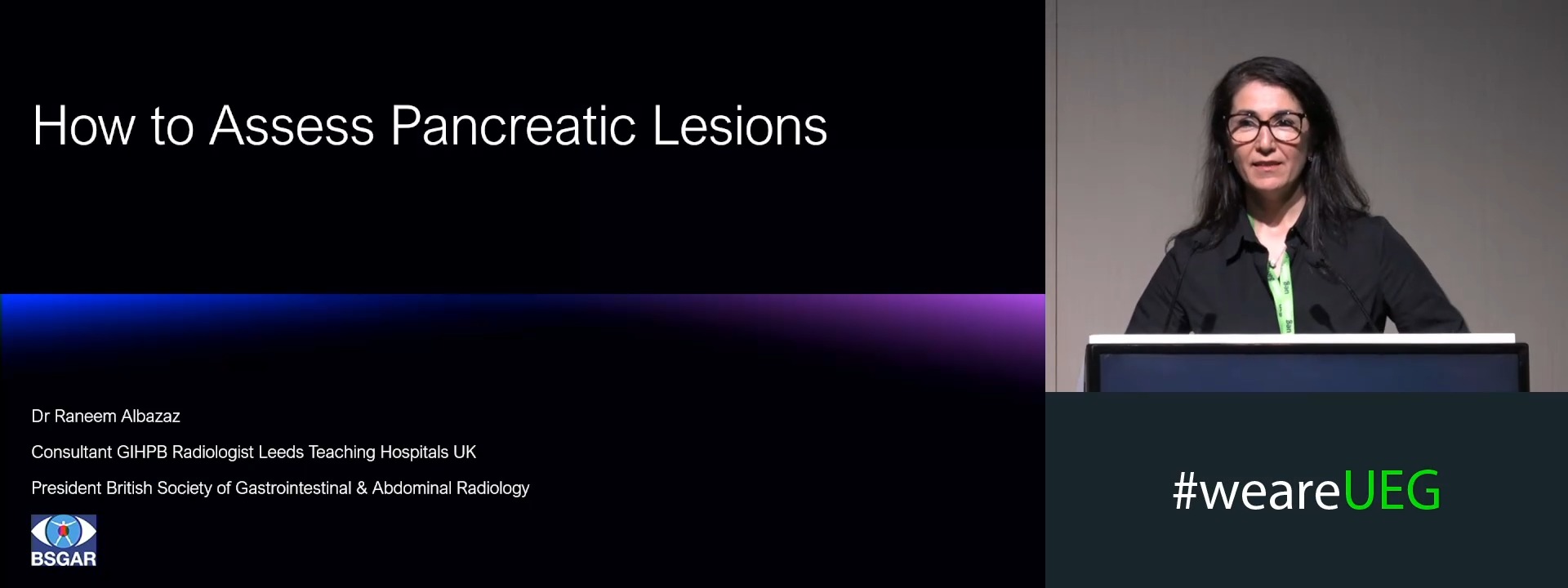
How to assess pancreatic lesions
Affiliations
1 St. James University Hospital, Leeds, United Kingdom

Log in to continue.
This content is part of Gutflix. Log in with your myUEG account, or create one free, to watch it.
Not sure what you can access? Learn more about account types.
Panel discussion: Decision-making in acute liver failure: From expectant management to emergency transplant
Log in to continue.
This content is part of Gutflix. Log in with your myUEG account, or create one free, to watch it.
Not sure what you can access? Learn more about account types.
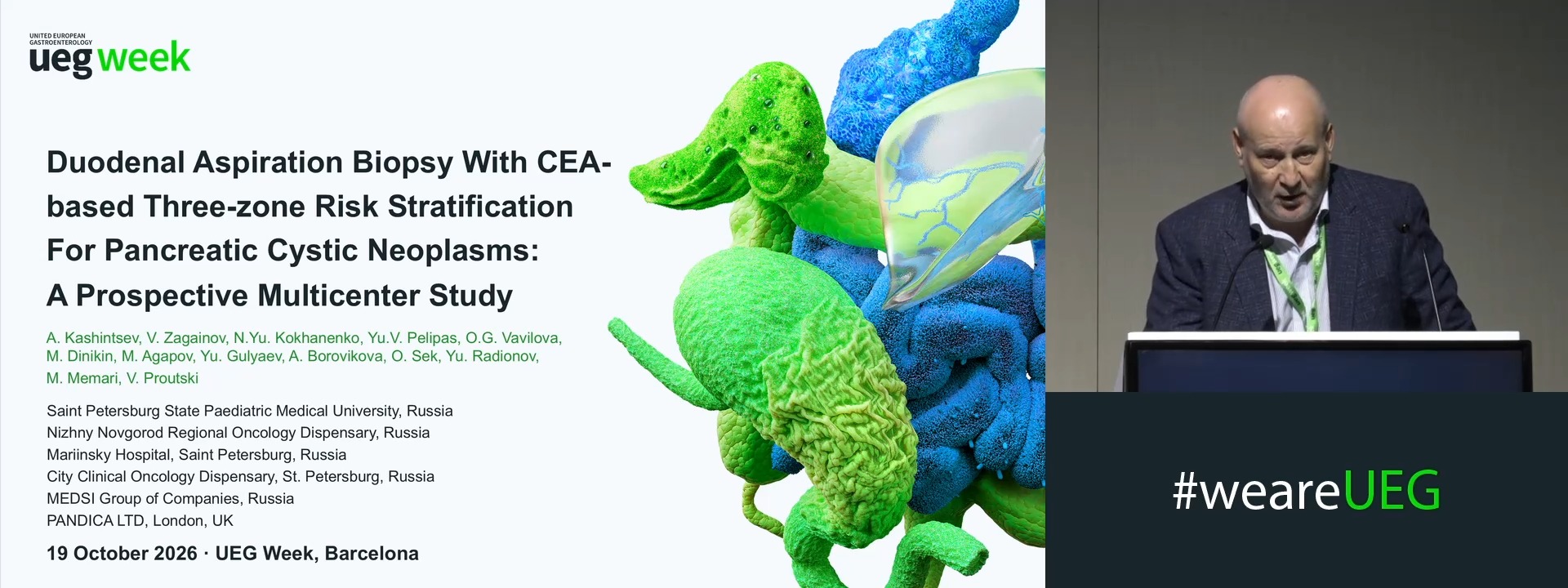
DUODENAL ASPIRATION BIOPSY WITH CEA-BASED THREE-ZONE RISK STRATIFICATION FOR PANCREATIC CYSTIC NEOPLASMS: A PROSPECTIVE MULTICENTER STUDY
Aleksei Kashintsev 1,2, Anna Borovikova 3, Nikolai Kokhanenko 3, Mikhail Dinikin 4, Yuriy Pelipas 4, Olga Vavilova 3, Vladimir Zagainov 5,6, Ok Sek 2, Mikhail Vasilchenko 7, Olga Kolokolnikova 7, Aleksandr Kolbasov 7, Nasipbek Naraliev 5,6, Vitali Proutski 8
Affiliations
1 Pandica LTD/ State Pediatric Medical University, London, United Kingdom
2 Medsi LTD, Saint-Petersburg, Russian Federation
3 State Pediatric Medical University, Saint-Petersburg, Russian Federation
4 Cities oncological hospital, Saint-Petersburg, Russian Federation
5 Privolzhskiy research medical university, Nizhniy Novgorod, Russian Federation
6 Oncology research institute, Nizhniy Novgorod, Russian Federation
7 Medsi, Krasnogorsk, Russian Federation
8 Pandica LTD, London, United Kingdom