UEG's educational platform for gastroenterology education bringing recordings, courses, guidelines, and more together in one place.
Most popular content
Rate for better recommendations!
Your feedback helps us show you more of what you like and less of what you dislike!
Log in to access this content.
Free for all myUEG account holders. Your access level is set automatically based on your occupation. Medical professionals get full access to all content. If you are a non-medical user, you can only access UEG Week content from congresses you attended.
Not sure what you can access? Learn more about account types.

LONG-TERM DUPILUMAB MAINTAINS HISTOLOGIC AND ENDOSCOPIC IMPROVEMENTS IN CHILDREN WITH EOSINOPHILIC ESOPHAGITIS: 100-WEEK RESULTS FROM THE OPEN-LABEL EXTENSION OF THE EOE KIDS STUDY
Mirna Chehade 1, Evan S. Dellon 2, Robbie Pesek 3, Margaret H. Collins 4, Dhandapani Ashok 5, Ruiqi Liu 6, Margee Louisias 7, Allen Radin 7
1 Mount Sinai Center For Eosinophilic Disorders, Icahn School Of Medicine At Mount Sinai, New York, United States
2 University of North Carolina School of Medicine, Nc, United States
3 University of Arkansas for Medical Sciences and Arkansas Children’s Hospital, Little Rock, United States
4 Cincinnati Children’s Hospital Medical Center and University of Cincinnati College of Medicine, Cincinnati, United States
5 Children’s Hospital, London Health Sciences Centre, Western University, London, Canada
6 Regeneron Pharmaceuticals Inc, Tarrytown, United States
7 Sanofi, Cambridge, United States
Conference
Topics
Submission format
Session
Citation
Published
Log in to access this content.
Free for all myUEG account holders. Your access level is set automatically based on your occupation. Medical professionals get full access to all content. If you are a non-medical user, you can only access UEG Week content from congresses you attended.
Not sure what you can access? Learn more about account types.
Nurse Programme (Complete Session)
Event
Citation
Published
Log in to access this content.
Free for all myUEG account holders. Your access level is set automatically based on your occupation. Medical professionals get full access to all content. If you are a non-medical user, you can only access UEG Week content from congresses you attended.
Not sure what you can access? Learn more about account types.
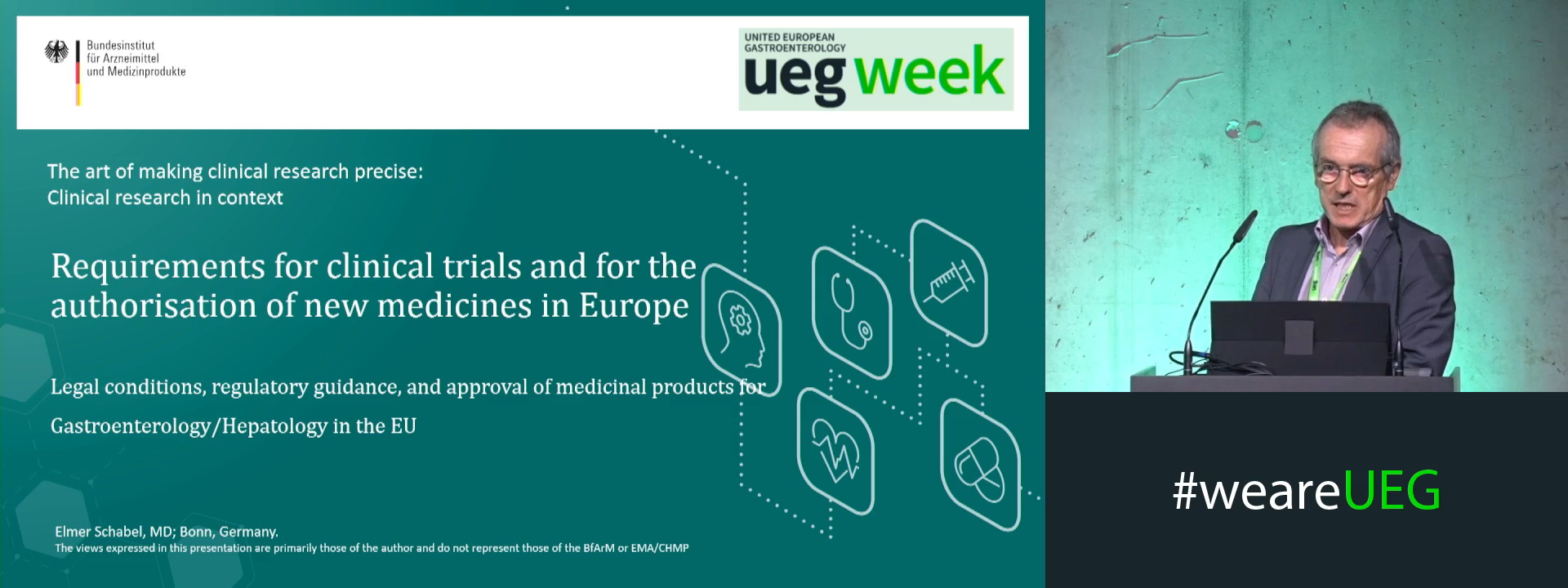
Requirements for clinical trials and for the authorisation of new medicines in Europe
1 Bundesinstitut für Arzneimittel und Medizinprodukte Abt. 2/FG Gastroenterologie, Bonn, Germany
Event
Citation
Published
Log in to access this content.
Free for all myUEG account holders. Your access level is set automatically based on your occupation. Medical professionals get full access to all content. If you are a non-medical user, you can only access UEG Week content from congresses you attended.
Not sure what you can access? Learn more about account types.
EFFICACY AND SAFETY OF MIRIKIZUMAB AS INDUCTION THERAPY FOR CHINESE PATIENTS WITH MODERATELY TO SEVERELY ACTIVE ULCERATIVE COLITIS: A SUBGROUP ANALYSIS OF THE PHASE 3 LUCENT-1 STUDY
Zhihua Ran 1, Jun Shen 2, Yan Chen 3, Juan Luo 4, Yufang Wang 5, Xueli Ding 6, Hao Fang 7, dan tang 8, Chenxi Qian 8, Jiao Yu 8
1 Renji Hospital, Shanghai, China|||Shanghai University of Medicine and Health Sciences Affiliated Zhoupu Hospital, Shanghai, China, SHANGHAI, China
2 Renji Hospital, School of Medicine, Shanghai Jiao Tong University, Shanghai, China, Shanghai, China
3 The Second Affiliated Hospital Zhejiang University School of Medicine, Hangzhou, China, Shanghai, China
4 The First Affiliated Hospital of Kunming Medical University, Kunming, China, Kunming, China
5 West China Hospital of Sichuan University, Chengdu, China, Chengduchina, China
6 The Affiliated Hospital of Qingdao University, Qingdao, China, Qingdao, China
7 Taian City Central Hospital, Taian, China, Taian, China
8 Eli Lilly and Company, Shanghai, China
Conference
Topics
Submission format
Session
Citation
Published
Log in to access this content.
Free for all myUEG account holders. Your access level is set automatically based on your occupation. Medical professionals get full access to all content. If you are a non-medical user, you can only access UEG Week content from congresses you attended.
Not sure what you can access? Learn more about account types.
TOFACITINIB VERSUS MONOCLONAL ANTIBODIES IN ULCERATIVE COLITIS: PROPENSITY SCORE MATCHED REAL WORLD EFFECTIVENESS DATA FROM THE PERSISTENCE AUSTRALIAN NATIONAL IBD COHORT (PANIC5)
Rupert W Leong 1, Yunki Yau 1, John Chetwood 1, Thanaboon Chaemsupaphan 1, Viraj Kariyawasam 1, Sudarshan Paramsothy 1, Aviv Pudipeddi 1
1 Concord Hospital, Sydney, Australia
Conference
Topics
Submission format
Citation
Published
Log in to access this content.
Free for all myUEG account holders. Your access level is set automatically based on your occupation. Medical professionals get full access to all content. If you are a non-medical user, you can only access UEG Week content from congresses you attended.
Not sure what you can access? Learn more about account types.
MULTI-OMICS BIOMARKERS FOR PREDICTING THERAPEUTIC EFFICACY IN INFLAMMATORY BOWEL DISEASE: ADVANCING TOWARDS TAILORED TREATMENTS
Montse Baldan Martin 1, Mikel Azkargorta 2, Ana M. Aransay 3, Rubén Gil-Redondo 4, Isabel Moreno-Indias 5, Ibon Iloro 2, Paula J Martínez 1, Irene Soleto 1, Macarena Orejudo del Río 1, Cristina Ramírez 1, Alfredo J. Lucendo 6, Cristina Rodríguez Gutiérrez 7, Ana Gutiérrez-Casbas 8, Eduardo Martín Arranz 9, Luis Bujanda Fernández de Piérola 10, Iago Rodríguez-Lago 11, Ruth María de Francisco García 12, Eva Iglesias-Flores 13, Fernando Bermejo 14, Manuel Van Domselaar 15, María José García 16, Luis Fernández-Salazar 17, Francisco Javier Garcia-Alonso 18, Xavier Calvet Calvo 19, Leyanira Torrealba 20, Iria Bastón-Rey 21, Hector Pallares Manrique 22, Yolanda Ber Nieto 23, Eduardo Leo Carnerero 24, María José Casanova 1, Oscar Millet 4, Felix Elortza 2, Jose Mato 4, Francisco J Tinahones 5, María Chaparro 1, Javier P. Gisbert 1
1 Hospital Universitario de La Princesa, Instituto de Investigación Sanitaria Princesa (IIS-Princesa), Universidad Autónoma de Madrid (UAM) and Centro de Investigación Biomédica en Red de Enfermedades Hepáticas y Digestivas (CIBEREHD), Madrid, Spain
2 Proteomics Platform, CIC bioGUNE, Basque Research & Technology Alliance (BRTA), CIBEREHD, Derio, Spain
3 Genome Analysis Platform, CIC bioGUNE, BRTA, CIBEREHD, Derio, Spain
4 Precision Medicine and Metabolism Lab, CIC bioGUNE, Derio, Spain
5 Department of Endocrinology and Nutrition, Virgen de la Victoria University Hospital, Málaga; Centro de Investigación Biomédica en Red de Fisiopatología de la Obesidad y la Nutrición (CIBEROBN), Instituto de Salud Carlos III, Malaga, Spain
6 Hospital General de Tomelloso, Instituto de Investigación Sanitaria de Castilla-La Mancha (IDISCAM), CIBEREHD., Ciudad Real, Spain
7 Hospital Universitario de Navarra., Pamplona, Spain
8 Hospital General Universitario de Alicante, CIBERehd and Instituto Investigación Sanitaria y Biomédica de Alicante., Alicante, Spain
9 Hospital Universitario La Paz and Instituto de Investigación Sanitaria La Paz (IdiPaz)., Madrid, Spain
10 Hospital Universitario Donostia and Instituto Biodonostia. Universidad del País Vasco (UPV/EHU)., Donostia, Spain
11 Hospital Universitario de Galdakao, Biocruces Bizkaia HRI., Vizcaya, Spain
12 Hospital Universitario Central de Asturias and Instituto de Investigación Sanitaria del Principado de Asturias (ISPA)., Oviedo, Spain
13 Hospital Universitario Reina Sofia, Cordoba, Spain
14 Hospital Universitario de Fuenlabrada., Madrid, Spain
15 Hospital Universitario de Torrejón., Madrid, Spain
16 Hospital Universitario Marqués de Valdecilla and IDIVAL, Santander, Spain
17 Hospital Clínico Universitario de Valladolid., Valladolid, Spain
18 Hospital Universitario Rio Hortega, Valladolid, Spain
19 Consorci Corporació Santitària Parc Taulí, CIBEREHD., Sabadell, Spain
20 Hospital Universitario Dr. Josep Trueta., Girona, Spain
21 Hospital Clínico Universitario de Santiago., Santiago de Compostela, Spain
22 H. juan ramon jimenezHospital Juan Ramón Jiménez., Huelva, Spain
23 Hospital San Jorge., Huesca, Spain
24 Hospital Universitario Virgen del Rocío, Sevilla, Spain
Conference
Topics
Submission format
Citation
Published
Log in to access this content.
Free for all myUEG account holders. Your access level is set automatically based on your occupation. Medical professionals get full access to all content. If you are a non-medical user, you can only access UEG Week content from congresses you attended.
Not sure what you can access? Learn more about account types.
INTEGRATED RAMAN SPECTROSCOPY AND ADVANCED ENDOSCOPY FOR INTESTINAL BARRIER PROFILING IN INFLAMMATORY BOWEL DISEASE: TRYPTOPHAN METABOLITES AS DIAGNOSTIC BIOMARKERS
Marietta Iacucci 1, Giovanni Santacroce 1, Ivan Capobianco 1, Daniyal M. Ghauri 2, Katarzyna Komolibus 1, SNEHALI MAJUMDER 1, Cecilia Lina Pugliano 1, Andrea Ruffa 1, Sumedha Chanda 2, Maria Victoria Fernandez 1, Sanathana Konugolu Venkata Sekar 2, Irene Zammarchi 1, Brian Hayes 3, Rory Crotty 3, Rekha Gautam 1, Stefan Andersson-Engels 2, Subrata Ghosh 1
1 University College Cork, Cork, Ireland
2 University College Cork, Cork, Ireland|||University College Cork, Cork, Ireland
3 Cork University Hospital, Cork, Ireland
Conference
Topics