UEG's educational platform for gastroenterology education bringing recordings, courses, guidelines, and more together in one place.
Most popular content
Rate for better recommendations!
Your feedback helps us show you more of what you like and less of what you dislike!
Log in to access this content.
Free for all myUEG account holders. Your access level is set automatically based on your occupation. Medical professionals get full access to all content. If you are a non-medical user, you can only access UEG Week content from congresses you attended.
Not sure what you can access? Learn more about account types.

A PROSPECTIVE, RANDOMIZED TRIAL COMPARING PROPOFOL AND REMIMAZOLAM FOR SEDATION IN ADVANCED ENDOSCOPIC PROCEDURES
Alina Liliana Constantin 1, Nicoleta Podina 1, Despina Ungureanu 1, Ruxandra Pop 1, Iulia-Cristina Stoicoiu 2, Mihaela Roxana Badescu 1, Adrian Săftoiu 3
1 Ponderas Academic Hospital, Bucharest, Romania
2 Fundeni Clinical Institute, Bucharest, Romania
3 Elias Emergency University Hospital, Bucharest, Romania
Conference
Topics
Submission format
Citation
Published
Log in to access this content.
Free for all myUEG account holders. Your access level is set automatically based on your occupation. Medical professionals get full access to all content. If you are a non-medical user, you can only access UEG Week content from congresses you attended.
Not sure what you can access? Learn more about account types.
Welcome
1 ESGENA Scientific Secretary, Ulm, Germany
2 Mater Misericordiae University Hospital, Dublin, Ireland
Event
Topics
Session
Citation
Published
Log in to access this content.
Free for all myUEG account holders. Your access level is set automatically based on your occupation. Medical professionals get full access to all content. If you are a non-medical user, you can only access UEG Week content from congresses you attended.
Not sure what you can access? Learn more about account types.
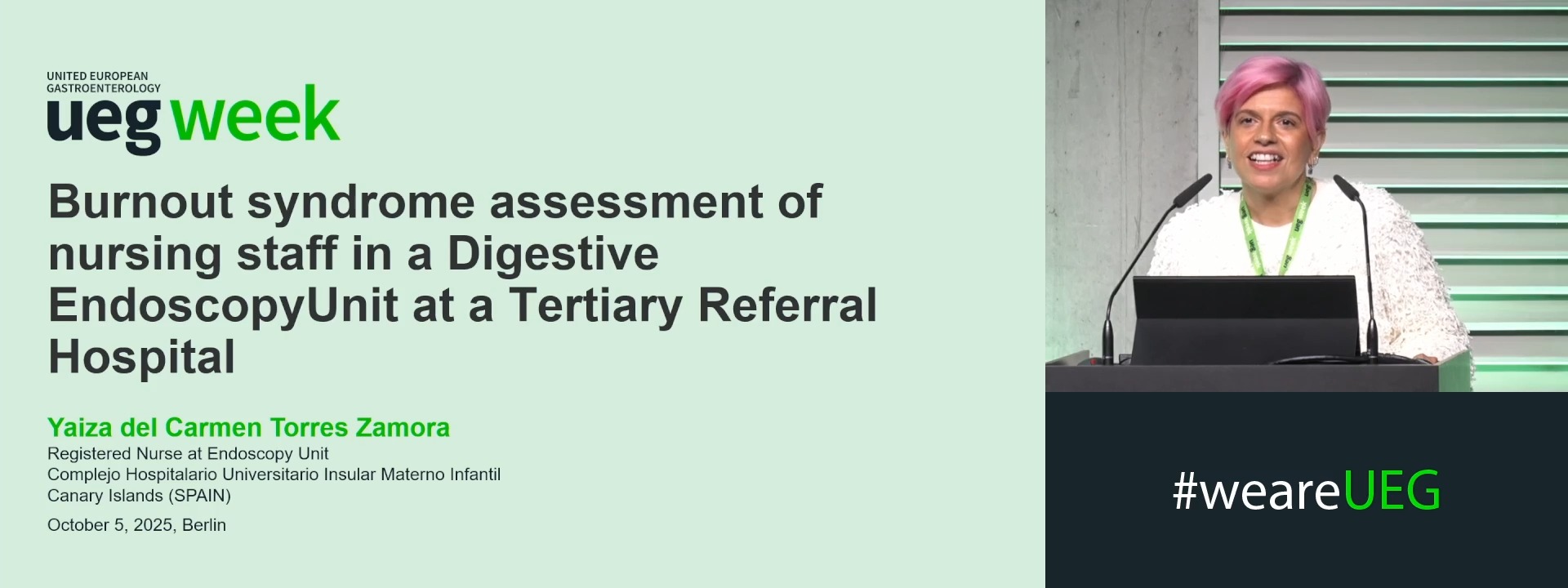
BURNOUT SYNDROME ASSESSMENT OF NURSING STAFF IN A DIGESTIVE ENDOSCOPY UNIT AT A TERTIARY REFERRAL HOSPITAL
1 Complejo Hospitalario Insular Materno Infantil, Las Palmas de Gran Canaria, Spain
Event
Topics
Submission format
Citation
Published
Log in to access this content.
Free for all myUEG account holders. Your access level is set automatically based on your occupation. Medical professionals get full access to all content. If you are a non-medical user, you can only access UEG Week content from congresses you attended.
Not sure what you can access? Learn more about account types.
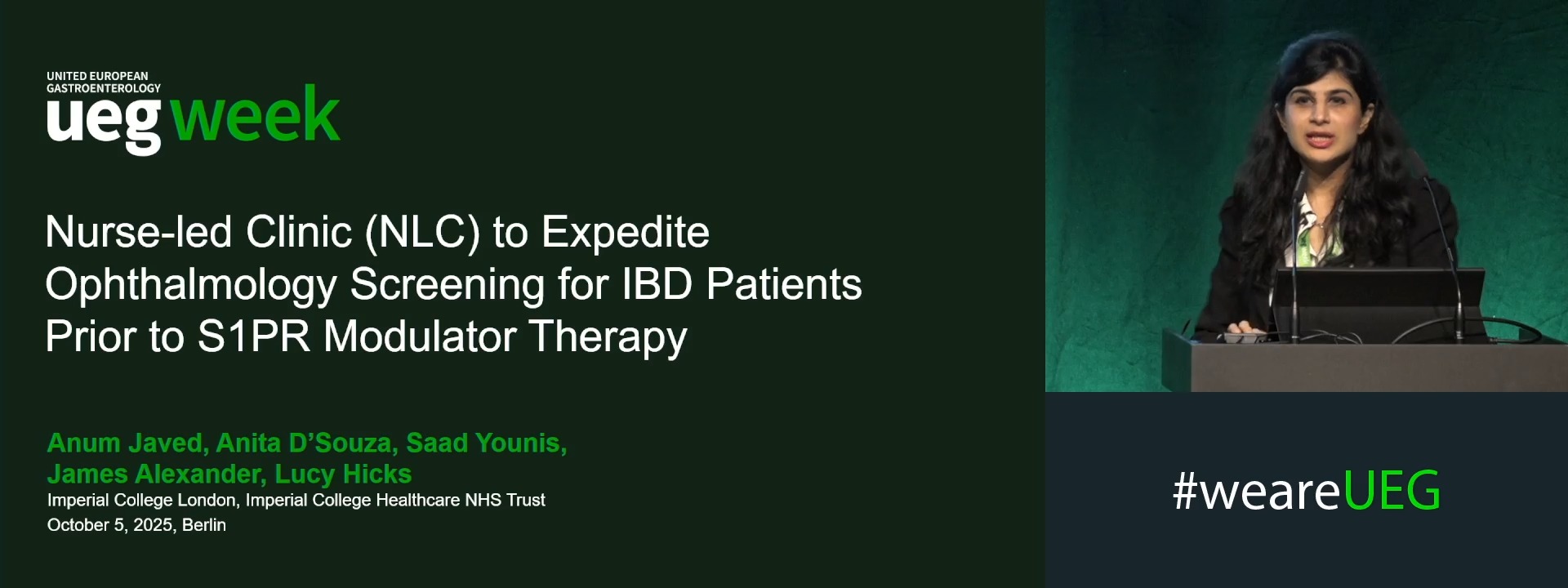
NURSE-LED CLINIC (NLC) TO STREAMLINE OPHTHALMOLOGY SCREENING FOR IBD PATIENTS PRIOR TO INITIATING SPHINGOSINE-1-PHOSPHATE RECEPTOR (S1PR) MODULATOR THERAPY
1 Imperial College Healthcare NHS Trust, London, United Kingdom
Event
Topics
Submission format
Citation
Published
Log in to access this content.
Free for all myUEG account holders. Your access level is set automatically based on your occupation. Medical professionals get full access to all content. If you are a non-medical user, you can only access UEG Week content from congresses you attended.
Not sure what you can access? Learn more about account types.
THE OLIVE TREE: AN ELECTRONIC TOOL TO SAFELY INITIATE PARENTERAL NUTRITION IN ADULT HOSPITALIZED PATIENTS WITH INTESTINAL FAILURE
1 KU Leuven, Leuven, Belgium|||University Hospitals Leuven, Leuven, Belgium
2 University Hospitals Leuven, Leuven, Belgium
Conference
Topics
Submission format
Session
Citation
Published
Log in to access this content.
Free for all myUEG account holders. Your access level is set automatically based on your occupation. Medical professionals get full access to all content. If you are a non-medical user, you can only access UEG Week content from congresses you attended.
Not sure what you can access? Learn more about account types.
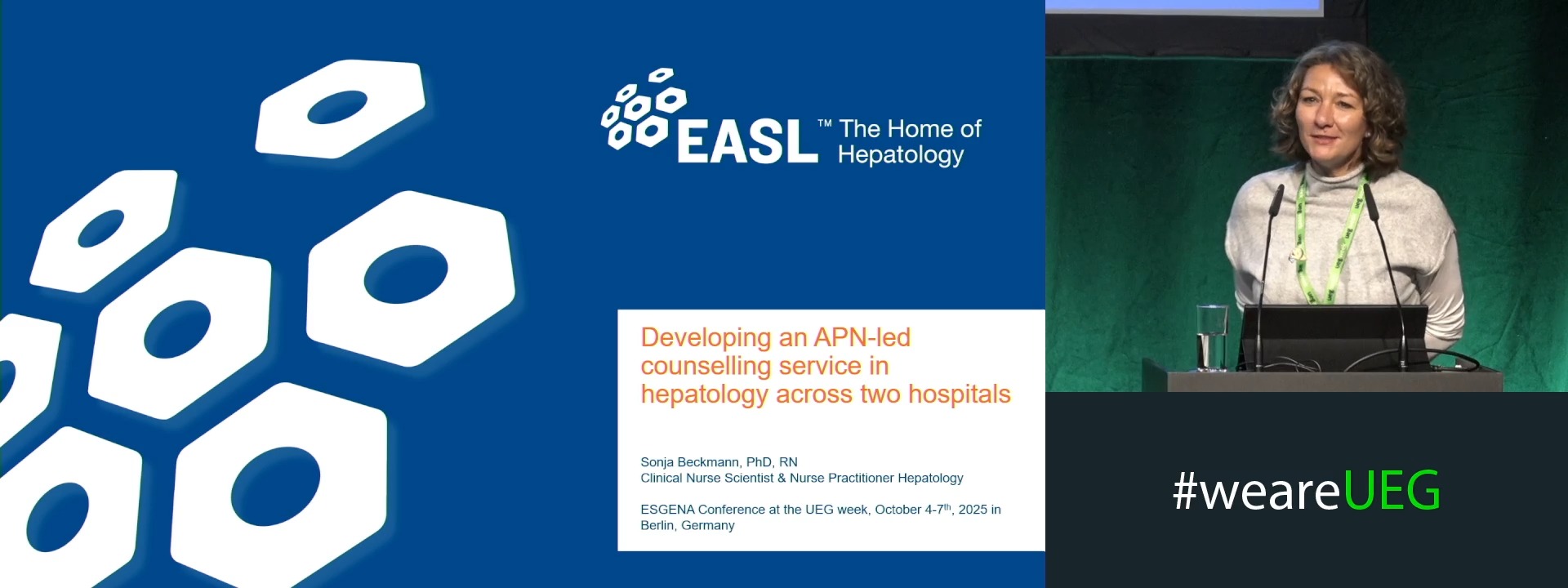
Developing a nurse-led counselling service in hepatology across two hospitals
1 None, None, Switzerland
Event
Topics
Citation
Published
Log in to access this content.
Free for all myUEG account holders. Your access level is set automatically based on your occupation. Medical professionals get full access to all content. If you are a non-medical user, you can only access UEG Week content from congresses you attended.
Not sure what you can access? Learn more about account types.
MORNING VS. AFTERNOON COLONOSCOPY: EFFECT OF PROCEDURE TIME ON ADENOMA DETECTION
Mahsa Taghiakbari 1, Sara-Ivana Calce 1, Douglas Kevin Rex 2, Roupen Djinbachian 1, Alan N. Barkun 3, Victoire Michal 4, Claire Gefflot 4, Mickael Bouin 1, Simon Bouchard 1, Benoit Panzini 1, Erik Deslandres 1, Dane Christina Daoud 1, Robert Battat 1, Katarzyna Orlicka 1, Edmond-Jean Bernard 1, Jeremy Liu Chen Kiow 1, Daniel von Renteln 1
1 University of Montreal Hospital Center (CHUM), Montreal, Canada
2 Indiana University School of Medicine, Indianapolis, United States
3 McGill University Health Centre and McGill University, Montreal, Canada
4 University of Montreal Hospital Research Center (CRCHUM), Montreal, Canada
Conference
Topics