Introduction
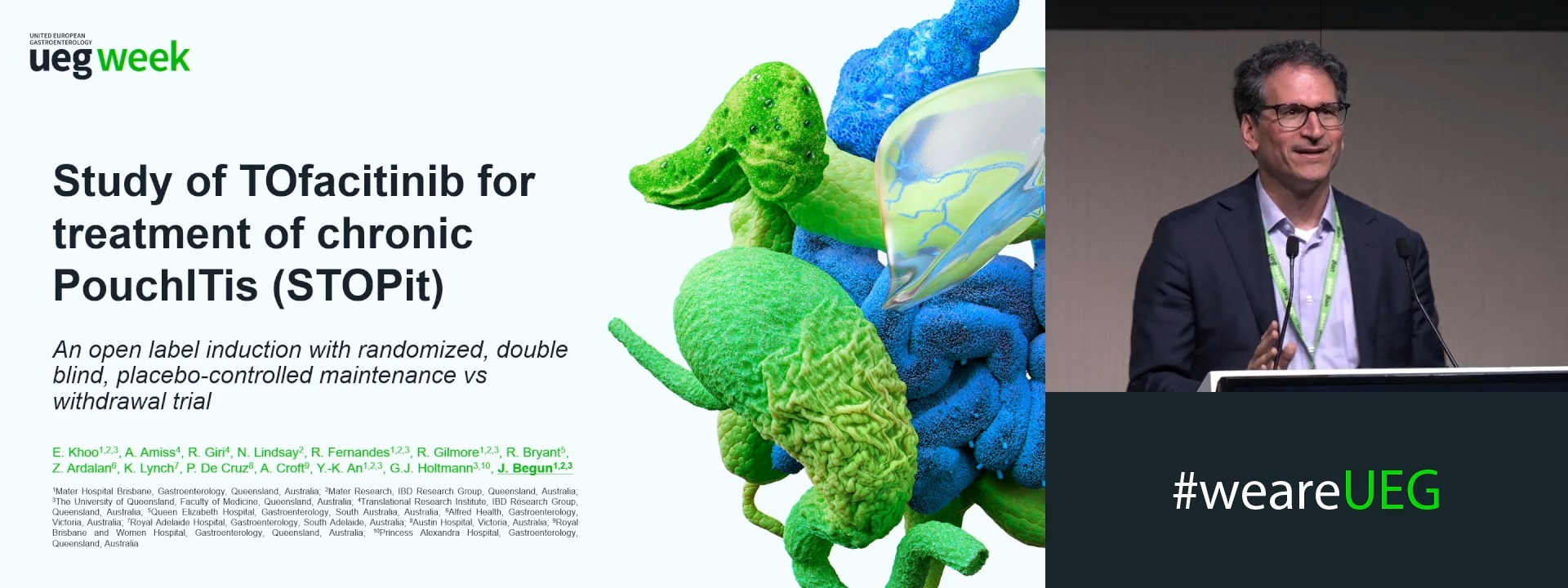
Chronic pouchitis affects up to 20% of patients following ileal pouch–anal anastomosis for ulcerative colitis and remains difficult to treat.(1) To date, vedolizumab is the only treatment that has demonstrated efficacy for chronic pouchitis in a double-blind randomised controlled trial (DBRCT).(2) We evaluated the efficacy of tofacitinib in a DBRCT and explored predictors of response.
Aims & Methods
We performed an Australia-wide open label induction with randomized withdrawal versus maintainence trial to assess the efficacy of tofacitinib in chronic pouchitis across sites within the Australia New Zealand Inflammatory Bowel Disease Consortium. All participants received tofacitinib 10mg twice daily for 8 weeks. Week-8 responders entered maintenance and were randomized 1:1 to receive placebo or tofacitinib 5mg twice daily, while non-responders continued 10mg twice daily for a further 8 weeks. At week 16, delayed responders entered the maintenance phase. The primary endpoint was clinical Pouchitis Disease Activity Index (PDAI)-defined response (a reduction from baseline>2) at end of study (week 24 of maintenance phase). Secondary endpoints included endoscopic response (a reduction of endoscopic PDAI>2), mPDAI remission (modified pouchitis disease activity index (mPDAI)<4 and a reduction of mPDAI>2), mPDAI response (a reduction of mPDAI>2) and improvement in health-related quality of life (HRQoL). Univariate analysis was performed to identify clinical and biochemical predictors of response to tofacitinib. Participants who terminated early due to recurrent pouchitis after randomization, were considered treatment failures.
Results
Fifty-three participants completed induction, with a clinical response rate of 59% (n=31/53) at week 8, with a further 50% (n=8/16) achieving response at week 16, yielding an overall clinical induction response rate of 74% (n=39/53) (Table 1). Endoscopic response and mPDAI remission at week 8 were 42% and 27% respectively. Faecal calprotectin and HRQoL improved significantly by week 8. Endoscopic features of friability, presence of nocturnal symptoms and lower serum interleukin-18 at baseline were predictors of response to tofacitinib at the end of induction. Responders demonstrated marked reductions in pro-inflammatory cytokines (TNF, IL-8) over time, whereas non-responders showed minimal change. Among the 38 participants entering the maintenance phase, 37% (n=14/38) completed the study without symptom flare. Of the patients who remained on maintenance treatment for 24 weeks, 61% (n=11/18) were receiving tofacitinib versus 15% (n=3/20) on placebo (delta 46%,p<0.01). The clinical response rates at the end of maintenance were 50% (n=9/18) and 10% (n=2/20) in tofacitinib and placebo groups respectively (delta 40%,p=0.01) (Table 1). The flare free survival was significantly higher in the tofacitinib versus the placebo group (Log rank survival p=0.003). All participants were followed up post termination (up to 175 days) for safety analysis with no new safety findings emerging.
Table 1 Clinical response rates in each phase
| | Open Label Induction Phase (n=53) | Maintenance Phase (n=38) |
| Intervention | Tofacitinib 10mg | Placebo | Tofacitinib 5mg |
| Phase | End of Standard Induction (week 8) | End of Extended Induction (week 16) | Overall | End of Maintenance (week 24) | End of Maintenance (week 24) |
| Clinical Response Rate | 59% (n=31/53) | 50% (n=8/16) | 74% (n=39/53) | 10%
(n=2/20) | 50%
(n=9/18) |
Conclusion
Tofacitinib was associated with high rates of clinical and endoscopic remission during induction in chronic pouchitis and was superior to placebo in maintenance of clinical response. Baseline IL-18 and dynamic cytokine suppression may serve as biomarkers of treatment response, supporting immune stratification in this population.
References
(1) Dalal, R.L., B. Shen, and D.A. Schwartz, Management of Pouchitis and Other Common Complications of the Pouch. Inflamm Bowel Dis, 2018. 24(5): p. 989-996.
(2) Travis, S., et al., Vedolizumab for the Treatment of Chronic Pouchitis. N Engl J Med, 2023. 388(13): p. 1191-1200.
Disclosure
EK has received research and education funding from Arrotex, Dr Falk, Pfizer and Celltrion; speaker funding from Ferring, CSL Seqirus and Menarini.
RF has received grant support from the GENIUS, a research scholarship from CCA, and speaker, advisory board or consultation honoraria or educational support from Janssen, Takeda, AbbVie, Ferring, Pfizer, BMS and Celltrion.
RG has received grant support from the Gastroenterological Society of Australia (GESA) and speaker honoraria from Johnson and Johnson, Pfizer, and education or conference support form Pfizer.
RB has received grant/research support/speaker honoraria/advisory board fees from AbbVie, Ferring, Janssen, Shire, Takeda, GSK, BMS, and Emerge Health; and is a shareholder in Biomebank.
KL has received speaker’s honoraria, advisory board fees, and/or conference travel/registration support from Abbvie, BMS, Chiesi, Dr Falk, Ferring, Gilead, Guidepoint, Intercept Pharmaceuticals, Ipsen, J&J, Norgine, Pfizer, Pliant, Sandoz, Takeda, The Limbic and RAH Research Fund.
PDC has served as a consultant, an advisory board member, or a speaker for AbbVie, Baxter, Ferring, Janssen, Celltrion, Emerge Health, Shire and Takeda. He is supported by a NHMRC Emerging Leader 2 Fellowship and has received research support from AbbVie, Ferring, Shire, Janssen, and Takeda.
YA has received consulting and speaker fees from AbbVie, Alimentiv, BMS, Eli Lilly, Dr Falk, Ferring, GSK, J&J, Pfizer, Samsung, Sandoz, Shire, Takeda and United Clinical; advisory board fees from AbbVie, BMS, Chiesi, J&J, Microba, NPS Medicine Wise, CATAG, Takeda and Xencor; research and educational support from AbbVie, BMS, Cannon, Celltrion, CR Kennedy, Chiesi, Dr Falk, Ferring, GE Healthcare, J&J, Pfizer, Samsung, Sandoz, Siemen, and Takeda.
JB has received consulting and speaking fees from Abbvie, Janssen, Takeda, Pfizer, Ferring, BMS, Gilead, Tillott’s, Sandoz, Celltrion, Chiesi, Dr Falk, Microba, GSK, MSD, Roche, Sandoz, Antara, Spyre.
AA, RB, NH, ZA, AC and GH have no conflict of interest.