UEG's content platform for gastroenterology education bringing recordings, courses, guidelines, and more together in one place.
Trending on Gutflix
Rate for better recommendations!
Your feedback helps us show you more of what you like and less of what you dislike!
Log in to continue.
This content is part of Gutflix. Log in with your myUEG account, or create one free, to watch it.
Not sure what you can access? Learn more about account types.
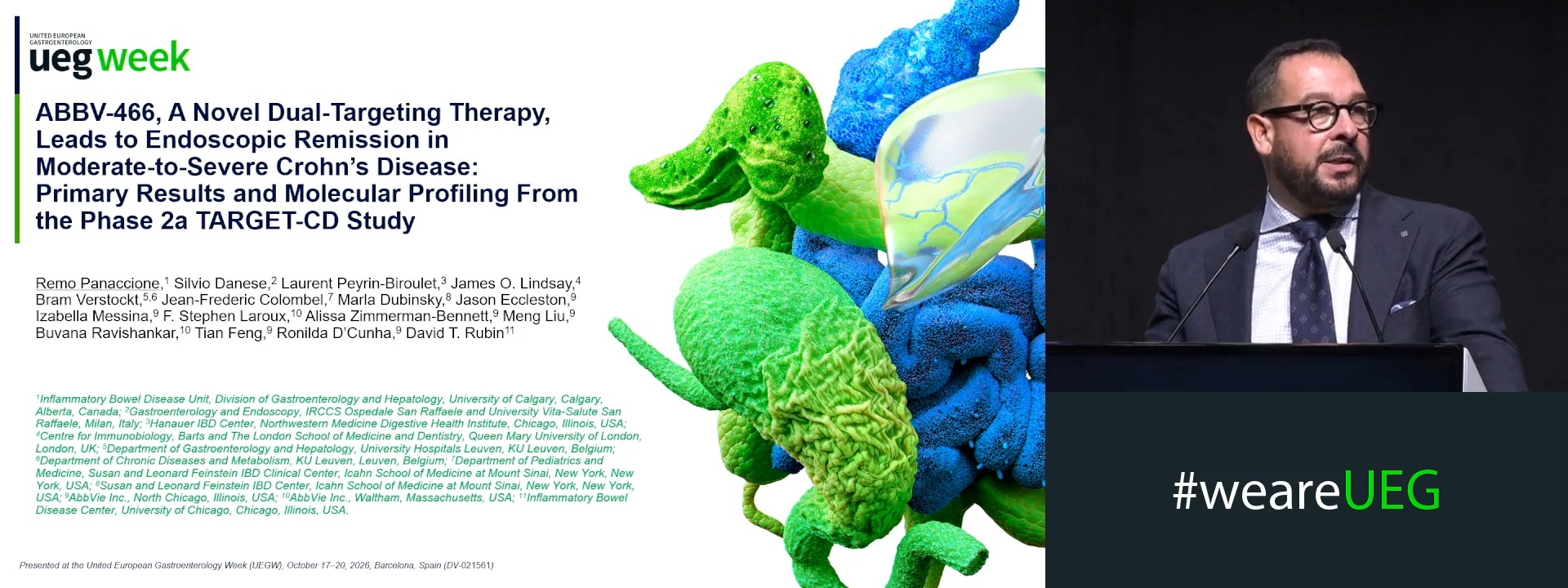
ABBV-466, A NOVEL DUAL-TARGETING THERAPY, LEADS TO ENDOSCOPIC REMISSION IN MODERATE-TO-SEVERE CROHN’S DISEASE: PRIMARY RESULTS AND MOLECULAR PROFILING FROM THE PHASE 2A TARGET-CD STUDY
Remo Panaccione 1, Silvio Danese 2, Laurent Peyrin-Biroulet 3, James O. Lindsay 4, Bram Verstockt 5, Jean-Frédéric Colombel 6, Marla C. Dubinsky 6, Jason Eccleston 7, Izabella Messina 7, Stephen Laroux 8, Alissa Zimmerman-Bennett 7, Meng Liu 7, Buvana Ravishankar 8, Tian Feng 7, Ronilda D'Cunha 7, David T. Rubin 9
Affiliations
1 University of Calgary, Calgary, Canada
2 IRCCS Ospedale San Raffaele and University Vita-Salute San Raffaele,, Milan, Italy
3 Northwestern Medicine Digestive Health Institute, Chicago, United States
4 Barts and The London School of Medicine and Dentistry, Queen Mary University of London, London, United Kingdom
5 University Hospitals Leuven, Department of Gastroenterology and Hepatology, Leuven, Belgium
6 Icahn School of Medicine at Mount Sinai, New York, United States
7 AbbVie Inc., North Chicago, United States
8 AbbVie Inc., Walthan, United States
9 University of Chicago Medicine, Chicago, United States
Log in to continue.
This content is part of Gutflix. Log in with your myUEG account, or create one free, to watch it.
Not sure what you can access? Learn more about account types.
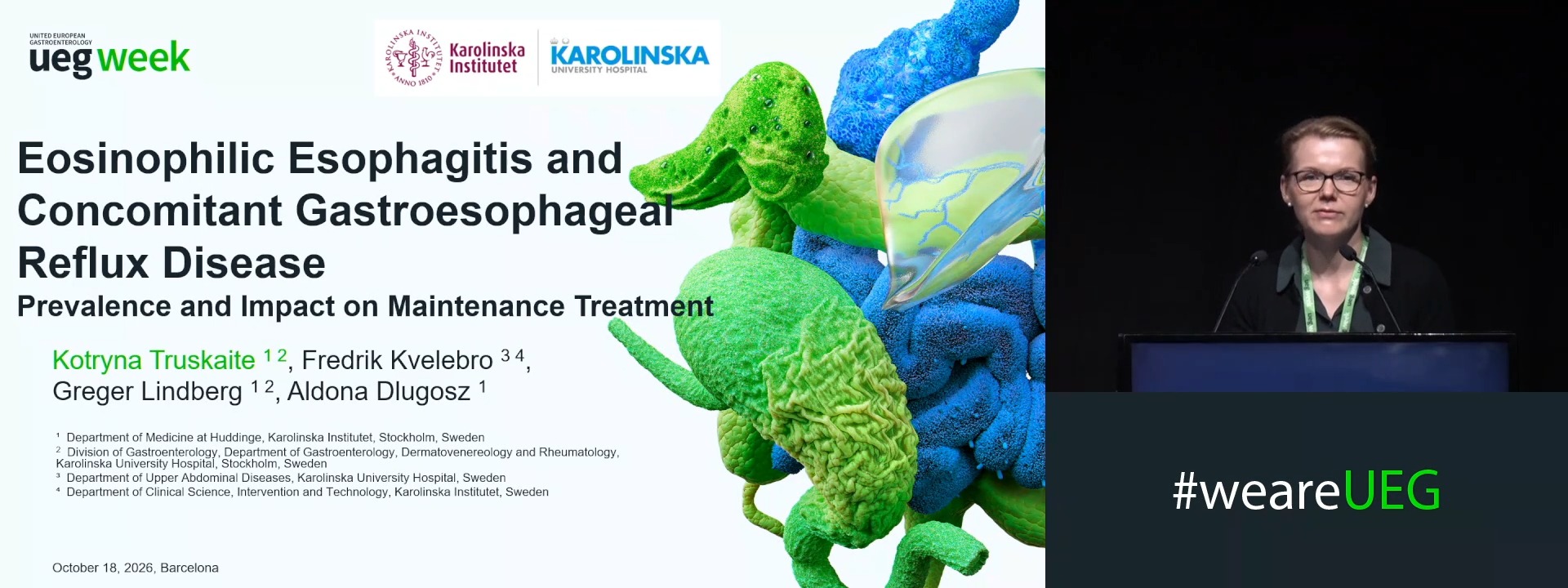
PREVALENCE OF GERD IN PATIENTS WITH EOSINOPHILIC ESOPHAGITIS AND ITS IMPACT ON TREATMENT OUTCOMES: INSIGHTS FROM A SWEDISH TERTIARY CENTRE COHORT
Affiliations
1 Karolinska Institutet, Stockholm, Sweden
2 Karolinska University Hospital, Stockholm, Sweden
Log in to continue.
This content is part of Gutflix. Log in with your myUEG account, or create one free, to watch it.
Not sure what you can access? Learn more about account types.
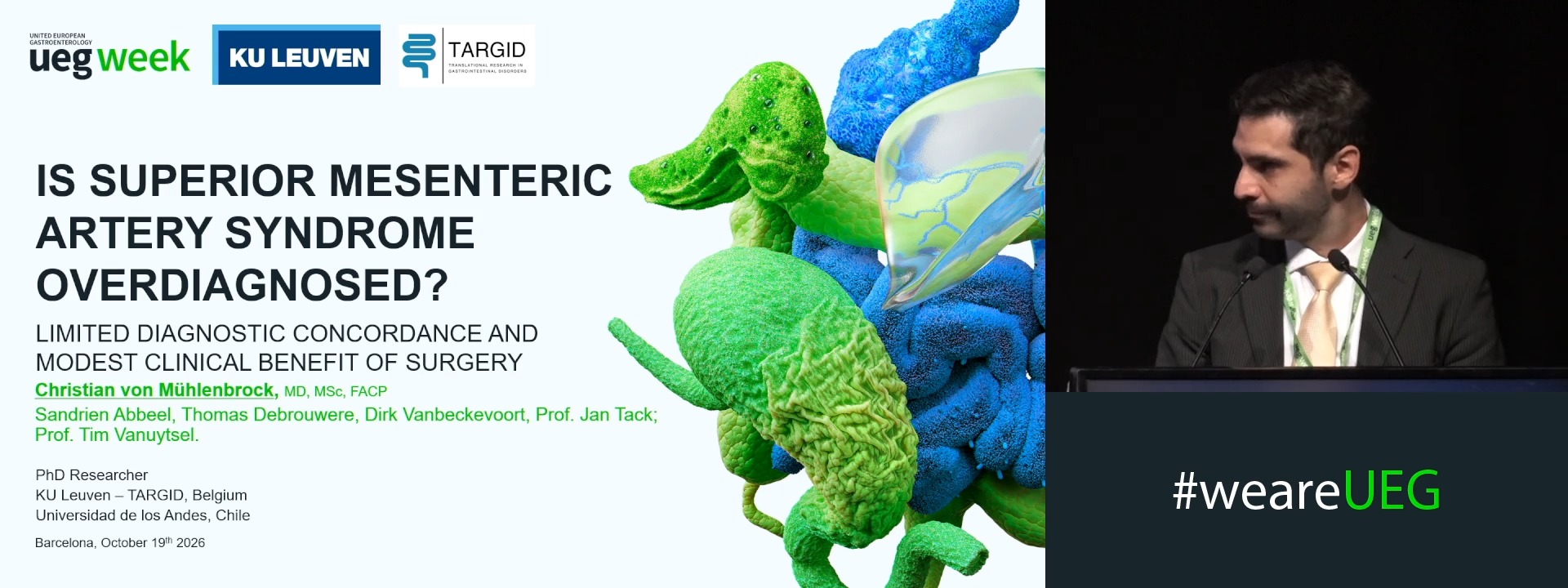
OVERDIAGNOSIS OF SUPERIOR MESENTERIC ARTERY SYNDROME: LIMITED DIAGNOSTIC CONCORDANCE BETWEEN IMAGING MODALITIES AND LIMITED BENEFIT OF SURGERY
Christian von Muhlenbrock 1,2,3, Sandrien Abbeel 4, Thomas Debrouwere 1, Dirk Vanbeckevoort 1, Jan Tack 1, Tim Vanuytsel 1
Affiliations
1 KU Leuven, Leuven, Belgium
2 Universidad de Chile, Santiago, Chile
3 Universidad de los Andes, Santiago, Chile
4 KU Leuven, Eppegem, Belgium
Log in to continue.
This content is part of Gutflix. Log in with your myUEG account, or create one free, to watch it.
Not sure what you can access? Learn more about account types.
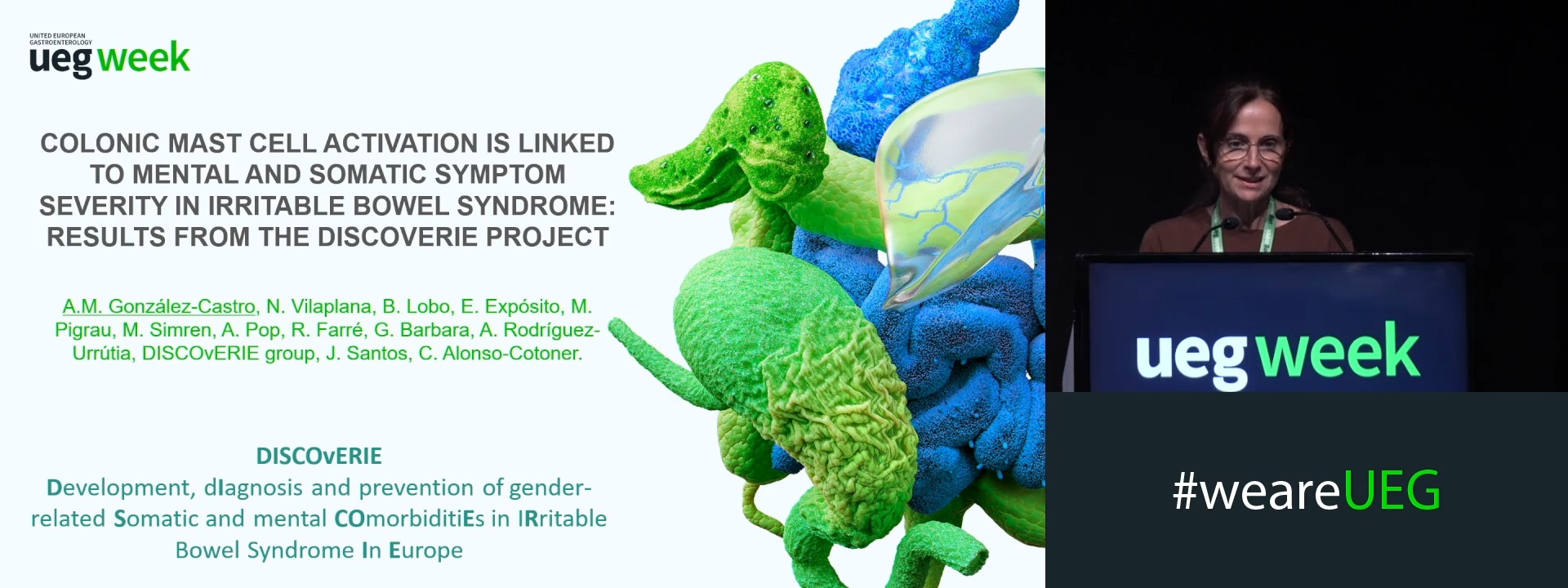
COLONIC MAST CELL ACTIVATION IS LINKED TO MENTAL AND SOMATIC SYMPTOM SEVERITY IN IRRITABLE BOWEL SYNDROME: RESULTS FROM THE DISCOVERIE PROJECT (EU-FUNDED PROJECT Nº: 848228)
Ana Maria González 1,2, Núria Vilaplana 1, Beatriz Lobo Alvarez 1,2,3, Elba Expósito 1, Marc Pigrau Pastor 3, Irina Midenfjord 4, Magnus Simrén 4, Andrei Pop 5, Ricard Farré 6, Giovanni Barbara 7, Amanda Rodriguez 8,9, Javier Santos 3,2,1, Carmen Alonso-Cotoner 3,2,1
Affiliations
1 Vall d’Hebron Institut de Recerca, Barcelona, Spain
2 Centro de Investigación Biomédica en Red en Enfermedades Hepáticas y Digestivas (CIBER-EHD), Madrid, Spain
3 Hospital Universitari Vall d'Hebron, Barcelona, Spain
4 Institute of Medicine, University of Gothenburg, Gothenburg, Sweden
5 University of Medicine and Pharmacy Cluj-Napoca, Cluj-Napoca, Romania
6 KU Leuven, Leuven, Belgium
7 University of Bologna and IRCCS Azienda Ospedaliero Universitaria di Bologna, Bologna, Italy
8 University Hospital Vall d’Hebron, Barcelona, Spain
9 CIBERSAM, Madrid, Spain
Log in to continue.
This content is part of Gutflix. Log in with your myUEG account, or create one free, to watch it.
Not sure what you can access? Learn more about account types.
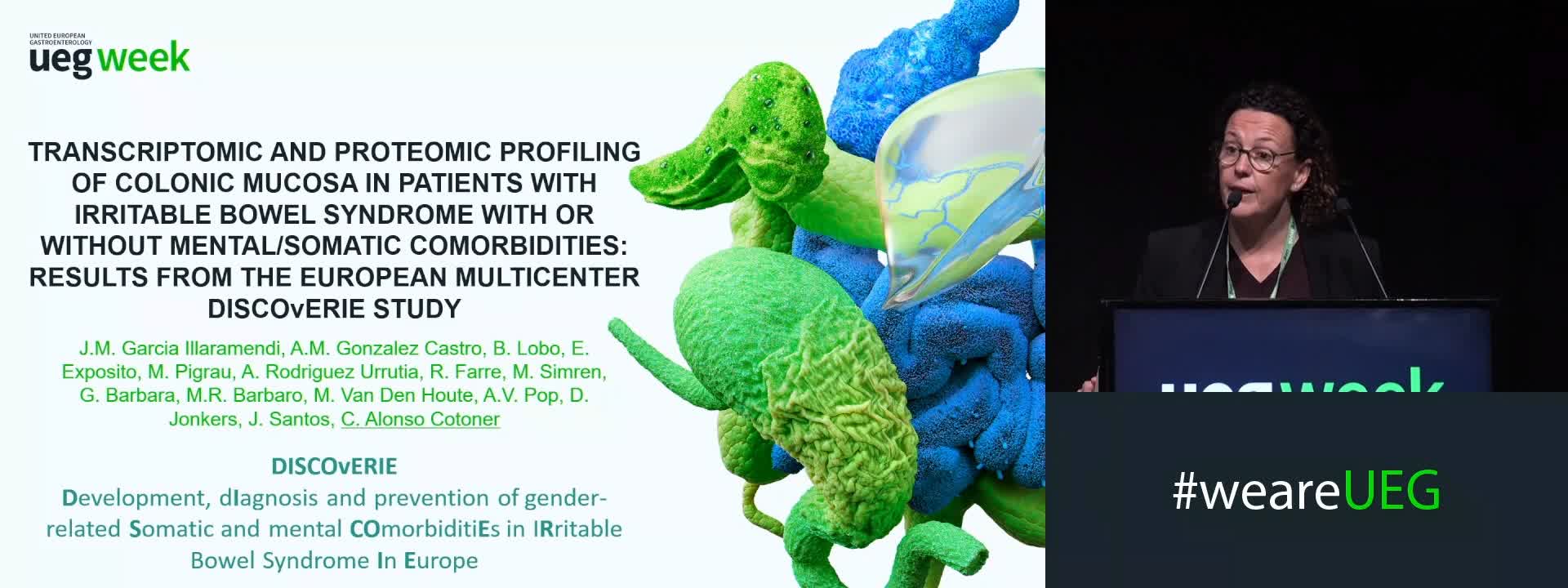
TRANSCRIPTOMIC AND PROTEOMIC PROFILING OF COLONIC MUCOSA IN PATIENTS WITH IRRITABLE BOWEL SYNDROME WITH OR WITHOUT MENTAL/SOMATIC COMORBIDITIES: RESULTS FROM THE EUROPEAN MULTICENTER DISCOVERIE STUDY
Juan Manuel Garcia 1, Ana Maria Gonzalez-Castro 1,2, Beatriz Lobo Alvarez 1,2,3, Elba Exposito 1, Marc Pigrau Pastor 4,3, Amanda Rodriguez 1,3,5, Ricard Farré 6, Magnus Simrén 7, Giovanni Barbara 8,9, Maria Raffaella Barbaro 9,8, Maaike Van Den Houte 10, Andrei Pop 11, Daisy Mae Jonkers 12, Javier Santos 1,2,3, Carmen Alonso-Cotoner 1,2,3
Affiliations
1 Vall d’Hebron Research Institute, Barcelona, Spain
2 CIBEREHD, Madrid, Spain
3 Vall d’Hebron Hospital Universitari, Vall d’Hebron Barcelona Hospital Campus, Barcelona, Spain
4 Universitat Autonoma de Barcelona, Barcelona, Spain
5 CIBERSAM, Madrid, Spain
6 University of Leuven, Translational Research Center for Gastrointestinal Disorders (TARGID), Leuven, Belgium
7 Sahlgrenska University Hospital - Dept of Internal Medicine, Sahlgrenska University Hospital ; Gothe, Gothenburg, Sweden
8 University of Bologna, Bologna, Italy
9 Università di Bologna, Bologna, Italy
10 Laboratory for Brain-Gut Axis Studies, Translational Research in Gastrointestinal Disorders (TARGID), Leuven, Belgium
11 Iuliu Hatieganu University of Medicine and Pharmacy Cluj-Napoca, Cluj-Napoca, Romania
12 Maastricht University Medical Center, Maastricht, Netherlands
Log in to continue.
This content is part of Gutflix. Log in with your myUEG account, or create one free, to watch it.
Not sure what you can access? Learn more about account types.
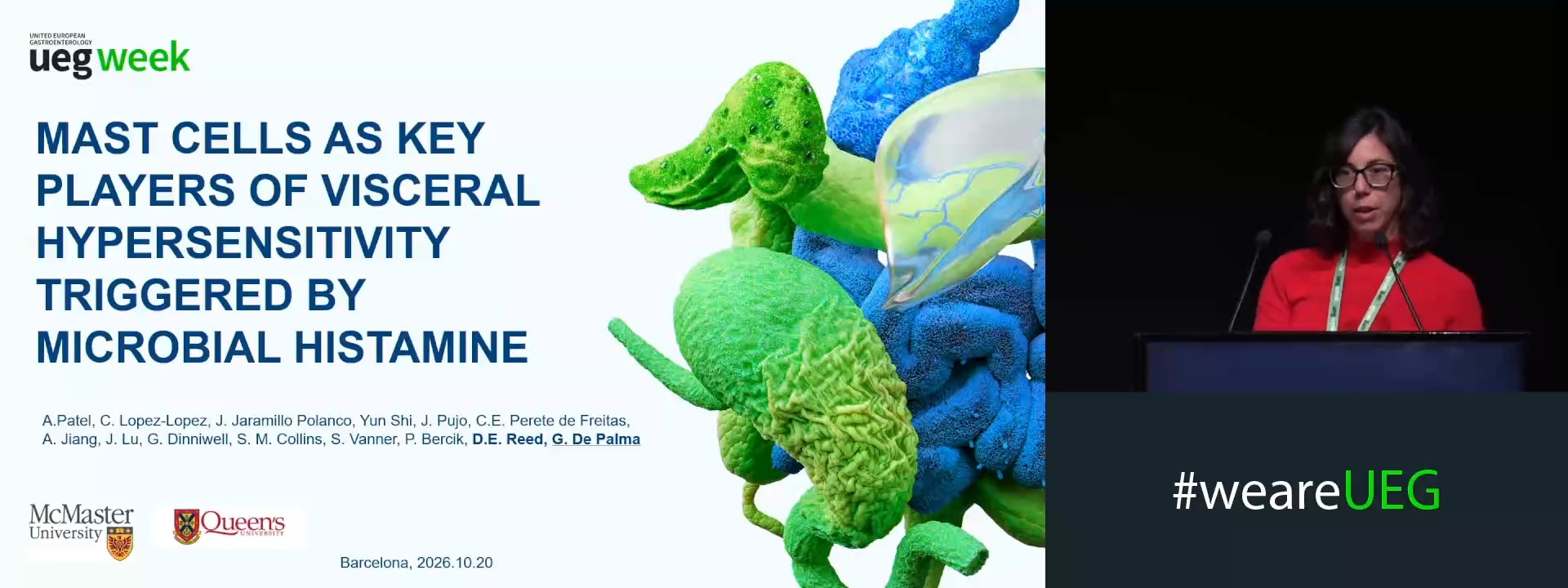
MAST CELLS AS KEY PLAYERS OF VISCERAL HYPERSENSITIVITY TRIGGERED BY MICROBIAL HISTAMINE
Anushka Patel 1, Cynthia Lopez-Lopez 2, Josue Jaramillo Polanco 2, Yun Shi 2, Julien Pujo 1, Camila E. Perete de Freitas 1, Andy Jiang 1, Jun Lu 1, Graham Dinniwell 1, Stephen Collins 1, Stephen Vanner 2, Premysl Bercik 1, David E. Reed 2, Giada De Palma 1
Affiliations
1 McMaster University/Farncombe Institute, Hamilton, Canada
2 Queen's University/GIDRU, Kingston, Canada