Introduction
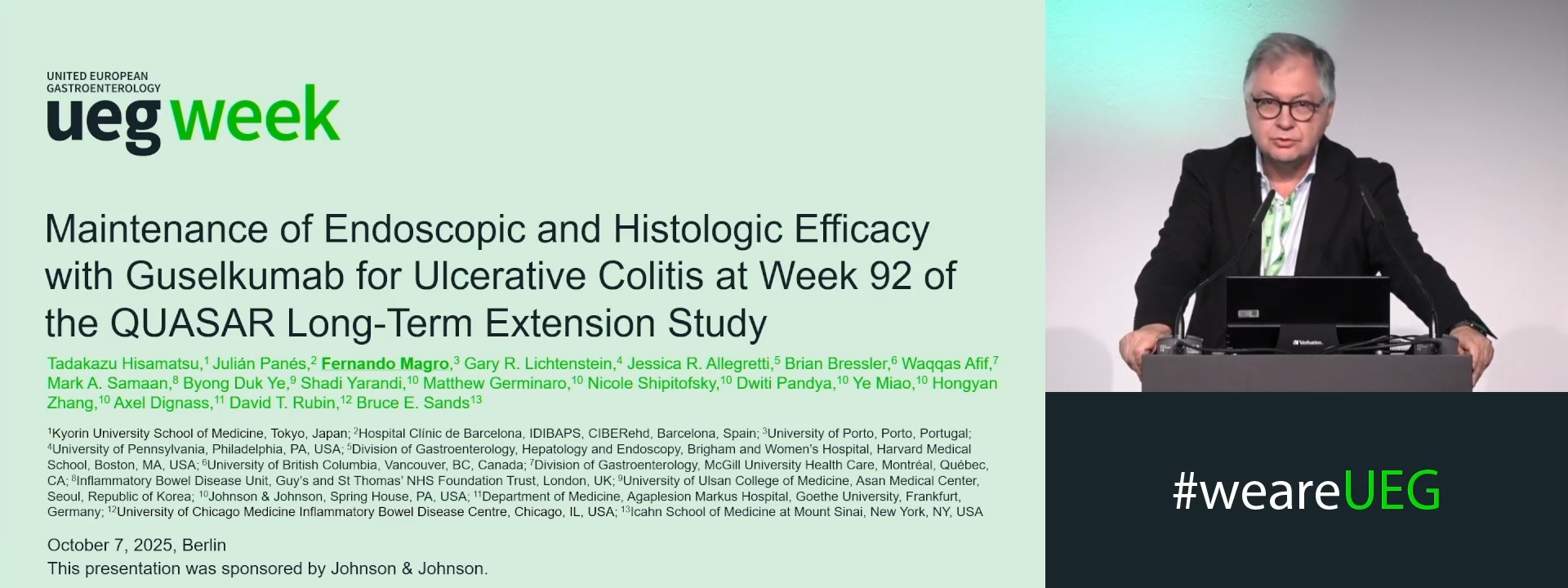
Guselkumab (GUS) is a dual-acting IL-23p19 subunit inhibitor that potently neutralizes IL-23 and binds to CD64, a receptor on cells that produce IL-23. In the QUASAR studies, GUS intravenous (IV) induction and subcutaneous (SC) maintenance demonstrated symptomatic, endoscopic, and histologic efficacy through 2 years.1,2 Here, we describe maintenance of endoscopic and histologic efficacy in the long-term extension (LTE).
Aims & Methods
At maintenance week (W) 0, GUS IV induction responders were randomized 1:1:1 to GUS 100 mg SC every 8 weeks (q8w), GUS 200 mg SC q4w or placebo (GUS withdrawal). Participants (pts) completing the W44 visit could enter the LTE and continue the treatment regimen they were receiving at W44. Placebo pts discontinued after study unblinding. Efficacy data for randomized pts who continued to receive their GUS regimen assigned at W0 in the LTE were analyzed using 2 methods: 1) nonresponder imputation (NRI) accounting for pts with treatment failure or missing data, and 2) “as observed.”
Results
Overall, 303 randomized pts (155 for 100 mg q8w and 148 for 200 mg q4w) continued their GUS treatment assigned at W0 in the LTE. Of pts who achieved endoscopic improvement at W44, 87.2% of GUS 100 mg q8w pts and 80.2% GUS 200 mg q4w pts maintained endoscopic improvement through W92 (NRI analysis; Table). Of pts who achieved histologic improvement at W44, 77.9% and 75.2%, respectively, maintained histologic improvement at W92. Of pts who achieved histo-endoscopic mucosal improvement (HEMI) at W44, 73.5% and 75.5%, respectively, maintained HEMI through W92. Of pts who were in histologic remission at W44, 71.2% maintained histologic remission at W92 in both GUS groups. Results of the as-observed analysis were consistent with the NRI analysis; the dropout rate was low among GUS-treated pts in the LTE. Proportions of pts who maintained endoscopic and histologic outcomes from W0 to W92 are presented in the Table.
| Table. Maintenance of endoscopic and histologic efficacy with GUS in the QUASAR LTE study |
|---|
aPercentages represent proportions of pts achieving the endpoint at W92 among those who achieved the corresponding endpoint at W44. CIs in each treatment group are based on the normal approximation confidence limits. bPercentages represent proportions of pts achieving the endpoint at W92 among those who achieved the corresponding endpoint at W0 (baseline of the maintenance study). CIs in each treatment group are based on the normal approximation confidence limits. Includes pts with modified Mayo score of 5-9 at induction baseline who achieved clinical response to GUS IV induction and were randomized to receive GUS maintenance treatment and did not experience a dose adjustment from W8 through W32. Endoscopic improvement is defined as an endoscopic subscore of 0 or 1. Histologic improvement is defined as neutrophil infiltration in <5% of crypts, no crypt destruction, and no erosions, ulcerations or granulation tissue according to the Geboes grading system. HEMI is defined as achieving a combination of histologic improvement and endoscopic improvement. Histologic remission is defined as the absence of neutrophils from the mucosa (both lamina propria and epithelium), no crypt destruction, and no erosions, ulcerations or granulation tissue according to the Geboes grading system (equivalent to a Robarts Histopathology Index ≤2b, with subscores of 0 for lamina propria neutrophils and neutrophils in the epithelium and without ulcers or erosion). CI=Confidence interval; GUS=Guselkumab; HEMI=histologic-endoscopic mucosal improvement; IV=Intravenous; LTE=Long-term extension; m=Number of pts achieving endpoint at W0 or W44; n=Number of pts achieving endpoint at week 92; NRI=Nonresponder imputation; pts=Participants; q4w=Every 4 weeks; q8w=Every 8 weeks; SC=Subcutaneous; W=Week. |
| Endpoint maintenance: W44 to W92a
| Endpoint maintenance: W0 to W92b
|
| NRI analysis | As-observed analysis
| NRI analysis
| As-observed analysis
|
% [95% CI] (n/m)
| GUS 100mg SC q8w
| GUS 200mg SC q4w
| GUS 100mg SC q8w
| GUS 200mg SC q4w
| GUS 100mg SC q8w
| GUS 200mg SC q4w
| GUS 100mg SC q8w
| GUS 200mg SC q4w
|
| Endoscopic improvement | 87.2% [80.5, 94.0] (82/94)
| 80.2% [72.4, 88.0] (81/101)
| 92.1% [86.5, 97.7] (82/89)
| 90.0% [83.8, 96.2] (81/90)
| 80.3% [70.7, 89.9] (53/66)
| 85.9% [77.4, 94.5] (55/64)
| 85.5% [76.7, 94.3] (53/62)
| 94.8% [89.1, 100] (55/58)
|
| Histologic improvement | 77.9% [70.5, 85.2] (95/122)
| 75.2% [67.6, 82.8] (94/125)
| 83.3% [76.5, 90.2] (95/114)
| 83.2% [76.3, 90.1] (94/113)
| 74.3% [65.7, 82.8] (75/101)
| 72.0% [62.9, 81.2] (67/93)
| 80.6% [72.6, 88.7] (75/93)
| 80.7% [72.2, 89.2] (67/83)
|
| HEMI | 73.5% [64.0, 83.0] (61/83)
| 75.5% [66.8, 84.2] (71/94)
| 80.3% [71.3, 89.2] (61/76)
| 85.5% [78.0, 93.1] (71/83)
| 70.2% [58.3, 82.1] (40/57)
| 79.6% [68.9, 90.4] (43/54)
| 78.4% [67.1, 89.7] (40/51)
| 91.5% [83.5, 99.5] (43/47)
|
| Histologic remission | 71.2% [62.7, 79.6] (79/111)
| 71.2% [63.0, 79.4] (84/118)
| 76.7% [68.5, 84.9] (79/103)
| 77.8 % [69.9, 85.6] (84/108)
| 67.0% [57.4, 76.7] (61/91)
| 67.1% [56.9, 77.2] (55/82)
| 73.5% [64.0, 83.0] (61/83)
| 76.4% [66.6, 86.2] (55/72)
|
Conclusion
High rates of long-term sustained endoscopic and histologic endpoints were observed at W92 of the LTE with both GUS dose regimens.
References
- Rubin DT, et al. Guselkumab in patients with moderately to severely active ulcerative colitis (QUASAR): phase 3 double-blind, randomised, placebo-controlled induction and maintenance studies. Lancet. 2025;405(10472):33-49.
- Lichtenstein GR, et al. Efficacy and safety of guselkumab for ulcerative colitis through week 92 of the QUASAR long-term extension study. Presented at: Digestive Disease Week (DDW); May 4–6, 2025; San Diego, CA.
Disclosure
Study support: Johnson & Johnson.
TH: AbbVie, Bristol Myers Squibb, Daiichi-Sankyo, EA Pharma Co, Ltd., JIMRO, Eli Lilly, Gilead Sciences, Johnson & Johnson, Kissei Pharmaceutical Co, Ltd., Mitsubishi Tanabe Pharma Corporation, Mochida Pharmaceutical Co., Ltd., Nippon Kayaku Co., Ltd., Pfizer Inc, Takeda Pharmaceutical Co., Ltd.
JP: AbbVie, Alimentiv, Athos, Atomwise, Boehringer Ingelheim, Celsius, Ferring, Galapagos, Genentech/Roche, GlaxoSmithKline, Johnson & Johnson, Mirum, Nimbus, Pfizer, Progenity, Prometheus, Protagonist, Revolo, Sanofi, Sorriso, Surrozen, Takeda, Wasserman.
FM: AbbVie, Arena, Celltrion, Eli Lilly and Company, Ferring, Fresenius, Galapagos, GlaxoSmithKline, Johnson & Johnson, Merck, Pfizer, Prometheus Biosciences, Roche, Sandoz, Tillots, Takeda, Teva.
GRL: AbbVie, American College of Gastroenterology, CellCeutrix, Celgene, Clinical Advances in Gastroenterology, Ferring, Gastroenterology and Hepatology [Gastro-Hep Communications], Gilead, Johnson & Johnson, Orthobiotech, Eli Lilly, Luitpold / American Regent, Merck, McMahon Publishing, Pfizer, Prometheus, Romark, Salix/ Valeant, Shire, SLACK, Springer, Takeda, UCB, Up-To-Date, Vindico, Virgo.
JRA: Abbvie, Bristol Myer Squibb, Ferring, Finch, Iterative Scopes, Johnson & Johnson, Merck, Pfizer, Roivant, Seres Therapeutics, Roivant Adiso.
BB: AbbVie, Alimentiv, Allergan, Amgen, AMT, Bausch Health, Bristol Myers Squibb, Business Intelligence, Celgene, Celltrion, Eupraxia Fresenius Kabi, Ferring, Genentech/Roche, Gilead, Iterative Scopes, GlaxoSmithKline, Jamp, Johnson & Johnson, Merck, Microbiome Insights, Mylan, Novartis, Organon, Pendopharm, Pfizer, Protagonist, Qu Biologic, Sandoz, Takeda, Viatris.
WA: AbbVie, Amgen, BMS, Dynacare, Eli-Lilly, Johnson & Johnson, Merck, Novartis, Pfizer, Prometheus, Sandoz, Sanofi, Takeda, Theradiag.
MAS: AbbVie, Bristol-Myers Squibb, Falk, Galapagos, Janssen, Lilly, MSD, Pfizer, Samsung Bioepis, Sandoz, Sanofi, STADA, Takeda, Tillotts.
BDY: AbbVie Korea, BMS Pharmaceutical Korea Ltd., Celltrion, Chong Kun Dang Pharm, CJ Red BIO, Cornerstones Health, Curacle, Daewoong Pharm, Dong-A ST, Eisai Korea, Eli Lilly and Company Korea, Ferring Korea, Imscout, IQVIA, Johnson & Johnson, Johnson & Johnson Korea, JEIL PHARMACEUTICAL CO., Kangstem Biotech, Korea Otsuka Pharm, Korea United Pharm, Medtronic Korea, NanoEntek, ORGANOIDSCIENCES LTD, Pfizer Korea, Samsung Bioepis, Takeda, Takeda Korea, Yuhan.
SY, MG, NS, DP, YM, HZ: Johnson & Johnson.
AD: Abivax, AbbVie, Amgen, Arena Pharmaceuticals, Biogen, Boehringer Ingelheim, Bristol Myers Squibb, CED Service GmbH, Celltrion, Dr Falk Foundation, Ferring Pharmaceuticals, Fresenius Kabi, Galapagos, Gilead, High5MD, Johnson & Johnson, Lilly, Materia Prima, MedToday, MSD, Pfizer, Pharmacosmos, Roche, Sandoz, Stada, Takeda, Thieme, Tillotts, UniMed Verlag, Vifor Pharma.
DTR: Abbvie, Altrubio, Apex, Avalo Therapeutics, Bristol-Myers Squibb, Buhlmann Diagnostics Corp, Celgene, Connect BioPharma, Intouch Group, Iterative Health, Johnson & Johnson, Lilly, Pfizer, Samsung Neurologica, Takeda.
BES: AbbVie, Abivax, Adiso Therapeutics, Agomab, Alimentiv, Amgen, AnaptysBio, Arena Pharmaceuticals, AstraZeneca, Biolojic Design, Biora Therapeutics, Boehringer Ingelheim, Boston Pharmaceuticals, Bristol Myers Squibb, Celltrion, Equillium, Enthera, Enveda Biosciences, Evommune, Ferring, Galapagos, Genentech (Roche), Gilead Sciences, GlaxoSmithKline, Gossamer Bio, Imhotex, Index Pharmaceuticals, Innovation Pharmaceuticals, Inotrem, Johnson & Johnson, Kaleido, Kallyope, Lilly, Merck, Microba, Mirador Therapeutics, Mobius Care, Morphic Therapeutics, MRM Health, Nexus Therapeutics, Nimbus Discovery, Odyssey Therapeutics, Pfizer, Progenity, Prometheus Biosciences, Prometheus Laboratories, Protagonist Therapeutics, Q32 Bio, Rasayana Therapeutics, Recludix Therapeutics, Reistone Biopharma, Sanofi, Sorriso Pharmaceuticals, Spyre Therapeutics, Sun Pharma, Surrozen, Takeda, Target RWE, Teva, TLL Pharmaceutical, Tr1X, Union Therapeutics, Ventyx Biosciences, and Vividion Therapeutics.