UEG's content platform for gastroenterology education bringing recordings, courses, guidelines, and more together in one place.
Trending on Gutflix
Rate for better recommendations!
Your feedback helps us show you more of what you like and less of what you dislike!
Log in to continue.
This content is part of Gutflix. Log in with your myUEG account, or create one free, to watch it.
Not sure what you can access? Learn more about account types.
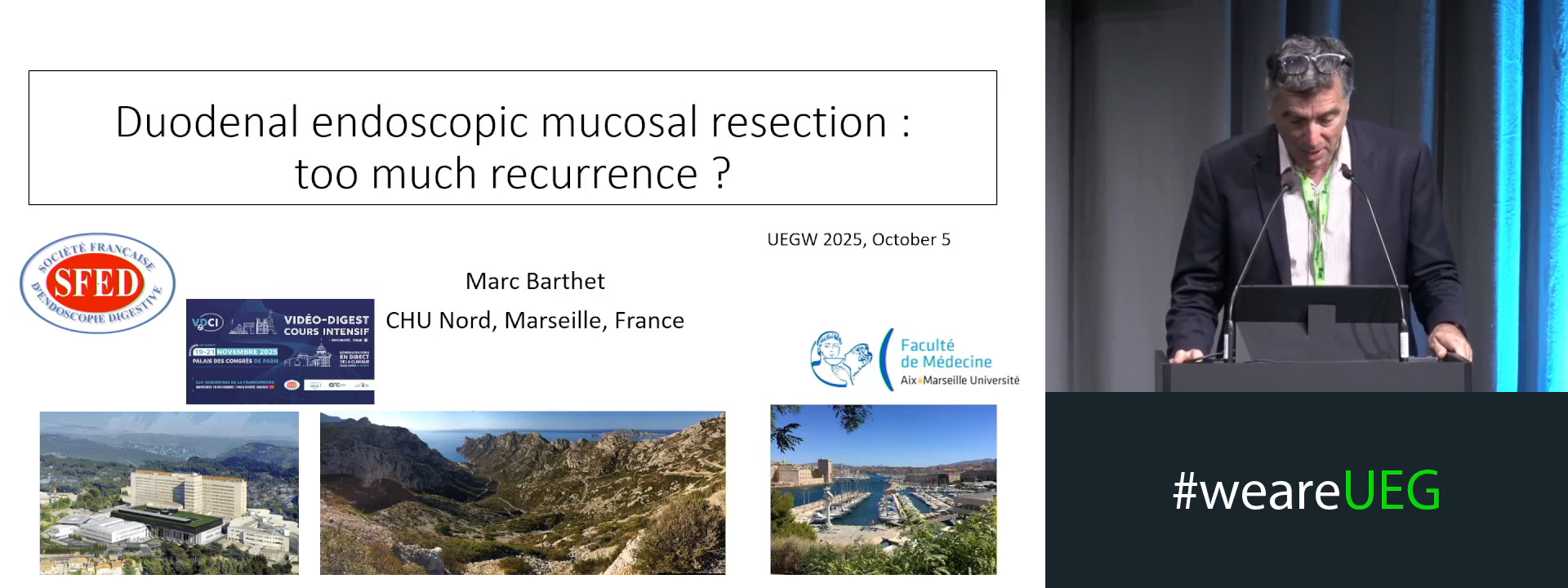
EMR or ESD for duodenal adenoma: Too much recurrence and too much risk?
Affiliations
1 Hopital Nord, Marseille, France
2 Keio University Cancer Center - Cancer Center, Keio University Cancer Center; Tokyo/JP, Tokyo, Japan
Log in to continue.
This content is part of Gutflix. Log in with your myUEG account, or create one free, to watch it.
Not sure what you can access? Learn more about account types.
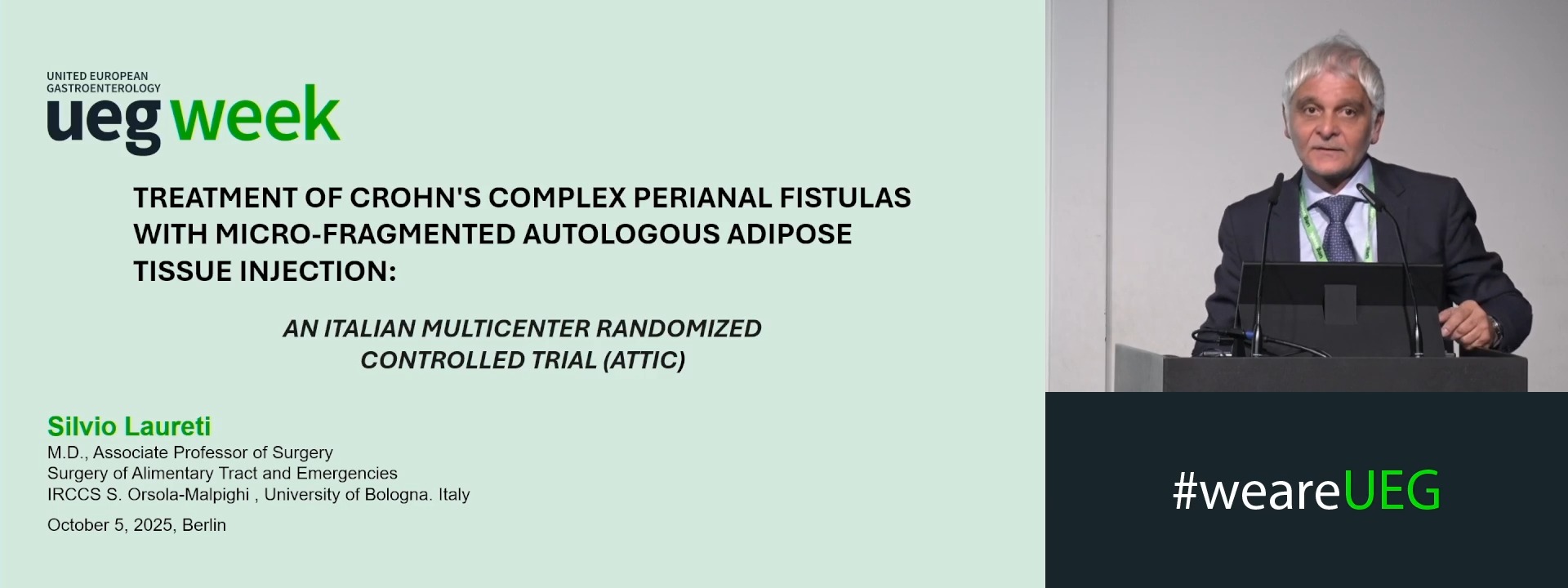
TREATMENT OF CROHN'S COMPLEX PERIANAL FISTULAS WITH MICRO-FRAGMENTED AUTOLOGOUS ADIPOSE TISSUE INJECTION: AN ITALIAN MULTICENTER RANDOMIZED CONTROLLED TRIAL (ATTIC)
Silvio Laureti 1, Luigi Sofo 2, Alberta Cappelli 1, Francesco Colombo 3, Gaetano Luglio 4, Stefano Scaringi 5, Claudio Isopi 1, Franco Sacchetti 2, Giuseppe Clerico 6, Pier Giorgio Danelli 7, Michele Cricrì 4, Ferdinando Ficari 5, Lorenzo Gentilini 1, Alessandra Menon 8, Paolo Gionchetti 1, Gilberto Poggioli 1, Antonino Spinelli 9
Affiliations
1 IRCCS Azienda Ospedaliero-Universitaria di Bologna, Bologna, Italy
2 Policlinico Universitario Fondazione Agostino Gemelli IRCCS, Roma, Italy
3 L.Sacco University Hospital General Surgery II, Milano, Italy
4 Università Federico II, Napoli, Italy
5 Azienda Ospedaliero-Universitaria Careggi, Firenze, Italy
6 IRCCS Humanitas Research Hospital, Rozzano, Italy
7 Università degli studi La Statale, Milano, Italy
8 Università degli Studi di Milano, Milan, Italy
9 Humanitas University, Rozzano Milano, Italy

Log in to continue.
This content is part of Gutflix. Log in with your myUEG account, or create one free, to watch it.
Not sure what you can access? Learn more about account types.
Circulating microbiome: Hopes and pitfalls
Affiliations
1 Lithuanian University of Health Sciences, Kaunas, Lithuania

Log in to continue.
This content is part of Gutflix. Log in with your myUEG account, or create one free, to watch it.
Not sure what you can access? Learn more about account types.
Proposing faecal microbial transfer for IBS?
Affiliations
1 University of Helsinki Research Portal, Helsinki, Finland

Log in to continue.
This content is part of Gutflix. Log in with your myUEG account, or create one free, to watch it.
Not sure what you can access? Learn more about account types.
VONOPRAZAN-DUAL AND TRIPLE THERAPIES WERE NON-INFERIOR TO BISMUTH-BASED QUADRUPLE THERAPY AS FIRST-LINE THERAPY FOR HELICOBACTER PYLORI INFECTION IN CHINA: A THREE-ARM, RANDOMIZED CLINICAL TRIAL
Ka Shing Cheung 1,2, Tao Lyu 1, Zijie Deng 1, Shaowei Han 1, Li Ni 1, Juan Wu 1, Jing Tong Tan 2, Ho Yu Ng 2, Wai Keung Leung 2, Wai-Kay Seto 1,2
Affiliations
1 The University of Hong Kong-Shenzhen Hospital, Shenzhen, China
2 The University of Hong Kong, Hong Kong, Hong Kong

Log in to continue.
This content is part of Gutflix. Log in with your myUEG account, or create one free, to watch it.
Not sure what you can access? Learn more about account types.
THE VALUE OF SERUM PRONEUROTENSIN AS A PREDICTOR OF CARDIOVASCULAR RISK IN NAFLD PATIENTS
Affiliations
1 Cairo University, Cairo, Egypt