UEG's content platform for gastroenterology education bringing recordings, courses, guidelines, and more together in one place.
Trending on Gutflix
Rate for better recommendations!
Your feedback helps us show you more of what you like and less of what you dislike!
Log in to continue.
This content is part of Gutflix. Log in with your myUEG account, or create one free, to watch it.
Not sure what you can access? Learn more about account types.
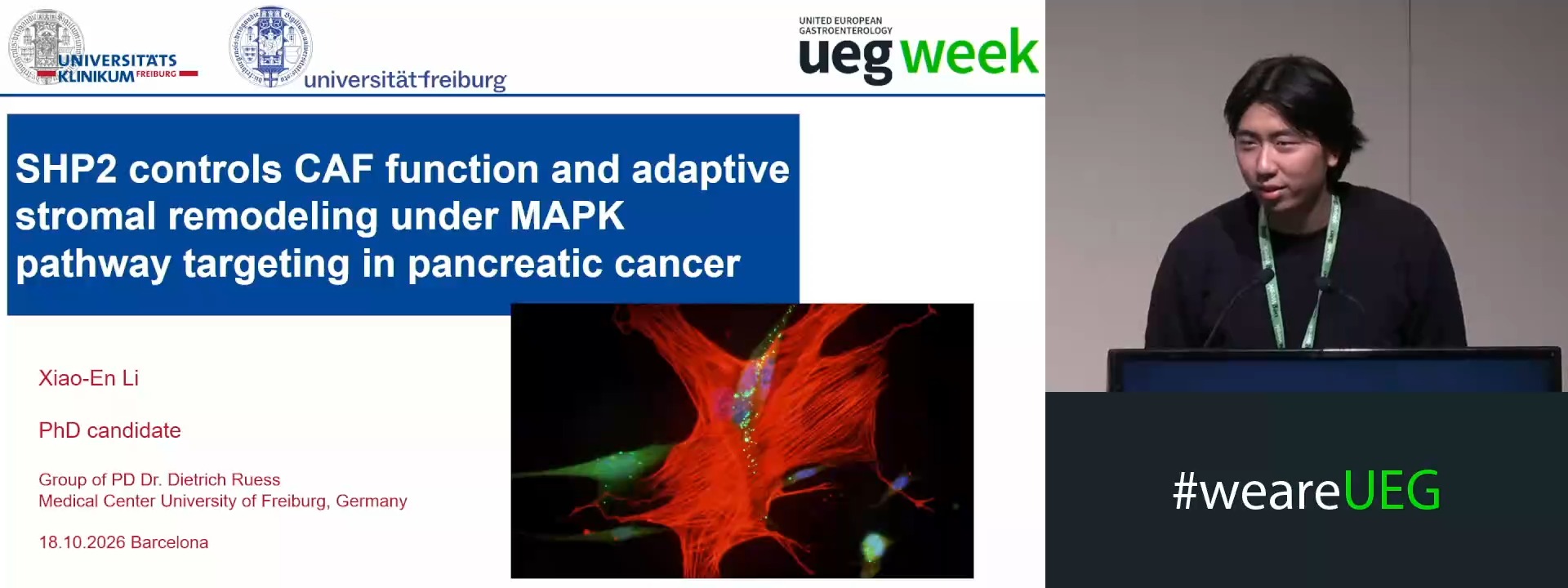
SHP2 REGULATES CAF ACTIVITY AND ADAPTIVE STROMAL REMODELING DURING VERTICAL RAS PATHWAY INHIBITION IN PANCREATIC CANCER
Steffen Keller 1, Xun Chen 1, Tonmoy Das 2, Xiao-En Li 1, Hanna Scheffold 1, Philipp Hafner 1, Asma Alrawashdeh 1, Huda Jumaa 1, Dominik von Elverfeldt 1, Wilfried Reichardt 1, Geoffroy Andrieux 2, Melanie Boerries 2,3, Stefan Fichtner-Feigl 1, Dietrich Alexander Ruess 1,3
Affiliations
1 University Medical Center Freiburg, Freiburg, Germany
2 Institute of Medical Bioinformatics and Systems Medicine, University of Freiburg, Freiburg, Germany
3 German Cancer Consortium (DKTK), Freiburg, Germany
Log in to continue.
This content is part of Gutflix. Log in with your myUEG account, or create one free, to watch it.
Not sure what you can access? Learn more about account types.
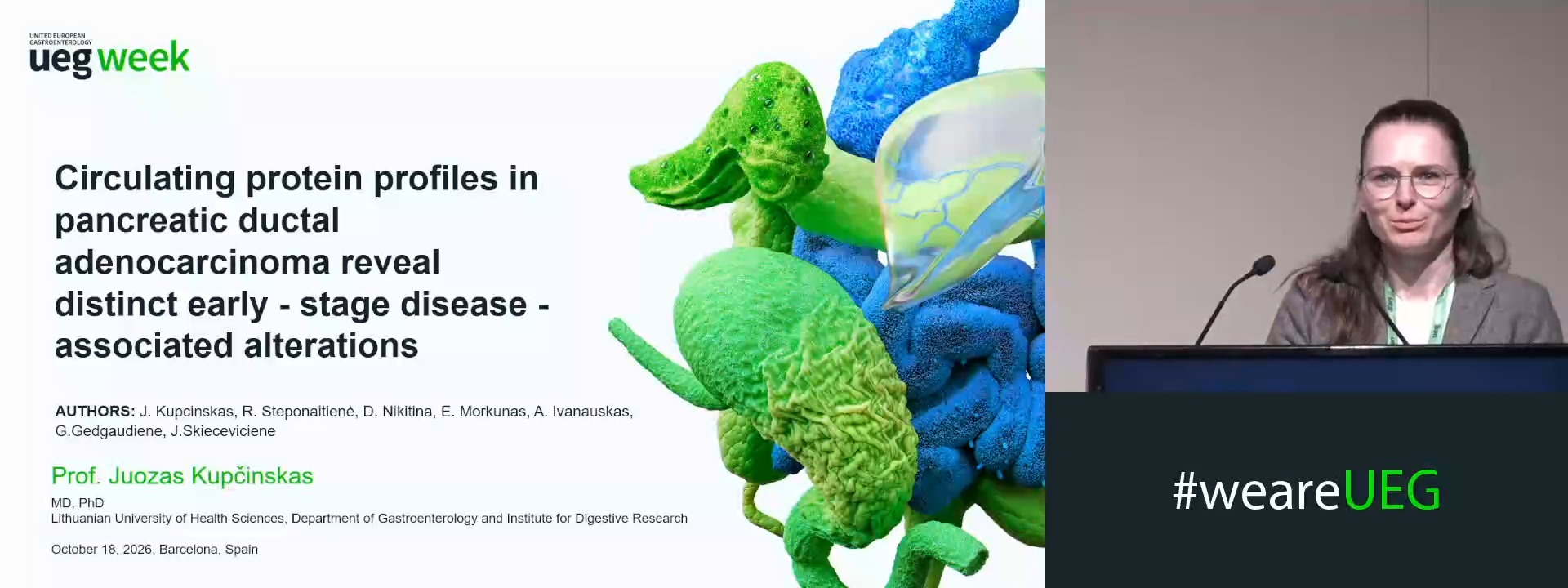
CIRCULATING PROTEIN PROFILES IN PANCREATIC DUCTAL ADENOCARCINOMA REVEAL DISTINCT EARLY-STAGE DISEASE-ASSOCIATED ALTERATIONS
Juozas Kupcinskas 1,2, Rūta Steponaitienė 2, Darja Nikitina 2, Egidijus Morkunas 1, Audrius Ivanauskas 1, Greta Gedgaudiene 2, Jurgita Skieceviciene 2
Affiliations
1 Lithuanian University of Health Sciences, Kaunas, Lithuania
2 Lithuanian University Of Health Sciences, Kaunas, Lithuania
Log in to continue.
This content is part of Gutflix. Log in with your myUEG account, or create one free, to watch it.
Not sure what you can access? Learn more about account types.
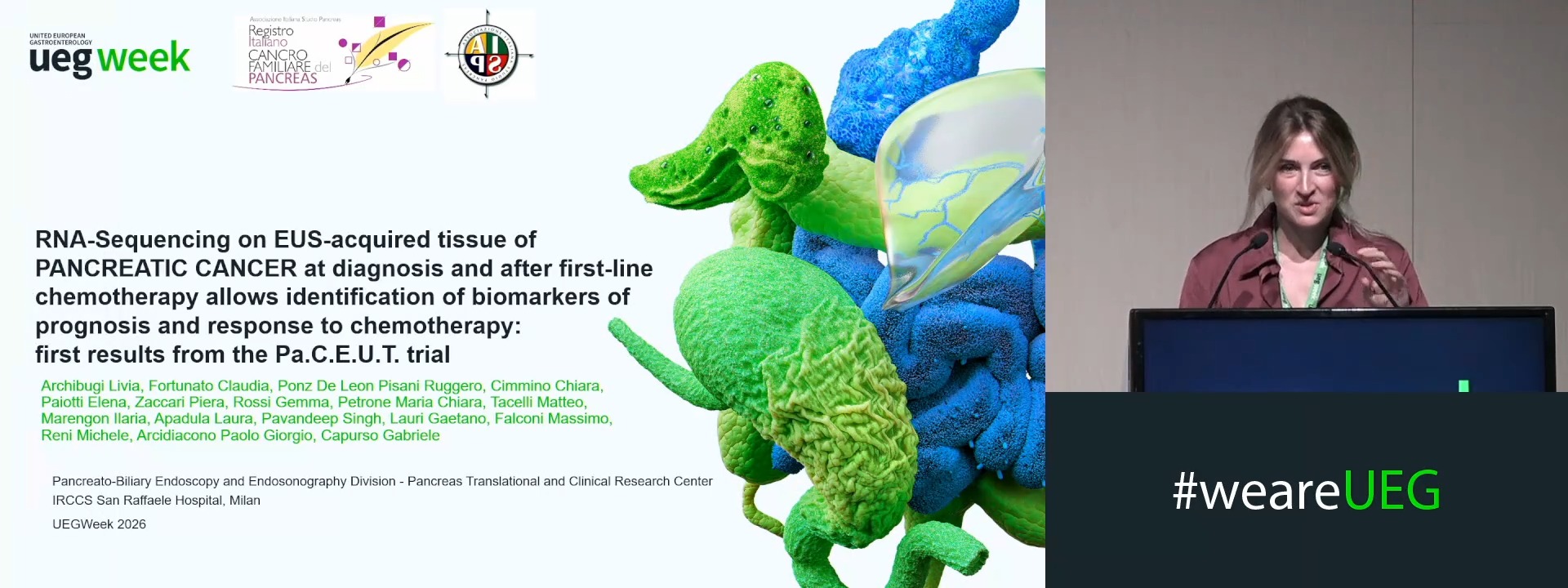
RNA-SEQUENCING ON EUS-ACQUIRED TISSUE OF PANCREATIC CANCER AT DIAGNOSIS AND AFTER FIRST-LINE CHEMOTHERAPY ALLOWS IDENTIFICATION OF BIOMARKERS OF PROGNOSIS AND RESPONSE TO CHEMOTHERAPY: FIRST RESULTS FROM THE PACEUT TRIAL
Livia Archibugi 1, Claudia Fortunato 2, Ruggero Ponz de Leon Pisani 3, Chiara Cimmino 2, Elena Paiotti 2, Piera Zaccari 4, Gemma Rossi 5, Maria Chiara Petrone 6, Matteo Tacelli 7, Ilaria Marengon 5, Laura Apadula 8, Pavandeep Singh 5, Gaetano Lauri 9, Massimo Falconi 10, Michele Reni 8, Paolo Giorgio Arcidiacono 11, Gabriele Capurso 12
Affiliations
1 Hospital San Raffaele, Milan, Italy
2 Università Vita Salute San Raffaele, Milan, Italy
3 IRCCS San Raffaele Hospital Milan, Milano, Italy
4 IRCCS San Raffaele Scientific Institute, Milan, Italy
5 Pancreas Translational and Clinical Research Center; San Raffaele Scientific Institute IRCCS; Vita S, Milano, Italy
6 Vita-Salute San Raffaele University, Milano, Italy
7 San Raffaele Scientific Institute IRCCS, Milano, Italy
8 IRCCS Ospedale San Raffaele, Milano, Italy
9 IRCCS Ospedale San Raffaele, Pescara, Italy
10 Università Vita-Salute San Raffaele, San Raffaele, Italy
11 Ospedale San Raffaele, Milan, Italy
12 San Raffaele Scientific Institute Irccs, Rome, Italy
Log in to continue.
This content is part of Gutflix. Log in with your myUEG account, or create one free, to watch it.
Not sure what you can access? Learn more about account types.
Differential diagnosis and medical workup of fulminant liver failure
Affiliations
1 Klinikum rechts der Isar, München, Germany