UEG's content platform for gastroenterology education bringing recordings, courses, guidelines, and more together in one place.
Trending on Gutflix
Rate for better recommendations!
Your feedback helps us show you more of what you like and less of what you dislike!
Log in to continue.
This content is part of Gutflix. Log in with your myUEG account, or create one free, to watch it.
Not sure what you can access? Learn more about account types.
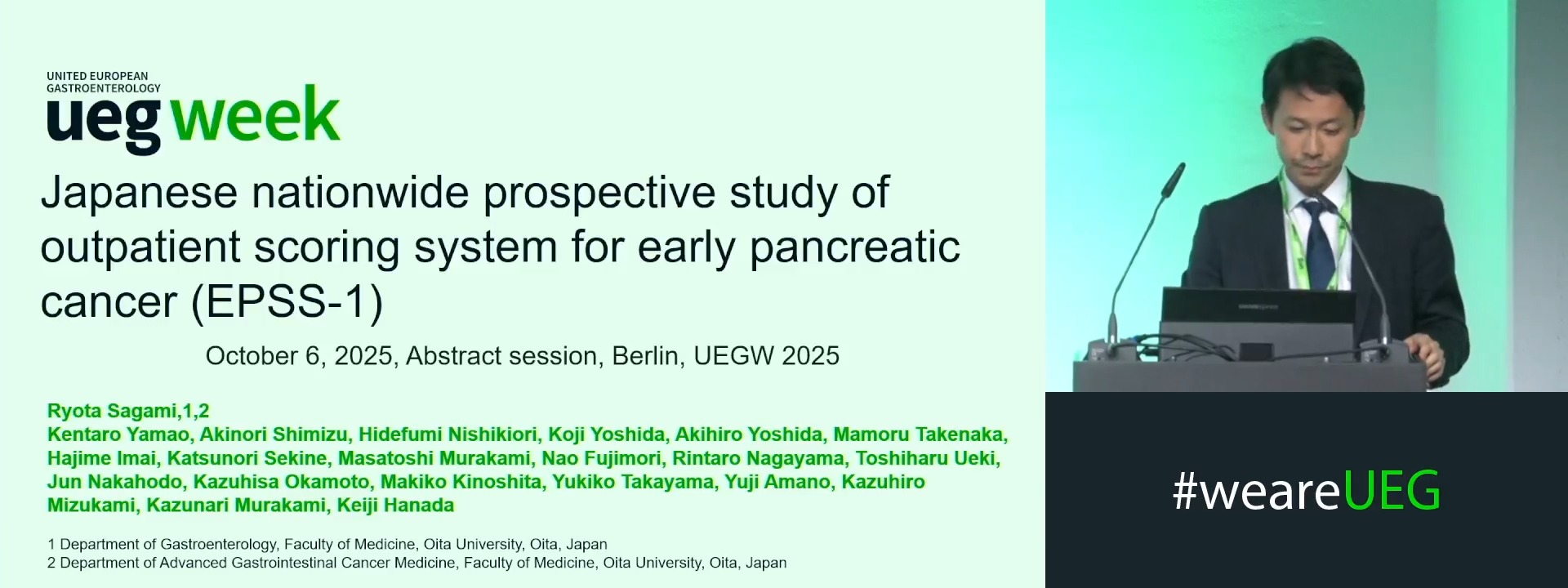
A JAPANESE NATIONWIDE PROSPECTIVE OBSERVATIONAL STUDY ON EARLY PANCREATIC CANCER SCREENING IN HOSPITAL OUTPATIENTS USING A COMPREHENSIVE SCORING SYSTEM COMPARED WITH WESTERN SCREENING METHODS (EPSS-1)
Ryota Sagami 1, Kentaro Yamao 2, Akinori Shimizu 3, Hidefumi Nishikiori 4, Koji Yoshida 5, Mamoru Takenaka 6, Akihiro Yoshida 6, HAJIME IMAI 7, Katsunori Sekine 8, Masatoshi Murakami 9, Nao Fujimori 9, Rintaro Nagayama 10, Toshiharu Ueki 10, Jun Nakahodo 11, Kazuhisa Okamoto 1, Makiko Kinoshita 12, Yukiko Takayama 13, Yuji Amano 14, Kazuhiro Mizukami 1, Kazunari Murakami 15, Keiji Hanada 3
Affiliations
1 Faculty of Medicine, Oita University, Yufu, Japan
2 Nagoya University, Nagoya, Japan
3 Onomichi General Hospital, Onomichi, Japan
4 Oita San-ai Medical Center, Oita, Japan
5 Faculty of Medicine, Kawasaki Medical University, Kurashiki, Japan
6 Kinki University, Osaka sayama, Japan
7 Okanami General Hospital, Iga, Japan
8 National Center for Global Health and Medicine, Kohnodai Hospital, Chiba, Japan
9 Graduate School of Medical Sciences, Kyushu University, Fukuoka, Japan
10 Fukuoka University Chikushi Hospital, Fukuoka, Japan
11 Department of Gastroenterology, Tokyo Metropolitan Cancer and Infectious Diseases Center, Komagome H, Tokyo, Japan
12 National Organization Minamiwakayama Medical Center, Tanabe, Japan
13 Tokyo Women's Medical University, Shinjuku, Japan
14 Urawa GIE clinic group, Urawa, Japan
15 Oita University Dept. of Gastroenterology, Yuhu, Japan

Log in to continue.
This content is part of Gutflix. Log in with your myUEG account, or create one free, to watch it.
Not sure what you can access? Learn more about account types.
Image-guided surgery techniques
Affiliations
1 Maastricht UMC, Dubai, United Arab Emirates

Log in to continue.
This content is part of Gutflix. Log in with your myUEG account, or create one free, to watch it.
Not sure what you can access? Learn more about account types.
CANCER IN PATIENTS WITH FAMILIAL ADENOMATOUS POLYPOSIS – A NATIONWIDE DANISH COHORT STUDY WITH MATCHED CONTROLS
John Gásdal Karstensen 1,2, Steffen Bülow 1, Helle Højen 1, Anne Marie Jelsig 3, Niels Jespersen 1, Klaus Kaae Andersen 4, Mads Damsgaard Wewer 1, Johan Burisch 1, Hans Christian Pommergaard 3,2
Affiliations
1 Copenhagen University Hospital Hvidovre, Hvidovre, Denmark
2 University of Copenhagen, Copenhagen, Denmark
3 Copenhagen University Hospital - Rigshospitalet, Copenhagen, Denmark
4 Omicron ApS, Copenhagen, Denmark
Log in to continue.
This content is part of Gutflix. Log in with your myUEG account, or create one free, to watch it.
Not sure what you can access? Learn more about account types.
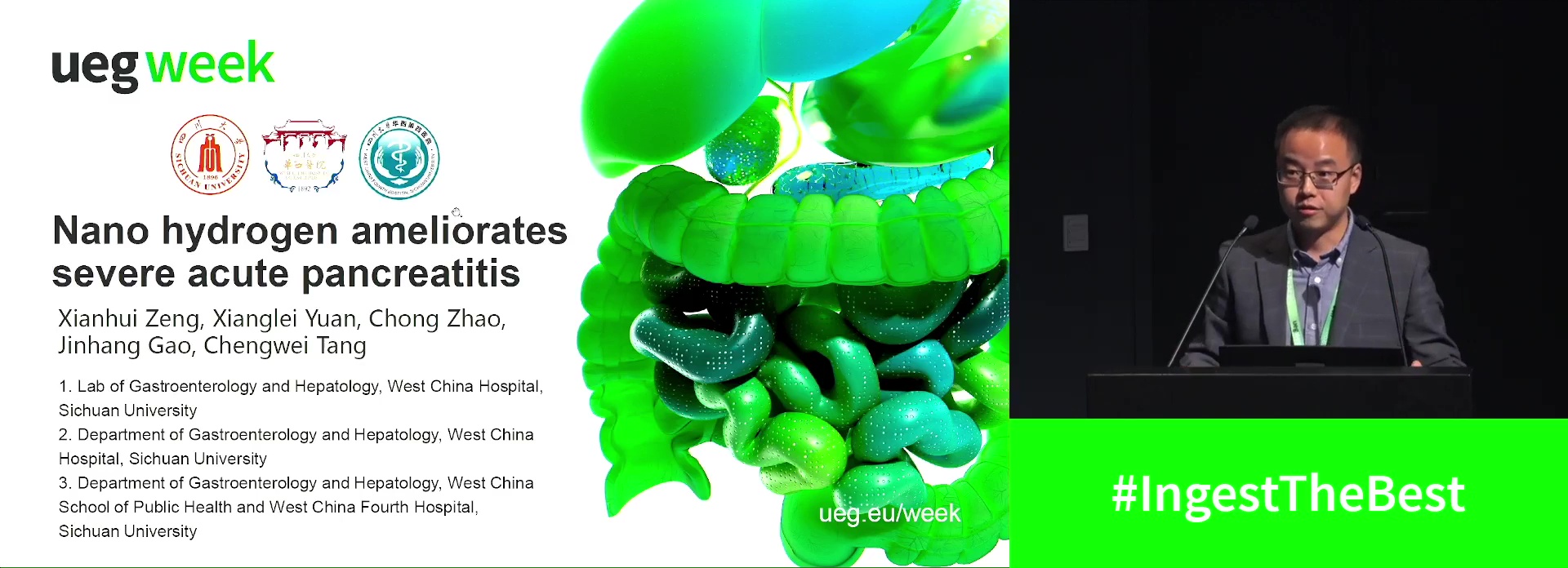
NANO HYDROGEN AMELIORATES SEVERE ACUTE PANCREATITIS
Affiliations
1 West China Hospital, Sichuan University, Chengdu, China
2 West China School of Public Health and West China Fourth Hospital, Sichuan University, Chengdu, China