UEG's educational platform for gastroenterology education bringing recordings, courses, guidelines, and more together in one place.
Most popular content
Rate for better recommendations!
Your feedback helps us show you more of what you like and less of what you dislike!
Log in to access this content.
Free for all myUEG account holders. Your access level is set automatically based on your occupation. Medical professionals get full access to all content. If you are a non-medical user, you can only access UEG Week content from congresses you attended.
Not sure what you can access? Learn more about account types.

EFFECTIVENESS AND SAFETY OF MIRIKIZUMAB IN PATIENTS WITH MODERATE-TO-SEVERE ULCERATIVE COLITIS: A REAL-LIFE MULTICENTER STUDY
Ferdinando D'Amico 1, Fabrizio Fanizzi 2, Arianna Dal Buono 3, Giorgia Michela Lauriola 4, Olga Maria Nardone 5, Alessandra Zilli 1, Mariangela Allocca 1, Laurent Peyrin-Biroulet 6, Fabiana Castiglione 5, Luca Massimino 4, Alessandro Armuzzi 3, Silvio Danese 2
1 IRCCS Ospedale San Raffaele, Milan, Italy
2 Vita e Salute San Raffaele University, Milan, Italy|||IRCCS Ospedale San Raffaele, Milan, Italy
3 Humanitas University, Milan, Italy|||IRCCS Humanitas Research Hospital, Milan, Italy
4 Vita e Salute San Raffaele University, Milan, Italy
5 University of Naples Federico II, Naples, Italy
6 INFINY Institute, INSERM NGERE, CHRU Nancy, Vandoeuvre-les-Nancy, France
Conference
Topics
Submission format
Citation
Published
Log in to access this content.
Free for all myUEG account holders. Your access level is set automatically based on your occupation. Medical professionals get full access to all content. If you are a non-medical user, you can only access UEG Week content from congresses you attended.
Not sure what you can access? Learn more about account types.
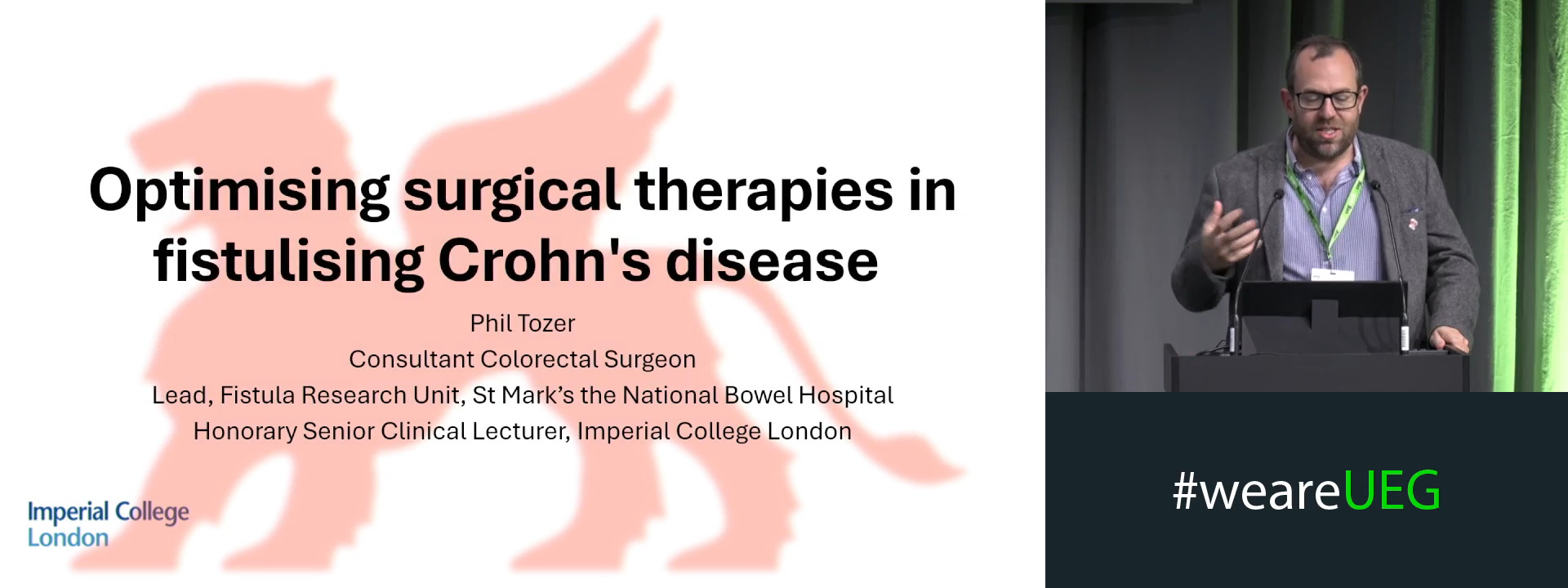
Optimising surgical therapies in fistulising Crohn's disease
1 St Marks Hospital, London, United Kingdom
Event
Citation
Published
Log in to access this content.
Free for all myUEG account holders. Your access level is set automatically based on your occupation. Medical professionals get full access to all content. If you are a non-medical user, you can only access UEG Week content from congresses you attended.
Not sure what you can access? Learn more about account types.
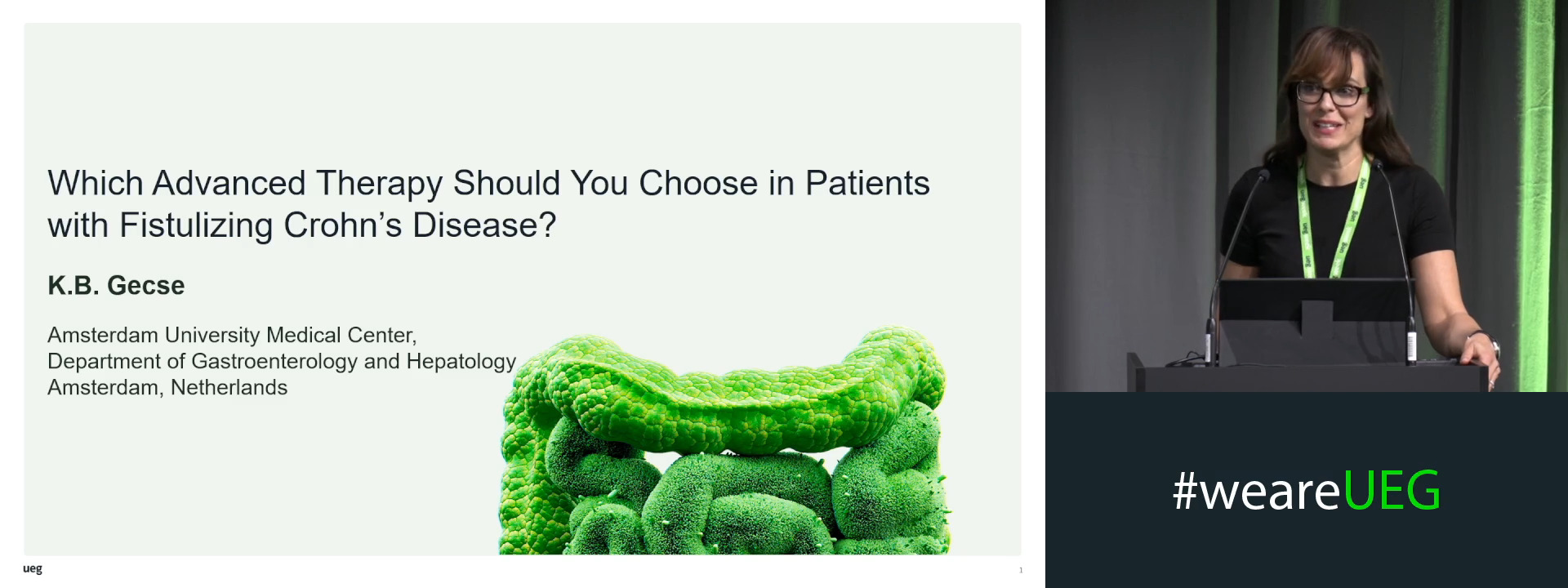
Which advanced therapy should you choose in patients with fistulising Crohn's disease?
1 Amsterdam University Medical Center, Amsterdam, Netherlands
Event
Citation
Published
Log in to access this content.
Free for all myUEG account holders. Your access level is set automatically based on your occupation. Medical professionals get full access to all content. If you are a non-medical user, you can only access UEG Week content from congresses you attended.
Not sure what you can access? Learn more about account types.
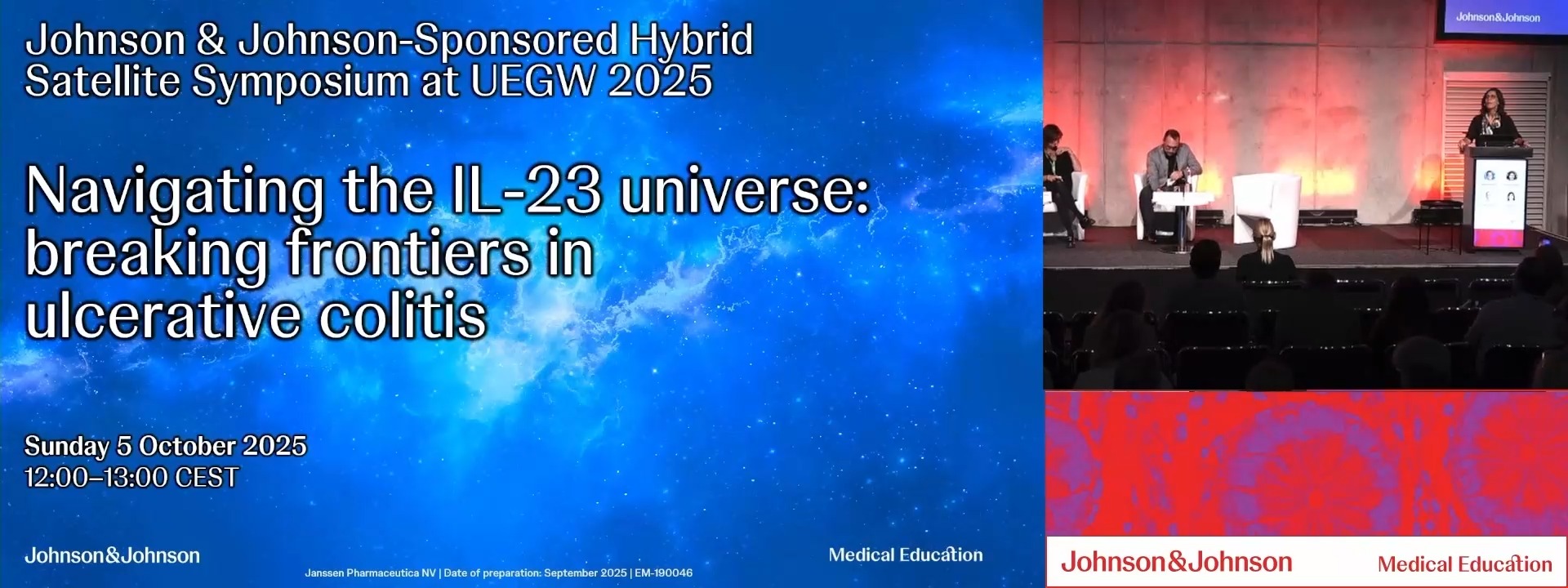
Navigating the IL-23 universe: breaking frontiers in ulcerative colitis (Johnson and Johnson) (Complete Session)
1 Kepler University Hospital, Johannes Kepler University Linz, Graz, Austria
2 University Hospital Liège, Liege, Belgium
3 The University of Chicago Medicine, Chicago, United States of America
4 Division of Gastroenterology, Hospital Beatriz Ângelo, Loures, Portugal
Event
Session
Citation
Published
Log in to access this content.
Free for all myUEG account holders. Your access level is set automatically based on your occupation. Medical professionals get full access to all content. If you are a non-medical user, you can only access UEG Week content from congresses you attended.
Not sure what you can access? Learn more about account types.
UPADACITINIB-INDUCED REMISSION OF SEVERE LEUKOCYTOCLASTIC VASCULITIS IN A YOUNG PATIENT WITH VERY EARLY-ONSET CROHN’S DISEASE
Livio Bonacci 1, Olga Maria Nardone 1, Camilla Leo 1, Flavia Palumbo 1, Martina Petolicchio 1, Francesca Wanda Rossi 1, Fabiana Castiglione 1
1 University of Naples Federico II, Naples, Italy
Conference
Topics
Submission format
Session
Published
Log in to access this content.
Free for all myUEG account holders. Your access level is set automatically based on your occupation. Medical professionals get full access to all content. If you are a non-medical user, you can only access UEG Week content from congresses you attended.
Not sure what you can access? Learn more about account types.
EFFECT OF GUSELKUMAB SUBCUTANEOUS INDUCTION AND MAINTENANCE ON BOWEL URGENCY AND ABDOMINAL PAIN AS MEASURED BY THE UC-PRO/SS IN PARTICIPANTS WITH MODERATELY TO SEVERELY ACTIVE ULCERATIVE COLITIS: RESULTS FROM THE PHASE 3 ASTRO STUDY
Silvio Danese 1, Laurent Peyrin-Biroulet 2, Millie Long 3, Matthew Germinaro 4, Thomas Baker 4, Yelina Alvarez 4, Mary Kavalam 4, Chenglong Han 5, Silke Jorgens 4, Lingjing Jiang 4, Hongyan Zhang 4, Tadakazu Hisamatsu 6, David T. Rubin 7, Jessica Allegretti 8
1 Vita-Salute San Raffaele University - IRCCS San Raffaele Scientific Institute, Milan, Italy
2 Inserm U1256, Nancy University Hospital, Vandoeuvre-les-Nancy, France
3 University of North Carolina at Chapel hill, Chapel Hill, United States
4 Johnson & Johnson, Spring House, United States
5 Johnson & Johnson, Malvern, United States
6 Kyorin University School of Medicine, Tokyo, Japan
7 University of Chicago Medicine, Chicago, United States
8 Brigham and Women´s Hospital, Boston, United States
Conference
Topics
Submission format
Citation
Published
Log in to access this content.
Free for all myUEG account holders. Your access level is set automatically based on your occupation. Medical professionals get full access to all content. If you are a non-medical user, you can only access UEG Week content from congresses you attended.
Not sure what you can access? Learn more about account types.
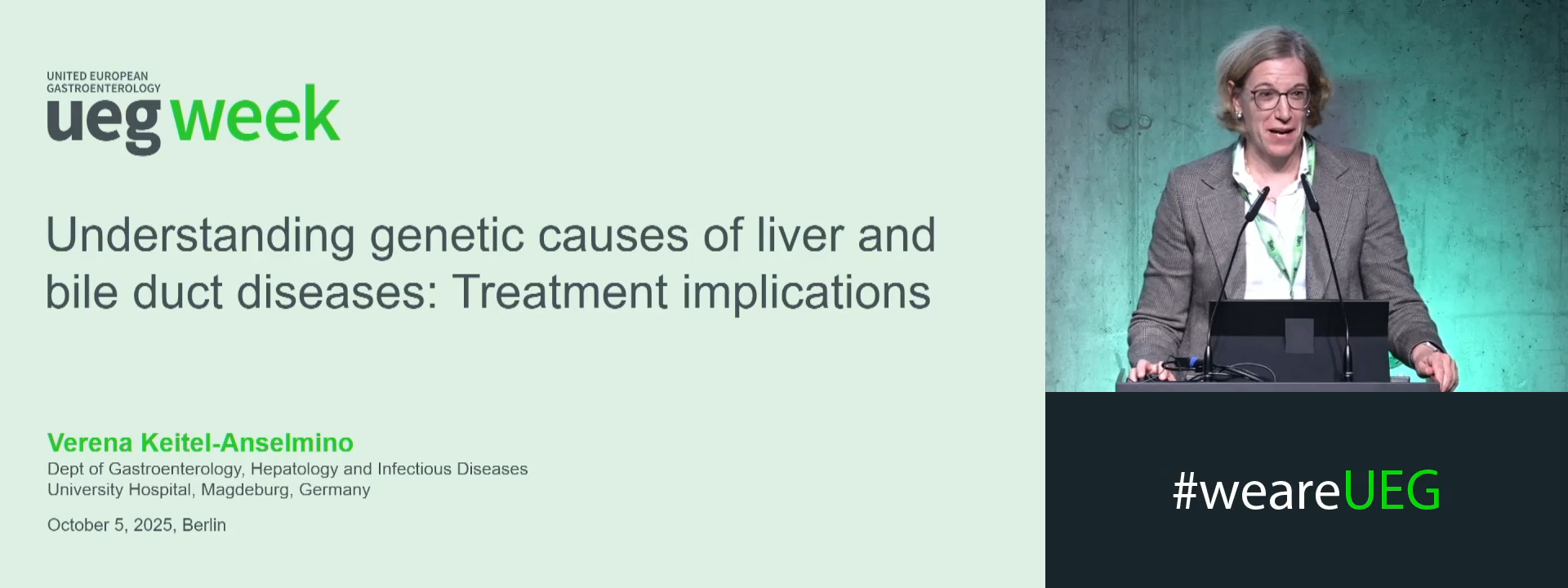
Undertstanding genetic causes of liver and bile duct diseases: Treatment implications
1 University Hospital Magdeburg, Magdeburg, Germany
Event
Session