UEG's educational platform for gastroenterology education bringing recordings, courses, guidelines, and more together in one place.
Most popular content
Rate for better recommendations!
Your feedback helps us show you more of what you like and less of what you dislike!
Log in to access this content.
Free for all myUEG account holders. Your access level is set automatically based on your occupation. Medical professionals get full access to all content. If you are a non-medical user, you can only access UEG Week content from congresses you attended.
Not sure what you can access? Learn more about account types.

GUSELKUMAB PHARMACOKINETICS AND EXPOSURE-RESPONSE RELATIONSHIPS ARE CONSISTENT FOLLOWING INTRAVENOUS VERSUS SUBCUTANEOUS INDUCTION IN PARTICIPANTS WITH CROHN’S DISEASE
Geert R. D'Haens 1, Joseph Adedokun 2, Tae Eun Yang 2, Bruce E. Sands 3, Silvio Danese 4, Natalie Terry 2, Mobolaji Olurinde 2, Rian Van Rampelbergh 5, Marion Vetter 2, Tadakazu Hisamatsu 6, Remo Panaccione 7
1 Amsterdam University Medical Centers, Amsterdam, Netherlands
2 Janssen R&D, LLC., Spring House, United States
3 Icahn School of Medicine at Mount Sinai, New York, United States
4 IRCCS San Raffaele Hospital and Vita-Salute San Raffaele University, Milan, Italy
5 Janssen R&D, Antwerp, Belgium
6 Kyorin University School of Medicine, Tokyo, Japan
7 University of Calgary, Calgary, Canada
Conference
Topics
Submission format
Citation
Published
Log in to access this content.
Free for all myUEG account holders. Your access level is set automatically based on your occupation. Medical professionals get full access to all content. If you are a non-medical user, you can only access UEG Week content from congresses you attended.
Not sure what you can access? Learn more about account types.
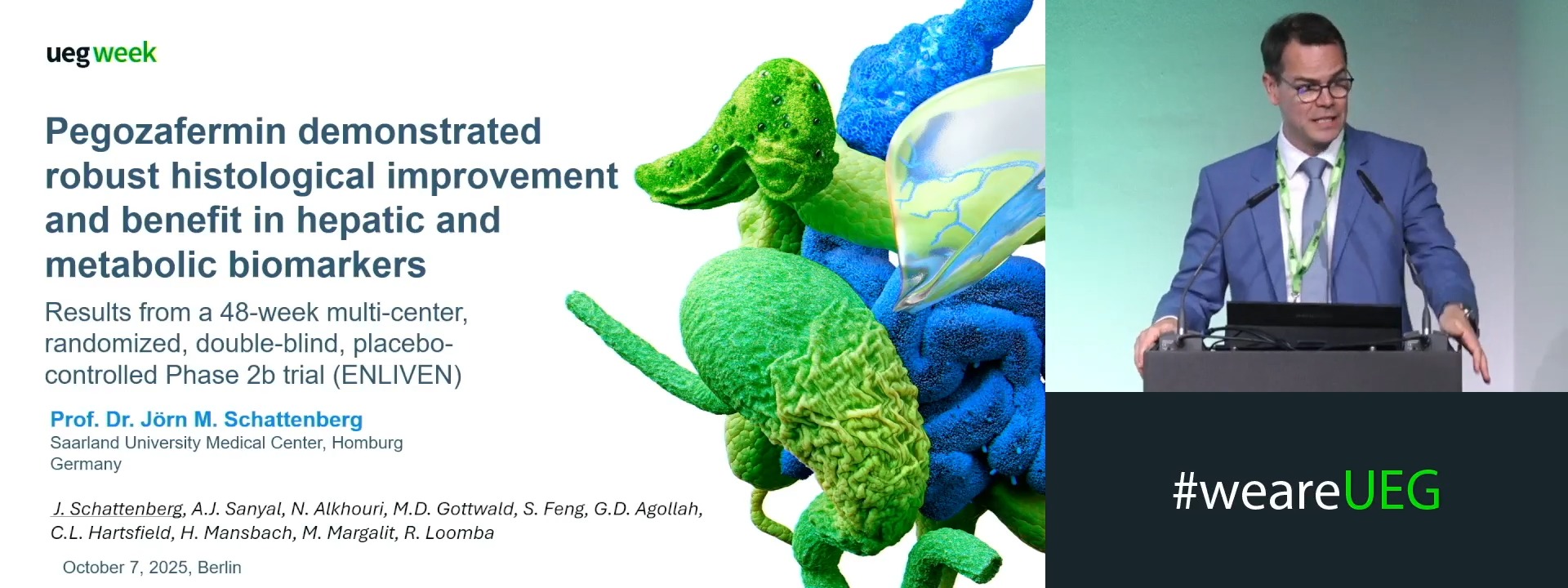
PEGOZAFERMIN DEMONSTRATED ROBUST HISTOLOGICAL IMPROVEMENT AND BENEFIT IN HEPATIC AND METABOLIC BIOMARKERS: RESULTS FROM A 48-WEEK MULTI-CENTER, RANDOMIZED, DOUBLE-BLIND, PLACEBO-CONTROLLED PHASE 2B TRIAL (ENLIVEN)
Jörn Schattenberg 1, Arun J Sanyal 2, Naim Alkhouri 3, Mildred D. Gottwald 4, Shibao Feng 4, Germaine D. Agollah 4, Cynthia L Hartsfield 4, Hank Mansbach 4, Maya Margalit 5, Rohit Loomba 6
1 Universitätsklinikum des Saarlandes und Medizinische Fakultät der Universität des Saarlandes, Homburg, Germany
2 Virginia Commonwealth University School of Medicine, Richmond, United States
3 Arizona Liver Health, Phoenix, United States
4 89bio, San Francisco, United States
5 89bio, Rehovot, Israel
6 University of California San Diego MASLD Research Center, San Diego, United States
Event
Topics
Submission format
Citation
Published
Log in to access this content.
Free for all myUEG account holders. Your access level is set automatically based on your occupation. Medical professionals get full access to all content. If you are a non-medical user, you can only access UEG Week content from congresses you attended.
Not sure what you can access? Learn more about account types.
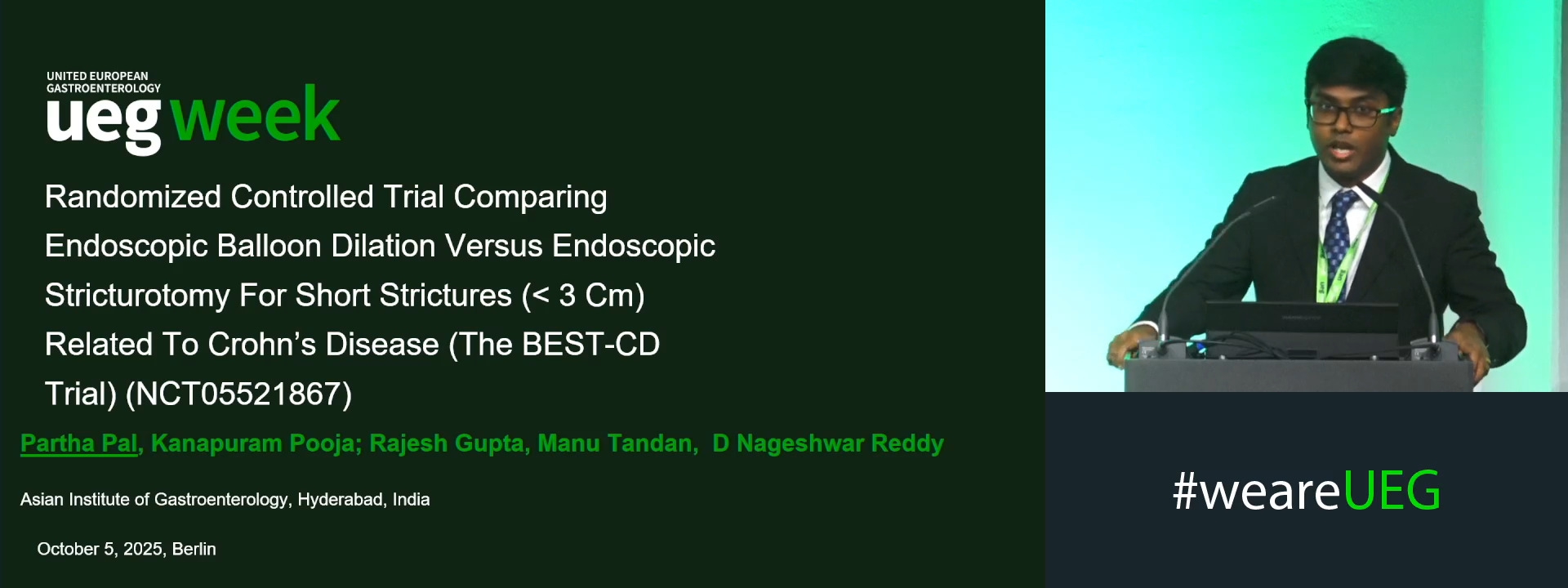
RANDOMIZED CONTROLLED TRIAL COMPARING ENDOSCOPIC BALLOON DILATION VERSUS ENDOSCOPIC STRICTUROTOMY FOR SHORT STRICTURES (< 3 CM) RELATED TO CROHN’S DISEASE (THE BEST-CD TRIAL) (NCT05521867)
1 Asian Institute of Gastroenterology, Hyderabad, India
Event
Topics
Submission format
Citation
Published
Log in to access this content.
Free for all myUEG account holders. Your access level is set automatically based on your occupation. Medical professionals get full access to all content. If you are a non-medical user, you can only access UEG Week content from congresses you attended.
Not sure what you can access? Learn more about account types.
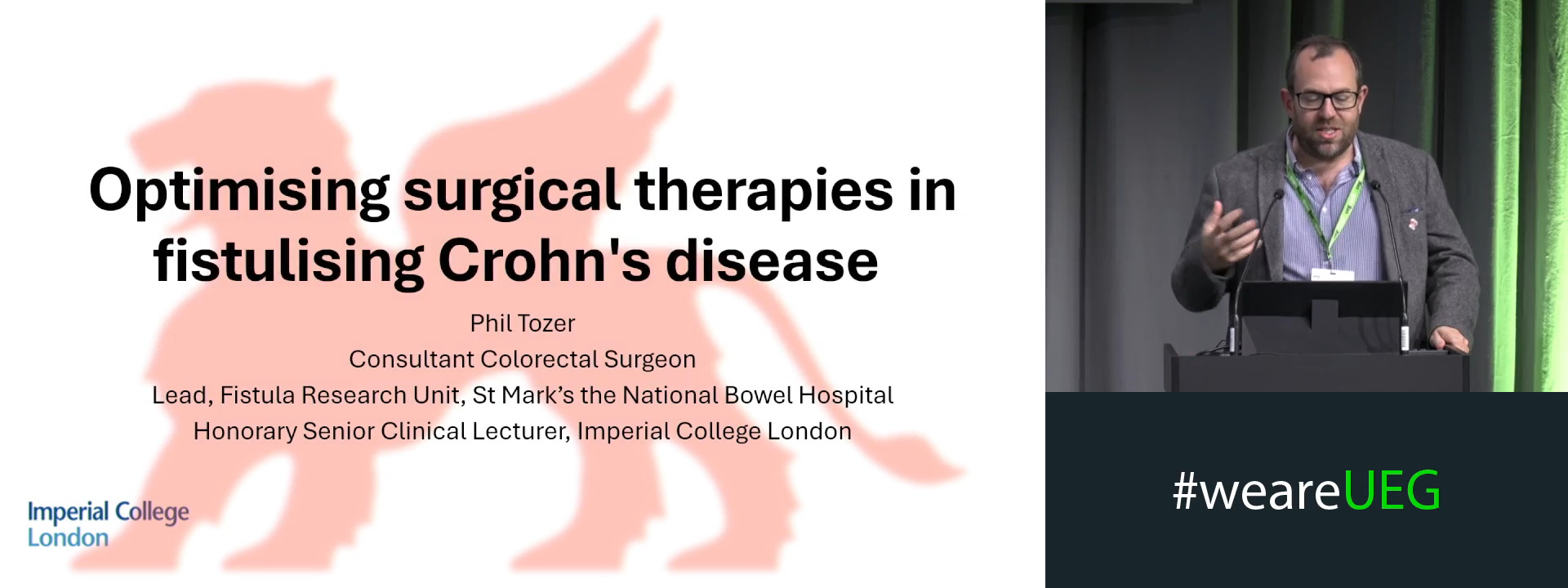
Optimising surgical therapies in fistulising Crohn's disease
1 St Marks Hospital, London, United Kingdom
Event
Citation
Published
Log in to access this content.
Free for all myUEG account holders. Your access level is set automatically based on your occupation. Medical professionals get full access to all content. If you are a non-medical user, you can only access UEG Week content from congresses you attended.
Not sure what you can access? Learn more about account types.
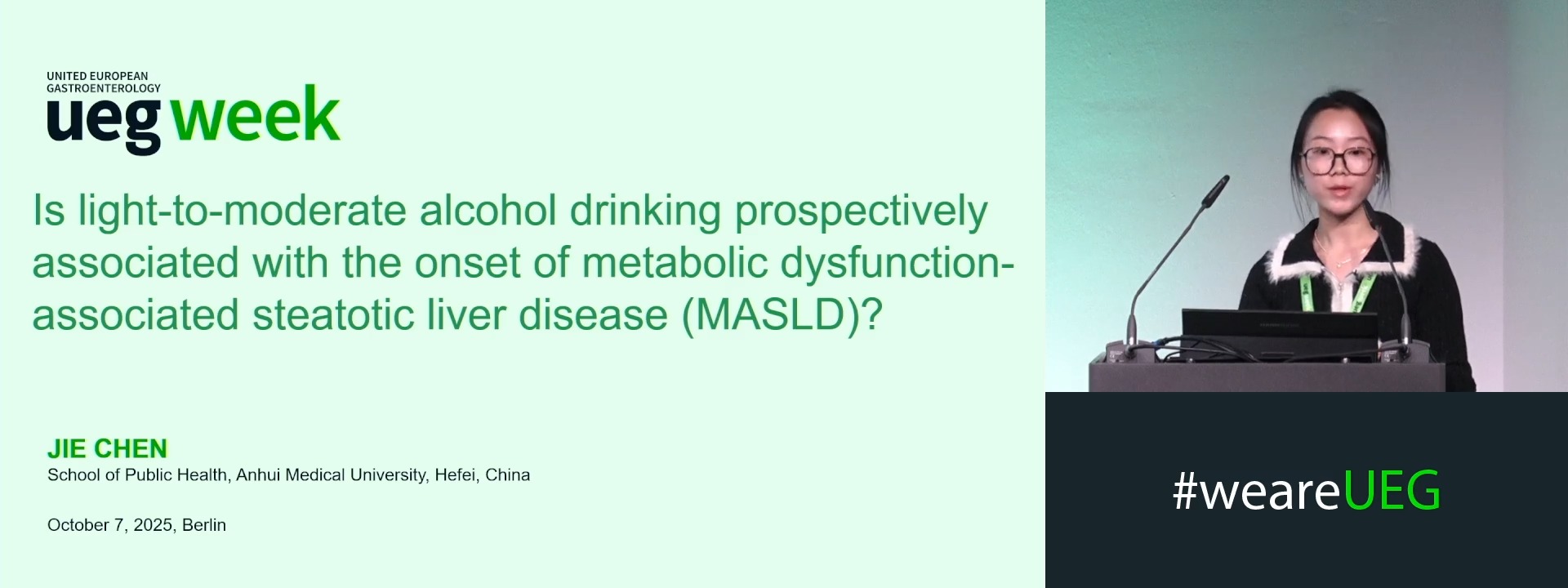
IS LIGHT TO MODERATE ALCOHOL DRINKING PROSPECTIVELY ASSOCIATED WITH THE ONSET OF METABOLIC DYSFUNCTION-ASSOCIATED STEATOTIC LIVER DISEASE?
Jie Chen 1, Yangxin Xu 1, Yu Chang 1, Qin Xinsheng 1, Hongjuan Cao 2, Zhuang Zhang 1, Wanshui Yang 1
1 Anhui Medical University, Hefei, China
2 Lu'an Municipal Center for Disease Control and Prevention, Lu'an, China
Event
Topics
Submission format
Citation
Published
Log in to access this content.
Free for all myUEG account holders. Your access level is set automatically based on your occupation. Medical professionals get full access to all content. If you are a non-medical user, you can only access UEG Week content from congresses you attended.
Not sure what you can access? Learn more about account types.
RELATIONSHIP BETWEEN CLINICAL AND HISTOLOGIC FINDINGS WITH TULISOKIBART INDUCTION AT WEEK 12 AND MAINTENANCE DOSING AT WEEK 50 IN THE PHASE 2 RANDOMIZED CONTROLLED ARTEMIS-UC STUDY IN PARTICIPANTS WITH ULCERATIVE COLITIS
Christopher Ma 1, Brigid S. Boland 2, Rupert Leong 3, Jaroslaw Leszczyszyn 4, Xavier Hebuterne 5, Zhi Jin Xu 6, Wen Zhou 6, Mark Yen 6
1 University of Caglary, Calgary, Canada
2 Altman Clinical Translational Research Institute, University of California, San Diego, United States
3 Macquarie University, Sydney, Australia
4 Melita Medical Center, Wroclaw, Poland
5 Hospital Archet 2, Nice, Nice, France
6 Merck & Co., Inc., Rahway, United States
Conference
Topics
Submission format
Citation
Published
Log in to access this content.
Free for all myUEG account holders. Your access level is set automatically based on your occupation. Medical professionals get full access to all content. If you are a non-medical user, you can only access UEG Week content from congresses you attended.
Not sure what you can access? Learn more about account types.
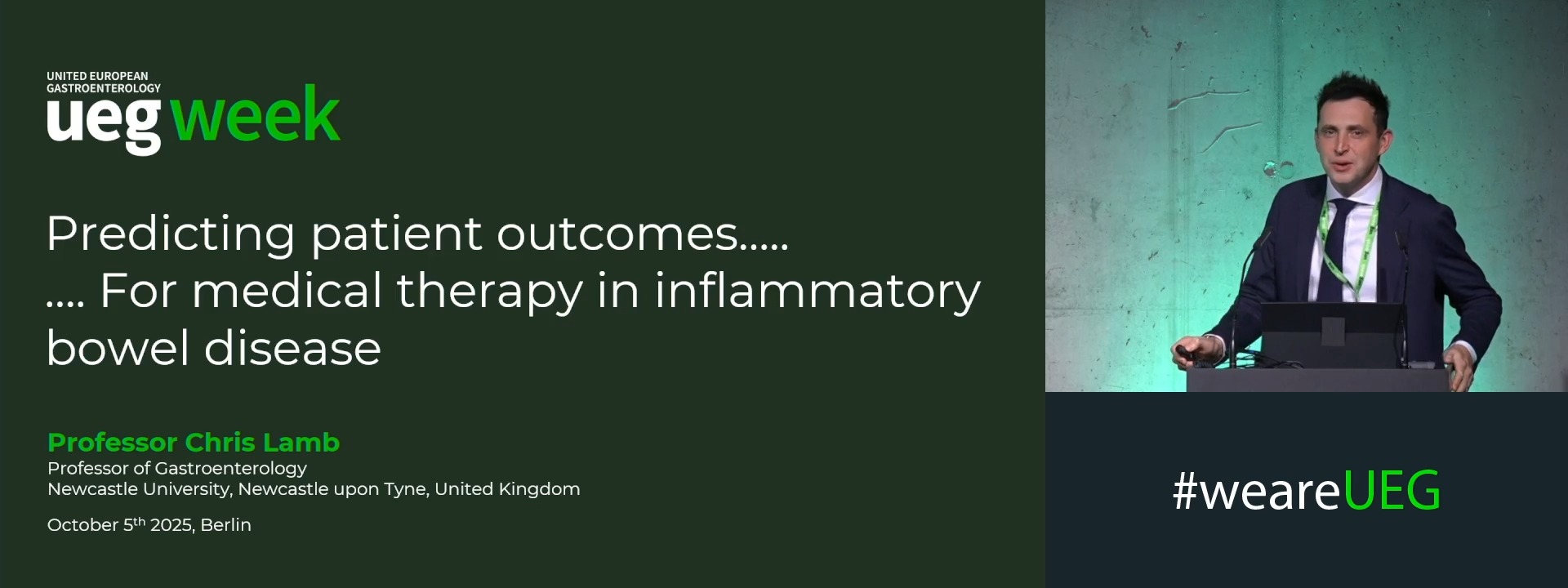
... for medical therapy in inflammatory bowel diseases
1 Newcastle Hospitals NHS Foundation Trust, Newcastle, United Kingdom
Event
Topics
Session