UEG's content platform for gastroenterology education bringing recordings, courses, guidelines, and more together in one place.
Trending on Gutflix
Rate for better recommendations!
Your feedback helps us show you more of what you like and less of what you dislike!
Log in to continue.
This content is part of Gutflix. Log in with your myUEG account, or create one free, to watch it.
Not sure what you can access? Learn more about account types.
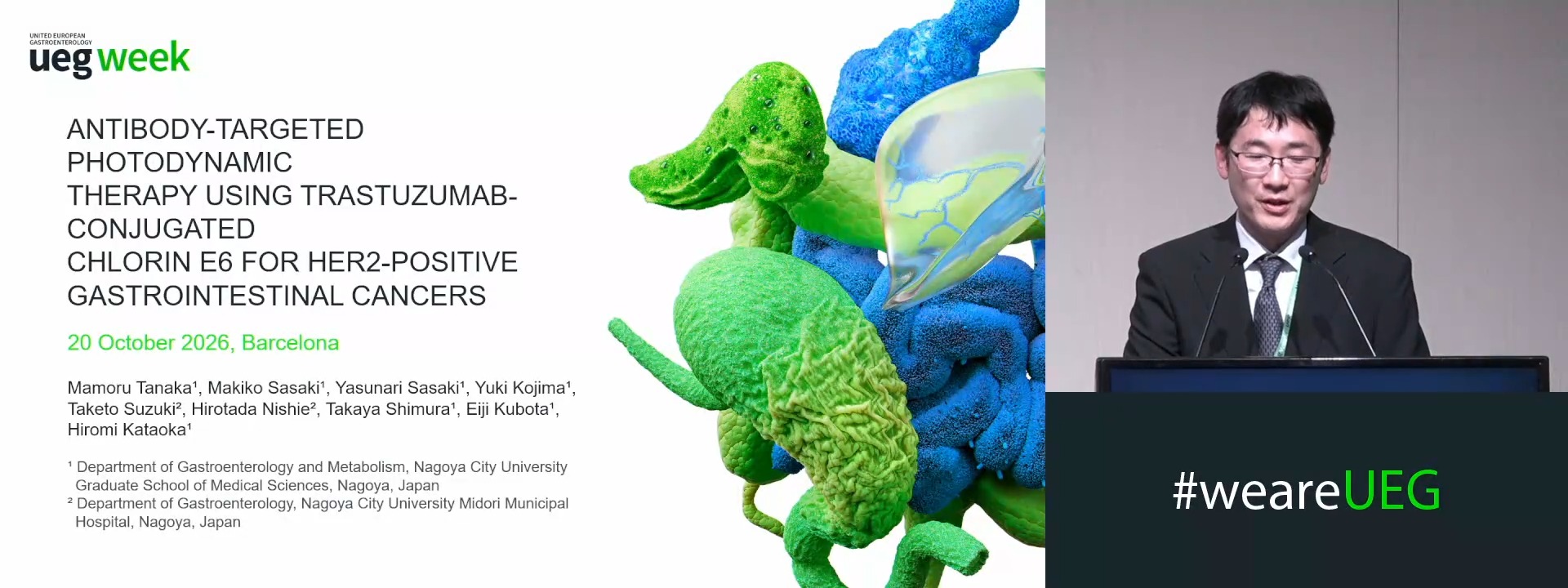
ANTIBODY-TARGETED PHOTODYNAMIC THERAPY USING TRASTUZUMAB-CONJUGATED CHLORIN E6 FOR HER2-POSITIVE GASTROINTESTINAL CANCERS
Mamoru Tanaka 1, Makiko Sasaki 1, Yasunari Sasaki 1, Yuki Kojima 1, Taketo Suzuki 2, Hirotada Nishie 2, Takaya Shimura 1, Eiji Kubota 1, Hiromi Kataoka 1
Affiliations
1 Nagoya City University Graduate School of Medical Sciences, Nagoya, Japan
2 Nagoya City University Midori Municipal Hospital, Nagoya, Japan
Log in to continue.
This content is part of Gutflix. Log in with your myUEG account, or create one free, to watch it.
Not sure what you can access? Learn more about account types.
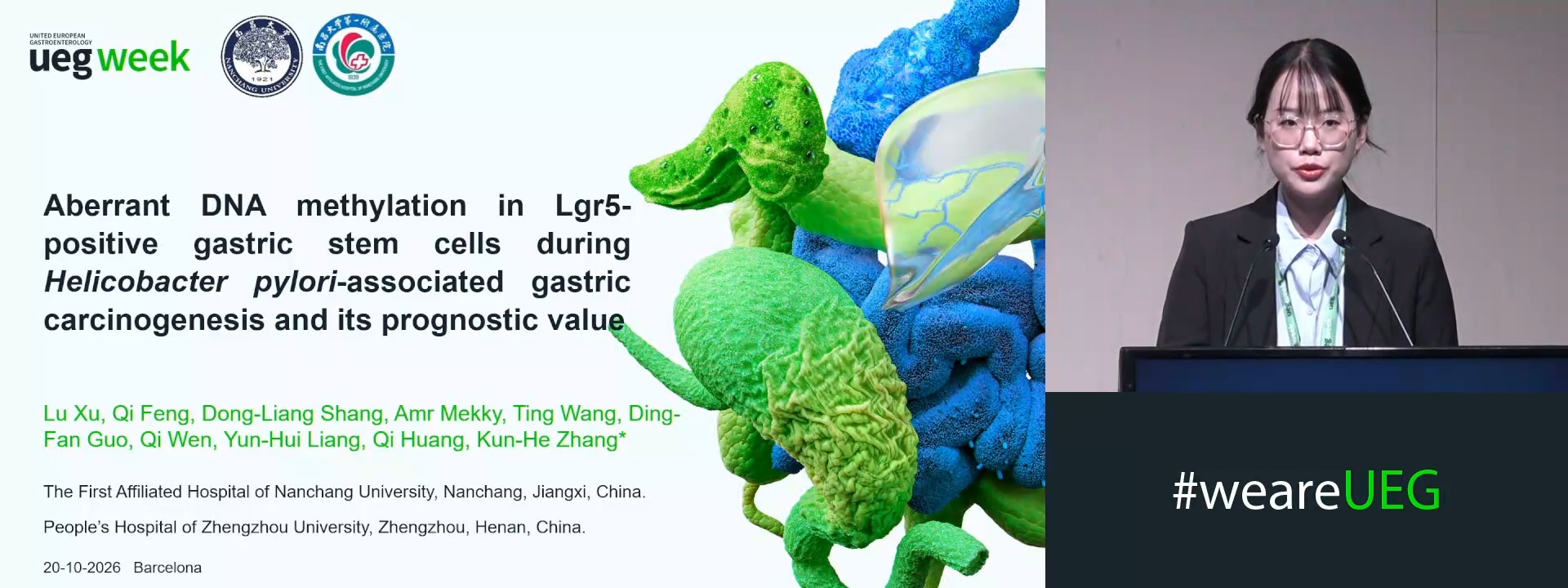
ABERRANT DNA METHYLATION IN LGR5-POSITIVE GASTRIC EPITHELIAL STEM CELLS DURING HELICOBACTER PYLORI-ASSOCIATED GASTRIC CARCINOGENESIS AND ITS PROGNOSTIC VALUE
Lu Xu 1, Qi Feng 1, Dong-Liang Shang 2, Ding-Fan Guo 1, Qi Wen 1, Yun-Hui Liang 1, Qi Huang 1, Ting Wang 1, Kun-He Zhang 1
Affiliations
1 Jiangxi Provincial Key Laboratory of Digestive Diseases, Jiangxi Clinical Research Center for Gastroenterology, Digestive Disease Hospital, The First Affiliated Hospital, Jiangxi Medical College, Nanchang University, Jiangxi, China
2 People’s Hospital of Zhengzhou University, and Henan Provincial People’s Hospital, Zhengzhou, China
Log in to continue.
This content is part of Gutflix. Log in with your myUEG account, or create one free, to watch it.
Not sure what you can access? Learn more about account types.
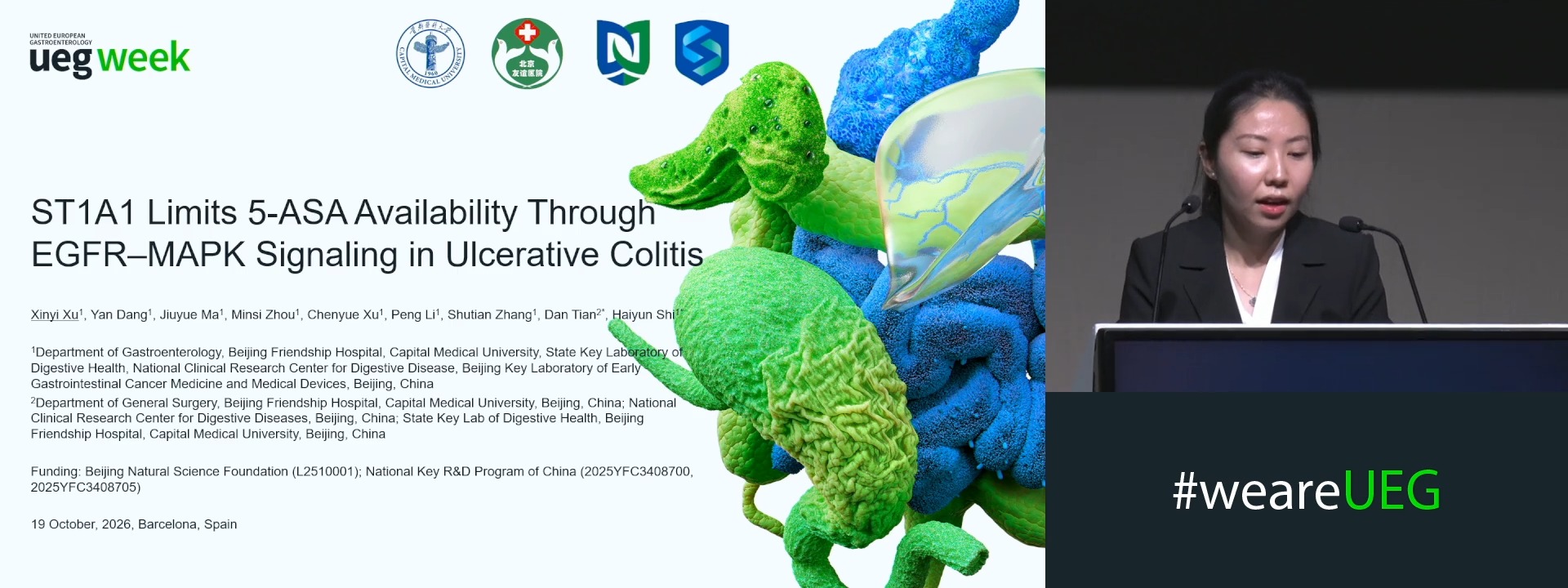
ST1A1 ATTENUATES 5-AMINOSALICYLIC ACID UPTAKE AND PROMOTES ITS METABOLISM IN INTESTINAL EPITHELIAL CELL THROUGH EGFR-MAPK SIGNALING IN ULCERATIVE COLITIS
Xinyi Xu 1, Yan Dang 1, Jiuyue Ma 1, Minsi Zhou 1, Chenyue Xu 1, Peng Li 1, Zhang Shutian 1, Dan Tian 1, Haiyun Shi 1
Affiliations
1 Capital Medical University Affliated Beijing Friendship Hospital, Beijing, China
Log in to continue.
This content is part of Gutflix. Log in with your myUEG account, or create one free, to watch it.
Not sure what you can access? Learn more about account types.
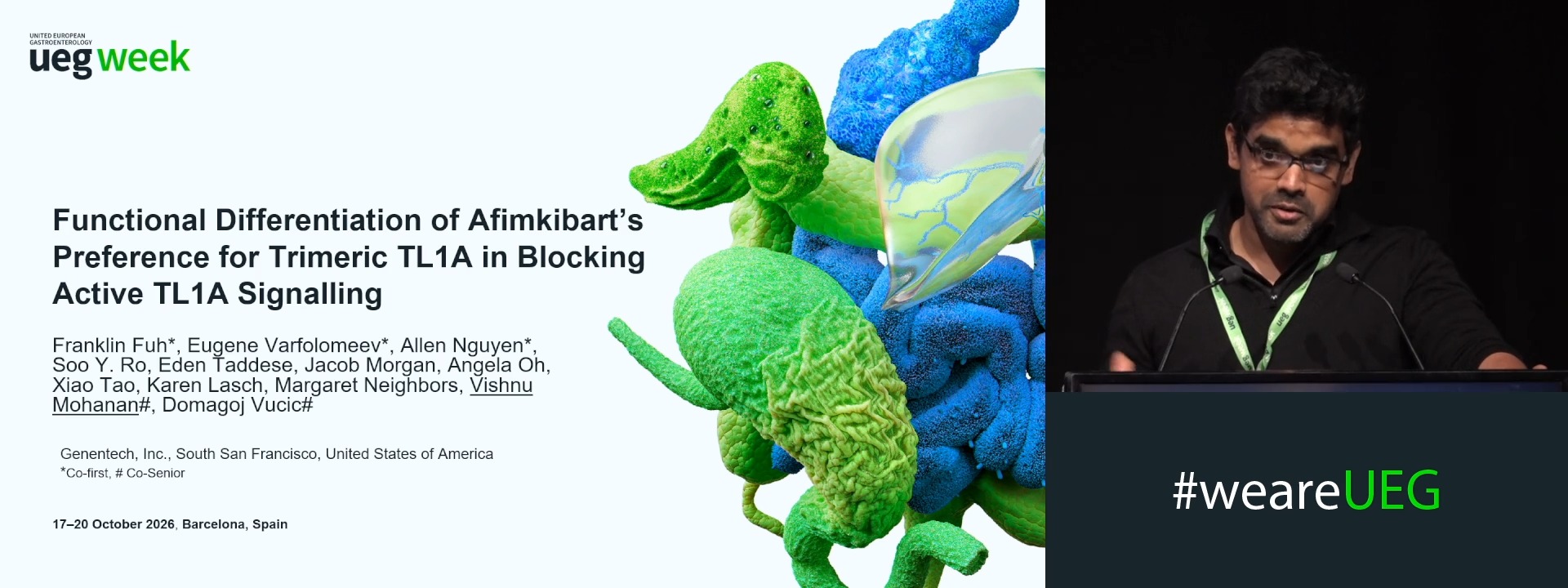
FUNCTIONAL DIFFERENTIATION OF AFIMKIBART’S PREFERENCE FOR TRIMERIC TL1A IN BLOCKING ACTIVE TL1A SIGNALING
Franklin Fuh 1, Eugene Varfolomeev 1, Allen Nguyen 1, Angela Oh 1, Geil Merana 1, Xiao Tao 1, Karen Lasch 1, Maggie Neighbors 1, Vishnu Mohanan 1, Domagoj Vucic 1
Affiliations
1 Genentech Inc., South San Francisco, United States
Log in to continue.
This content is part of Gutflix. Log in with your myUEG account, or create one free, to watch it.
Not sure what you can access? Learn more about account types.
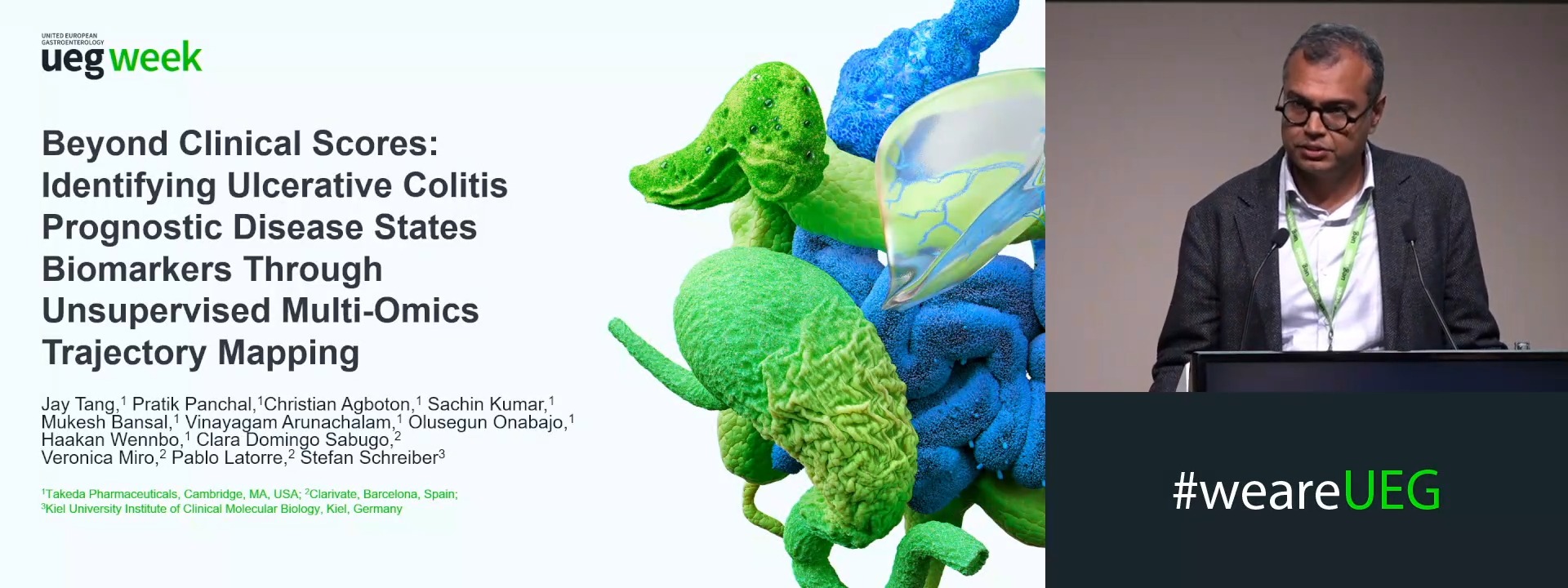
BEYOND CLINICAL SCORES: IDENTIFYING ULCERATIVE COLITIS PROGNOSTIC DISEASE STATES BIOMARKERS THROUGH UNSUPERVISED MULTI-OMICS TRAJECTORY MAPPING
Jay Tang 1, Pratik Panchal 1, Christian Agboton 1, Sachin Kumar 1, Mukesh Bansal 1, Vinayagam Arunachalam 1, Olusegun Onabajo 1, Hakan Wennbo 1, Clara Domingo Sabugo 2, Veronica Miro 2, Pablo Latorre 2, Stefan Schreiber 3
Affiliations
1 Takeda Pharmaceuticals, Cambridge, United States
2 Clarivate Analytics, Barcelona, Spain
3 University Hospital Schleswig-Holstein, Kiel, Germany