Introduction
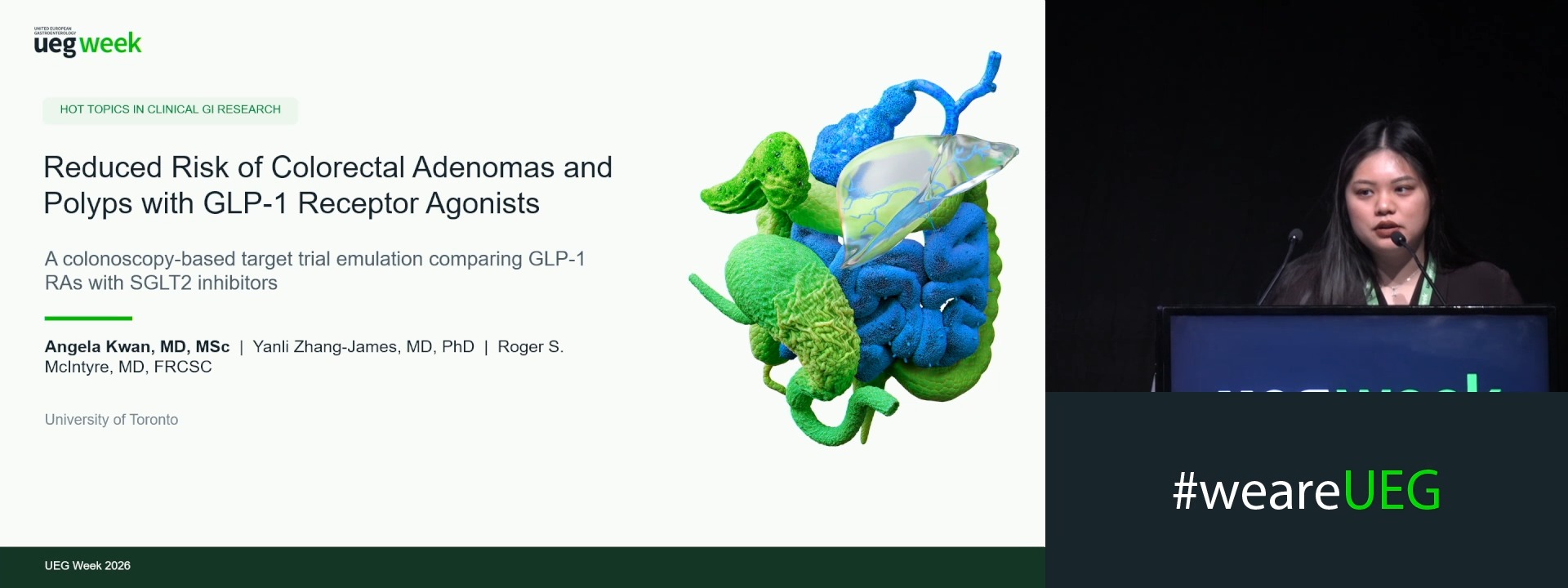
Amid the accelerating global adoption of glucagon-like peptide-1 receptor agonists (GLP-1 RAs), their impact on the earliest stages of colorectal neoplasia remains fundamentally and clinically undefined. Prior studies are constrained by colonoscopy-dependent detection bias, in which precursor lesions are only identified upon examination and short-latency outcomes may misclassify prevalent or missed lesions as incident disease. We developed a novel, scalable, colonoscopy-anchored causal framework to isolate true incident colorectal lesions, independent of detection bias.
Aims & Methods
We conducted a multinational, colonoscopy-anchored target trial emulation using de-identified TriNetX EHR data spanning >140M patients. Adults initiating GLP-1 RAs or SGLT2 inhibitors who subsequently underwent colonoscopy were included; time zero was defined as the first post-initiation colonoscopy to standardize outcome ascertainment.
The primary exposure was sustained therapy (≥2 prescriptions), mitigating transient-use misclassification. Propensity score matching rigorously adjusted for demographics and established colorectal neoplasia risk factors (age, sex, BMI, comorbidities); excellent covariate balance was achieved (standardized mean differences ≤0.1).
Cox proportional hazards models quantified incident neoplasia across prespecified 180-, 365-, and 730-day latency windows. A ≥180-day lag further minimized reverse causation and early detection bias. Appendicitis and urinary tract infection served as negative and positive control outcomes, respectively. Sensitivity analyses demonstrated robustness across alternative exposure definitions and cohort restrictions.
Results
Among 258,674 eligible patients, 68,605 propensity-matched participants per group entered the primary sustained-exposure analysis with well-balanced baseline characteristics. GLP-1 RA use was associated with a 15% lower hazard of incident colorectal neoplasia versus SGLT2 inhibitors (HR 0.85, 95% CI 0.84–0.87; p<0.0001), with consistent effects across latency windows and progressive Kaplan–Meier separation.
Despite similar crude incidence proportions, time-to-event analyses uncovered meaningful temporal divergence not captured by cumulative incidence alone. Initiation-based exposure estimates attenuated toward the null (HR 0.96, 95% CI 0.94–0.98), while sensitivity analyses remained directionally concordant: persistent exposure (HR 0.86), mutually exclusive treatment groups (HR 0.90), and colonoscopy within 2 years (HR 0.94).
In the expanded propensity-matched ≥180-day lag analysis, 59,896 patients per group were matched from 133,771 GLP-1 RA and 60,436 SGLT2 inhibitor initiators. After excluding pre-lag events, GLP-1 RA users had fewer incident neoplasia events than SGLT2 inhibitor users (915/16,973 [5.39%] vs 1,035/17,532 [5.90%]; RR 0.913, 95% CI 0.838–0.996; OR 0.908, 95% CI 0.829–0.995; p=0.0393). Follow-up remained well balanced (mean 835 vs 856 days; median 708 vs 739 days). Appendicitis showed no association (HR 1.00), while urinary tract infection recapitulated the established SGLT2 inhibitor signal, supporting internal validity.
Conclusion
In this multinational, colonoscopy-anchored target trial emulation, sustained GLP-1 RA use was associated with a reduced risk of colorectal neoplasia. Convergent evidence across analytic frameworks supports a robust, duration-dependent biological effect despite residual limitations. These findings mitigate detection bias and establish a strong rationale for prospective GLP-1 chemoprevention trials, positioning GLP-1 RAs as a promising strategy for colorectal cancer prevention.
Disclosure
Dr. Roger S. McIntyre has received research funding from CIHR, GACD, NSFC, and the Milken Institute, and has received speaking or consulting fees from Lundbeck, Janssen, Alkermes, Neumora Therapeutics, Boehringer Ingelheim, Sage, Biogen, Mitsubishi Tanabe, Purdue, Pfizer, Otsuka, Takeda, Neurocrine, Sunovion, Bausch Health, Axsome, Novo Nordisk, Kris, Sanofi, Eisai, Intra-Cellular Therapies, NewBridge Pharmaceuticals, Viatris, AbbVie, and Atai Life Sciences.
All other authors declare no financial or personal relationships that could have influenced the work submitted for publication. This includes employment, consultancies, equity interests, honoraria, paid expert testimony, patents, grants, or travel support within the past three years. No additional relationships or activities were identified as potential conflicts of interest.