Introduction
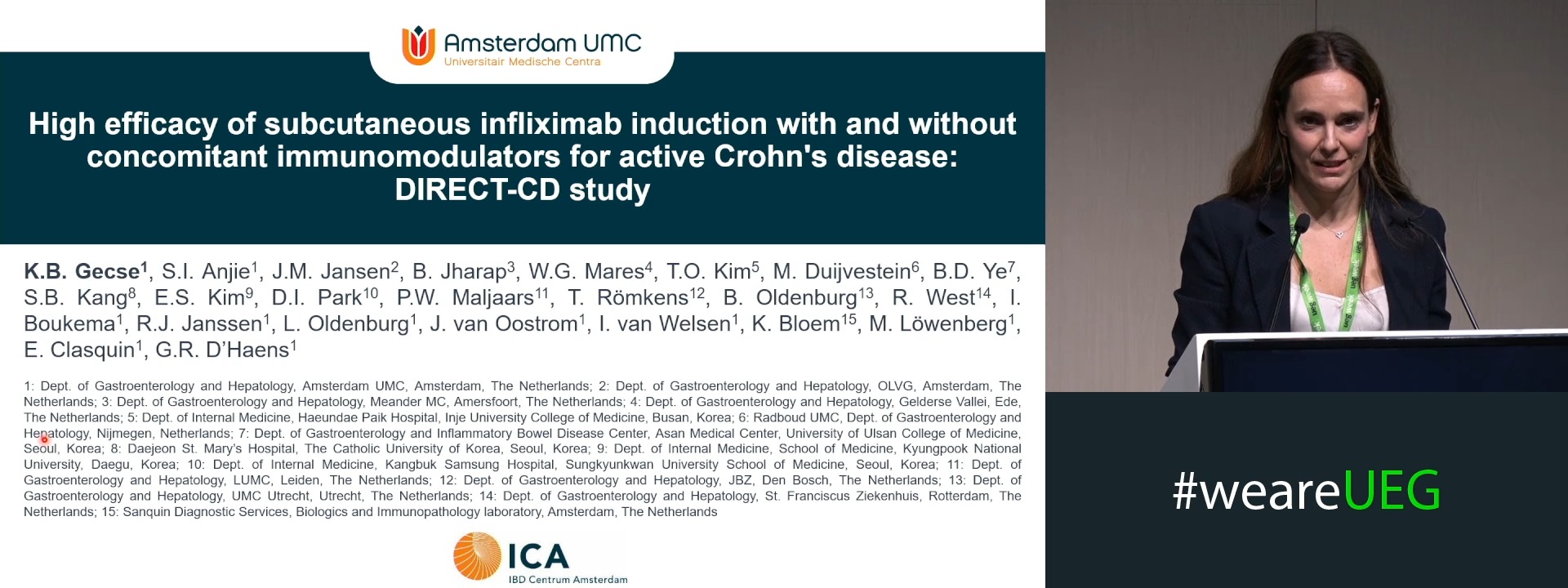
Subcutaneous (SC) infliximab (IFX) is approved for maintenance treatment of IBD. We investigated the safety and efficacy of a SC IFX regimen in mono- and combination therapy for both induction and maintenance in moderate-severe Crohn’s disease (CD).
Aims & Methods
This is a prospective, multinational trial in adult IFX-naïve patients with moderate-to-severe CD (CD Activity Index [CDAI] 220-450 and ulcerations seen at baseline endoscopy). Patients were randomized 1:1 to receive SC IFX as monotherapy or in combination with an immunomodulator (IMM, thiopurine or methotrexate). SC IFX induction was given at 240mg at week (W) 0 and 2, followed by 120mg every other week (eow) from W4 onwards. Following a protocol amendment based on interim pharmacokinetic analysis, the dose was changed to 480mg at W0, 240mg at W2 and further 120mg eow or 240mg eow for patients with body weight >80kg. The primary endpoint was a composite of corticosteroid-free clinical remission (CDAI<150) AND endoscopic response (≥50% decrease in Simple Endoscopic Score [SES]-CD) at W26. Key secondary endpoints were IFX serum concentrations and anti-drug antibodies (drug-tolerant assay) at W2, 4, 8, 14 and 26, and safety. The trial was designed to demonstrate non-inferiority of monotherapy, with a margin set at −10%. The study was prematurely discontinued due to slow recruitment.
Results
In total, 60 patients were randomized (mono n=29, combo n=31). Baseline characteristics, prior biologic use and corticosteroid use at baseline were comparable. The primary endpoint was achieved in 62.1% and 54.8% of patients in the mono vs combo therapy group, respectively (risk difference +7.2%, 95% CI −13.3% to +26.8%). Corticosteroid-free clinical remission and endoscopic remission (SES-CD≤2) were comparable in both groups. IFX serum concentrations were comparable at all timepoints in the two treatment groups. In a Bayesian analysis with an uninformative prior, the posterior probability of non-inferiority was 91.4%. A numerical trend toward higher anti-drug antibody development (≥3.5AU/mL) was observed early during monotherapy (W2: 7.1% vs 0%; W4: 14.3% vs 3.4%), with no significant difference at W14 (38.5% vs 37.0%) or W26 (56.0% vs 50.0%). Three serious adverse events were observed: two in the combination therapy group (CD flare and severe nausea requiring hospitalization) and one patient in the monotherapy group (ciprofloxacin-induced tendinitis requiring hospitalization).
Median (IQR) or n (%)
| Monotherapy (n=29)
| Combination Therapy (n=31)
|
|
Demographics
Age, years
Sex, female
Active smoker
Body weight, kg |
31 (23–41)
11 (37.9%)
7 (24.1%)
72.1 (68.9–86.9)
|
30 (23–41)
21 (67.7%)
7 (22.6%)
68.1 (63.6–78.9)
|
|
Disease Activity at Baseline
CDAI score
Fecal calprotectin, µg/g
SES-CD score
|
308 (262–362)
749 (240–1753)
13 (7–20)
|
304 (265–394)
547 (192–2900)
13 (10–22)
|
|
Infliximab Serum Concentration, mg/L
Week 2
Week 4
Week 8
Week 14
Week 26
|
20.3 (14.7–31.1)
21.1 (15.3-31.0)
18.7 (9.4–22.6)
17.7 (10.3–22.3)
17.5 (10.8-24.1)
|
19.7 (13.9–27.9)
24.0 (18.4-30.8)
18.9 (11.8–24.9)
18.1 (11.9–22.9)
20.7 (14.2-28.7)
| P-value
0.849
0.544
0.501
0.593
0.267
|
Clinical and Endoscopic Outcomes at Week 26
Corticosteroid-free clinical remission and endoscopic response
Endoscopic remission (SES-CD ≤2)
Endoscopic response (-≥50% SES-CD)
Corticosteroid-free clinical remission (CDAI <150)
|
62.1%
48.3%
72.4%
72.4%
|
54.8%
48.4%
67.7%
67.7%
| P-value
0.570
0.993
0.693
0.693
|
Conclusion
In DIRECT-CD, we observed high and comparable corticosteroid-free clinical remission and endoscopic response rates with both the mono- and combination therapy with SC IFX. Immunogenicity was not significantly different and IFX serum concentrations were comparable between the two treatment groups. Both strategies were well tolerated. Our data support the use of SC IFX treatment for both induction and maintenance treatment without concomitant IMM.
Disclosure
KG has received research grants from AbbVie, Pfizer Inc, Celltrion and Galapagos; consultancy fees from AbbVie, Galapagos, Gilead, Janssen Pharmaceuticals, Pfizer Inc., Samsung Bioepis and Takeda and speaker’s honoraria from AbbVie, Galapagos, Janssen Pharmaceuticals, Pfizer Inc, Samsung Bioepis, Takeda and Tillotts.
JJ has served on advisory boards or as a speaker or consultant for AbbVie, Amgen, Ferring, Fresenius, Janssen, MSD, Pfizer, and Takeda.
WM received speaker fees from Janssen and advisory committee AbbVie, Ferring, and Takeda.
MD received speaking fees from Bristol Myers Squibb, Takeda, and Galapagos; served on an advisory board for AbbVie, Bristol Myers Squibb, Celltrion, Galapagos, Janssen, and Takeda; and received grant or research support from Pfizer, Bristol Myers Squibb, Galapagos, and Janssen. KBG has received grants from Pfizer, Celltrion, and Galapagos; consultancy fees from AbbVie, Arena Pharmaceuticals, Galapagos, Gilead, Immunic Therapeutics, Janssen Pharmaceuticals, Novartis, Pfizer, Samsung Bioepsis, and Takeda; and speaker honoraria from Celltrion, Ferring, Janssen Pharmaceuticals, Novartis, Pfizer, Samsung Bioepis, Takeda, and Tillotts.
BY reports consulting fees from AbbVie Korea, BMS Pharmaceutical Korea Ltd., Celltrion, Chong Kun Dang Pharm, CJ Red BIO, Curacle, Daewoong Pharm, Dong-A ST, Ferring Korea, Hanmi Pharmaceutical, Imscout, IQVIA, Johnson & Johnson, Johnson & Johnson Korea, Jeil Pharmaceutical Co., Kangstem Biotech, Korea Otsuka Pharm, Korea United Pharm, Lilly Korea, Medtronic Korea, NanoEntek, ORGANOIDSCIENCES Ltd., Pfizer Korea, Samsung Bioepis, Takeda, Takeda Korea and Yuhan; speaker fees from AbbVie Korea, BMS Pharmaceutical Korea Ltd., Celltrion, Cornerstones Health, Curacle, Daewoong Pharm, Eisai Korea, Ferring Korea, IQVIA, Johnson & Johnson Korea, Pfizer Korea, Samsung Bioepis, and Takeda Korea; and research support from Celltrion and Pfizer Korea.
ESK has acted as a speaker or advisory board member of AbbVie, Celltrion, J&J, Ferring, Pfizer, Samsung Bioepis, and Takeda.
SBK has received research grants from Celltrion, Chong Kun Dang Pharm, Il-Yang Pharm, Pharmbio Korea, and Taejoon Pharm; consulting fees from AbbVie Korea, Ferring Korea, Janssen Korea, and Takeda Korea; and speaking fees from AbbVie Korea, Celltrion, Ferring Korea, Janssen Korea, Pfizer Korea, Taejoon Pharm, and Takeda Korea.
Dong Il Park has served as an advisory board member for AbbVie, Celltrion, Ferring, and Shire (a member of the Takeda group of companies).
RW has participated in advisory boards or as a speaker for Janssen, AbbVie, Ferring, and Pfizer.
TR has served as a speaker and/or an advisory board member for AbbVie, Bristol-Myers Squibb, and Janssen
BO has served as a speaker for Takeda, Galapagos, Ferring, Celltrion, Jansen. He has received grants from Pfizer, Takeda, Abbvie, BMS, Celltrion,and Ferring. He has served as a consultant/on the advisory board for Janssen, Pfizer, Takeda, Ferring, Abbvie, Galapagos, Takeda
ML has received consultancy/lecture fees from AbbVie, Bristol-Myers Squibb, Eli Lilly, Alfasigma/Galapagos, Janssen-Cilag, Johnson & Johnson, Medtronic, Pfizer, Takeda, and Tillotts; and grant support from Alfasigma, Top consortium for Knowledge and Innovation (TKI), NFU transformation deal, and ZonMW.
GD has served as advisor for AbbVie, Abivax, Alimentiv, Astrazeneca, Bristol Myers Squibb, Boehringer Ingelheim, Celltrion, Eli Lilly, GlaxoSmithKline, Johnson and Johnson, Merck Sharp Dome, Pfizer, Polpharm, Sanofi, Takeda, Tillotts, and received speaker fees from AbbVie, Eli Lilly, Johnson and Johnson, Merck Sharp Dome, Pfizer, Takeda, Tillotts.
Nothing to disclose: SIA, TK, BJ, IB, RJ, LO, JO, IW, KB, EC, PM