UEG's content platform for gastroenterology education bringing recordings, courses, guidelines, and more together in one place.
Trending on Gutflix
Rate for better recommendations!
Your feedback helps us show you more of what you like and less of what you dislike!
Log in to continue.
This content is part of Gutflix. Log in with your myUEG account, or create one free, to watch it.
Not sure what you can access? Learn more about account types.
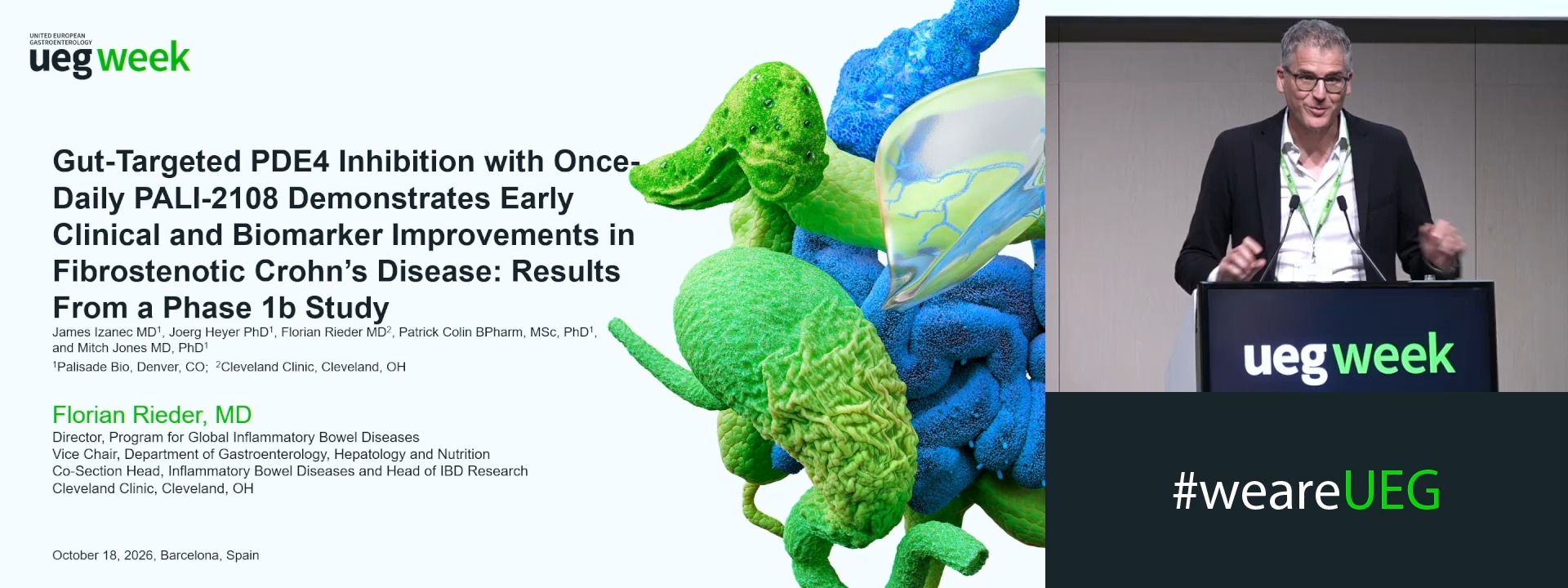
GUT-TARGETED PDE4 INHIBITION WITH ONCE-DAILY PALI-2108 DEMONSTRATES EARLY CLINICAL AND BIOMARKER IMPROVEMENTS IN FIBROSTENOTIC CROHN’S DISEASE: RESULTS FROM A PHASE 1B STUDY
Affiliations
1 Palisade Bio, Denver, United States
2 Cleveland Clinic Foundation, Cleveland, United States
Log in to continue.
This content is part of Gutflix. Log in with your myUEG account, or create one free, to watch it.
Not sure what you can access? Learn more about account types.
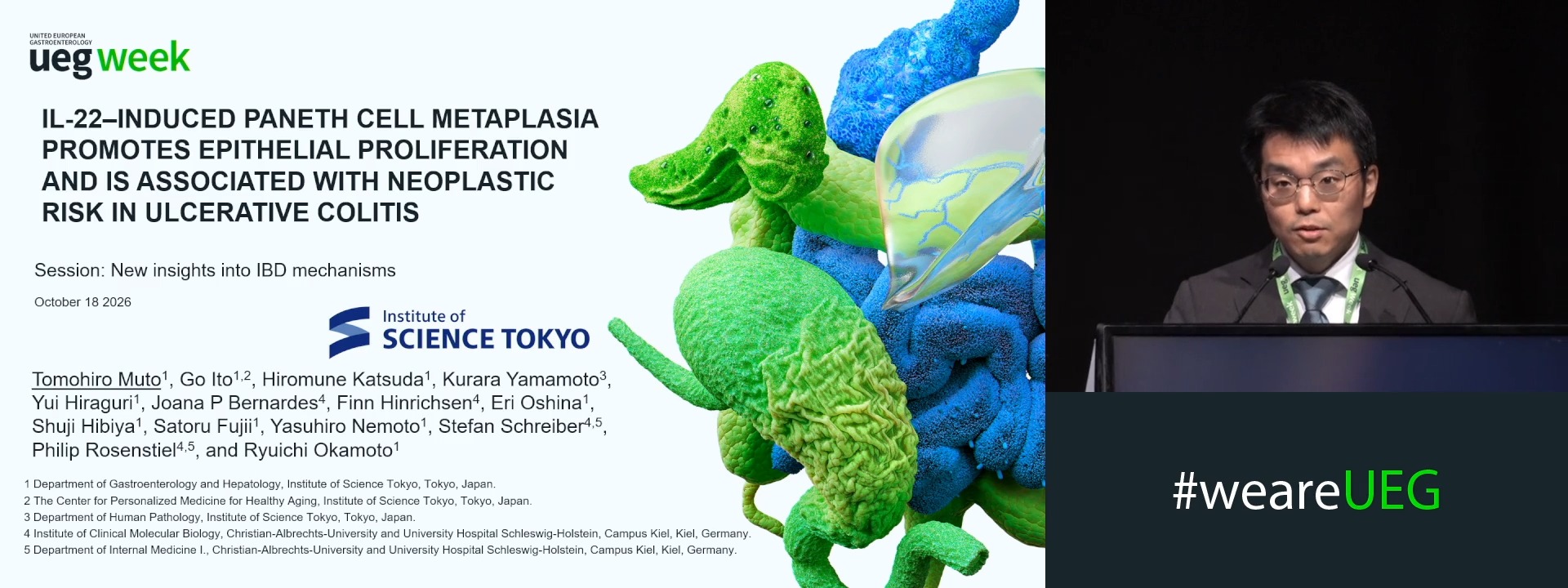
IL-22–INDUCED PANETH CELL METAPLASIA PROMOTES EPITHELIAL PROLIFERATION AND IS ASSOCIATED WITH NEOPLASTIC RISK IN ULCERATIVE COLITIS
Tomohiro Muto 1, Go Ito 1, Hiromune Katsuda 1, Kurara Yamamoto 1, Yui Hiraguri 1, Joana P. Bernardes 2, Finn Hinrichsen 2, Eri Oshina 1, Shuji Hibiya 1, Satoru Fujii 1, Yasuhiro Nemoto 1, Stefan Schreiber 2, Philip Rosenstiel 2, Ryuichi Okamoto 1
Affiliations
1 Institute of Science Tokyo, Tokyo, Japan
2 Christian-Albrechts-University and University Hospital Schleswig-Holstein, Campus Kiel, Kiel, Germany
Log in to continue.
This content is part of Gutflix. Log in with your myUEG account, or create one free, to watch it.
Not sure what you can access? Learn more about account types.
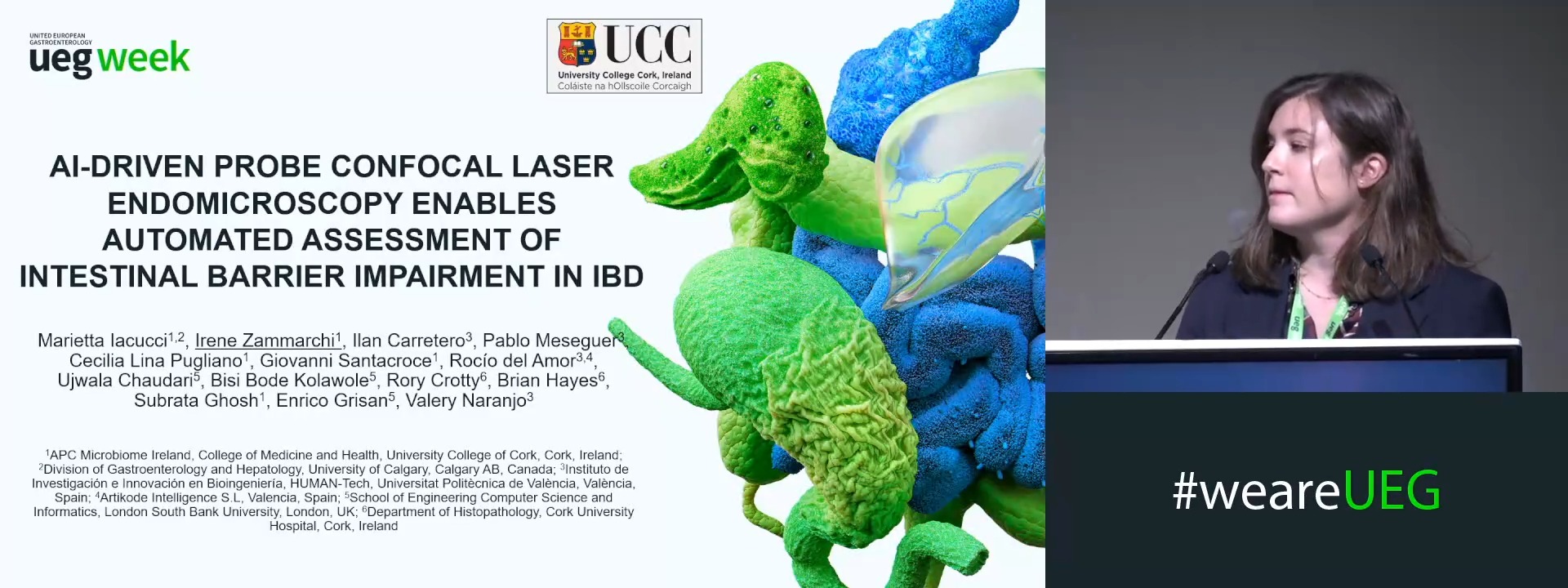
AI-DRIVEN PROBE CONFOCAL LASER ENDOMICROSCOPY ENABLES AUTOMATED ASSESSMENT OF INTESTINAL BARRIER IMPAIRMENT IN IBD
Marietta Iacucci 1,2, Irene Zammarchi 1, Ilan Carretero 3, Pablo Meseguer 3, Cecilia Lina Pugliano 1, Giovanni Santacroce 1, Rocio Del Amor 3,4, Ujwala Chaudhari 5, Bisi Bode Kolawole 5, Rory Crotty 6, Brian Hayes 6, Subrata Ghosh 1, Enrico Grisan 5, Valery Naranjo 3,4
Affiliations
1 University College Cork, Cork, Ireland
2 University of Calgary, Calgary, Canada
3 Universitat Politècnica de València, Valencia, Spain
4 Artikode Intelligence S.L., Valencia, Spain
5 London South Bank University, London, United Kingdom
6 Cork University Hospital, Cork, Ireland
Log in to continue.
This content is part of Gutflix. Log in with your myUEG account, or create one free, to watch it.
Not sure what you can access? Learn more about account types.
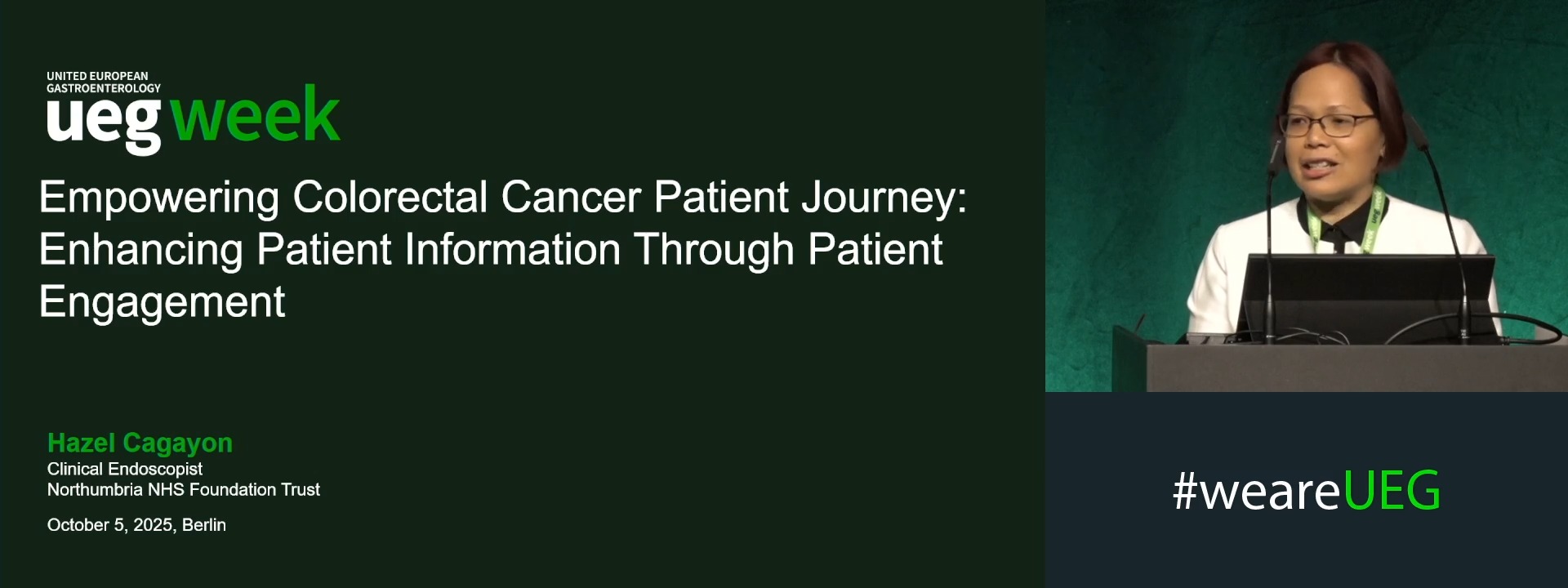
EMPOWERING COLORECTAL CANCER PATIENT JOURNEY: ENHANCING PATIENT INFORMATION THROUGH PATIENT ENGAGEMENT
Affiliations
1 Northumbria NHS Trust, Northumberland, United Kingdom
Log in to continue.
This content is part of Gutflix. Log in with your myUEG account, or create one free, to watch it.
Not sure what you can access? Learn more about account types.
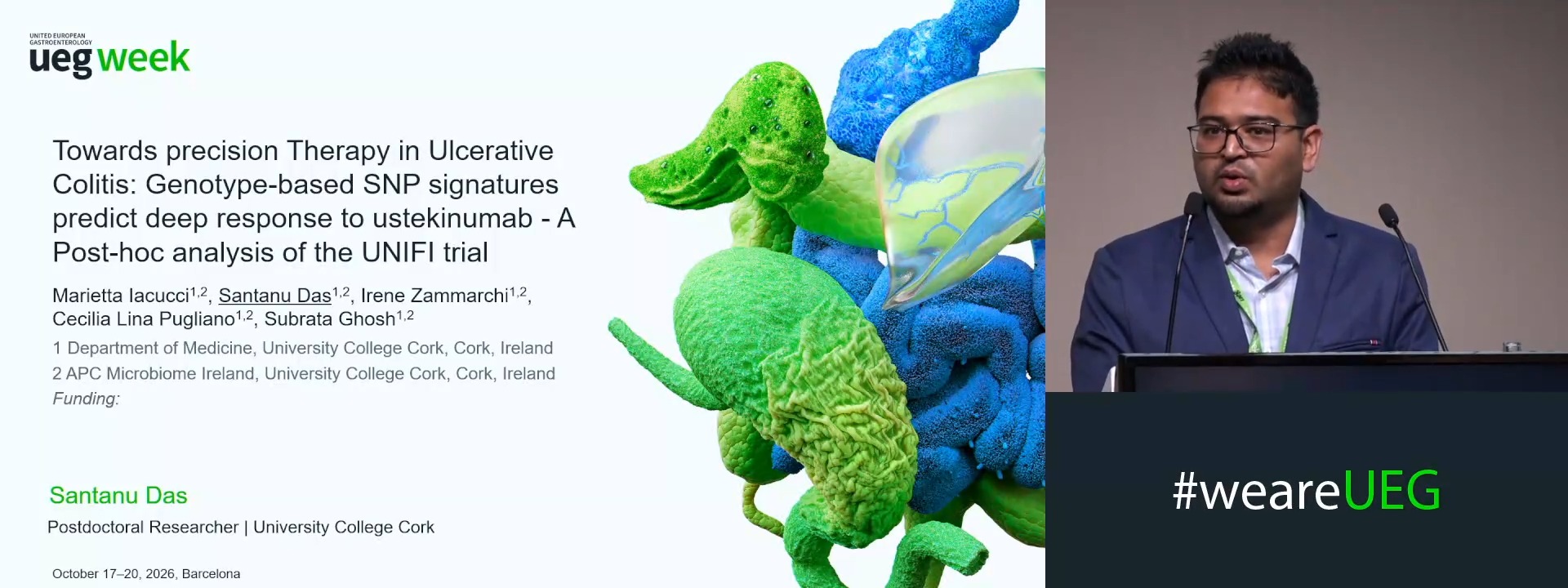
TOWARD PRECISION THERAPY IN ULCERATIVE COLITIS: GENOTYPE-BASED SINGLE-NUCLEOTIDE POLYMORPHISM (SNPS) SIGNATURES PREDICT DEEP RESPONSE TO USTEKINUMAB - A POST-HOC ANALYSIS OF THE UNIFI TRIAL
Affiliations
1 University College Cork, Cork, Ireland