UEG's educational platform for gastroenterology education bringing recordings, courses, guidelines, and more together in one place.
Most popular content
Rate for better recommendations!
Your feedback helps us show you more of what you like and less of what you dislike!
Log in to access this content.
Free for all myUEG account holders. Your access level is set automatically based on your occupation. Medical professionals get full access to all content. If you are a non-medical user, you can only access UEG Week content from congresses you attended.
Not sure what you can access? Learn more about account types.

THE COMPARATIVE EFFECTIVENESS OF ANTI-TNF IN BIO-NAÏVE AND BIO-EXPERIENCED PATIENTS WITH IBD: RESULTS FROM A REAL-WORLD EXPERIENCE AT A BELGIAN TERTIARY CENTRE
Liesbeth Deroo 1, Laura Suarez 2, Marie Truyens 3, Jeroen Geldof 1, Soumaya Akhayad 1, Goedele Dewitte 1, Elien Glorieus 3, Triana Lobaton 3
1 Ghent University Hospital, Ghent, Belgium
2 University Hospital of Santiago of Compostela, Santiago de Compostela, Spain
3 Ghent University Hospital, Ghent, Belgium|||Ghent University Hospital, Ghent, Belgium
Conference
Topics
Submission format
Session
Citation
Published
Log in to access this content.
Free for all myUEG account holders. Your access level is set automatically based on your occupation. Medical professionals get full access to all content. If you are a non-medical user, you can only access UEG Week content from congresses you attended.
Not sure what you can access? Learn more about account types.
Introduction
Patients with acute-on-chronic liver failure (ACLF) have traditionally been considered with a tendecy for bleeding however, they frequently display a paradoxical prothrombotic state. ACLF is characterized systemic inflammation and an increased risk of both bleeding and thrombosis. Bleeding arises from decreased pro-coagulation factors and platelet sequestration due to portal hypertension, while thrombosis is exacerbated by endothelial dysfunction and elevated heparinoids, thrombomodulin, or von Willebrand factor.
Aims & Methods
The aim of this study was to evaluate platelet aggregation pattern in patients with ACLF compared to acute decompensated (AD) liver cirrhosis.
The study took place in between the 1st of July 2024- 31st of January 2025 and we prospectively included cirrhotic patients, divided in two groups: ACLF group and AD group. The exclusion criteria were people with compensated liver cirrhosis, antiaggregant or anticoagulant treatment and patients with hepatocellular carcinoma or other malignancies. We investigated platelet aggregability in whole blood, by using multiplate aggregometry. For analysis, platelet aggregometry was performed induced by: adenosine diphosphate (ADP), arachidonic acid (ASPI), prostaglandin E2 (PGE2) and thrombin receptor-activated peptide (TRAP-6) as agonist were determined. TRAP‑6 is a peptide that stimulates protease-activated receptor 1 (PAR1) on platelet membrane.
Results
In this study we included 52 patients – 25 patients with ACLF and 27 patients with AD. There were no differences regarding demographic parameters and liver disease etiology between the two study groups. Compared to AD group, patients with ACLF showed an enhanced maximal platelet aggregation with TRAP-6 (AUC 85±12 U vs 45±10 U, p<0.0001). In contrast, we did not detect any differences in platelet aggregation between the two groups after ADP, ASPI or PGE2 activations. We observe that PAR-1 stimulation induces the highest aggregation curve and area under the curve in patients with ACLF and AD, but ACLF patients show the strongest response, highlighting that the degree of liver decompensation influences aggregation results. Severe decompensation correlates with a stronger TRAP response, suggesting that there are more PAR-1 receptors on platelets of this patients.
Conclusion
Our results indirectly indicate that platelet reactivity is higher in patients with ACLF likely due to enhanced PAR-1 receptor activity. Severe decompensation correlates with a stronger TRAP response, suggesting that there are more PAR-1 receptors on platelets of this patients.
References
1. EASL Clinical Practice Guidelines on acute on liver failure; J. Hepatol. 2023
2. Napolitano et al. European Journal of Internal Medicine 2017
3. Tripodi et al. Hepatology 2006
4. Lisman et al. Hepatology 2006
5. Nassar et al. BIOMEDICINES 2023
6. Rogalski et al. Scandinavian Journal of Gastroenterology 2019
7. Zanetto et al. Liver International 2022
8. Vecerzan et al. Cureus 2024
ENHANCED PLATELET AGGREGATION WITH TRAP-6 IN PLATELET AGGREGOMETRY IN PATIENTS WITH ACUTE-ON CHRONIC LIVER FAILURE
Irina Girleanu 1, Corugă Ioana 1, Cristina Maria Muzica 1, Laura Huiban 1, Sebastian Zenovia 1, Ana Maria Singeap 1, Raluca Avram 1, Lavinia Oloeru 1, Oancea Georgeta 1, Fominov Anastasia 1, Iulian Buzincu 2, Tarniceriu Cristina 2, Cimpoesu Diana 2, Anca-Victorita Trifan 1
1 Institute of Gastroenterology and Hepatology, Iasi, Romania
2 Grigore T. Popa” University of Medicine and Pharmacy, Iasi, Romania
Conference
Topics
Submission format
Session
Citation
Published
Log in to access this content.
Free for all myUEG account holders. Your access level is set automatically based on your occupation. Medical professionals get full access to all content. If you are a non-medical user, you can only access UEG Week content from congresses you attended.
Not sure what you can access? Learn more about account types.
THE IMPACT OF THE RAPID-RESPONSE PATHWAY FOR THE EMERGENCY MANAGEMENT OF HIGH-RISK UPPER GASTROINTESTINAL BLEEDING ON CLINICAL OUTCOMES IN PATIENTS WITH CIRRHOSIS AND ACUTE VARICEAL BLEEDING
1 Westchina Hospital, Chengdu, China
2 Sichuan University, chengdu, China
Conference
Topics
Submission format
Session
Citation
Published
Log in to access this content.
Free for all myUEG account holders. Your access level is set automatically based on your occupation. Medical professionals get full access to all content. If you are a non-medical user, you can only access UEG Week content from congresses you attended.
Not sure what you can access? Learn more about account types.
Introduction
Eosinophilic esophagitis (EoE) is an increasingly prevalent esophageal disease resulting in dysphagia and food impaction. ESO-101 targets the esophageal mucosa by significantly increasing topical medication contact time through the slow release of mometasone furoate. This innovative application technology consists of a drug-loaded thin-film rolled up in a capsule that unravels and sticks to the esophageal mucosa when swallowed. The current proof-of-concept phase 2 study evaluated the efficacy and safety of ESO-101.
Aims & Methods
This randomized, double-blind, placebo-controlled trial (NCT04849390) investigated the safety and efficacy of ESO-101 in adult patients with EoE and dysphagia. Patients were randomized 2:1 to once-daily treatment with ESO-101 800 µg or placebo and treated for 4-weeks. The primary endpoint was the absolute change in peak eosinophil count (eos/hpf) from baseline. Secondary endpoints were the change in EoE Endoscopic Reference Score (EREFS) and dysphagia symptoms measured by the 11-point numeric rating scale (NRS). Safety was also assessed.
Results
59 patients were screened at 13 European study sites, 43 patients were randomized, and 40 (27 to ESO-101 and 13 to placebo) completed the trial. For all histological and endoscopic endpoints, ESO-101 led to a statistical improvement compared to placebo. The mean decrease in peak eosinophil count was 49.1 (±88.4) eos/hpf with ESO-101, while counts increased by a mean of 6.6 (±65.1) eos/hpf in the placebo group (p=0.0318). Mean EREFS decreased by 3.9 (±2.6) with ESO-101 and there was no change with placebo (-0.1 [2.3]) (p=0.0001). A higher proportion of patients showed a histological response (<15 eos/hpf) with ESO-101 versus placebo (48% vs 0%; p=0.0028). There was also numerical improvement in the dysphagia severity score in the ESO-101 group (median improvement in the dysphagia severity of 4 scores [relative change: -71%]) compared to placebo (improvement in 3 scores [relative change: -57%]). No cases of oropharyngeal or esophageal candidiasis were observed (Table 1).
| Table 1: Main Outcome Parameters ACESO Study | |||
|---|---|---|---|
| Outcome parameters ACESO study | ESO-101 (n=28) | Placebo (n=15) | p-value |
| Absolute change in peak eosinophil count CFB mean (SD) | -49.11 (88.42) | 6.63 (65.11) | 0.0318 |
| Histological response < 15 eos/hpf (n [%]) | 13 (48.1) | 0 (0.0) | 0.0028 |
| Histological response < 15 eos/hpf and improvement in the dysphagia severity score (n [%]) | 12 (44.4) | 0 (0.0) | 0.0035 |
| Absolute change in the EREFS CFB mean (SD) | -3.9 (2.6) | -0.1 (2.3) | 0.0001 |
| Absolute change in dysphagia severity score CFB mean (SD) | -3.2 (2.0) | -3.0 (2.2) | n.s. |
| Relative change in dysphagia severity score CFB mean (SD) | -61.46 (37.87) | -47.27 (30.36) | n.s. |
| Oropharyngeal or esophageal candidiasis (n [%]) | 0 (0) | 0 (0) | - |
| Treatment compliance defined as proportion of days IMP was taken (n [%]) | 96.44 (5.52) | 92.88 (17.12) | - |
Conclusion
ESO-101 resulted in statistically significant histologic and endoscopic improvements compared with placebo, even with the 4-week treatment duration. ESO-101 was well tolerated. The ACESO study underscores the promise of topical drug delivery to the esophagus using the ESO-101 drug delivery system and provides a robust foundation for future ESO-101 development for EoE therapy.
Disclosure
- Lucendo AJ: Principal Investigator of the ACESO Study sponsored by EsoCap Biotech AG
- Dellon ES: Consultant to EsoCap Biotech AG
- Bredenoord AJ: Investigator of the ACESO study sponsored by EsoCap Biotech AG
- Straumann A: Consultant to EsoCap Biotech AG
- Racamier I: CEO of EsoCap Biotech AG
- Ghazaleh Gouya-Lechner: Medical Advisor of EsoCap Biotech AG
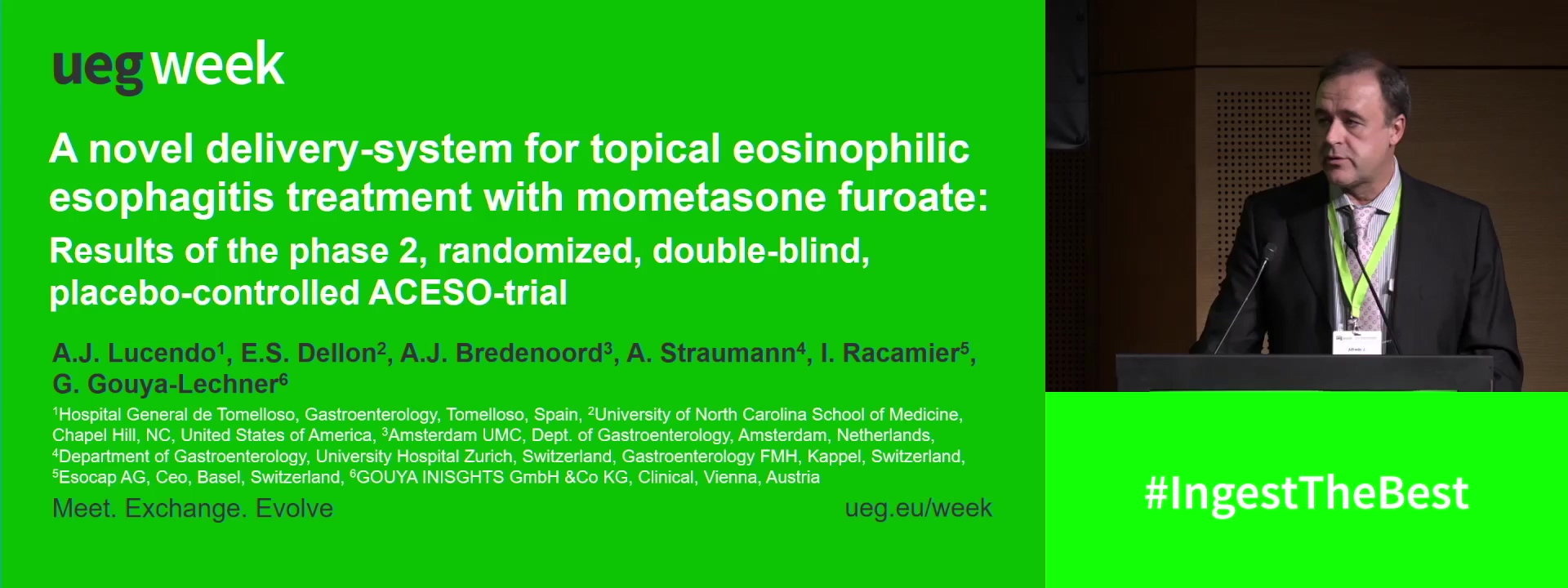
A NOVEL DELIVERY-SYSTEM FOR TOPICAL EOSINOPHILIC ESOPHAGITIS TREATMENT WITH MOMETASONE FUROATE: RESULTS OF THE PHASE 2, RANDOMIZED, DOUBLE-BLIND, PLACEBO-CONTROLLED ACESO-TRIAL
Alfredo J. Lucendo 1, Evan S. Dellon 2, Arjan Bredenoord 3, Alex Straumann 4, Isabelle Racamier 5, Ghazaleh Gouya-Lechner 6
1 Hospital General de Tomelloso, Tomelloso, Spain
2 University of North Carolina School of Medicine, Chapel Hill, NC, United States
3 Amsterdam UMC, Amsterdam, Netherlands
4 Department of Gastroenterology, University Hospital Zurich, Switzerland, Kappel, Switzerland
5 Esocap AG, Basel, Switzerland
6 GOUYA INISGHTS GmbH &Co KG, Vienna, Austria
Event
Topics
Submission format
Session
Citation
Published
Log in to access this content.
Free for all myUEG account holders. Your access level is set automatically based on your occupation. Medical professionals get full access to all content. If you are a non-medical user, you can only access UEG Week content from congresses you attended.
Not sure what you can access? Learn more about account types.
IN PATIENTS WITH GASTROESOPHAGEAL REFLUX DISEASE GERD-Q SCORE CORRELATES WITH METHYLBUTYRIC ACID, CAPROIC ACID AND ENANTIIC ACID IN STOOL SAMPLES
1 Federal Research Center of Nutrition and Biotechnology, Moscow, Russian Federation|||Russian Medical Academy of Continuing Professional Education, Moscow, Russian Federation
2 Federal Research Center of Nutrition and Biotechnology, Moscow, Russian Federation
Conference
Topics
Submission format
Citation
Published
Log in to access this content.
Free for all myUEG account holders. Your access level is set automatically based on your occupation. Medical professionals get full access to all content. If you are a non-medical user, you can only access UEG Week content from congresses you attended.
Not sure what you can access? Learn more about account types.
ELECTIVE DIAGNOSTIC UPPER GASTROINTESTINAL ENDOSCOPY: ANALYSIS OF PRESCRIPTION APPROPRIATENESS IN THE HOSPITAL SETTING
Rute Gomes 1, Gonçalo Silva 1, Hugo Sousa 1, Caroline Soares 1, Ângela Domingues 1, Ana Catarina Carvalho 1, Diana Martins 1, Ricardo Araújo Cardoso 1, Americo Jeronimo Taveira da Silva 1
1 ULS Viseu Dão-Lafões, Viseu, Portugal
Conference
Topics
Submission format
Citation
Published
Log in to access this content.
Free for all myUEG account holders. Your access level is set automatically based on your occupation. Medical professionals get full access to all content. If you are a non-medical user, you can only access UEG Week content from congresses you attended.
Not sure what you can access? Learn more about account types.
CMV INFECTION IN ULCERATIVE COLITIS: FOCUS ON TISSUE PCR AND IMMUNOHISTOCHEMISTRY
Raffaella Rima 1, Chiara Maria Penati 2, Francesco Maria Stalla 3, Mariabeatrice Rita Daniela Principi 4, Stefano Okolicsanyi 2
1 Umberto Parini Hospital, Aosta, Italy|||Azienda Ospedaliero Universitaria Consorziale Policlinico, Bari, Italy
2 Umberto Parini Hospital, Aosta, Italy
3 Mauriziano Hospital, Turin, Italy
4 Azienda Ospedaliero Universitaria Consorziale Policlinico, Bari, Italy
Conference
Topics