UEG's educational platform for gastroenterology education bringing recordings, courses, guidelines, and more together in one place.
Most popular content
Rate for better recommendations!
Your feedback helps us show you more of what you like and less of what you dislike!
Log in to access this content.
Free for all myUEG account holders. Your access level is set automatically based on your occupation. Medical professionals get full access to all content. If you are a non-medical user, you can only access UEG Week content from congresses you attended.
Not sure what you can access? Learn more about account types.
Introduction
The quality of bowel preparation is crucial for adenoma detection. High-quality colon cleansing significantly enhances the adenoma detection rate (ADR). A higher segmental BBPS score has been associated with a higher ADR, advanced ADR (AADR), as well as with the improved detection of serrated sessile lesions as opposed to an adequate cleansing level [1,2].
Aims & Methods
We evaluated the relationship between ADR and increasing bowel cleansing quality in a real-world setting.
We conducted a post-hoc analysis of an observational, multi-centre, retrospective real-world study in Spain and Portugalbetween July 2019 and September 2021 [3]. Patients received 1L PEG + ASC before colonoscopy. Bowel cleansing quality was evaluated using the Boston Bowel Preparation Scale (BBPS). ADR was compared for an adequate BBPS 6 (2+2+2) versus a high-quality cleansing score of 9 in the total colon and a BBPS score of 2 versus 3 in the right colon. The relationship between cleansing quality and ADR was analyzed using a logistic regression model with the successful BBPS score as the covariate. Resulting odds ratios (OR) are presented with 95% confidence intervals.
Results
Among 9,310 colonoscopies with ADR data, 2,846 achieved a BBPS of 6, and 2,471 scored a BBPS 9. The mean age was 57.5 (12.5) for BBPS 6 and 58.6 (13.2) for BBPS 9, with a male proportion of 51.1% versus 50.6%. Reasons for colonoscopy included screening (46.3% vs 38.8%), diagnostic (25.2% vs 24.4%), follow-up (26.2% vs 32.9%), and other (2.2% vs 3.8%), respectively.
In the right colon, data were available from 4,036 with BBPS 2 and 3,216 with BBPS 3 with a mean age of 57.2 (12.4) and 57.5 (12.9), and male proportions of 51.6 versus 47.5% and reasons for colonoscopy were screening (46.1% vs 41%), diagnostic (25.4% vs 24.1%), follow-up (26.7% vs 32.3%) and other (1.8% vs 2.5%), respectively.
When the overall colon BBPS score increased from 6 to 9, ADR increased from 42.4% to 48.8%, OR:1.29 (1.16-1.44); p<0.0001. When right colon BBPS increased from 2 to 3, ADR increased from 24.1% to 27.5%, OR:1.20 (1.08-1.33); p=0.0008 (Table 1). This effect remained similar in the total and right colon when the covariates of age, sex, and reason for colonoscopy were included in the model. Table 1. Association between BBPS score and ADR in overall and right colon
| BBPS score | ADR |
|---|---|
| Total colon, n (%) | N=5317 |
| BBPS=6 | 1208/2846 (42.4) |
| BBPS=9 | 1207/2471 (48.8) |
| OR (95%CI): 1.29 (1.16-1.44) p<0.0001 | |
| Right colon, n (%) | N=7252 |
| BBPS=2 | 972/4036 (24.1) |
| BBPS=3 | 886/3216 (27.5) |
| OR (95%CI): 1.20 (1.08-1.33) p=0.0007 |
Conclusion
In real-world clinical practice, a higher quality bowel cleansing correlates significantly with an increased ADR, especially important in the right colon with the use of 1LPEG+ASC.
References
- Hassan C, et al. Endosc Int Open. 2020;8(7):E928-37
- Guo R, et al. BMC Gastroenterol. 2019 Jul 8;19(1):119
- López-Jamar JME, et al. Endosc Int Open. 2023;11(8):E785-93
Disclosure
Conflict of interest: C.Turbi is an employee of Norgine Ltd. All other authors have a nothing to declare.

IMPROVED ADENOMA DETECTION RATES WITH HIGH VERSUS ADEQUATE QUALITY COLON CLEANSING USING 1L POLYETHYLENE GLYCOL PLUS ASCORBIC ACID IN A REAL-WORLD STUDY
Fernando Sábado 1, David Carral 2, Salvador Machlab 3, Vicente Lorenzo-Zúñiga García 4, Sarbelio Rodriguez Muñoz 5, Miguel A. Pantaleón 6, José Berkeley Cotter 7, Cátia Arieira 7, Elena Pérez Arellano 8, Blas José Gómez Rodríguez 9, Ricardo José Gomes Gorjão Martins 10, Carmen Turbi 11, Jose Miguel Esteban López-Jamar 12
1 Consorcio Hospitalario Provincial de Castellón, Madrid, Spain
2 Hospital San Rafael, A Coruña, Spain
3 Parc Tauli. Hospital Universitari. Institut d’Investigacio i Innovacio Parc Tauli I3PT, Sabadell, Spain
4 Hospital HM Sant Jordi, Barcelona, Spain
5 Hospital Ruber Juan Bravo, Madrid, Spain
6 Hospital del Mar, Barcelona, Spain
7 Hospital da Senhora da Oliveira, Guimarães, Portugal
8 Hospital La Zarzuela, Madrid, Spain
9 Hospital Quirón Salud Sagrado Corazón, Sevilla, Spain
10 10Hospital CUF Descobertas, Lisbon, Portugal
11 Norgine Ltd, Harefield, United Kingdom
12 Hospital Clinico San Carlos, Madrid, Spain
Conference
Topics
Submission format
Citation
Published
Log in to access this content.
Free for all myUEG account holders. Your access level is set automatically based on your occupation. Medical professionals get full access to all content. If you are a non-medical user, you can only access UEG Week content from congresses you attended.
Not sure what you can access? Learn more about account types.
SAFETY AND SHORT-TERM OUTCOMES OF ERCP IN TRANSPLANT RECIPIENTS: A PROPENSITY SCORE-MATCHED COHORT STUDY
1 Taichung Veterans General Hospital, Taichung, Taiwan, Taichung, Taiwan, Province of China
2 Taichung Veterans General Hospital, Taichung, Taiwan, Province of China
Conference
Topics
Submission format
Citation
Published
Log in to access this content.
Free for all myUEG account holders. Your access level is set automatically based on your occupation. Medical professionals get full access to all content. If you are a non-medical user, you can only access UEG Week content from congresses you attended.
Not sure what you can access? Learn more about account types.
TO BIOPSY, RESECT, OR REFER? RETHINKING THE PRE-REFERRAL PATHWAY AND DECISION-MAKING FOR LARGE NON-PEDUNCULATED COLORECTAL POLYPS
Olaolu Olabintan 1, Homira Ayubi 2, Ali Eqbal 3, Ciaran Judge 4, Jemma Bhoday 4, Marie-Anne Noreillie 5, Shraddha Gulati 2, Noriko SUZUKI 1, Bu Hayee 1, Amyn Haji 4, Andrew Emmanuel 4
1 King’s College Hospital NHS Foundation Trust, London, United Kingdom
2 Kings College Hospital, London, United Kingdom
3 Peninsula Health, Melbourne, Australia
4 King's College Hospital, London, United Kingdom
5 AZ Delta, Roeselare, Belgium
Conference
Topics
Submission format
Citation
Published
Log in to access this content.
Free for all myUEG account holders. Your access level is set automatically based on your occupation. Medical professionals get full access to all content. If you are a non-medical user, you can only access UEG Week content from congresses you attended.
Not sure what you can access? Learn more about account types.
EUS-HGS IS SAFE, EFFECTIVE AND COMPLEMENT WITH ERCP, UNIVERSITY HOSPITAL EXPERIENCE
Mitsuhiro Kida 1, Kai Adachi 1, Taro Hanaoka 1, Akihiko Tamaki 1, Takahiro Kurosu 1, Masafumi Watanabe 2, Toru Kaneko 1, Kosuke Okuwaki 1, Tomohisa Iwai 1, Chikako Kusano 1
1 Kitasato University, Sagamihara, Japan
2 Kitasato University School of Medicine, Sagamihara, Japan
Conference
Topics
Submission format
Session
Citation
Published

Log in to access this content.
Free for all myUEG account holders. Your access level is set automatically based on your occupation. Medical professionals get full access to all content. If you are a non-medical user, you can only access UEG Week content from congresses you attended.
Not sure what you can access? Learn more about account types.
Welcome
1 ESGENA Scientific Secretary, Ulm, Germany
2 Mater Misericordiae University Hospital, Dublin, Ireland
Event
Topics
Session
Citation
Published
Log in to access this content.
Free for all myUEG account holders. Your access level is set automatically based on your occupation. Medical professionals get full access to all content. If you are a non-medical user, you can only access UEG Week content from congresses you attended.
Not sure what you can access? Learn more about account types.
DISTINCT GUT MICROBIAL PROFILES IN LYNCH SYNDROME CARRIERS AND AVERAGE-RISK INDIVIDUALS: IMPLICATIONS FOR COLORECTAL CANCER SURVEILLANCE
Sandra Taboada 1, Marta Malagón 2, Lia Oliver 2, L Jesús Garcia-Gil 3, Mariona Serra-Pagès 2, Xavier Aldeguer Mante 4, Anna Bahí 5, REBECA MOREIRA DE ABREU 6, Antoni Castells 6, Teresa Ocaña 6, Joaquín Castillo 6, Jordi Guardiola 7, Núria Dueñas 8, Virginia Piñol 9, Marta Pineda 8, Gabriel Capellà 8, Sara Ramió-Pujol 2, Laura Baldo 10, Francesc Balaguer 6, Joan Brunet 11
1 GoodGut, Girona, Spain|||University of Girona, Girona, Spain|||University of Barcelona, Barcelona, Spain
2 GoodGut, Girona, Spain
3 University of Girona, Girona, Spain
4 Dr. Josep Trueta University Hospital, Girona, Spain
5 Biomedical Research Institute of Girona, Salt, Spain
6 Hospital Clínic of Barcelona, Barcelona, Spain
7 Hospital Universitario de Bellvitge, L'Hospitalert de LLobregat (Barcelona), Spain
8 Catalan Institute of Oncology, Hospitalet de Llobregat, Spain
9 Dr. Josep Trueta University Hospital, Girona, Spain|||Universitat de Girona, Girona, Spain
10 University of Barcelona, Barcelona, Spain|||Institute for Research on Biodiversity (IRBio), Barcelona, Spain
11 Catalan Institute of Oncology, Girona, Spain|||Catalan Institute of Oncology, Hospitalet de Llobregat, Spain
Conference
Topics
Submission format
Citation
Published
Log in to access this content.
Free for all myUEG account holders. Your access level is set automatically based on your occupation. Medical professionals get full access to all content. If you are a non-medical user, you can only access UEG Week content from congresses you attended.
Not sure what you can access? Learn more about account types.
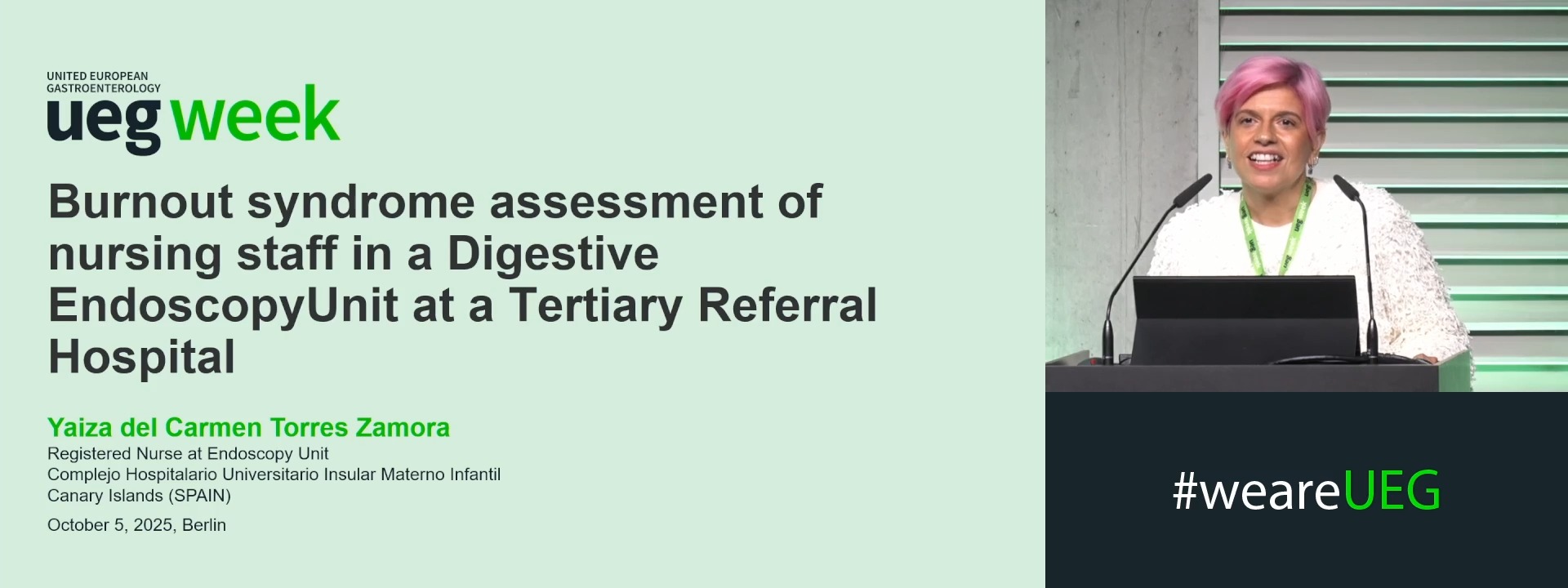
BURNOUT SYNDROME ASSESSMENT OF NURSING STAFF IN A DIGESTIVE ENDOSCOPY UNIT AT A TERTIARY REFERRAL HOSPITAL
1 Complejo Hospitalario Insular Materno Infantil, Las Palmas de Gran Canaria, Spain
Event
Topics