UEG's educational platform for gastroenterology education bringing recordings, courses, guidelines, and more together in one place.
Most popular content
Rate for better recommendations!
Your feedback helps us show you more of what you like and less of what you dislike!
Log in to access this content.
Free for all myUEG account holders. Your access level is set automatically based on your occupation. Medical professionals get full access to all content. If you are a non-medical user, you can only access UEG Week content from congresses you attended.
Not sure what you can access? Learn more about account types.
COMPUTER AIDED QUALITY CONTROL SYSTEM IMPROVES BARRETT’S NEOPLASIA DETECTION IN AN EX-VIVO SETTING
Martijn R. Jong 1, Tim Jaspers 2, Rixta van Eijck van Heslinga 1, Jelmer Jukema 1, Carolus Kusters 2, Tim Boers 2, Roos E. Pouw 3, Lucas Duits 1, Peter H. N. de With 2, Fons van der Sommen 2, Jeroen de Groof 1, Jacques J. Bergman 1
1 Amsterdam UMC, Amsterdam, Netherlands
2 TU Eindhoven, Eindhoven, Netherlands
3 UMC Utrecht, Utrecht, Netherlands
Event
Submission format
Citation
Published
Log in to access this content.
Free for all myUEG account holders. Your access level is set automatically based on your occupation. Medical professionals get full access to all content. If you are a non-medical user, you can only access UEG Week content from congresses you attended.
Not sure what you can access? Learn more about account types.
Gastric cancer: Individualised surgical and personalised systemic treatment
1 Universitätsklinikum Köln, Köln, Germany
2 Paris-Cité University, Paris, France
Event
Session
Citation
Published
Log in to access this content.
Free for all myUEG account holders. Your access level is set automatically based on your occupation. Medical professionals get full access to all content. If you are a non-medical user, you can only access UEG Week content from congresses you attended.
Not sure what you can access? Learn more about account types.
I do underwater resection
1 Westmead Hospital Sydney, Westmead, Australia
Event
Citation
Published
Log in to access this content.
Free for all myUEG account holders. Your access level is set automatically based on your occupation. Medical professionals get full access to all content. If you are a non-medical user, you can only access UEG Week content from congresses you attended.
Not sure what you can access? Learn more about account types.
WEIGHT-INDEPENDENT BENEFITS OF SEMAGLUTIDE ON HISTOLOGY AND NON-INVASIVE TESTS IN PARTICIPANTS WITH BIOPSY-DEFINED METABOLIC DYSFUNCTION-ASSOCIATED STEATOHEPATITIS: POST HOC ANALYSIS OF THE ESSENCE TRIAL PART 1
Philip Newsome 1, Matthew Armstrong 2, Igor Bakulin 3, Adel Belloum 4, Anna M.G. Cali 4, Unknown Unknown 5, Jacob George 6, Unknown Unknown 7, Niels Krarup 4, Chun-Jen Liu 8, Håvard Midgard 9, Vlad Ratziu 10, Mary Rinella 11, Michael Roden 12, Arun Sanyal 13, Jörn Schattenberg 14, Mohamed Tawfik 4, Thea Cæcilie Vestergaard 4, Elisabetta Bugianesi 15
1 Roger Williams Institute of Liver Studies, Faculty of Life Sciences and Medicine, King’s College London, Foundation for Liver Research and King’s College Hospital, London, United Kingdom|||College of Medical and Health, University of Birmingham, Birmingha
2 Liver Unit, Queen Elizabeth Hospital Birmingham and NIHR Biomedical Research Centre, University of Birmingham, Birmingham, United Kingdom
3 Mechnikov North-Western State Medical University, Saint Petersburg, Russian Federation
4 Novo Nordisk A/S, Bagsværd, Denmark
5 Department of Gastroenterology & Hepatology, University Hospital Ghent, Ghent, Belgium|||Faculty of Medicine and Health Sciences, University of Ghent, Ghent, Belgium
6 Storr Liver Centre, The Westmead Institute for Medical Research, Westmead Hospital, New South Wales, Australia
7 Hepatology Outpatient Clinic, ID Clinic, Mysłowice, Poland
8 Department of Internal Medicine, National Taiwan University College of Medicine, Taipei, Taiwan, Province of China|||Hepatitis Research Center and Clinical Trial Center, National Taiwan University Hospital, Taipei, Taiwan, Province of China
9 Department of Gastroenterology, Oslo University Hospital, Oslo, Norway
10 Institute of Cardiometabolism and Nutrition, INSERM UMRS 1138 CRC, Hospital Pitié Salpêtrière (ICAN), Sorbonne Université, Paris, France
11 Division of Gastroenterology, Hepatology and Nutrition, University of Chicago, Chicago, United States
12 Department of Endocrinology and Diabetology, Medical Faculty and University Hospital of Düsseldorf, Heinrich Heine University Düsseldorf, Düsseldorf, Germany|||Institute for Clinical Diabetology, German Diabetes Center, Leibniz Center for Diabetes Researc
13 Stravitz-Sanyal Institute for Liver Disease and Metabolic Health, Virginia Commonwealth University School of Medicine, Richmond, United States
14 Department of Internal Medicine II, Saarland University Medical Center, Homburg, Germany
15 Department of Medical Sciences, University of Turin, Torino, Italy
Event
Topics
Submission format
Citation
Published
Log in to access this content.
Free for all myUEG account holders. Your access level is set automatically based on your occupation. Medical professionals get full access to all content. If you are a non-medical user, you can only access UEG Week content from congresses you attended.
Not sure what you can access? Learn more about account types.
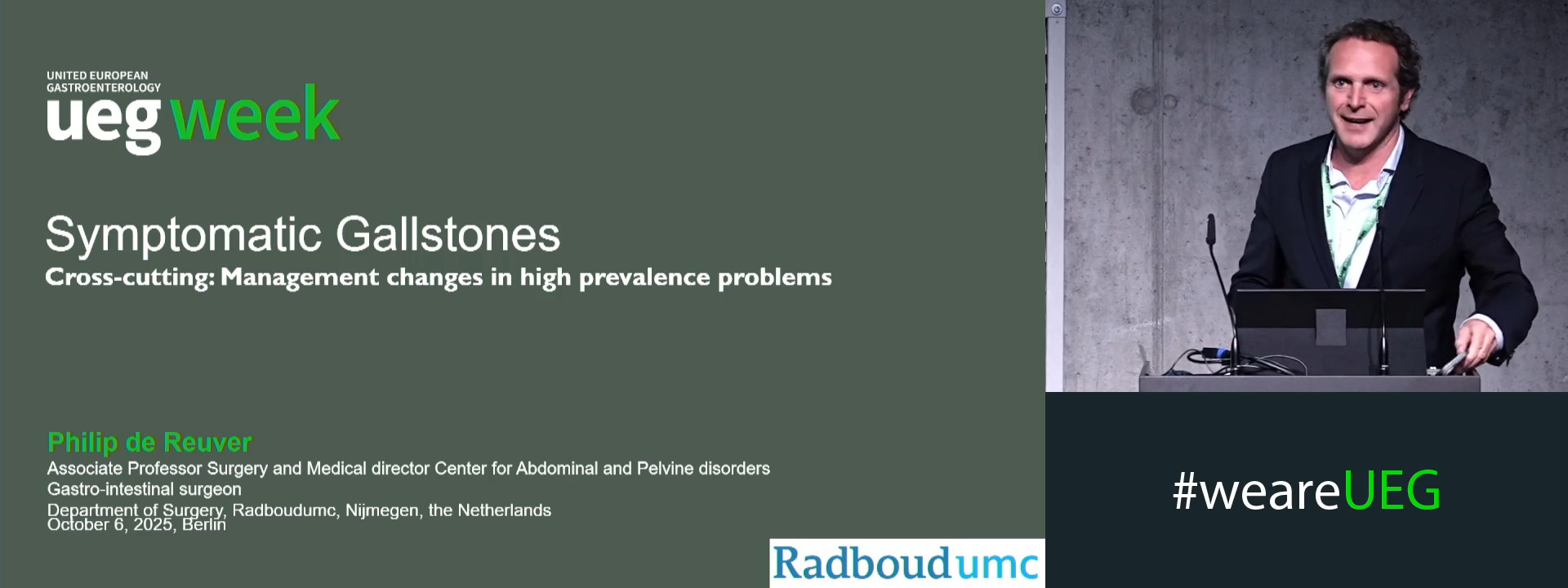
Symptomatic gallstones
1 Radboudumc, Nijmegen, Netherlands
Event
Topics
Citation
Published
Log in to access this content.
Free for all myUEG account holders. Your access level is set automatically based on your occupation. Medical professionals get full access to all content. If you are a non-medical user, you can only access UEG Week content from congresses you attended.
Not sure what you can access? Learn more about account types.
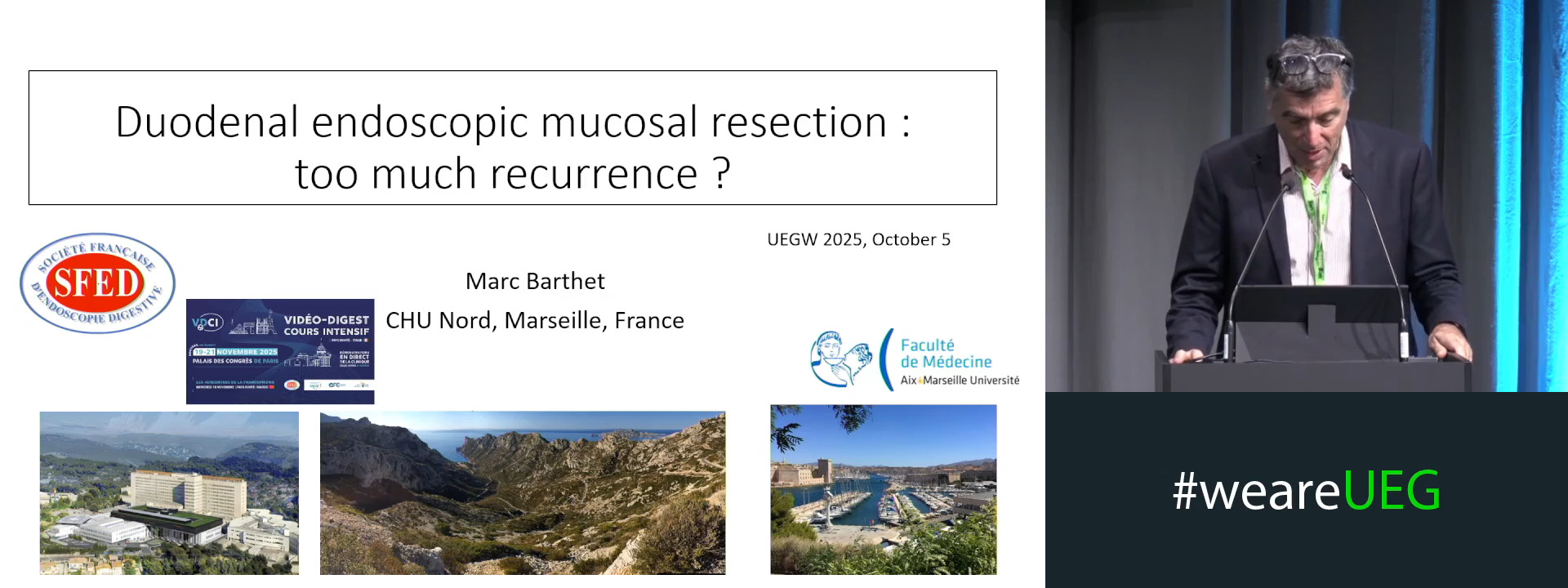
EMR or ESD for duodenal adenoma: Too much recurrence and too much risk?
1 Hopital Nord, Marseille, France
2 Keio University Cancer Center - Cancer Center, Keio University Cancer Center; Tokyo/JP, Tokyo, Japan
Event
Session
Citation
Published
Log in to access this content.
Free for all myUEG account holders. Your access level is set automatically based on your occupation. Medical professionals get full access to all content. If you are a non-medical user, you can only access UEG Week content from congresses you attended.
Not sure what you can access? Learn more about account types.
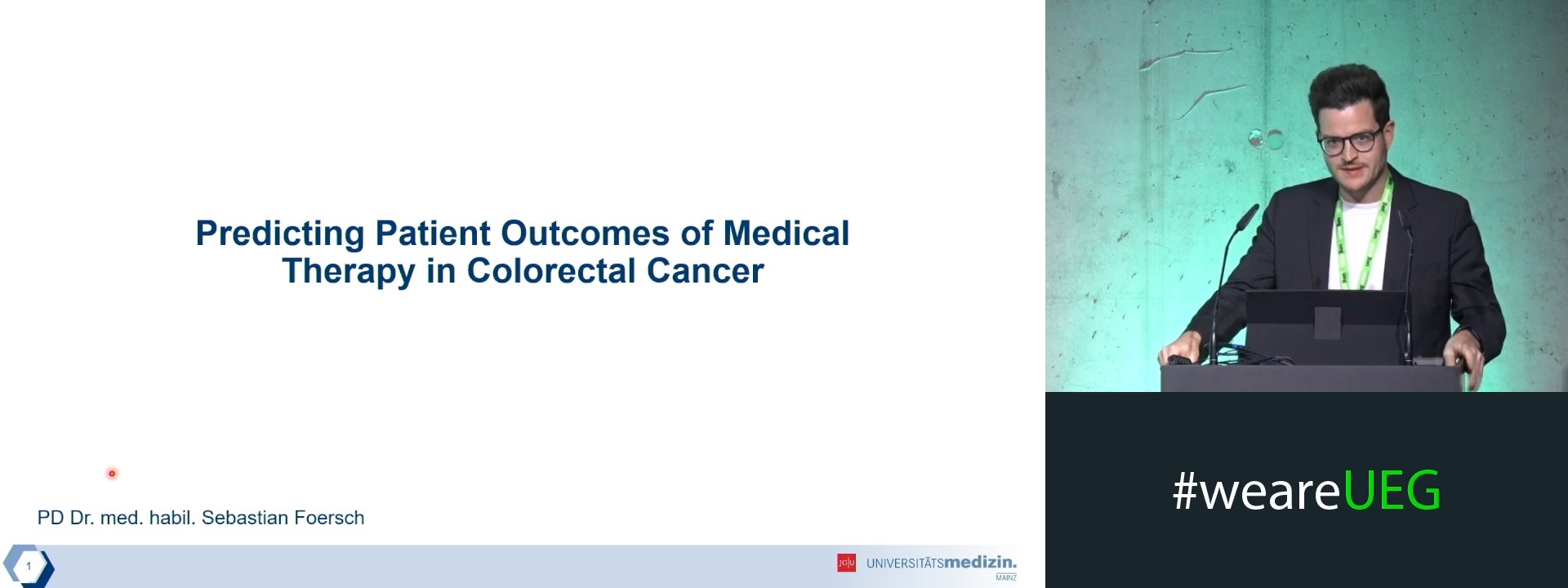
... for medical therapy in colorectal cancer
1 University Medical Center Mainz, Mainz, Germany
Event
Topics
Session