Introduction
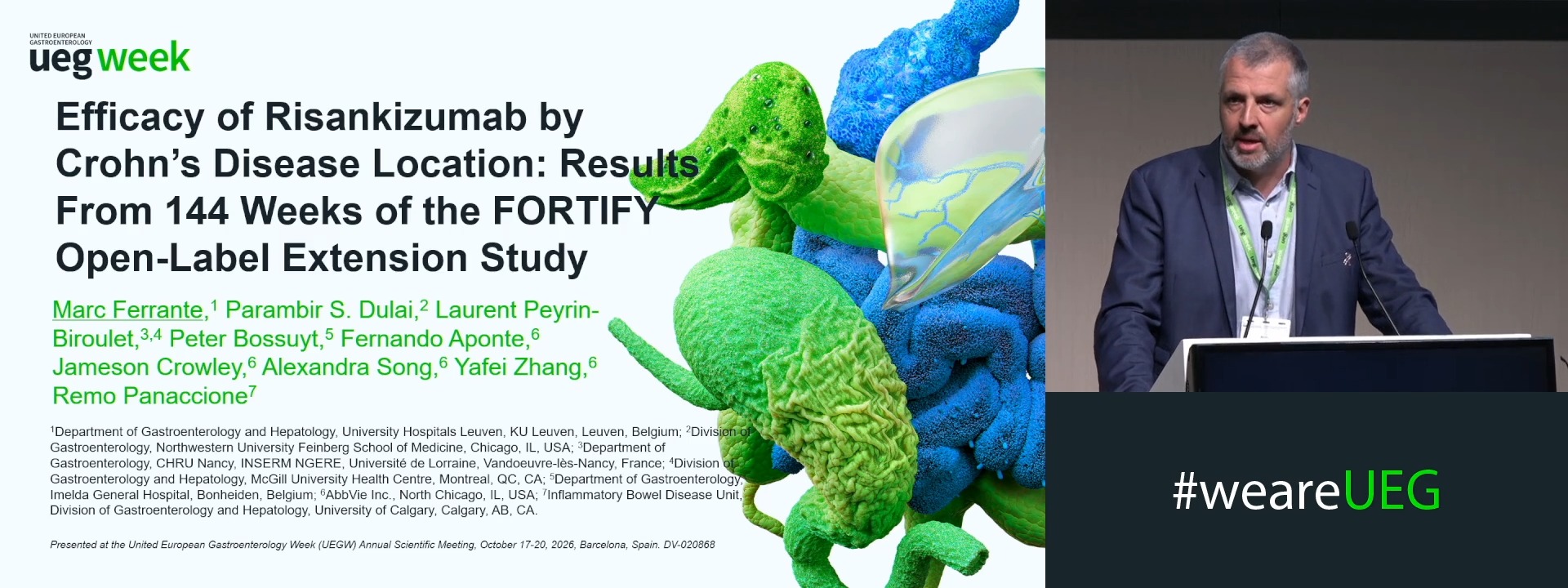
In patients with Crohn’s disease (CD), disease location is a key predictor of response to biological therapies,1 but long-term outcomes by location with risankizumab (RZB) have not been reported. Here, we report efficacy outcomes by baseline disease location through 144 weeks of RZB treatment in the FORTIFY open-label extension (OLE) in a population including patients with refractory CD.
Aims & Methods
Adults with moderately to severely active CD who completed 52 weeks of RZB maintenance during the FORTIFY substudies or the RZB phase 2 OLE were eligible to enroll in the FORTIFY (NCT03105102) phase 3 OLE.2–4 Patients received subcutaneous (SC) RZB 180 mg maintenance doses every 8 weeks (Q8W), except for those who had previously received rescue therapy before week 52; they continued RZB 360 mg SC Q8W.4 This post hoc analysis evaluated rates of clinical remission, endoscopic response, endoscopic remission, and ulcer-free endoscopy stratified by baseline disease location through 96 or 144 weeks of RZB treatment in the OLE (definition provided in table footnotes). Results were summarized descriptively. As observed (AO) analyses included all available measurements (before rescue therapy in the OLE; no missing values were imputed), modified nonresponder imputation (mNRI) analyses categorized patients as nonresponders after discontinuation or rescue therapy (all other missing values were imputed using multiple imputation).
Results
Overall, 1112 total patients were in the pooled RZB 180 and 360 mg SC population; 852 patients (ileal, n=138; colonic, n=325; ileocolonic, n=389) received RZB 180 mg and 260 patients (ileal, n=33; colonic, n=109; ileocolonic, n=118) received RZB 360 mg. Patient demographics and baseline disease characteristics were generally similar across disease locations with some expected exceptions. Overall, high rates of clinical and endoscopic remission (including ulcer-free endoscopy) were achieved across all disease locations through week 96 or 144 of the OLE. Over 96 or 144 weeks of the OLE, AO analyses showed measures of disease activity generally improved across all disease locations except rates of average daily stool frequency and daily abdominal pain score clinical remission, which improved in patients with ileocolonic or colonic disease and remained consistent in those with ileal disease (Table). mNRI analyses showed improvements over time in endoscopic response, endoscopic remission, and ulcer-free endoscopy rates for patients with colonic and ileocolonic disease, while those with ileal disease showed consistency over time. There were no new safety signals; the safety profile through week 144 was consistent with previous reports of RZB.
Table. Efficacy Outcomes Through 96 or 144 Weeks of Treatment
|
Endpoint
Week of OLE, n/N (%) | Pooled RZB 180 and 360 mg SC |
| AO | mNRI |
| Colonic | Ileocolonic | Ileal | Colonic | Ileocolonic | Ileal |
CDAI clinical remission
Week 0
Week 96
Week 144 |
300/434 (69.1)
228/275 (82.9)
206/238 (86.6) |
343/507 (67.7)
249/317 (78.5)
223/270 (82.6) |
120/171 (70.2)
70/97 (72.2)
67/91 (73.6) |
300/434 (69.1)
289/434 (66.5)
286/434 (65.8) |
343/507 (67.7)
311/507 (61.3)
302/507 (59.6) |
120/171 (70.2)
102/171 (59.5)
101/171 (59.3) |
SF/APS clinical remission
Week 0
Week 96
Week 144 |
291/434 (67.1)
220/290 (75.9)
206/259 (79.5) |
316/507 (62.3)
242/331 (73.1)
217/282 (77.0) |
110/171 (64.3)
61/102 (59.8)
60/96 (62.5) |
291/434 (67.1)
262/434 (60.3)
254/434 (58.5) |
316/507 (62.3)
280/507 (55.3)
269/507 (53.0) |
110/171 (64.3)
82/171 (47.7)
82/171 (47.8) |
Endoscopic response
Week 0
Week 96 |
240/411 (58.4)
246/307 (80.1) |
281/490 (57.3)
267/352 (75.9) |
67/167 (40.1)
60/117 (51.3) |
247/434 (56.9)
279/434 (64.2) |
288/507 (56.8)
306/507 (60.4) |
67/171 (39.2)
63/171 (36.9) |
Endoscopic remission
Week 0
Week 96 |
165/411 (40.1)
196/307 (63.8) |
181/490 (36.9)
197/352 (56.0) |
71/167 (42.5)
63/117 (53.8) |
166/434 (38.3)
209/434 (48.2) |
182/507 (35.9)
213/507 (42.1) |
71/171 (41.6)
69/171 (40.2) |
Ulcer-free endoscopy
Week 0
Week 96 |
156/408 (38.2)
187/305 (61.3) |
134/489 (27.4)
155/352 (44.0) |
60/167 (35.9)
54/117 (46.2) |
157/431 (36.5)
197/431 (45.8) |
135/506 (26.7)
164/506 (32.5) |
60/171 (35.2)
59/171 (34.5) |
AO, as observed; APS, abdominal pain score; CDAI, Crohn’s disease activity index; mNRI, modified nonresponder imputation; OLE, open-label extension; RZB, risankizumab; SC, subcutaneous; SF, stool frequency.
Efficacy assessments were defined as CDAI clinical remission: a CDAI <150; SF/APS clinical remission: an average SF ≤2.8 and daily APS ≤1 with no worsening from baseline measures; endoscopic response: a decrease >50% in SES-CD from baseline of the induction study; endoscopic remission: an SES-CD score of ≤4 with reduction ≥2 points from baseline and no subscore >1; and ulcer-free endoscopy: an SES-CD ulcerated surface subscore of 0 in patients who had a score of ≥1 at baseline. |
Conclusion
Efficacy outcomes were generally consistent or improved in all disease locations through 96 or 144 weeks of RZB treatment in the FORTIFY OLE despite including a refractory patient population. These results demonstrate the prolonged beneficial effects of RZB for patients with moderately to severely active CD across disease locations among maintenance responders, emphasizing the durability of effect with long-term use.
References
- Riviere P, et al. Am J Gastroenterol. 2021;116:134–41.
- Ferrante M, et al. Lancet. 2022;399:2031–46.
- Ferrante M, et al. J Crohns Colitis. 2024;18(Suppl1):i168–70.
- Ferrante M, et al. J Crohns Colitis. 2025;19(Suppl1):i113–15.
Disclosure
MF reports research grants from AbbVie, Celltrion, EG, Janssen, Pfizer, Takeda, and Viatris; consultancy fees from AbbVie, Agomab Therapeutics, BI, Celgene, Celltrion, Janssen-Cilag, Lilly, Merck Sharp and Dohme, MRM Health, Numab Therapeutics AG, Pfizer, Takeda, Thermo Fisher; and ZipBio; and speaker fees from AbbVie, Biogen, BI, Falk, Ferring, Janssen-Cilag, Merck Sharp and Dohme, Pfizer, Takeda, Truvion Healthcare, and Viatris.
PSD reports consultancy with AbbVie, Abivax, Adiso, Alimentev, BMS, BI, Campfield, Celltrion, Cristcot, Genentech, Geneoscopy, Janssen, Lilly, Merck, Pfizer, Sanofi, Shattuck, Takeda, and Xencor.
LP-B reports consultancy with AbbVie, Abivax, Adacyte, Alimentiv, Alfasigma, Amgen, Apini, Applied Molecular Transport, Aren, Banook, BMS, Celltrion, Cytoki, Enthera, Ferring, Fresenius Kabi, Galapagos, Genentech, Gilead, GSK, IAG Image Analysis, Index, Inotrem, Iterative Health, Janssen, Lilly, LifeMine, Medac, Mopac, Morphic, MSD, Nordic, Novartis, Oncodesign, Precision Medicine, ONO, OSE Immunotherapeutics, Par’ Immune, Pfizer, Prometheus, Roche, Roivant, Samsung, Sandoz, Sanofi, Sorriso, Spyre, Takeda, Teva, ThirtyfiveBio, Tillots, Vectivbio, Vedanta, and Ventyx. He has served as a lecturer for AbbVie, Alfasigma, Amgen, Arena, Biogen, Celltrion, Ferring, Galapagos, Genentech, Gilead, Iterative Health, Janssen, Lilly, Medac, MSD, Nordic, Pfizer, Sandoz, Takeda, and Tillots.
PB reports research grants from AbbVie, Amgen, Celltrion, Mylan, Pfizer and Takeda; lecture fees from AbbVie, Celltrion, Janssen, Lilly and Takeda; and consulting fees from AbbVie, Arena, BMS, Celltrion, Dr Falk, Galapagos, Janssen, Lilly, Pentax, PSI-CRO, Roche, Takeda, and Tetrameros.
FA, JC, AS, and YZ are employees of AbbVie, Inc. and may hold AbbVie stock and/or stock options.
RP reports consultancy with Abbott, AbbVie, Abbivax, Alimentiv, Amgen, AnaptysBio, Arena, AZ, Biogen, BI, BMS, Celgene, Celltrion, Cosmos, Eisai, Elan, Ferring, Galapagos, Fresenius Kabi, Genentech, Gilead, GSK, JAMP Bio, Janssen, Lilly, Merck, Mylan, Novartis, Oppilan, Organon, Pandion, Pendopharm, Pfizer, Progenity, Prometheus, Protagonist Therapeutics, Roche, Sanofi, Sandoz, Satisfai Health, Shire, Sublimity Therapeutics, Takeda, Theravance, Trellus, Viatris, Ventyx, and UCB; has received speaker’s fees from AbbVie, Amgen, Arena, BMS, Celgene, Ferring, Fresenius Kabi, Gilead, Janssen, Lilly, Merck, Organon, Pfizer, Roche, Sandoz, Shire, and Takeda; and has served on advisory boards for AbbVie, Alimentiv (formerly Robarts), Amgen, Arena, AZ, Biogen, BI, BMS, Celgene, Ferring, Fresenius Kabi, Genentech, Gilead, GSK, JAMP Bio, Janssen, Lilly, Merck, Mylan, Novartis, Oppilan, Organon, Pandion, Pfizer, Progenity, Protagonist Therapeutics, Roche, Sandoz, Shire, Sublimity Therapeutics, Takeda, and Ventyx.
AbbVie, Inc. participated in the study design; study research; collection, analysis and interpretation of data; and writing, reviewing, and approving this abstract for submission. All authors had access to the data; participated in the development, review, and approval of the abstract; and agreed to submit this abstract to UEGW for consideration as an oral presentation or poster.
AbbVie funded the research for this study and provided writing support for this abstract. Medical writing assistance, funded by AbbVie, was provided by Haley F. Spencer, PhD, of JB Ashtin.