UEG's educational platform for gastroenterology education bringing recordings, courses, guidelines, and more together in one place.
Most popular content
Rate for better recommendations!
Your feedback helps us show you more of what you like and less of what you dislike!
Log in to access this content.
Free for all myUEG account holders. Your access level is set automatically based on your occupation. Medical professionals get full access to all content. If you are a non-medical user, you can only access UEG Week content from congresses you attended.
Not sure what you can access? Learn more about account types.
JAK2 INHIBITION ATTENUATES PORTAL HYPERTENSION IN METABOLIC DYSFUNCTION-ASSOCIATED LIVER
1 Zhongshan Hospital, Fudan University, Shanghai, China
Event
Submission format
Session
Citation
Published
Log in to access this content.
Free for all myUEG account holders. Your access level is set automatically based on your occupation. Medical professionals get full access to all content. If you are a non-medical user, you can only access UEG Week content from congresses you attended.
Not sure what you can access? Learn more about account types.
The diagnosis
1 Icahn School of Medicine at Mount Sinai, New York, United States of America
Event
Topics
Citation
Published
Log in to access this content.
Free for all myUEG account holders. Your access level is set automatically based on your occupation. Medical professionals get full access to all content. If you are a non-medical user, you can only access UEG Week content from congresses you attended.
Not sure what you can access? Learn more about account types.
How to boost wound healing in- and outside
1 St Mark’s Hospital and Academic Institute, Harrow, United Kingdom
Event
Topics
Citation
Published
Log in to access this content.
Free for all myUEG account holders. Your access level is set automatically based on your occupation. Medical professionals get full access to all content. If you are a non-medical user, you can only access UEG Week content from congresses you attended.
Not sure what you can access? Learn more about account types.
Future trends in diagnosis and management of coeliac disease
1 University of Padua, Padua, Italy
Event
Citation
Published
Log in to access this content.
Free for all myUEG account holders. Your access level is set automatically based on your occupation. Medical professionals get full access to all content. If you are a non-medical user, you can only access UEG Week content from congresses you attended.
Not sure what you can access? Learn more about account types.
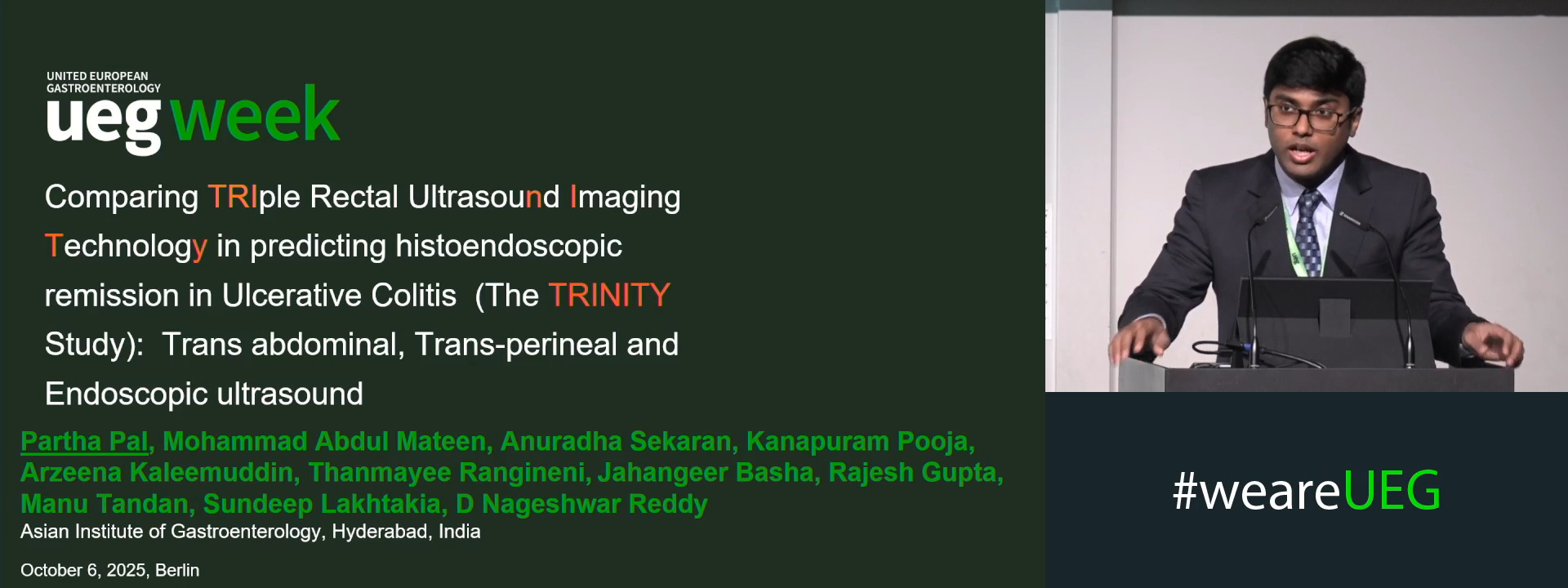
COMPARING TRIPLE RECTAL ULTRASOUND IMAGING TECHNOLOGY IN PREDICTING RECTAL HISTOENDOSCOPIC REMISSION IN ULCERATIVE COLITIS (THE TRINITY STUDY): TRANS ABDOMINAL, TRANS-PERINEAL AND ENDOSCOPIC ULTRASOUND (NCT06717906)
Partha Pal 1, Mohammad Abdul Mateen 1, Anuradha Sekaran 1, Kanapuram Pooja 1, Arzeena Kaleemuddin 1, Thanmayee Rangineni 1, Jahangeer Basha 1, Rajesh Gupta 1, Manu Tandan 1, Sundeep Lakhtakia 1, D. Nageshwar Reddy 1
1 Asian Institute of Gastroenterology, Hyderabad, India
Event
Topics
Submission format
Session
Citation
Published
Log in to access this content.
Free for all myUEG account holders. Your access level is set automatically based on your occupation. Medical professionals get full access to all content. If you are a non-medical user, you can only access UEG Week content from congresses you attended.
Not sure what you can access? Learn more about account types.
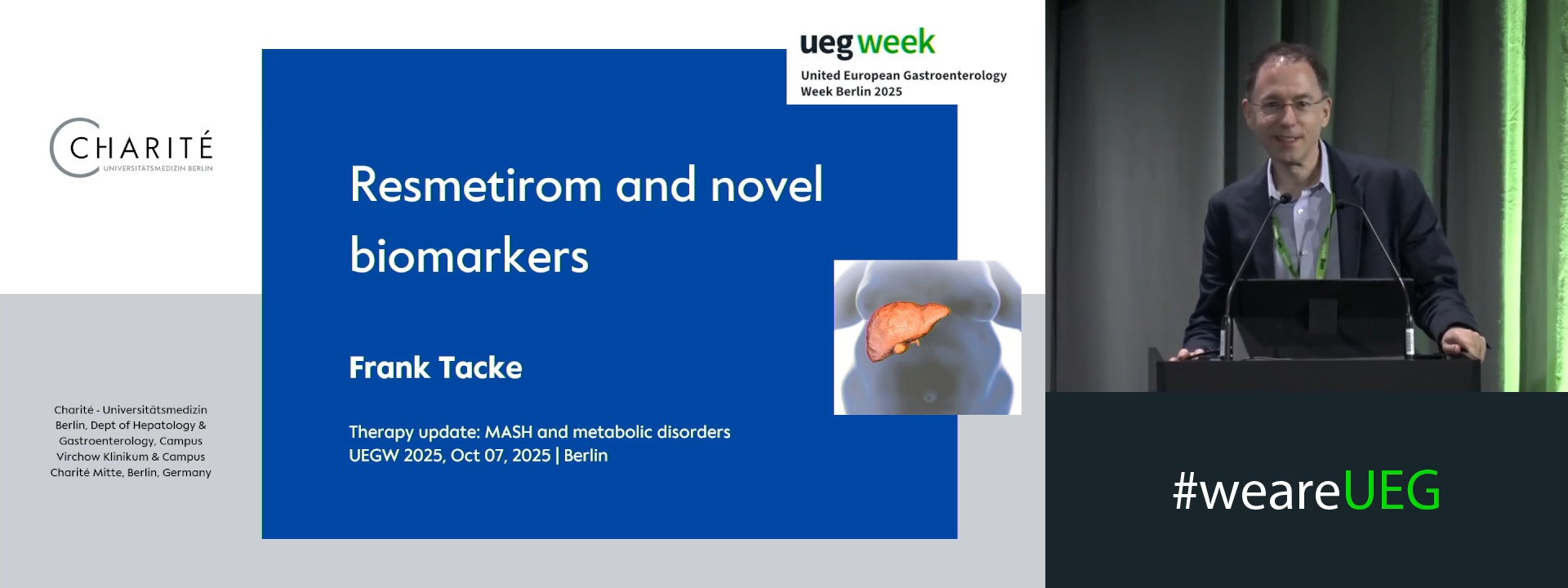
Resmetirom and novel biomarkers
1 Charité Universitaetsmedizin Berlin, Dept of Hepatology & Gastroenterology, Berlin, Germany
Event
Citation
Published
Log in to access this content.
Free for all myUEG account holders. Your access level is set automatically based on your occupation. Medical professionals get full access to all content. If you are a non-medical user, you can only access UEG Week content from congresses you attended.
Not sure what you can access? Learn more about account types.
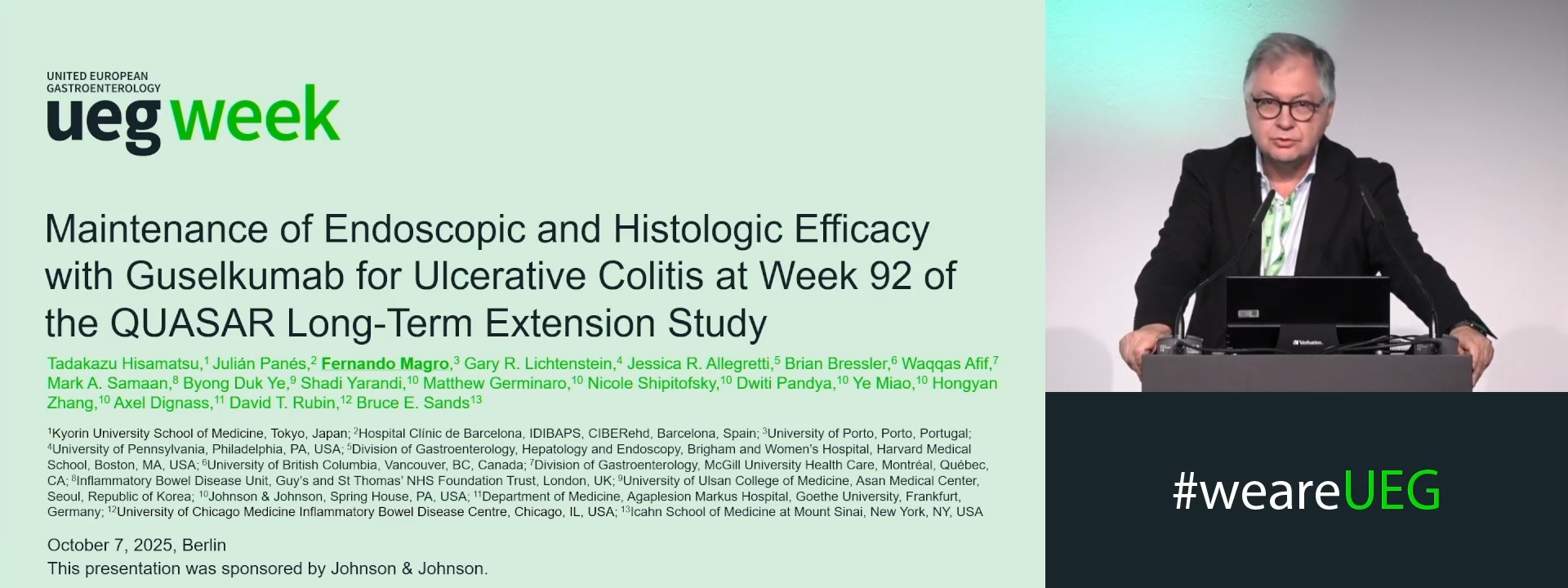
MAINTENANCE OF ENDOSCOPIC AND HISTOLOGIC EFFICACY WITH GUSELKUMAB FOR ULCERATIVE COLITIS AT WEEK 92 OF THE QUASAR LONG-TERM EXTENSION STUDY
Tadakazu Hisamatsu 1, Julian Panés 2, Fernando Magro 3, Gary Lichtenstein 4, Jessica Allegretti 5, Brian Bressler 6, Waqqas Afif 7, Mark A Samaan 8, Byong Duk Ye 9, Shadi Yarandi 10, Matthew Germinaro 10, Nicole Shipitofsky 10, Dwiti Pandya 10, Ye Miao 10, Hongyan Zhang 10, Axel Dignass 11, David T. Rubin 12, Bruce E. Sands 13
1 Kyorin University School of Medicine, Tokyo, Japan
2 Hospital Clínic de Barcelona, Barcelona, Spain
3 University of Porto, Porto, Portugal
4 University of Pennsylvania, Philadelphia, United States
5 Brigham and Women´s Hospital, Harvard Medical School, Boston, United States
6 University of British Columbia, Vancouver, Canada
7 McGill University Health Center, Montreal, Canada
8 Guy’s and St Thomas’ NHS Foundation Trust, London, United Kingdom
9 University of Ulsan College of Medicine, Asan Medical Center, Seoul, Korea, Republic of
10 Johnson & Johnson, Spring House, United States
11 Agaplesion Markus Hospital, Goethe University, Frankfurt, Germany
12 University of Chicago Medicine, Chicago, United States
13 Icahn School of Medicine at Mount Sinai, New York, United States