UEG's educational platform for gastroenterology education bringing recordings, courses, guidelines, and more together in one place.
Most popular content
Rate for better recommendations!
Your feedback helps us show you more of what you like and less of what you dislike!
Log in to access this content.
Free for all myUEG account holders. Your access level is set automatically based on your occupation. Medical professionals get full access to all content. If you are a non-medical user, you can only access UEG Week content from congresses you attended.
Not sure what you can access? Learn more about account types.

IMPAIRMENT OF REGENERATIVE AND METABOLIC PATHWAYS IN DUODENAL ORGANOIDS FROM PATIENTS WITH MASLD-CIRRHOSIS
Federico Salomone 1, Agnese Filippello 2, Alessandra Scamporrino 3, Stefania Di Mauro 2, Anna Fichera 1, Angela Maria Amorini 3, Salvatore Piro 3
1 Azienda Sanitaria Provinciale di Catania, Catania, Italy
2 University of Enna "Kore", Enna, Italy
3 University of Catania, Catania, Italy
Conference
Topics
Submission format
Citation
Published
Log in to access this content.
Free for all myUEG account holders. Your access level is set automatically based on your occupation. Medical professionals get full access to all content. If you are a non-medical user, you can only access UEG Week content from congresses you attended.
Not sure what you can access? Learn more about account types.
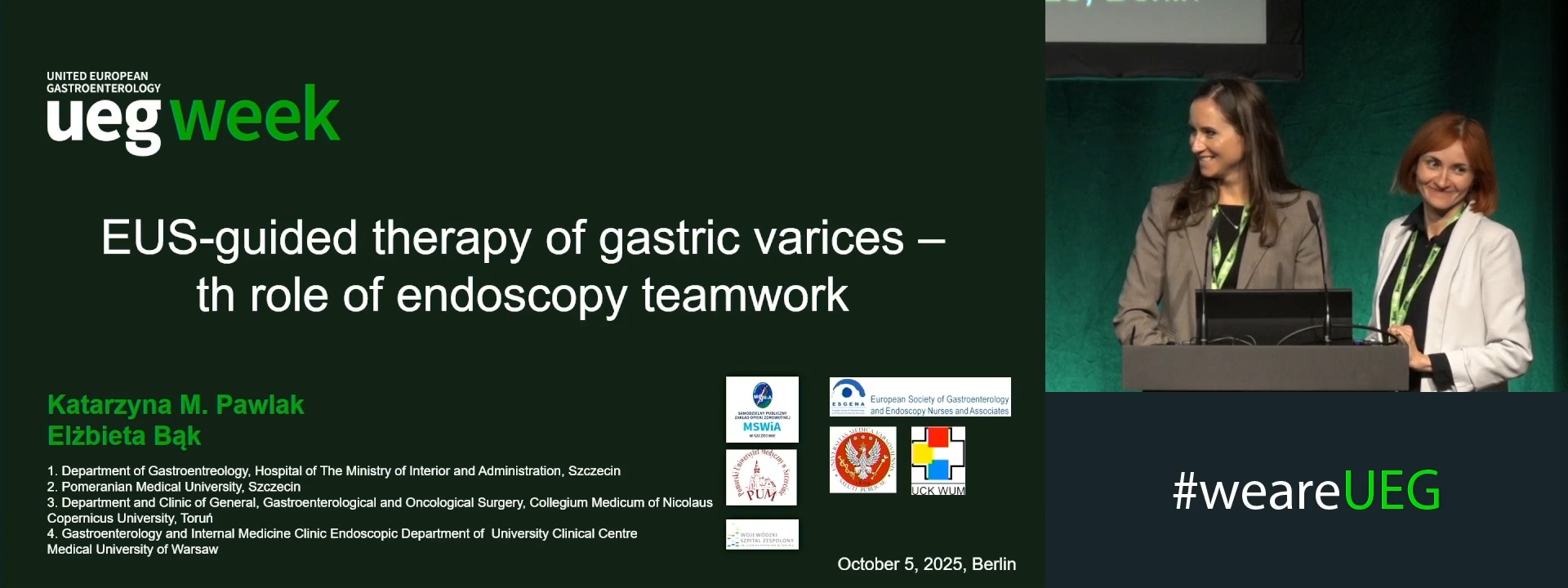
EUS-guided therapy of gastric varices: The role of endoscopic nurse-team work
1 Wojskowy Instytut Medyczny, Warsaw, Poland
2 Hospital of the Ministry of Interior and Administration, Szczecin, Poland
Event
Topics
Citation
Published
Log in to access this content.
Free for all myUEG account holders. Your access level is set automatically based on your occupation. Medical professionals get full access to all content. If you are a non-medical user, you can only access UEG Week content from congresses you attended.
Not sure what you can access? Learn more about account types.
The endoscopy nurse's guide to the GI galaxy
1 University General Hospital Attikon, Athens, Greece
Event
Topics
Session
Citation
Published
Log in to access this content.
Free for all myUEG account holders. Your access level is set automatically based on your occupation. Medical professionals get full access to all content. If you are a non-medical user, you can only access UEG Week content from congresses you attended.
Not sure what you can access? Learn more about account types.
GLOBAL PREVALENCE OF BURNOUT IN GASTROENTEROLOGY, HEPATOLOGY AND ENDOSCOPY: A SYSTEMATIC REVIEW AND META-ANALYSIS
Francesca Manza 1, Mohamed G. Shiha 2, John Ong 3, Iago Rodríguez-Lago 4, Martina Müller-Schilling 5, Reena Sidhu 6
1 Sheffield Teaching Hospitals, Sheffield, United Kingdom|||University of Ferrara, Ferrara, Italy
2 University of Sheffield, Sheffield, United Kingdom|||University Hospitals of Leicester, Leicester, United Kingdom
3 University of Cambridge, Cambridge, United Kingdom|||Bedfordshire Hospitals NHS Trust, Bedford, United Kingdom
4 Hospital Universitario de Galdakao, Bilbao, Spain
5 University Hospital Regensburg, Regensburg, Germany
6 Sheffield Teaching Hospitals, Sheffield, United Kingdom|||University of Sheffield, Sheffield, United Kingdom
Conference
Submission format
Citation
Published
Log in to access this content.
Free for all myUEG account holders. Your access level is set automatically based on your occupation. Medical professionals get full access to all content. If you are a non-medical user, you can only access UEG Week content from congresses you attended.
Not sure what you can access? Learn more about account types.
RANDOMIZED CONTROLLED TRIAL ON THE USE OF NASOGASTRIC AND NASOJEJUNAL TUBES(NG AND NJ TUBES) AFTER GASTRECTOMY FOR CANCER
1 Tuen Mun Hospital, Hong Kong, Hong Kong
Conference
Topics
Submission format
Citation
Published
Log in to access this content.
Free for all myUEG account holders. Your access level is set automatically based on your occupation. Medical professionals get full access to all content. If you are a non-medical user, you can only access UEG Week content from congresses you attended.
Not sure what you can access? Learn more about account types.
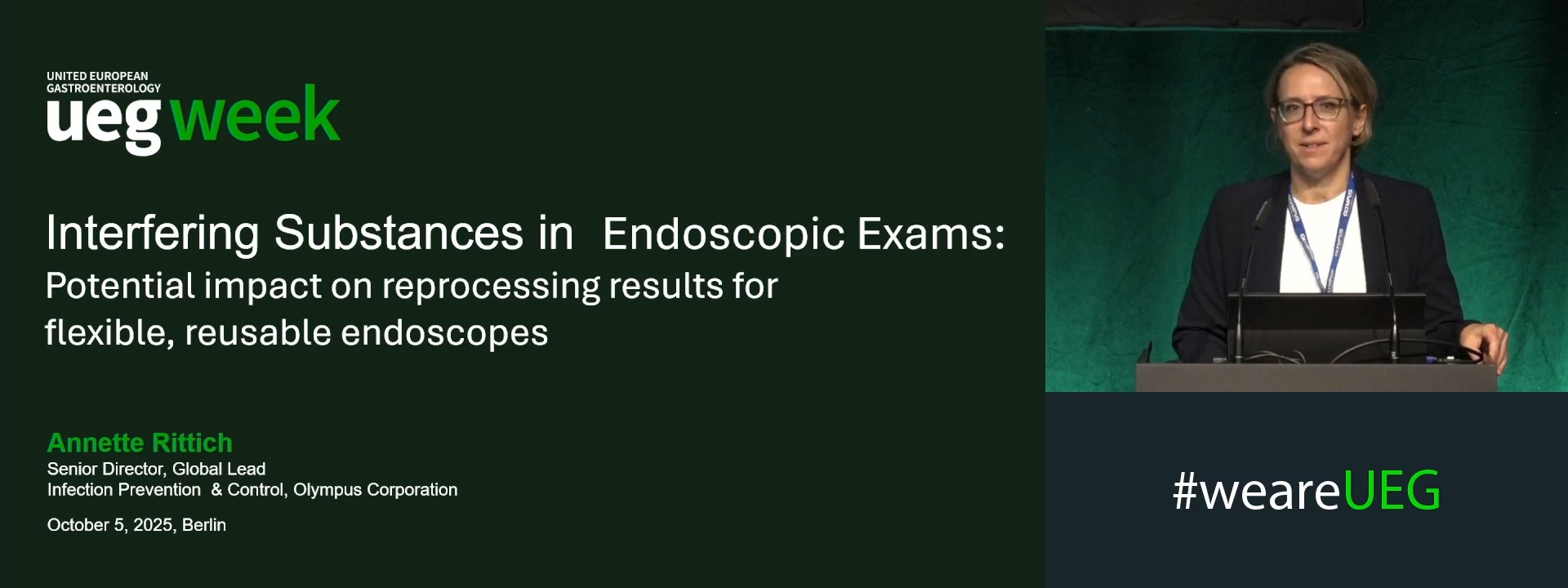
Interfering substances effect endoscope reprocessing
1 None, Hamburg, Germany
Event
Topics
Session
Citation
Published
Log in to access this content.
Free for all myUEG account holders. Your access level is set automatically based on your occupation. Medical professionals get full access to all content. If you are a non-medical user, you can only access UEG Week content from congresses you attended.
Not sure what you can access? Learn more about account types.
RESULTS FROM RESOLVE, AN ONGOING PHASE 1B/2A STUDY OF EP-104GI (LONG-ACTING FLUTICASONE PROPIONATE INJECTABLE SUSPENSION) FOR EOSINOPHILIC ESOPHAGITIS: DOSE ESCALATION COHORTS 3 THROUGH 6
Amanda Malone 1, James Helliwell 1, Mark Kowalski 1, Nam Quoc Nguyen 2, Hin Hin Ko 3, Gerald J. Holtmann 4, Albert J. Bredenoord 5, Evan S. Dellon 6, Christine Dobek 1, Vik Peck 1, Waqqas Afif 7
1 Eupraxia Pharmaceuticals, Victoria, Canada
2 Royal Adelaide Hospital, Adelaide, Australia
3 G.I. research Institute, Vancouver, Canada
4 University of Queensland, Hamilton, QLD, Andorra
5 Amsterdam UMC, Amsterdam, Netherlands
6 University of North Carolina School of Medicine, Chapel Hill, NC, United States
7 McGill University Health Center, Montreal, Canada
Conference
Topics
Submission format
Session