UEG's educational platform for gastroenterology education bringing recordings, courses, guidelines, and more together in one place.
Most popular content
Rate for better recommendations!
Your feedback helps us show you more of what you like and less of what you dislike!
Log in to access this content.
Free for all myUEG account holders. Your access level is set automatically based on your occupation. Medical professionals get full access to all content. If you are a non-medical user, you can only access UEG Week content from congresses you attended.
Not sure what you can access? Learn more about account types.

LIQUID BIOPSY OF BILE IN PATIENTS WITH PANCREATIC DUCTAL ADENOCARCINOMA: PRELIMINARY RESULTS FROM THE "BILE BIOPSY" STUDY
Cecilia Binda 1, Paolo Giuffrida 1, Michele Zanoni 2, Giorgia Marisi 2, Andrea Fabbri 1, Chiara Coluccio 1, Stefano Fabbri 1, Barbara Perini 3, Monica Cricca 4, Vittorio Sambri 4, Paola Ulivi 2, Carlo Fabbri 1
1 AUSL Romagna, Forlì, Italy
2 IRCCS, Istituto Romagnolo per lo studio dei Tumori (IRST), Meldola (FC), Italy
3 Azienda Ospedale-Università di Padova (AOUP), Padova, Italy
4 University of Bologna, Bologna, Italy
Conference
Topics
Submission format
Citation
Published
Log in to access this content.
Free for all myUEG account holders. Your access level is set automatically based on your occupation. Medical professionals get full access to all content. If you are a non-medical user, you can only access UEG Week content from congresses you attended.
Not sure what you can access? Learn more about account types.
Portal vein thrombosis: Aetiologies and differential management
1 University Hospital Magdeburg, Magdeburg, Germany
Event
Topics
Citation
Published
Log in to access this content.
Free for all myUEG account holders. Your access level is set automatically based on your occupation. Medical professionals get full access to all content. If you are a non-medical user, you can only access UEG Week content from congresses you attended.
Not sure what you can access? Learn more about account types.
Dilated main pancreatic duct of unknown origin: Chronic pancreatitis or MD-IPMN?
1 Klinikum Oldenburg, Oldenburg, Germany
Event
Topics
Session
Citation
Published
Log in to access this content.
Free for all myUEG account holders. Your access level is set automatically based on your occupation. Medical professionals get full access to all content. If you are a non-medical user, you can only access UEG Week content from congresses you attended.
Not sure what you can access? Learn more about account types.
Robotic living donor hepatectomy: A novel tool to expand the donor pool
1 Hannover Medical School, Hannover, Germany
Event
Topics
Citation
Published
Log in to access this content.
Free for all myUEG account holders. Your access level is set automatically based on your occupation. Medical professionals get full access to all content. If you are a non-medical user, you can only access UEG Week content from congresses you attended.
Not sure what you can access? Learn more about account types.
Panel discussion: Metabolic and vascular disorders of the liver
Event
Topics
Citation
Published

Log in to access this content.
Free for all myUEG account holders. Your access level is set automatically based on your occupation. Medical professionals get full access to all content. If you are a non-medical user, you can only access UEG Week content from congresses you attended.
Not sure what you can access? Learn more about account types.
INCIDENCE, PREVALENCE AND OVERALL RISK OF ESOPHAGEAL CANCER IN ACHALASIA: A PROPENSITY-MATCHED POPULATION-BASED STUDY FROM A LARGE MULTICENTER DATABASE
Alberto Barchi 1, Edoardo Vespa 1, Francesco Vito Mandarino 1, Antonio Ventimiglia 1, Marina Girelli 1, Micaela Marchisotta 1, Giuseppe Dell'Anna 1, Milli Gupta 2, Francesca Rusconi 3, Vito Annese 4, Edoardo Vincenzo Savarino 5, Silvio Danese 1, Sandro Passaretti 1, Albert J. Bredenoord 6
1 IRCCS Ospedale San Raffaele, Milan, Italy
2 University of Calgary, Calgary, AB, Canada
3 TriNetX Europe NV, Sint-Martens-Latem, Belgium
4 IRCCS Policlinico San Donato, Milan, Italy
5 University of Padua, Division of Gastroenterology, Padua, Italy
6 Amsterdam UMC, Amsterdam, Netherlands
Event
Submission format
Citation
Published
Log in to access this content.
Free for all myUEG account holders. Your access level is set automatically based on your occupation. Medical professionals get full access to all content. If you are a non-medical user, you can only access UEG Week content from congresses you attended.
Not sure what you can access? Learn more about account types.
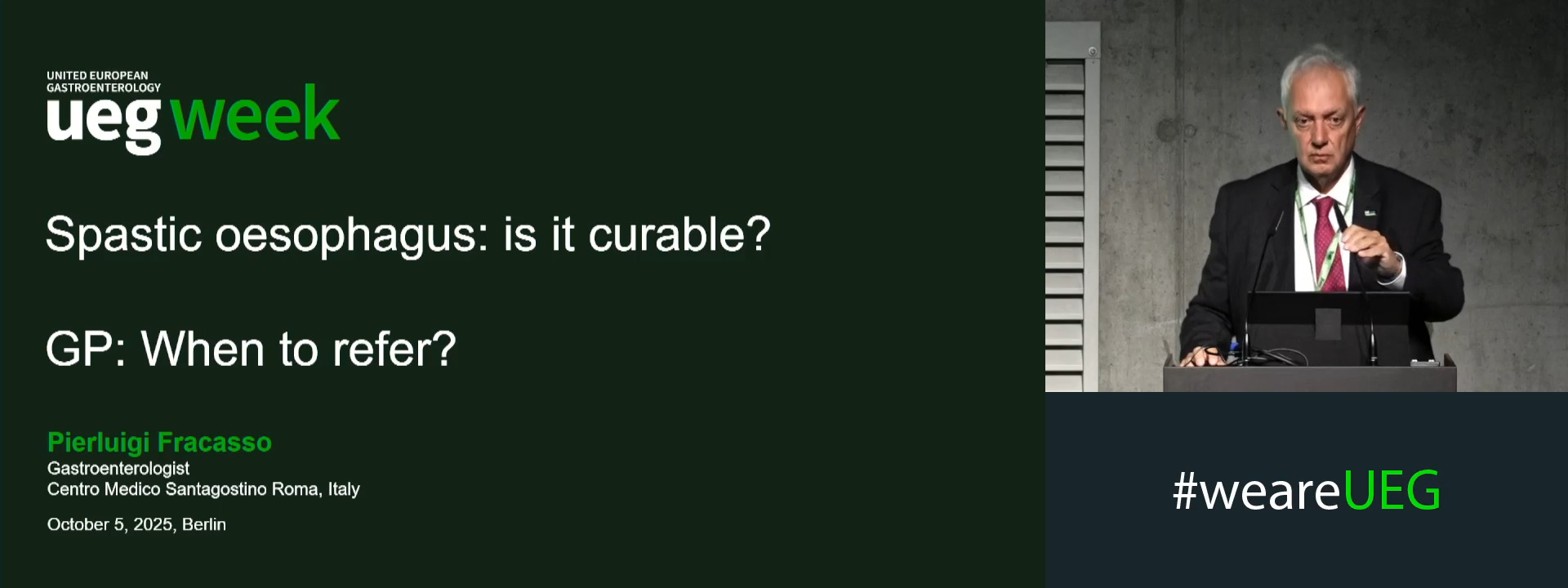
GP: When to refer?
1 Ospedale Sandro Pertini, Roma, Roma, Italy
Event
Topics