Introduction
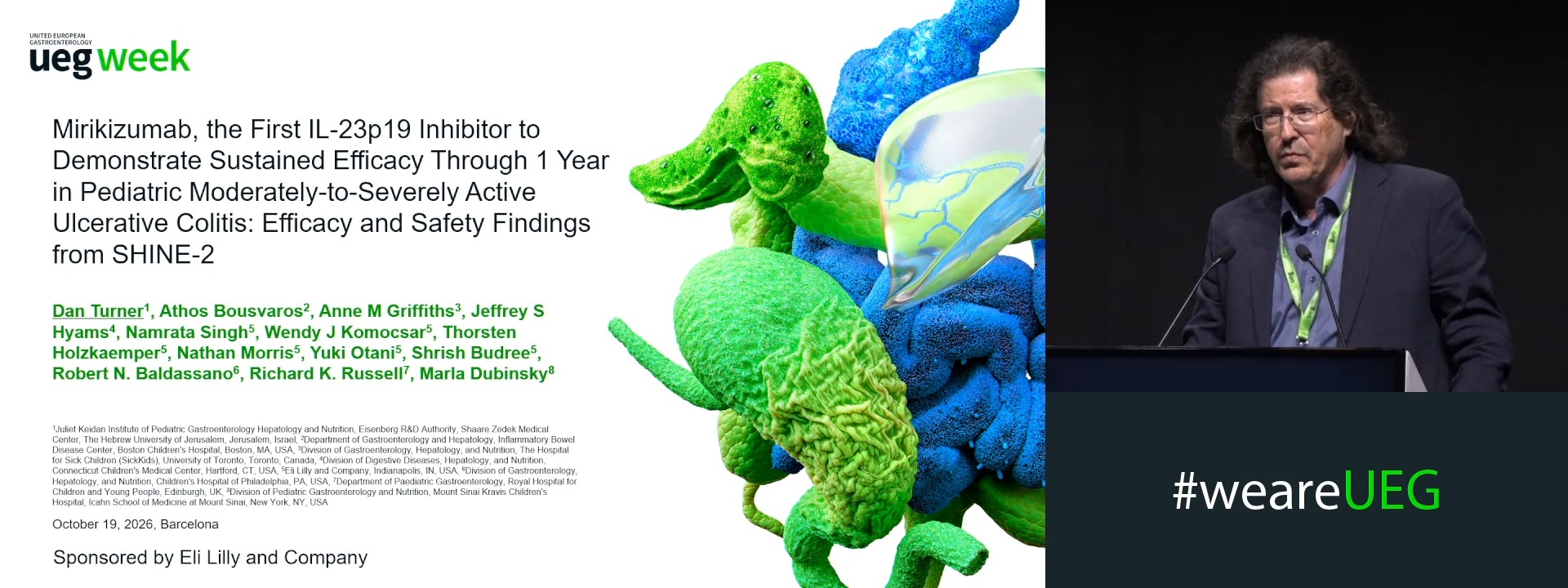
Ulcerative colitis (UC) is associated with high morbidity in the pediatric population, with increasing prevalence but limited therapies. This open label, single arm Phase 3 pediatric study (NCT05784246) is the first to report the efficacy, safety, and pharmacokinetics (PK) of a humanized anti-IL23p19 monoclonal antibody, mirikizumab, in children and adolescents with moderately to severely active UC.
Aims & Methods
Participants aged 2 to <18 years with moderately to severely active UC (modified Mayo score (MMS) 5–9 and endoscopic subscore (ES) ≥2) and weighing ≥10kg, received weight-based mirikizumab: intravenous induction every 4 weeks (Q4W) for 3 doses (300 mg for >40 kg; 5 mg/kg for ≤40 kg) followed by subcutaneous maintenance Q4W from Week (W)12 (200 mg for >40 kg; 100 mg for >20 to ≤40 kg; 50 mg for ≤20 kg). The primary endpoint was the proportion of W12 clinical responders who achieved MMS clinical remission at W52. Secondary endpoints included clinical, endoscopic, and symptomatic remission and response rates. Efficacy was compared with adult UC phase 3 (LUCENT 2) endpoints using Bayesian credible intervals (CrI) for the primary endpoint and frequentist confidence intervals for others. Safety was summarized descriptively through W52. PK/PD analyses were based on samples collected across predefined study visits.
Results
A total of 63 participants with mean age 13.2 years, 34 (54%) with previous biologic failure, and mean MMS of 6.5 were enrolled. Among 81% of responders at W12, 50.0% achieved clinical remission at W52, comparable to the adult mirikizumab remission rate (50.7%) and exceeding the adult placebo rate (26.6%). The pre-specified success criterion was met: the lower bound of the 80% CrI for the pediatric remission rate at W52 among responders at W12 (42.8%) exceeded the adult placebo 90% CrI upper bound (32.6%). Induction responders at W52 showed higher response rates than adult placebo including clinical response (73.1% vs. 49.1%), corticosteroid-free remission without surgery (50.0% vs. 22.5%), symptomatic remission (71.2% vs. 39.1%), endoscopic improvement (53.8% vs. 29.6%) and endoscopic remission (44.2% vs. 13.6%) (Table 1). Most treatment-emergent adverse events were mild/moderate, with 2 discontinuations due to UC flare. Four participants (6.3%) experienced serious adverse events (UC flare, intestinal polyp, anal abscess, procedure related bleed, skull injury), none assessed as related to study drug by the investigator. There were no deaths, malignancies, opportunistic infections, or growth-related safety concerns. PK analysis at W16-W52 showed mirikizumab exposures after weight-based dosing were generally comparable across subgroups and with adults; however, the sample size limited assessment of different weight categories through W12.
Conclusion
Mirikizumab provides sustained clinical and endoscopic benefit through one year in pediatric ulcerative colitis, comparable to mirikizumab treated adults, demonstrating meaningful steroid-sparing effects, and no new safety signals.
Table 1. Proportion of W12 Clinical Responders Achieving Outcomes at W52 (NRI), mITT: SHINE-2 (pediatric) and LUCENT-2 (adult) studies
a Response CIs are constructed using Wilson method, without continuity correction. b Primary endpoint, SF=0 or 1, RB=0, and ES=0 or 1 (excluding friability). c A decrease in the MMS of ≥2 points and ≥30% decrease from induction baseline plus a decrease of ≥1 point in the RB subscore from induction baseline or an RB subscore of 0 or 1. d ES=0. e ES=0 or 1 (excluding friability). f Clinical remission at W52 without surgery and no corticosteroid use for at least 12 weeks prior to W52. g SF subscore=0 or 1 with a ≥1 point decrease from baseline and RB subscore=0.
Abbreviations: CI = confidence interval; CSF = corticosteroid-free; ES = endoscopic subscore; Miri = mirikizumab; mITT=modified intent to treat; MMS = Modified Mayo Score; N = number of patients in the analysis population; n = number of patients in the specified category; NRI = nonresponder imputation; PBO = placebo; RB = rectal bleeding; SF=stool frequency; UC = ulcerative colitis; W=week. |
Outcomes, % (95% CIa)
| Pediatric Miri (N=52)
| Adult PBO (N=169)
| Adult Miri (N=337)
|
Clinical Remissionb
| 50.0 (36.9, 63.1)
| 26.6 (20.5, 33.8)
| 50.7 (45.4, 56.0)
|
Clinical Responsec
| 73.1 (59.7, 83.2)
| 49.1 (41.7, 56.6)
| 81.3 (76.8, 85.1)
|
Endoscopic Remissiond
| 44.2 (31.6, 57.7)
| 13.6 (9.2, 19.6)
| 22.0 (17.9, 26.7)
|
Endoscopic Improvemente
| 53.8 (40.5, 66.7)
| 29.6 (23.2, 36.9)
| 57.9 (52.5, 63.0)
|
CSF Remissionf
| 50.0 (36.9, 63.1)
| 22.5 (16.8, 29.4)
| 46.3 (41.0, 51.6)
|
Symptomatic Remissiong
| 71.2 (57.7, 81.7)
| 39.1 (32.0, 46.6)
| 72.4 (67.4, 76.9)
|
Disclosure
Dr. Dan Turner has received consultation fees, research grants, royalties, and/or honoraria from AbbVie, Bristol Myers Squibb, Celgene, Eli Lilly and Company, Ferring Pharmaceuticals, Janssen, Pfizer, Prometheus Biosciences, Roche, Shaare Zedek Medical Center, Shire, Sorriso Pharmaceuticals, Takeda, The Hospital for Sick Children, and Thermo Fisher Scientific.
Dr. Marla Dubinsky has received honoraria as a consultant for AbbVie, Arena Pharmaceuticals, Boehringer Ingelheim, Bristol Myers Squibb, Celgene, Eli Lilly and Company, F. Hoffmann-La Roche, Genentech, Gilead Sciences, Janssen, Pfizer, Prometheus Therapeutics and Diagnostics, Takeda, and UCB Pharma; has been contracted for research by AbbVie, Janssen, Pfizer, and Prometheus Biosciences; has stock interest in Trellus Health; and has received licensing fees from Takeda.
Dr. Richard K Russell has received speaker’s fees, travel support from, or has performed consultancy work with Nestle Health Sciences, AbbVie, Takeda, Lilly, Celltrion Healthcare, Janssen, Pfizer and Ferring
Dr. Jeffrey S Hyams serves on an advisory board for AbbVie, Eli Lilly and Company, and Janssen and has been a consultant to Boehringer Ingelheim, Bristol Myers Squibb, Genentech, and Takeda.
Dr. Athos Bousvaros has received research support from AbbVie, Arena Pharmaceuticals, Bristol Myers Squibb, Buhlmann Diagnostics, Eli Lilly and Company, Janssen, ProciseDx, and Takeda; was a consultant for Best Doctors, Eli Lilly and Company, Fresenius Kabi, and Takeda; and has received honoraria and royalties from Boston University and UptoDate.
Dr. Anne Griffiths has received advisory board/consultancy/speaker fees from Abbvie, Alfasigma, Janssen, Lilly, Pfizer, Roche and Takeda and has received royalties for PUCAI from the Hospital for Sick Children and from Shaare Zedek Hospital for TUMMY-UC.
Dr. Robert N. Baldassano is a Pediatric Consultant for Janssen Research & Development and Eli Lilly and Company.
Namrata Singh, Wendy J Komocsar, Thorsten Holzkämper, Nathan Morris, Yuki Otani, and Shrish Budree are employees and minor shareholders of Eli Lilly and Company.