UEG's educational platform for gastroenterology education bringing recordings, courses, guidelines, and more together in one place.
Most popular content
Rate for better recommendations!
Your feedback helps us show you more of what you like and less of what you dislike!
Log in to access this content.
Free for all myUEG account holders. Your access level is set automatically based on your occupation. Medical professionals get full access to all content. If you are a non-medical user, you can only access UEG Week content from congresses you attended.
Not sure what you can access? Learn more about account types.

LONG–TERM RESULTS OF ENDOSCOPIC MANAGEMENT OF BILE DUCT INJURIES AFTER LAPAROSCOPIC CHOLECYSTECTOMY
Djalma Ernesto Coelho Neto 1, Mariana Issa Ernesto Coelho 2, Gabriela Coelho 2, Jose Flavio Coelho 3, Luiz guilherme Gallito Demarco 2, Felipe Villas Bôas Legentil 2, Erika Padilha Custodio Nunes 2, Diane Yuki Murayama 2, Ana Júlia Almeida Baptista de Souza 2, Isabela Pereira Nolasco 2, Marina Noronha Barbosa 2, Carlos Amaral 4, José Celso Ardengh 5
1 Universidade Estacio de Sá, Rio de Janeiro, Brazil
2 Faculdade de Medicina Souza Marques, Rio de Janeiro, Rio de Janeiro, Brazil
3 Universidade Federal do Rio de Janeiro, Rio de Janeiro, Brazil
4 Santa Casa de Macéio, Macéio, Brazil
5 HCFMRP-USP Dept. of Surgery and Anatomy, São Paulo, Brazil
Conference
Topics
Submission format
Citation
Published
Log in to access this content.
Free for all myUEG account holders. Your access level is set automatically based on your occupation. Medical professionals get full access to all content. If you are a non-medical user, you can only access UEG Week content from congresses you attended.
Not sure what you can access? Learn more about account types.
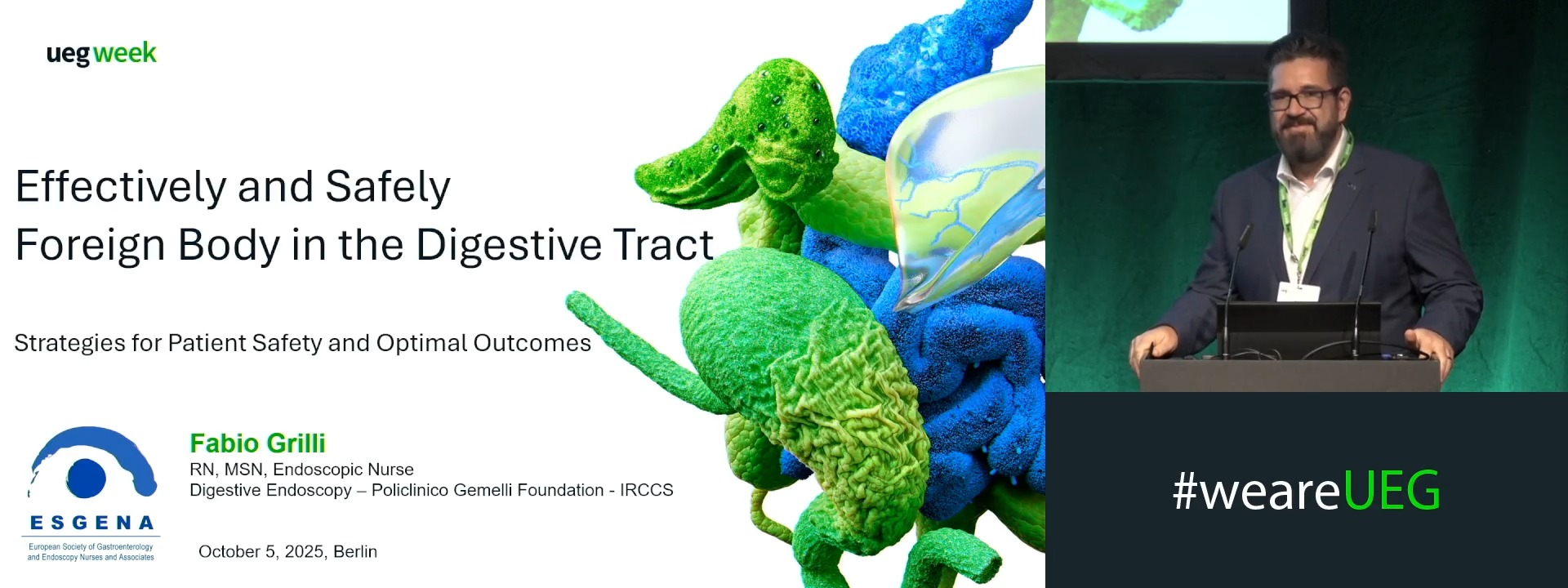
Effectively and safely- foreign body in the digestive tract
1 Fondazione Policlinico Universitario Agostino Gemelli IRCCS, Roma, Italy
Event
Topics
Citation
Published
Log in to access this content.
Free for all myUEG account holders. Your access level is set automatically based on your occupation. Medical professionals get full access to all content. If you are a non-medical user, you can only access UEG Week content from congresses you attended.
Not sure what you can access? Learn more about account types.
Panel Discussion
Event
Citation
Published
Log in to access this content.
Free for all myUEG account holders. Your access level is set automatically based on your occupation. Medical professionals get full access to all content. If you are a non-medical user, you can only access UEG Week content from congresses you attended.
Not sure what you can access? Learn more about account types.
APPROACH TO CASES OF FAILED PRE-CUT SPHINCTEROTOMY - SEEKING BILE DUCT WITH THE HYDROPHILIC GUIDE WIRE, COMPLETELY DEPENDENT ON FLUOROSCOPIC VIEW
1 Mitsui Memorial Hospital, Tokyo, Japan
Conference
Topics
Submission format
Citation
Published
Log in to access this content.
Free for all myUEG account holders. Your access level is set automatically based on your occupation. Medical professionals get full access to all content. If you are a non-medical user, you can only access UEG Week content from congresses you attended.
Not sure what you can access? Learn more about account types.
UNUSUAL PRESENTATION OF ACTINOMYCOSIS AS SOFT TISSUE MASS IN THE GASTROHEPATIC SPACE, IN THE POST LIVER TRANSPLANT SETTING
1 University Hospital Birmingham, Walsall, United Kingdom
2 Walsall Manor Hospital, Walsall, United Kingdom
3 Northern General Hospital, Sheffield, United Kingdom
4 Salisbury District Hospital, Salisbury, United Kingdom
Conference
Topics
Submission format
Session
Published
Log in to access this content.
Free for all myUEG account holders. Your access level is set automatically based on your occupation. Medical professionals get full access to all content. If you are a non-medical user, you can only access UEG Week content from congresses you attended.
Not sure what you can access? Learn more about account types.
THE USE OF SHEAR WAVE ELASTOGRAPHY IN DIFFERENTIATING FIBROTIC FROM INFLAMMATORY STRICTURES IN CROHN’S DISEASE
1 Luigi Sacco University Hospital, Milan, Italy
2 L.Sacco University Hospital General Surgery II, Milano, Italy
Conference
Topics
Submission format
Session
Citation
Published
Log in to access this content.
Free for all myUEG account holders. Your access level is set automatically based on your occupation. Medical professionals get full access to all content. If you are a non-medical user, you can only access UEG Week content from congresses you attended.
Not sure what you can access? Learn more about account types.
THE EARLY IMPACT OF BARIATRIC SURGERY ON LIVER FIBROSIS AND STEATOSIS IN MASLD PATIENTS
Valentina Cossiga 1, Mario Capasso 1, Luisa Ranieri 1, Concetta Accongiagioco 1, Vincenzo Schiavone 2, Simona Albano 1, Francesco Capozzi 1, Maria Guarino 1, Mario Capasso 2, Mario Musella 2, Filomena Morisco 1
1 Department of Clinical Medicine and Surgery, Diseases of the Liver and Biliary System Unit, University of Naples "Federico II", Naples, Italy
2 Department of Advanced Biomedical Science, University of Naples "Federico II", Naples, Italy
Conference
Topics