UEG's educational platform for gastroenterology education bringing recordings, courses, guidelines, and more together in one place.
Most popular content
Rate for better recommendations!
Your feedback helps us show you more of what you like and less of what you dislike!
Log in to access this content.
Free for all myUEG account holders. Your access level is set automatically based on your occupation. Medical professionals get full access to all content. If you are a non-medical user, you can only access UEG Week content from congresses you attended.
Not sure what you can access? Learn more about account types.

C7M, A MARKER OF TYPE VII COLLAGEN DEGRADATION, IS REFLECTIVE OF EPITHELIAL REMODELING AND IS STRONGLY ASSOCIATED WITH INTESTINAL MUCOSAL DAMAGE IN CROHN’S DISEASE
Joachim Høg Mortensen 1, Anja Poulsen 2, Marta Sorokina Alexdóttir 1, Thomai Tsapanou-Katranara 1, Lene Buhl Riis 3, Pernille Dige Ovesen 4, Julie Rasmussen 5, Mads Damsgaard Wewer 6, Louise Camilla Porsbjerg 2, Ismail Gögenur 5, Johan Burisch 7, Anne-Christine Bay-Jensen 1, Jakob Seidelin 8, Morten Asser Karsdal 1
1 Nordic Bioscience A/S, Herlev, Denmark
2 Rigshospitalet, Copenhagen Ø, Denmark
3 Herlev Hospital, Herlev, Denmark|||Rigshospitalet, Copenhagen Ø, Denmark
4 Herlev Hospital, Herlev, Denmark
5 Køge Hospital, København S, Denmark
6 Amager Hvidovre University Hospital, Hvidovre, Denmark
7 Hvidovre University Hospital, Virum, Denmark|||University of Copenhagen, Copenhagen, Denmark
8 Rigshospitalet, University Of Copenhagen, Copenhagen, Denmark
Conference
Topics
Submission format
Citation
Published
Log in to access this content.
Free for all myUEG account holders. Your access level is set automatically based on your occupation. Medical professionals get full access to all content. If you are a non-medical user, you can only access UEG Week content from congresses you attended.
Not sure what you can access? Learn more about account types.
Nurse Programme (Complete Session)
Event
Citation
Published
Log in to access this content.
Free for all myUEG account holders. Your access level is set automatically based on your occupation. Medical professionals get full access to all content. If you are a non-medical user, you can only access UEG Week content from congresses you attended.
Not sure what you can access? Learn more about account types.
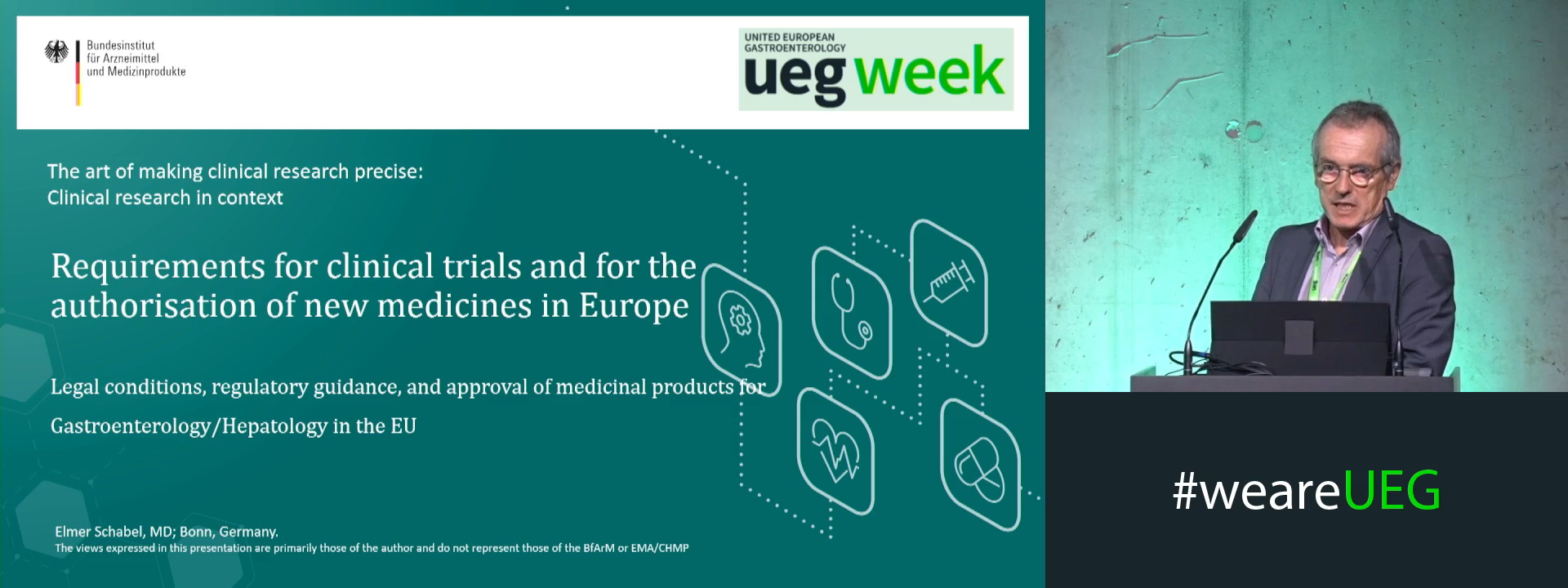
Requirements for clinical trials and for the authorisation of new medicines in Europe
1 Bundesinstitut für Arzneimittel und Medizinprodukte Abt. 2/FG Gastroenterologie, Bonn, Germany
Event
Citation
Published
Log in to access this content.
Free for all myUEG account holders. Your access level is set automatically based on your occupation. Medical professionals get full access to all content. If you are a non-medical user, you can only access UEG Week content from congresses you attended.
Not sure what you can access? Learn more about account types.
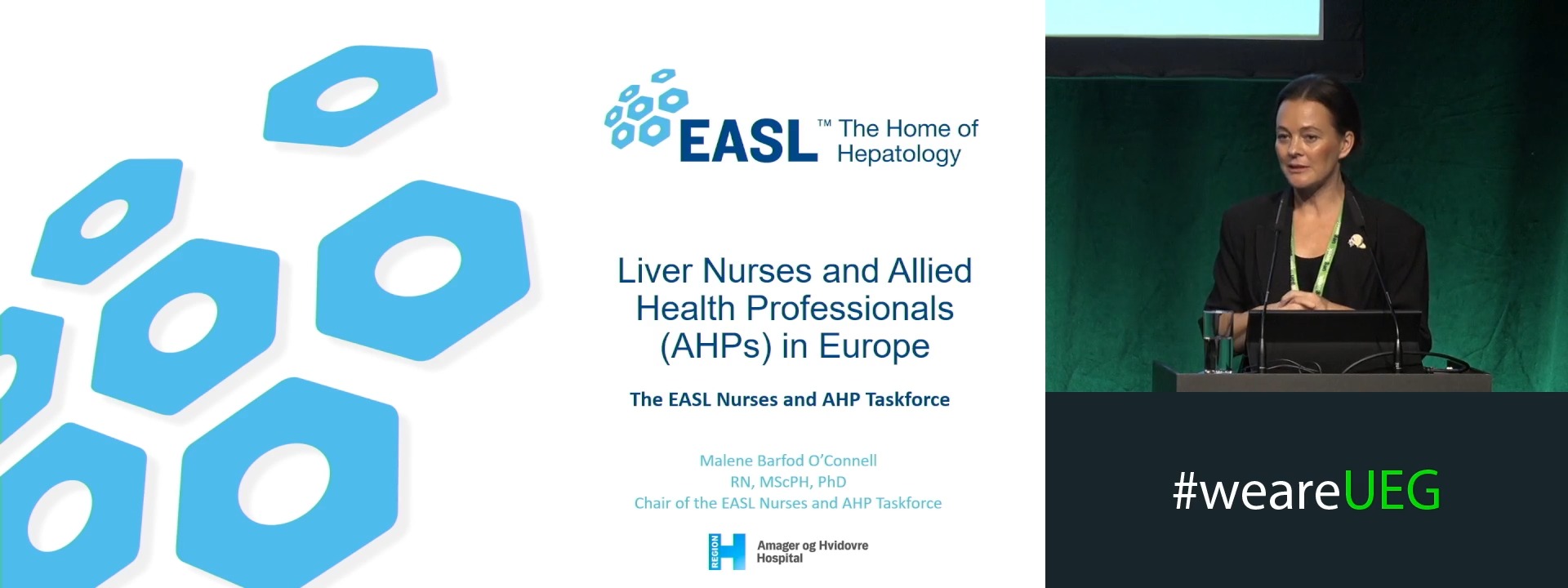
Liver nurses and allied health professions in Europe: The EASL taskforce
1 None, None, Denmark
Event
Topics
Citation
Published
Log in to access this content.
Free for all myUEG account holders. Your access level is set automatically based on your occupation. Medical professionals get full access to all content. If you are a non-medical user, you can only access UEG Week content from congresses you attended.
Not sure what you can access? Learn more about account types.
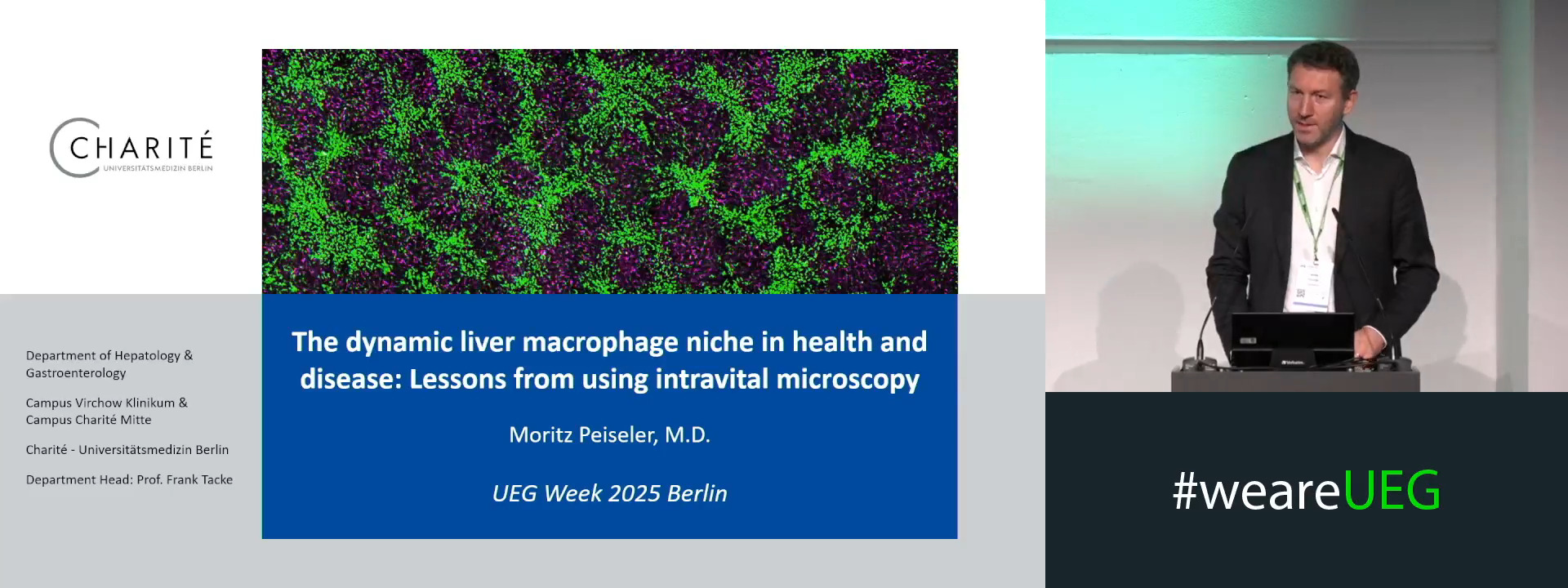
The dynamic liver macrophage niche in health and disease: Lessons from using intravital microscopy
1 Charité University Medicine Berlin, Berlin, Germany
Event
Citation
Published
Log in to access this content.
Free for all myUEG account holders. Your access level is set automatically based on your occupation. Medical professionals get full access to all content. If you are a non-medical user, you can only access UEG Week content from congresses you attended.
Not sure what you can access? Learn more about account types.
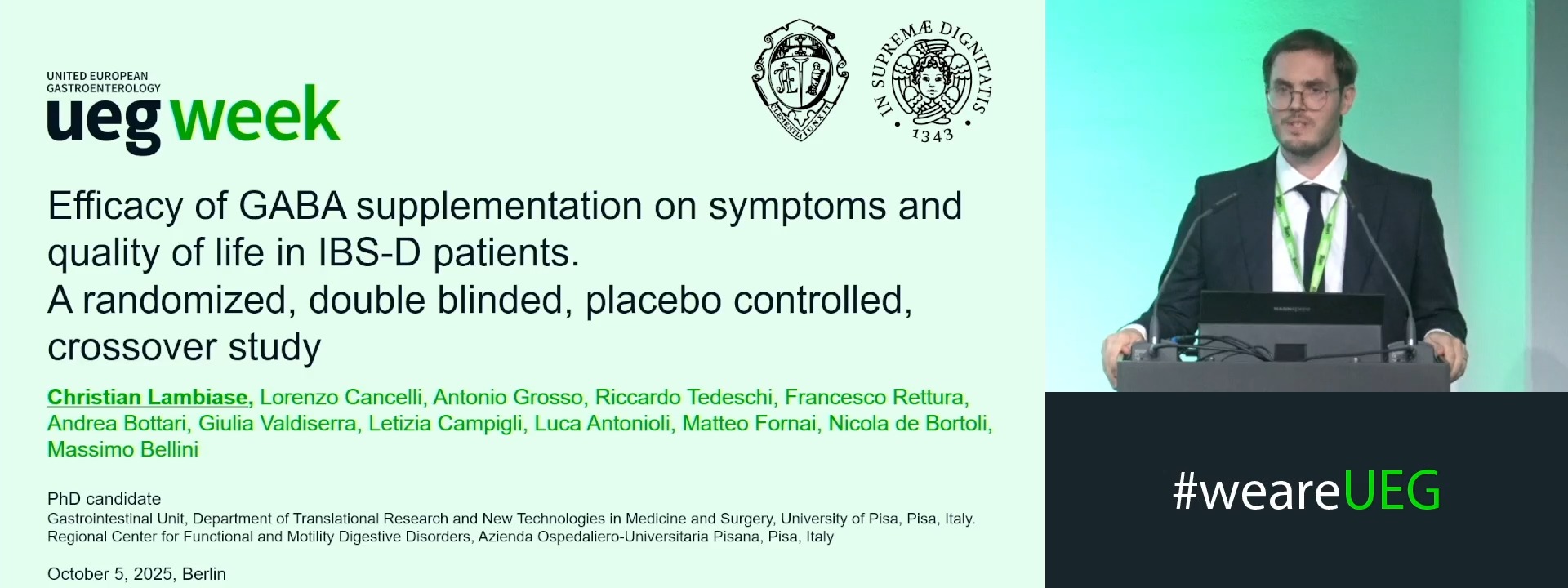
EFFECTS OF GAMMA-AMINOBUTYRIC ACID SUPPLEMENTATION ON SYMPTOMS AND QUALITY OF LIFE IN IBS-D PATIENTS. PRELIMINARY RESULTS FROM A RANDOMIZED, DOUBLE BLINDED, PLACEBO CONTROLLED, CROSSOVER STUDY
Christian Lambiase 1, Lorenzo Cancelli 1, Antonio Grosso 1, Riccardo Tedeschi 1, Francesco Rettura 1, Andrea Bottari 1, Giulia Valdiserra 2, Letizia Campigli 2, Luca Antonioli 2, Matteo Fornai 2, Nicola de Bortoli 1, Massimo Bellini 1
1 University of Pisa, Pisa, Italy|||Azienda Ospedaliero-Universitaria Pisana, Pisa, Italy
2 University of Pisa, Pisa, Italy
Event
Topics
Submission format
Session
Citation
Published
Log in to access this content.
Free for all myUEG account holders. Your access level is set automatically based on your occupation. Medical professionals get full access to all content. If you are a non-medical user, you can only access UEG Week content from congresses you attended.
Not sure what you can access? Learn more about account types.
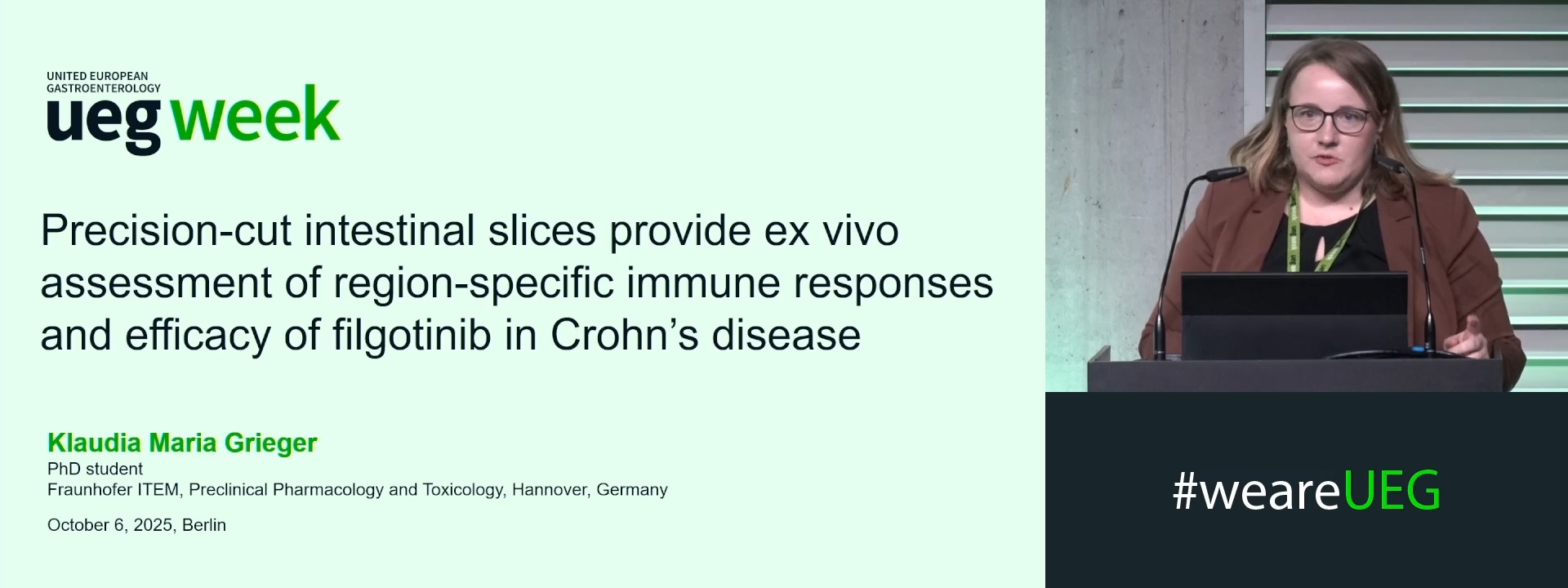
PRECISION-CUT INTESTINAL SLICES PROVIDE EX VIVO ASSESSMENT OF REGION-SPECIFIC IMMUNE RESPONSES AND EFFICACY OF FILGOTINIB IN CROHN'S DISEASE
Klaudia Maria Grieger 1, Valerie Beneke 1, Vanessa Neuhaus 1, Ulf Kulik 2, Heiko Aselmann 3, Benjamin Gundert 3, Armin Braun 1, Christina Hesse 1, Susann Dehmel 1, Katherina Sewald 1
1 Fraunhofer Institute for Toxicology and Experimental Medicine, Hannover, Germany
2 Hannover Medical school (MHH), Hannover, Germany
3 KRH Klinikum Region Hannover, Hannover, Germany