UEG's educational platform for gastroenterology education bringing recordings, courses, guidelines, and more together in one place.
Most popular content
Rate for better recommendations!
Your feedback helps us show you more of what you like and less of what you dislike!
Log in to access this content.
Free for all myUEG account holders. Your access level is set automatically based on your occupation. Medical professionals get full access to all content. If you are a non-medical user, you can only access UEG Week content from congresses you attended.
Not sure what you can access? Learn more about account types.
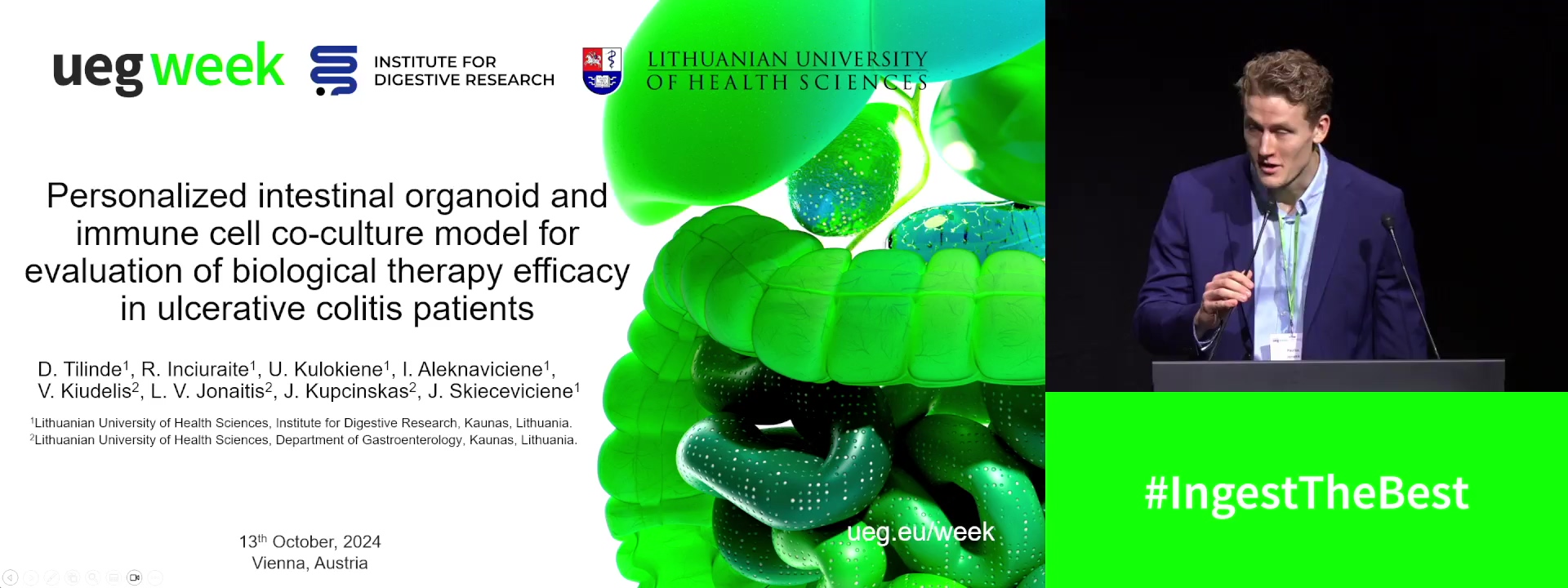
PERSONALIZED INTESTINAL ORGANOID AND IMMUNE CELL CO-CULTURE MODEL FOR EVALUATION OF BIOLOGICAL THERAPY EFFICACY IN ULCERATIVE COLITIS PATIENTS
Deimantė Tilindė 1, Ruta Inciuraite 1, Ugne Kulokiene 1, Indre Aleknaviciene 1, Vytautas Kiudelis 2, Laimas Virginijus Jonaitis 2, Juozas Kupcinskas 2, Jurgita Skieceviciene 1
1 Lithuanian University of Health Sciences/Institute for Digestive Research, Kaunas, Lithuania
2 Lithuanian University of Health Sciences, Kaunas, Lithuania
Event
Submission format
Citation
Published
Log in to access this content.
Free for all myUEG account holders. Your access level is set automatically based on your occupation. Medical professionals get full access to all content. If you are a non-medical user, you can only access UEG Week content from congresses you attended.
Not sure what you can access? Learn more about account types.
Log in to access this content.
Free for all myUEG account holders. Your access level is set automatically based on your occupation. Medical professionals get full access to all content. If you are a non-medical user, you can only access UEG Week content from congresses you attended.
Not sure what you can access? Learn more about account types.
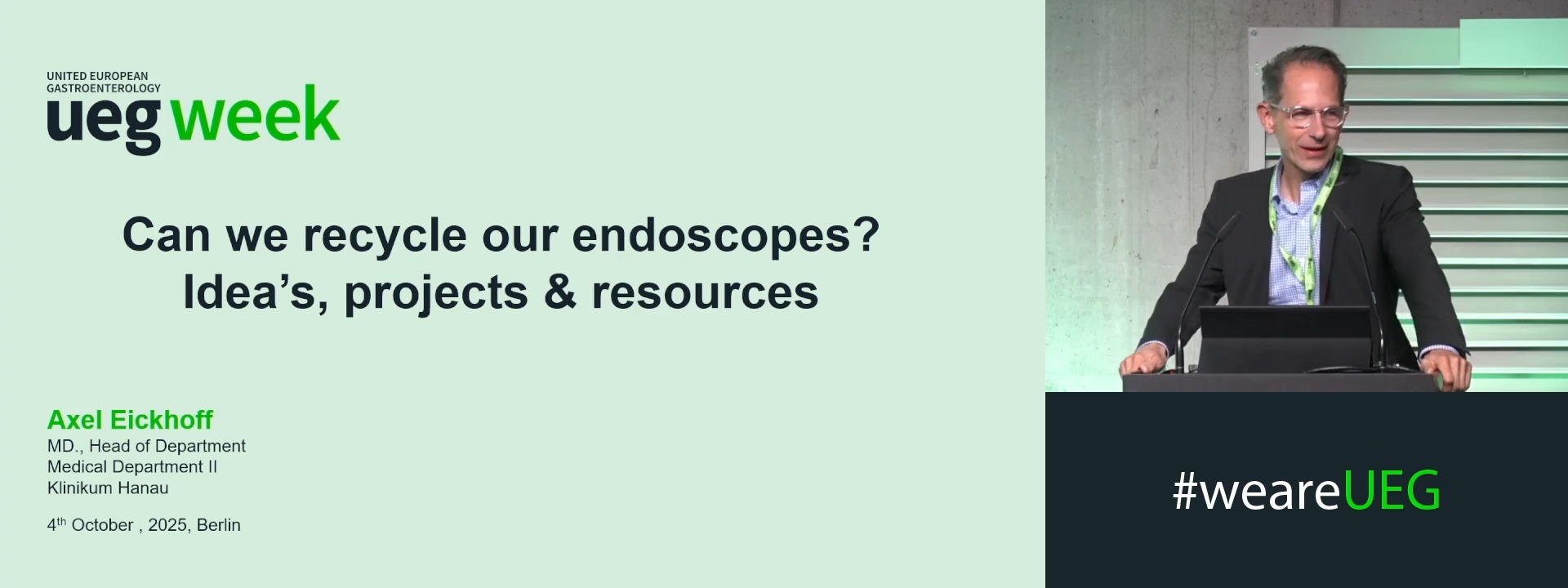
Can we recycle our endoscopes? Ideas, Projects and resources
1 Klinikum Hanau, None, Germany
Event
Topics
Citation
Published
Log in to access this content.
Free for all myUEG account holders. Your access level is set automatically based on your occupation. Medical professionals get full access to all content. If you are a non-medical user, you can only access UEG Week content from congresses you attended.
Not sure what you can access? Learn more about account types.

PREVALENCE OF DIAGNOSED CELIAC DISEASE IN THE UNITED STATES (2013–2022): A HEALTH CLAIMS DATABASE STUDY
1 Takeda Development Center Americas, Inc., Cambridge, United States
2 Takeda Development Center Americas, Inc., Cambridge, United States|||Harvard Medical School, Boston, United States
Conference
Topics
Submission format
Session
Citation
Published
Log in to access this content.
Free for all myUEG account holders. Your access level is set automatically based on your occupation. Medical professionals get full access to all content. If you are a non-medical user, you can only access UEG Week content from congresses you attended.
Not sure what you can access? Learn more about account types.
DEMOGRAPHIC TRENDS IN MORTALITY RELATED TO GASTRIC CANCER IN THE UNITED STATES, 1999-2022 - A CDC WONDER STUDY
Arkadeep Dhali 1, Muhammad Faizan 2, Abdul Rafae Faisal 3, Pramod Singh 4, Asad Zaman 3, Ali Shan Hafeez 3, -. Abdullah 5, Laiba Razaq 6, Mohammad Abdullah Humayun 7, Henna Qadri 8, Ahila Ali 9, Syed Zaeem Ahmed 9, Shaikh Muhammad Daniyal 9, Rick Maity 10
1 Sheffield Teaching Hospitals NHS Foundation Trust & University of Sheffield, UK, Sheffield, United Kingdom
2 Hammad Medical Corporation, Doha, Qatar
3 CIMS, Multan, Pakistan
4 Barhabise Primary Health Care Centre, Barhabise, Nepal
5 Rawalpindi Medical University, Rawalpindi, Pakistan
6 Akhtar Saeed Medical and Dental College, Lahore, Pakistan
7 Shalamar Institute of Health Sciences, Lahore, Pakistan
8 Memorial Healthcare System, Pembroke Pines, United States
9 Dow University of Health Sciences, Karachi, Pakistan
10 Indian Institute of Technology Kharagpur, Kharagpur, India
Conference
Topics
Submission format
Citation
Published
Log in to access this content.
Free for all myUEG account holders. Your access level is set automatically based on your occupation. Medical professionals get full access to all content. If you are a non-medical user, you can only access UEG Week content from congresses you attended.
Not sure what you can access? Learn more about account types.
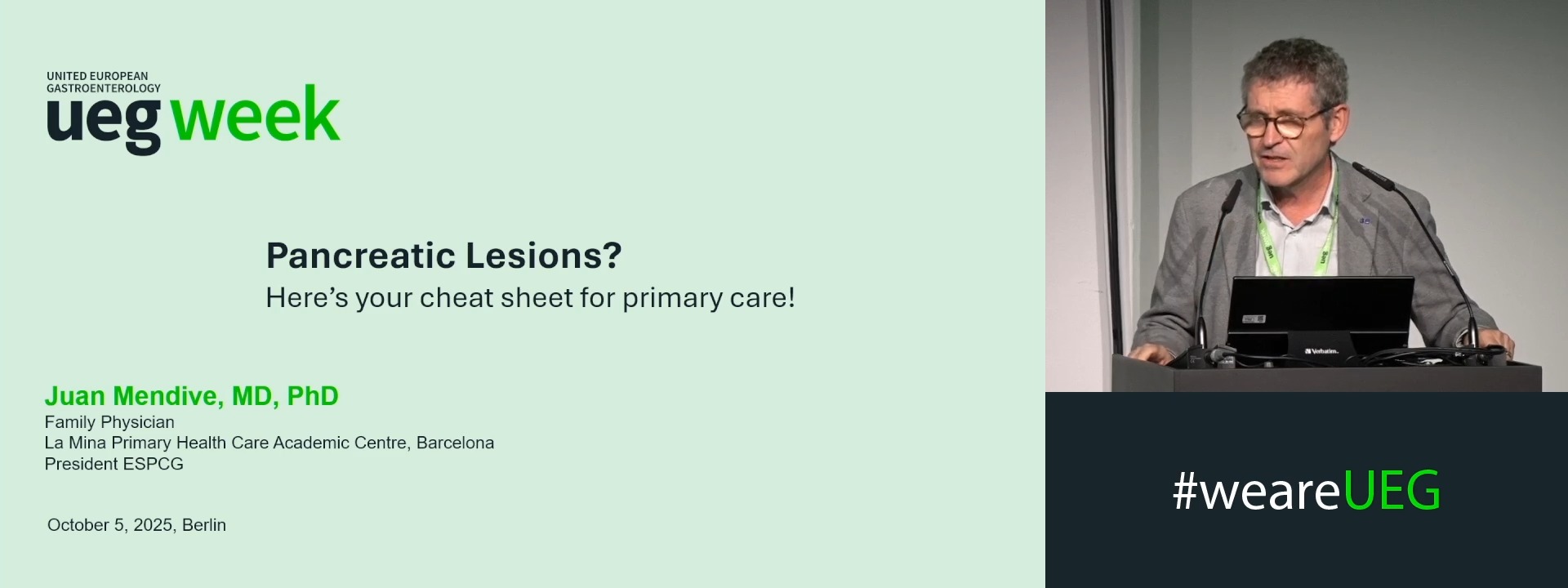
Pancreatic lesions? Here’s your cheat sheet for primary care!
1 European Society for Primary Care Gastroenterology (ESPCG), Sant Adrià de Besòs ( Barcelona), Spain
Event
Citation
Published
Log in to access this content.
Free for all myUEG account holders. Your access level is set automatically based on your occupation. Medical professionals get full access to all content. If you are a non-medical user, you can only access UEG Week content from congresses you attended.
Not sure what you can access? Learn more about account types.
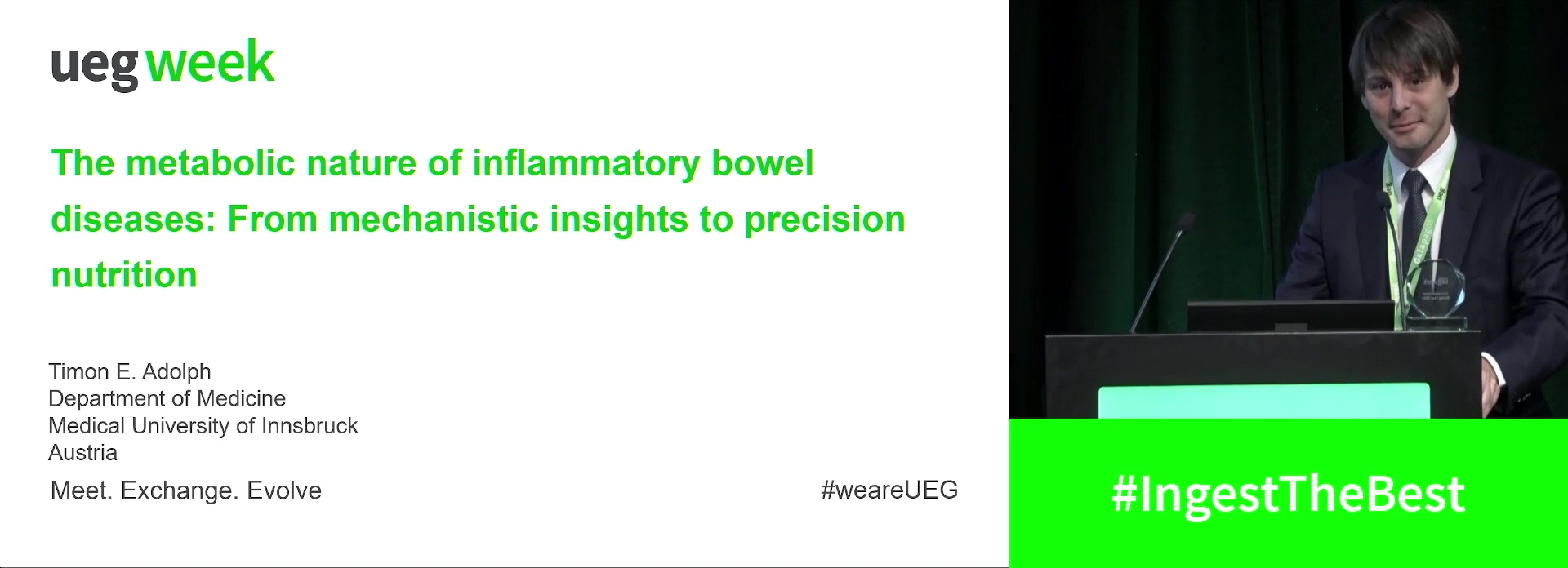
The metabolic nature of inflammatory bowel diseases: From mechanistic insights to precision nutrition
1 Univ.-Klinik für Innere Medizin / Univ.-Klinik für Innere Medizin I, Innsbruck, Austria
Event
Session